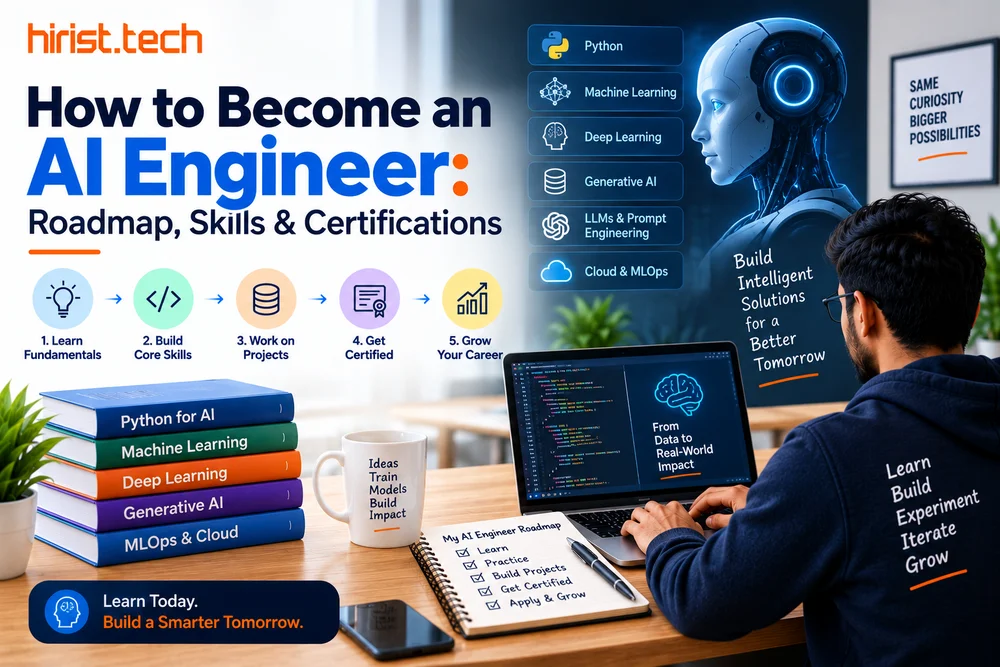
Artificial intelligence is growing fast and many people want to build a career in this field. Companies use these systems to solve daily problems and make better decisions. This has created a strong demand for skilled engineers. A recent Naukri JobSpeak report showed job postings in this field rose by over 25% in one year. So it is a good time to learn the skills and move into this path. This guide will show you how to become an AI engineer. We are sharing a complete roadmap with skills and certifications for beginners.
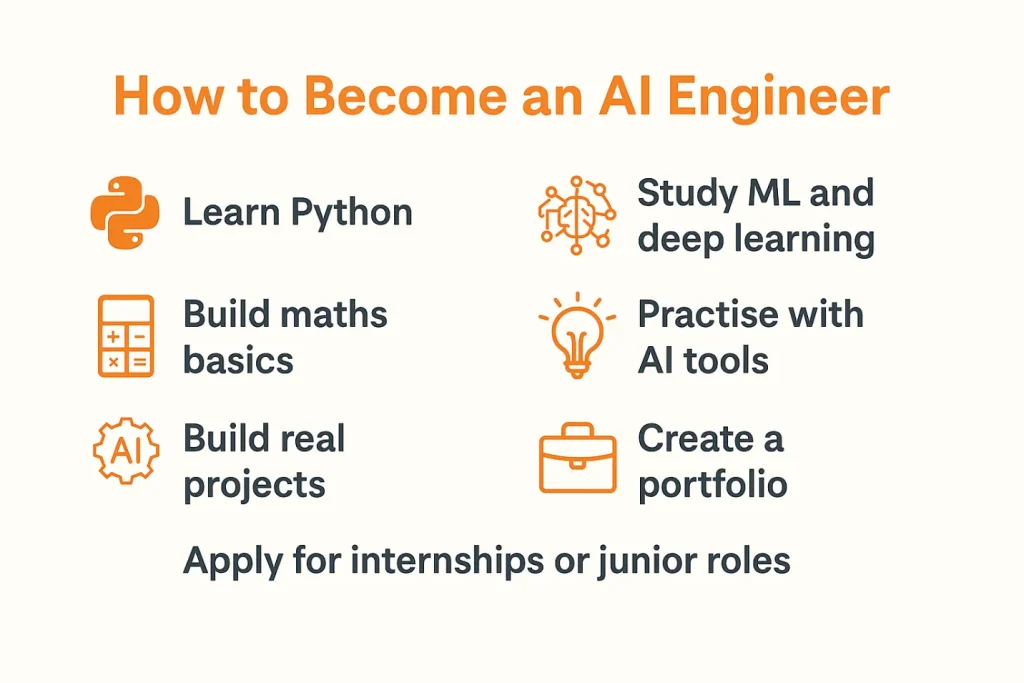
Who is an AI engineer?
An AI engineer is an IT professional who builds systems that learn from data and support smarter digital solutions. They work at the point where coding, maths, and data science meet. Their focus is on creating intelligent tools that can be used in real products. Most AI engineers have strong problem solving skills and a deep interest in how machines learn and improve.
Fun Fact:
A recent industry report showed that India may add over 2.3 million AI jobs by 2027.
This reflects how fast the demand is rising.
Now is one of the best times to step into this field.
AI engineer roles and responsibilities
AI engineers help build intelligent systems that solve problems for various companies. Their work involves coding, testing, and improving models so they can perform well in real use cases.
Key responsibilities include:
- Preparing and cleaning data so models can learn accurately
- Building machine learning and deep learning models from the ground up
- Testing models and improving them to boost performance
- Turning trained models into usable features through APIs or applications
- Setting up the infrastructure needed to train and deploy models at scale
- Automating workflows to make the work of data teams faster and smoother
- Working with developers, product teams, and analysts to bring AI ideas into use
- Monitoring deployed systems and fixing issues like drift or reduced accuracy
- Keeping documentation clear so teams can understand how the system was built and how to use it
This role blends technical depth with teamwork and offers plenty of space to grow as companies continue to adopt intelligent systems.
Also Read - How to Become a Machine Learning Engineer: Skills & Roadmap
How to become an AI engineer – Full roadmap
Many people want to enter this field, but most do not know where to begin. So, here are the clear steps on how to become an artificial intelligence engineer:
Step 1: Get the right educational foundation (1 to 3 months)
You do not need a perfect degree. But you do need the right base. The easiest path is a degree in Computer Science, IT, Data Science, Electronics, or Mathematics. These streams expose you to coding, algorithms, and basic maths early, which makes later topics like machine learning much easier to understand.
If you are from a non-tech background, you are still not blocked. You simply have to create that foundation yourself with online courses and self-study. Focus on three things first:
- Basic maths (algebra, probability, statistics)
- Logical thinking
- Comfort with computers and problem solving
Your education is your launchpad. It does not decide your ceiling, but it shapes how smooth your start feels.
Step 2: Build strong programming skills – start with Python (2 to 3 months)
Programming is the language you use to “talk” to machines. Without it, you cannot go far in this field. Start with Python because it is simple and widely used. Learn how to:
- Write basic programs
- Work with lists, loops, and functions
- Read and write files
- Handle errors without panicking
Then move to data work using NumPy and Pandas. Learn how to clean, filter, and transform data in code. You should feel relaxed when you open a code editor. Once that happens, every next step will feel lighter.
Step 3: Learn the maths behind machine learning (1 to 2 months)
You do not need to be a math genius. But you do need to understand the “why” behind the models. Focus on:
- Linear algebra: vectors and matrices (used inside neural networks)
- Probability and statistics: averages, variance, distributions, simple probability
- Basic calculus: the idea of gradients and how models “move” to reduce error
You do not have to derive complex formulas. You only need to know what these ideas mean in plain language. For example, you should understand that gradients show how to change weights to reduce loss.
This step gives you confidence. When a model behaves oddly, you will know where to look, instead of treating it like a magic box.
Step 4: Learn machine learning and deep learning step by step (3 to 4 months)
Now you start learning how machines actually “learn”. Begin with classic machine learning:
- Regression (predicting numbers)
- Classification (predicting labels like spam / not spam)
- Clustering (grouping similar data points)
Use tools like Scikit-learn. Build models on small, clean datasets first. Learn how to split data, train models, check accuracy, and improve results.
Then slowly move into deep learning with frameworks like TensorFlow or PyTorch. Explore:
- Simple neural networks
- Image tasks (with CNNs)
- Text tasks like sentiment analysis
Also Read - Top 25+ TensorFlow Interview Questions and Answers
Step 5: Build real projects and a strong portfolio (2 to 4 months)
This is where you move from “learning” to “showing”. Start with small but complete projects, such as:
- Price prediction for houses or cars
- Email spam classifier
- Sentiment analysis on product reviews
Each project should have:
- A clear problem statement
- Cleaned data
- A trained model
- Results you can explain
As you grow, build a few bigger projects:
- Recommendation system
- Chatbot
- Image classifier
Upload everything to GitHub. Your portfolio becomes proof that you can solve real problems, not just pass exams or finish courses. Recruiters look at this more than marksheets.
Step 6: Learn how to deploy models in the real world (1 to 2 months)
Many beginners stop after training a model in a notebook. But companies need models in products, not in notebooks. Learn basic deployment skills:
- Wrap your model in an API using Flask or FastAPI
- Containerise your app with Docker
- Try hosting it on a simple cloud service
Even one deployed project, no matter how small, puts you ahead of many other beginners. It shows you understand how models live in real systems with users, load, and errors.
Step 7: Get useful certifications and structured learning (1 to 6 months)
Certifications help you learn in a structured way and show commitment. Look for programs that:
- Teach Python, ML, and deep learning together
- Include hands-on labs and real projects
- Give feedback or mentoring
Well-known names like Microsoft, Google, and IBM carry weight. But more important than the brand is what you built during the course. A certificate with no projects will not impress hiring managers. Use certifications to fill gaps, not to replace your own practice.
Step 8: Apply for internships and starter roles early (start from month 7 onward)
Do not wait until you “know everything”. That day will never come in this field. Once you have:
- Basic Python skills
- A few ML projects on GitHub
- Some comfort with at least one framework
You can start applying for:
- AI / ML internships
- Junior ML engineer roles
- Data analyst roles that include model work
- Research assistant positions
Even if the role looks small or basic, it teaches you how real teams handle data and deployments. That experience is priceless.
Step 9: Keep learning and build a simple but strong network (Continuous – starts around month 6)
This field moves fast. New tools and models appear every few months. So, make a habit of:
- Improving one old project every few weeks
- Trying a new library or method regularly
- Reading blog posts or short explainers on new models
At the same time, grow your network slowly:
- Keep your LinkedIn profile updated with projects
- Connect with people who work in this field
- Join a few online communities or Kaggle discussions
Even a small circle of people who know your work can bring you referrals, advice, and better chances.
AI engineer roadmap with timeline
| Step | Focus Area | What You Learn | Time Needed |
|---|---|---|---|
| 1 | Educational Foundation | Basic maths, logic, CS fundamentals | 1 to 3 months |
| 2 | Learn Python | Coding basics, NumPy, Pandas | 2 to 3 months |
| 3 | Maths for ML | Linear algebra, probability, statistics | 1 to 2 months |
| 4 | ML & Deep Learning | ML models, neural networks, CNNs, NLP basics | 3 to 4 months |
| 5 | Build Projects | 5 to 8 ML/DL projects + GitHub portfolio | 2 to 4 months |
| 6 | Deployment Skills | Flask/FastAPI, Docker, cloud hosting | 1 to 2 months |
| 7 | Certifications (Optional) | Microsoft, Google, IBM programs | Parallel |
| 8 | Apply for Roles | Internships, junior ML/AI positions | Month 7 onward |
| 9 | Keep Learning | Update projects, learn new tools | Ongoing |
Also Read - Top 40+ Deep Learning Interview Questions and Answers
Key skills required for AI engineers
AI engineers need strong technical skills, the right tools, and solid soft skills to build systems and work well in teams.
| Technical Skills | Tools and Frameworks | Soft Skills |
|---|---|---|
| Python programming, C++, Java | NumPy, Pandas | Clear communication |
| Maths basics (algebra, probability, statistics) | Scikit-learn | Problem-solving mindset |
| Machine learning algorithms | TensorFlow / PyTorch | Ability to simplify complex ideas |
| Deep learning basics | SQL | Curiosity and continuous learning |
| Data cleaning and preprocessing | Git / GitHub | Team collaboration |
| Model evaluation and optimisation | Flask / FastAPI, Docker | Adaptability |
Also Read - Top 90+ Machine Learning Interview Questions and Answers
Top AI engineering certifications and courses in India
A good certification or course can boost your learning and resume. Below are some highly respected courses and certifications to help you build a successful career in AI engineering:
| Certification / Course | Provider / Platform | Who it’s Good For |
|---|---|---|
| IBM AI Engineering Professional Certificate | IBM | Beginners or career-switchers wanting solid AI/ML foundations |
| IBM Machine Learning Professional Certificate | IBM | Those focused on machine learning fundamentals and data analysis. |
| DeepLearning.AI Machine Learning Specialization | DeepLearning.AI | Learners who want to start from basics and build up to advanced ML and deep learning. |
| Microsoft AI & ML Engineering Professional Certificate | Microsoft | Those aiming for a broader skill set including ML and cloud-based AI deployment |
| IIIT Hyderabad AI & ML Course | IIIT-Hyderabad | Students or working professionals seeking a structured and comprehensive AI/ML program. |
| VIT Bangalore Certificate in AI & ML | VIT Bangalore (online) | Learners preferring an industry-oriented certificate with generative-AI and practical tools training |
Also Read - Top 40+ Generative AI Interview Questions & Answers
How long it takes to become an AI engineer?
The time it takes depends on your background, learning speed, and how deep you go into AI.
| Path | Time Required |
|---|---|
| Full-time online courses / bootcamps | 6 to 12 months |
| Self-learning from a non-tech background | 1 to 2 years |
| Bachelor’s degree route | 4 years |
| Internship + beginner role experience | Additional 6 months |
How to become an AI engineer after 12th
Students can start building the right foundation right after 12th. Here’s how to become an AI engineer after 12th:
- Choose a bachelor’s degree in Computer Science, IT, Data Science, or AI.
- Start learning Python and basic programming early.
- Build comfort with maths basics like algebra, probability, and statistics.
- Take beginner-friendly AI and ML online courses during college.
- Work on small projects and upload them to GitHub.
- Do internships in data, ML, or software fields.
- Build a strong portfolio and apply for entry-level AI roles.
How to become artificial intelligence engineer after 10th
You cannot start AI engineering directly after 10th, but you can slowly build the right base through subjects and skills. Here’s how to become an AI engineer after 10th:
- Choose the science stream in 11th with maths and computer science.
- Start learning Python through beginner-friendly online tutorials.
- Build basic skills in maths, logic, and problem solving.
- Explore simple AI ideas like chatbots or image detection using no-code tools.
- Join school or online coding clubs, competitions, or workshops.
- After 12th, pick a CS, IT, Data Science, or AI degree.
- Keep learning through courses and build small projects each year.
Also Read - How to Become a Data Scientist in 2026?
Wrapping up
AI engineering is a great career for anyone who enjoys solving problems and building smart systems. The path takes time, but each step pushes you closer to real opportunities. Keep learning and keep improving your skills. And when you feel ready to search for jobs, Hirist is a reliable IT job portal where you can find top tech openings across India.
FAQs
Python programming, basic data structures, linear algebra, probability, and hands‑on experience with ML libraries like TensorFlow, PyTorch, and Scikit‑learn are essential. Building and deploying small projects on GitHub also demonstrates practical competence.
Yes. Many companies value demonstrable skills over formal credentials. By completing online courses, earning certifications, and showcasing a robust GitHub portfolio, you can secure internships or entry‑level AI roles.
A bachelor’s degree in Computer Science, IT, Electronics, Data Science, or AI is typical, but strong coding and ML skills often outweigh the specific degree name.
A portfolio is crucial—it showcases real projects, demonstrates problem‑solving ability, and provides tangible evidence of your expertise to potential employers.