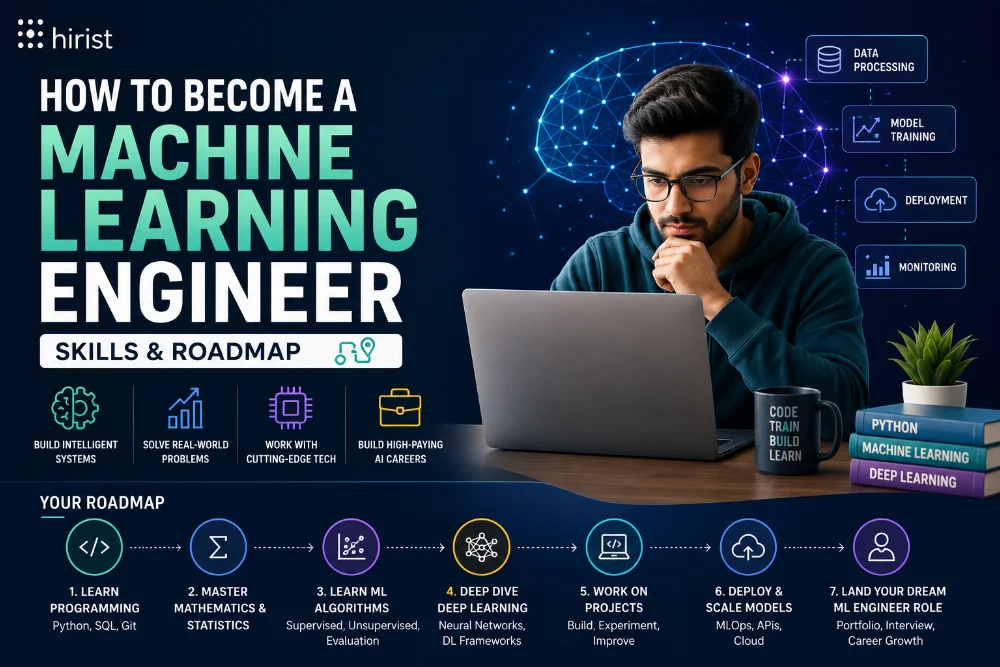
Are you looking for an ML engineer roadmap that shows you how to start your career in machine learning engineering?
The field can feel confusing when every guide recommends a different path or skillset. Yet the career opportunities are growing. The World Economic Forum’s Future of Jobs Report 2025 lists AI and machine learning specialists among the three fastest-growing job categories worldwide through 2030. However, becoming job ready requires the right foundation and practical experience. The path you take will also depend on whether you are a student or a working professional.
This guide explains how to become a machine learning engineer by sharing a simple roadmap for students, self-taught learners, and professionals considering a career change.
What is machine learning?
Machine learning is a part of artificial intelligence. It allows computers to learn from data instead of relying only on fixed instructions. The system studies past examples and looks for patterns. It then uses those patterns to make a prediction or choose an action.
For example, Gmail uses machine learning to identify spam and suspicious emails. PayPal uses it to detect unusual payment activity and reduce fraud. Netflix studies viewing behavior to recommend shows and movies that each member may enjoy.
What does a machine learning engineer do?
A machine learning engineer turns data and models into systems that people can actually use. The work often begins with preparing data. The engineer then selects an appropriate model and tests how well it performs. Once the model is ready, it must be connected to a website, app, or business system. The engineer also checks its performance after launch.
Common responsibilities include:
- Preparing data for training
- Building and testing machine learning models
- Improving model performance
- Writing reliable code
- Deploying models into real applications
- Tracking errors and changes in results
- Working with data scientists and software teams
The truth about becoming a machine learning engineer
You may not become a machine learning engineer immediately after graduation because the role is not always entry-level. Many employers expect candidates to have practical experience with data and software development.
LinkedIn’s Jobs on the Rise 2026 data for India found that professionals entering AI engineer roles had a median of two years of prior experience. A common route is to work as a data analyst or junior data scientist for two or more years before moving into machine learning engineering.
Machine learning career paths – ML engineer roadmap
The right roadmap for machine learning engineer roles depends on your education and work experience. Here are the most common routes into the field.
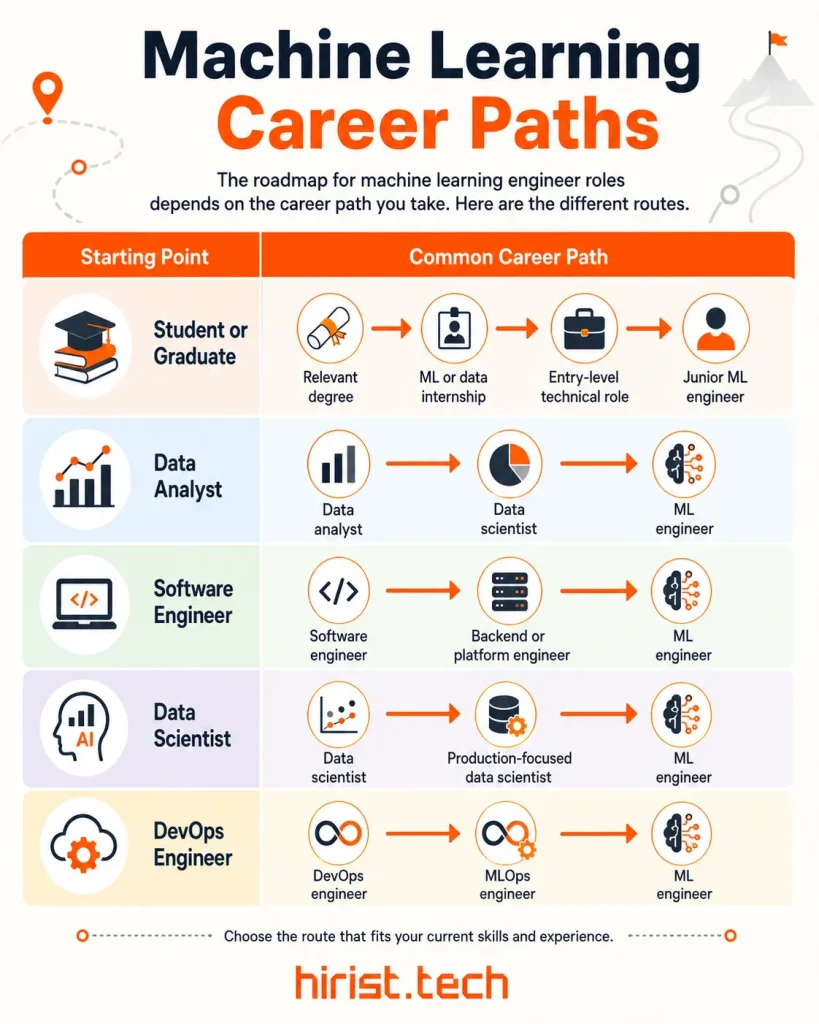
Starting Point | Common Career Path
| Starting Point | Common Career Path |
|---|---|
| Student or Graduate | Relevant degree → ML or data internship → Entry-level technical role → Junior ML engineer |
| Data Analyst | Data analyst → Data scientist → ML engineer |
| Software Engineer | Software engineer → Backend or platform engineer → ML engineer |
| Data Scientist | Data scientist → Production-focused data scientist → ML engineer |
| DevOps Engineer | DevOps engineer → MLOps engineer → ML engineer |
How to become a machine learning engineer: An ML engineer roadmap for students
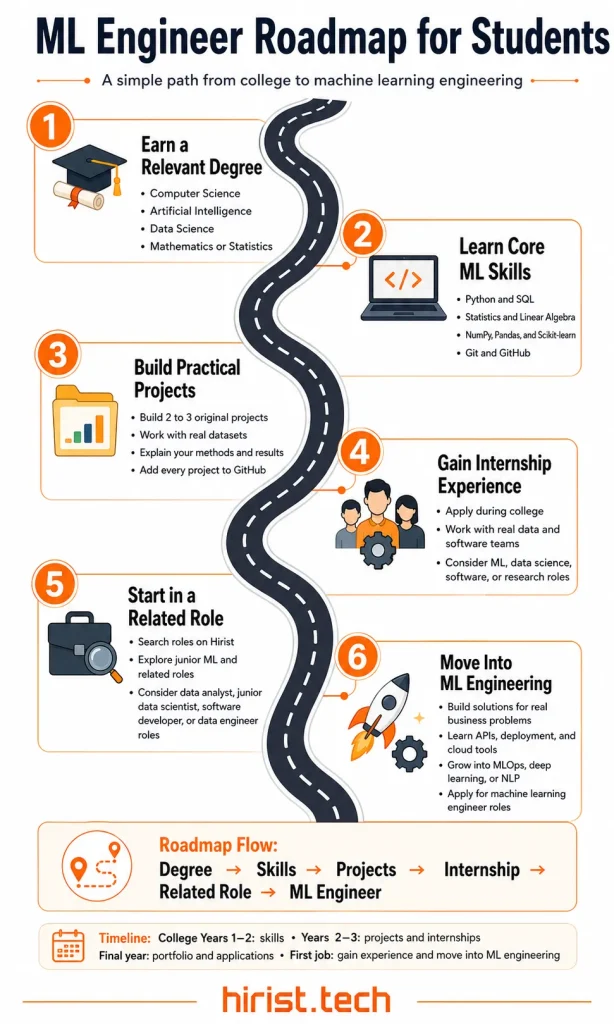
Becoming a machine learning engineer takes time. You need to build technical skills and gain real experience before you can move into the role. For students, the following six steps offer a direct ML engineer roadmap.
- Earn a relevant bachelor’s degree
A bachelor’s degree in computer science, artificial intelligence, data science, mathematics, statistics, or a related field is a good place to start. These courses can help you learn programming, databases, mathematics, data structures, software development, and machine learning.
A degree can also help you qualify for internships and junior technical roles. However, employers will look beyond your qualifications. They will also want to see what you can build and how well you can apply your knowledge.
- Build machine learning skills during college
You do not need to wait until your final year to start learning machine learning. Begin with Python and SQL. Then learn how to work with data using NumPy and Pandas. You should also study statistics, linear algebra, machine learning algorithms, and Scikit-learn.
Learn Git and GitHub so you can save your code and share your projects. By the end of this stage, you should be able to clean a dataset, train a simple model, and explain the results.
- Create practical machine learning projects
Projects show that you can use your knowledge to solve a problem. Start with two or three manageable projects.
You could build:
- A house price prediction model
- A spam email classifier
- A customer churn model
- A product recommendation system
Also Read - Top 40+ Generative AI Interview Questions & Answers
Machine Learning Engineer Skills Development
A sales forecasting model
Each project should explain the problem, the data, the model you selected, and how you measured the results. You should also mention the project’s limitations.
Do not upload only a notebook with unexplained code. Add a README file that explains your approach and shows other people how to run the project.
- Gain internship or entry-level experience
Machine learning engineering is not always an entry-level role. An internship or related first job can help you gain experience with real data and software systems.
Relevant starting roles include:
- Machine learning intern
- Data science intern
- Data analyst
- Junior data scientist
- Software developer
- Data engineer
- Research assistant
Start applying for internships while you are still in college. Your first role may involve data cleaning, SQL, testing, or basic model development. This experience can still prepare you for machine learning engineering.
- Apply for junior ML and related roles
Once you have the right foundation, strong projects, and some practical experience, start applying for jobs on platforms like Hirist. It is a dedicated IT job portal where you can find the best jobs in AI and ML.
Look beyond the title “machine learning engineer.” You can also apply for junior data science, AI development, software engineering, data engineering, backend development, and MLOps roles.
Your first job may be an adjacent role. That is not a setback. It can help you build the programming, data, and production experience needed to move into machine learning engineering.
Do not wait until you meet every requirement in a job description. Apply when you understand the core skills and can support your application with projects or internship experience.
- Advance your skills while gaining experience
Your first role may be in data analysis, data science, software development, or data engineering. Use this experience to improve the skills needed for machine learning engineering.
Look for opportunities to work with real datasets, build models, write production code, create APIs, or support deployment. You can also learn advanced areas such as deep learning, cloud platforms, MLOps, computer vision, or natural language processing.
As you gain experience, start applying for machine learning engineer roles. Show employers how your work solved a real problem. This will usually be more valuable than listing courses or certificates alone.
Also Read - Top 30 LangChain Interview Questions and Answers
Essential Machine Learning Engineer Skills
The machine learning engineer skills you need fall into five main areas. You do not need to learn them all at once. Start with programming and data skills. Then move to model building and deployment as per the ML engineer roadmap we have shared.
- Programming and Data Skills
Python is the main language used in machine learning. SQL is equally important because most business data is stored in databases. Learn:
- Python
- SQL
- NumPy
- Pandas
- Scikit-learn
- Git
- Basic command-line usage
You should be able to clean a dataset, write reusable Python functions, query data with SQL, and manage code using Git.
- Mathematics and Statistics
Mathematics helps you understand how models learn and why their predictions may fail. You do not need to master advanced proofs before starting practical work. Focus on:
- Probability
- Descriptive statistics
- Distributions
- Linear algebra
- Basic calculus
- Bias and variance
You should be able to explain concepts such as correlation, variance, probability, overfitting, and underfitting in simple terms.
- Machine Learning Fundamentals
Once you are comfortable with data and basic mathematics, start learning how models are built and evaluated. This is one of the most important ML engineer skills. Cover the following fundamentals.
- Regression
- Classification
- Clustering
- Decision trees
- Random forests
- Feature engineering
- Cross-validation
- Model evaluation
- Data leakage
- Hyperparameter tuning
Start with Scikit-learn before moving to deep learning frameworks such as PyTorch or TensorFlow.
You should be able to prepare data, train different models, choose the right evaluation metric, and explain the results.
- Software Engineering and Deployment
A model has little practical value if it only works inside a notebook. ML engineers must know how to connect models with websites, apps, and business systems. Learn:
- Clean project structure
- Error handling
- Logging
- Unit testing
- APIs
- FastAPI or Flask
- Docker
- Cloud deployment
- Model monitoring
You should be able to turn a notebook into reusable code and deploy a basic prediction API.
- Communication and Business Skills
ML engineers work with developers, data teams, product managers, and business leaders. They must understand the problem before choosing a model. Important skills include:
- Problem-solving
- Clear communication
- Teamwork
- Business understanding
- Documenting assumptions
- Explaining model limitations
- Continuous learning
These skills improve through internships and work experience.
Also Read - Top RAG Interview Questions and Answers
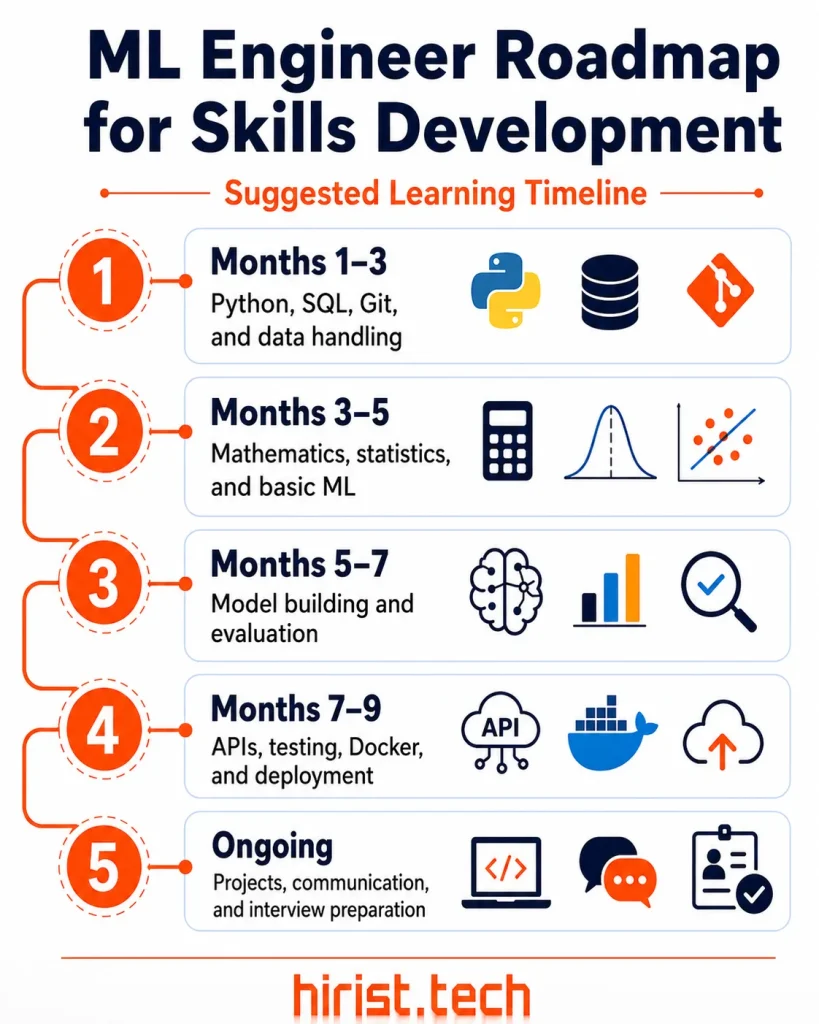
ML Engineer Roadmap for Skills Development – Suggested Learning Timeline
| Timeline | Main focus |
|---|---|
| Months 1–3 | Python, SQL, Git, and data handling |
| Months 3–5 | Mathematics, statistics, and basic ML |
| Months 5–7 | Model building and evaluation |
| Months 7–9 | APIs, testing, Docker, and deployment |
| Ongoing | Projects, communication, and interview preparation |
A complete beginner may need around 9 to 12 months to develop these skills for machine learning engineer roles. Someone with programming or data experience may progress faster.
How to Become a Machine Learning Engineer After 12th
After class 12, choose a degree in computer science, AI, data science, mathematics, or statistics. Check whether the course teaches Python, databases, algorithms, statistics, and software development. Also review its internship support and placement record.
- First Year – Learn Python, SQL, Git, and basic statistics. Complete one data analysis project and publish it on GitHub.
- Second Year – Study machine learning with Scikit-learn. Build projects in regression and classification. Learn how to evaluate models instead of focusing only on accuracy.
- Third Year – Apply for internships and work with real datasets. Build one project that includes data cleaning, model training, and a simple user interface.
- Final Year – Deploy a model using FastAPI or Flask. Improve your portfolio, practice interviews, and apply for ML internships, data roles, and junior software positions.
Also Read - Top 10 AI Skills to Learn in 2026: In-Demand Skills for AI Careers
How to Become an ML Engineer Without a Degree
It is possible to become an ML engineer without a degree, but the route is more competitive. A degree can make it easier to pass the first stage of resume screening.
However, skills-based hiring is becoming more common. The World Economic Forum reports that 30% of companies in India expect to remove degree requirements and use skills-based hiring, compared with 19% globally.
Self-taught candidates still need strong projects, practical skills, and relevant experience. You should focus on:
- Learning Python, SQL, mathematics, statistics, and machine learning
- Following a structured learning plan
- Building original projects with clear documentation
- Deploying at least one complete ML application
- Contributing to open-source or real projects
- Networking with professionals
- Applying for internships, startups, freelance work, and adjacent roles
- Looking for internal transfer opportunities
Certificates can support your learning, but they rarely replace practical experience.
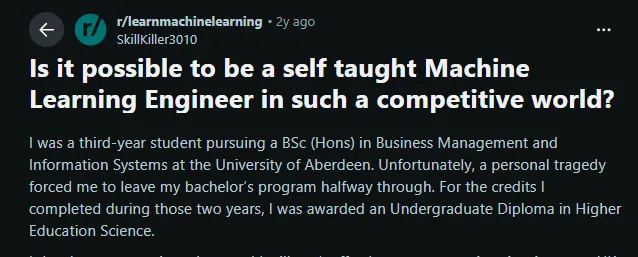
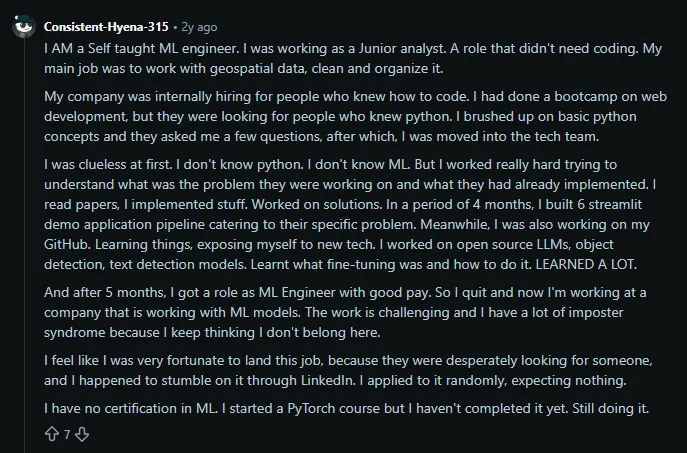
A Reddit discussion showed how different this journey can be. Some users warned that not having a degree makes interviews harder. One self-taught professional moved from a junior analyst role into a technical team, built several ML applications, and later secured an ML engineer position. They also acknowledged that timing and luck helped.
ML engineer roadmap – How to transition from another career to machine learning engineering?
Moving into machine learning engineering is easier when you build on the skills you already have. Professionals from software development, data analysis, data science, and other technical roles may already understand programming, data, or business problems.
Start by identifying the skills you are missing. These may include Python, statistics, machine learning, software engineering, APIs, deployment, or cloud platforms. Then build two or three projects that connect your previous experience with machine learning.
You may also need to begin in a related role such as data analyst, junior data scientist, software developer, or data engineer. This can help you gain practical experience before applying for ML engineer positions.
Also Read - Top 40+ Deep Learning Interview Questions and Answers
How much time does it take to become a machine learning engineer?
It usually takes 6 to 18 months to become a machine learning engineer if you already have programming or data science experience. Complete beginners may need 2 to 4 years to learn programming, mathematics, machine learning, and software development before becoming job-ready.
Machine Learning Engineer Job Outlook in India
The job outlook for machine learning engineers in India remains strong. Naukri’s June 2026 JobSpeak report recorded 25% year-over-year growth in AI and ML hiring across 14 sectors. AI-related hiring in the IT sector also rose by 16%. At the time of writing, Naukri displayed 26,812 active vacancies for machine learning engineer roles and 54,140 openings for ML engineer roles. Hirist also listed 2,665 machine learning jobs.
Machine Learning Engineer Salary in India
According to AmbitionBox, machine learning engineers in India earn an average salary of ₹13.1 lakh per year. The typical range is ₹12.5 lakh to ₹13.8 lakh for professionals with one to six years of experience. Bengaluru offers the highest city average at ₹14.1 lakh. The top 10% earn around ₹23.1 lakh, while salaries at leading companies such as Google can exceed ₹31 lakh per year.
Are you ready to apply for ML engineering jobs?
And that’s all about how to become a machine learning engineer. Once you complete the core steps in this ML engineer roadmap, start applying for relevant roles. Use Hirist to find openings in machine learning, data science, MLOps, and AI. Interviews and projects will help you turn your skills into career opportunities.
Also Read - Top 90+ Machine Learning Interview Questions and Answers
FAQs
No, you don’t necessarily need a computer science degree, but having one can make it easier to get interviews. Strong skills, original projects, and practical experience can also be a viable alternative.
Start with one framework, as both have their strengths. PyTorch is popular for research, while TensorFlow is widely used in production. Understanding model training and evaluation is more important than the specific framework.
A data scientist analyzes data and develops models, a machine learning engineer builds, deploys, and maintains ML systems, and an AI engineer works on broader AI applications such as chatbots, computer vision, and generative AI tools.
While machine learning engineering can be a challenging field, beginners can work towards this career with dedication and the right experience. Projects, internships, and related technical roles can help build the necessary skills.