Group discussions are a major part of campus placements and job interviews, as companies use them to check how well you communicate and work in a group. Most candidates focus only on starting or leading a group discussion and give very little attention to the conclusion. However, those last few seconds matter a lot, as they show how clearly you listened and understood different viewpoints. Many good speakers lose marks simply because they do not know how to close a GD properly. In this blog, you will learn how to conclude a group discussion in a clear and professional way, along with practical GD tips and real examples of closing lines you can use.
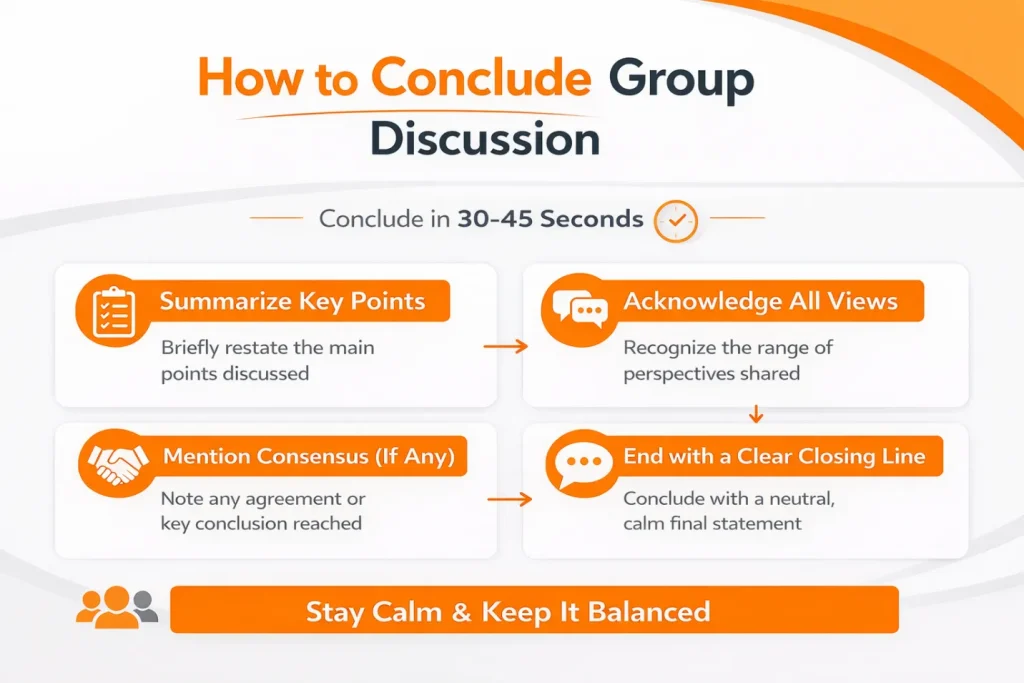
Example of how to conclude a group discussion professionally
Before we show you how to conclude GD, let’s take a look at what an impressive GD conclusion actually sounds like. This will help you understand the tone and flow you should aim for while concluding a GD.
Topic: Should Companies Use AI Tools for Software Development?
Example of GD conclusion:
“As the discussion came to an end, we talked about how AI tools can speed up coding, reduce manual effort, and help developers fix bugs faster. At the same time, some members raised concerns about over-dependence on AI, code quality, and data security. While no clear consensus was reached, the discussion showed that AI can support software development when used carefully. Moving forward, companies need to combine AI tools with strong human oversight to achieve the best results.”
Why this group discussion conclusion works?
- Summarizes both positive and negative points discussed in the GD.
- Stays neutral and does not favor one side strongly.
- Clearly mentions that no consensus was reached.
- Avoids adding new ideas and focuses only on what was discussed.
- Ends with a calm and practical closing line.
How to conclude a group discussion in 5 simple steps (with examples)
Concluding a GD becomes easy when you follow a simple flow that shows listening and balance, instead of rushing or trying to dominate the discussion. Here are the steps you can follow to end any type of group discussion.
- Start the conclusion in a neutral way
Always begin your conclusion in a calm and neutral tone. This tells the group and evaluators that you are about to summarize the discussion, not argue or add opinions. A neutral and unbiased opening prevents conflict and sets the right mood for closing the GD.
Example:
“As we come to the end of the discussion on employee work data tracking, I’ll bring together the main viewpoints and highlight the most important ideas shared.”
- Summarize the key points
Now bring together the most important ideas that were discussed. Choose only the points that were repeated or clearly debated. Avoid details, data, or names.
How to do this well:
- Stick to two main ideas
- Focus on what was discussed the most
Example:
“The group discussed how tracking work data can help improve productivity and accountability in organizations, while also raising concerns about employee privacy, trust, and constant monitoring.”
- Acknowledge different viewpoints
A good conclusion always shows that multiple perspectives were heard. This proves that you were listening throughout the GD and not waiting for your turn to speak. It shows respect, teamwork, and awareness of others’ opinions.
Example:
“While some participants viewed work data tracking as a way to improve transparency and performance, others were concerned about its impact on employee morale and privacy.”
- State the consensus (If reached)
Clearly mention whether the group agreed on something. If there was no agreement, say it honestly. Both are acceptable and score well when said correctly.
Examples:
If consensus was reached: “Most of the group agreed that limited data tracking with clear policies could be acceptable.”
If no consensus was reached: “While no clear consensus was reached, the discussion explored both the benefits and concerns in detail.”
- End with a clear closing line
Finish the GD with a simple and calm closing sentence. Do not add new ideas or suggestions. Just give the discussion a clean ending. It shows control and helps you stop at the right moment.
Example:
“Overall, the discussion highlighted that decisions around work data tracking require a careful balance between performance goals and employee trust.”
The 30-second GD conclusion formula with a template
A good GD conclusion does not need fancy language or long explanations. You only need a clear structure that fits within 30 seconds and sounds natural when spoken.
The 30-second formula
Use this flow when you are asked to conclude a GD:
- Signal the conclusion – 5 seconds
- Cover the two main points – 10 seconds
- Reflect viewpoints or consensus – 7 seconds
- Close with a forward-aware line – 8 seconds
Group discussion conclusion template you can use
Based on the 30-second formula explained above, this GD conclusion template gives you a ready structure to close any discussion calmly and within time.
“To conclude, I’ll briefly bring together the main points discussed. The group talked about [main point 1], while also discussing [main point 2]. Some participants supported this view, while others raised concerns about [opposing view]. [Mention consensus or say there was none]. Overall, the discussion highlighted [balanced closing line].”
How to End a Group Discussion – Dos and Don’ts
Ending a GD correctly helps you leave a strong final impression. These dos and don’ts will help you conclude the discussion clearly and avoid common mistakes.
| Dos | Don’ts |
|---|---|
| Stay calm and speak at a steady pace | Do not rush or sound nervous |
| Summarize the main points clearly | Do not repeat the entire discussion |
| Acknowledge different viewpoints respectfully | Do not push your personal opinion |
| Keep your conclusion within 30–45 seconds | Do not speak for too long |
| Use simple and professional language | Do not use slang or casual words |
| Stop once the conclusion is complete | Do not interrupt others or overtake the discussion |
Examples of Key Phrases and Closing Lines for GD Conclusion
Here are the best examples of phrases to conclude a GD smoothly. These closing lines sound natural when spoken and help you close the GD without forcing authority or adding new points.
- In conclusion……
- To conclude our discussion……
- Before we close….
- After considering all viewpoints……
- We have concluded that……
- Finally, we have arrived at….
- Therefore, we arrive at the conclusion that…..
- The group feels that…….
- The overall discussion suggests that…….
- We have reached an outcome where…….
- Based on the discussion, it is clear that……
Wrapping Up
And that is how you conclude a group discussion professionally in interviews and campus placements. Ending a group discussion the right way can set you apart from other candidates. With a calm tone and balanced summary, you can leave a strong final impression in any GD. Keep practicing these steps and closing lines to build confidence. If you are preparing for interviews, visit Hirist to find the best IT jobs in India. You can also find sample GD topics and practical GD tips on the Hirist blog.
Also Read - How to Start a Group Discussion: GD Tips & Examples
FAQs
The purpose of a conclusion in a group discussion is to summarize the main points, acknowledge different views, and close the discussion in a clear and balanced way.
You can conclude a group discussion effectively by starting calmly, speaking neutrally, summarizing key points, and avoiding new ideas. Use simple phrases like “To conclude” or “In conclusion” to aid your conclusion.
Some examples of phrases you can use to conclude a group discussion include “To conclude”, “In conclusion”, “Before we close”, “To sum up the discussion”, and “Based on the discussion”.