How to become AI Product Manager (quick answer)
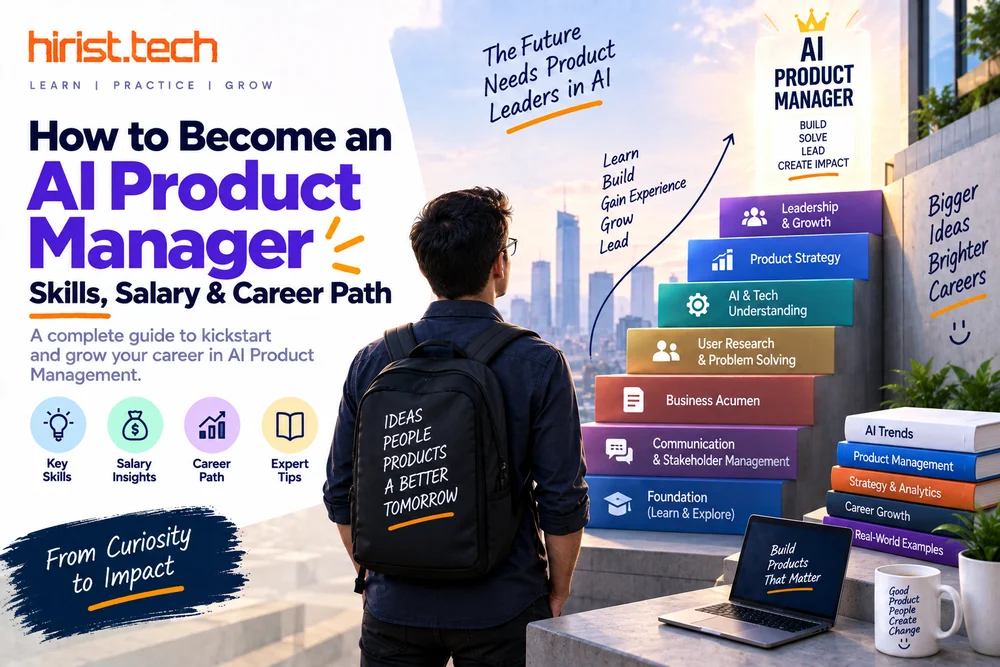
To become an AI Product Manager in India, you need to master core product management skills first and then build practical knowledge of artificial intelligence and machine learning. Here is a 7 step roadmap:
- Build the right educational foundation
- Master core product management skills
- Choose your AI Product Manager path
- Learn practical AI and ML fundamentals
- Develop AI product sense and evaluation skills
- Build and ship a real AI product
- Show proof of work and apply for AI PM roles
It takes 3 to 6 months of regular preparation if you already have a tech or product management background. Career switchers starting from scratch may need 6 to 18 months.
AI Product Managers are in higher demand as companies add artificial intelligence to everyday products. According to LinkedIn’s AI Labor Market Update, job postings requiring AI literacy grew 71% year over year. Product Manager ranked fourth among the job titles most frequently requiring these skills.
This creates a clear opportunity for people who can combine strong product thinking with practical AI knowledge. Companies do not expect every AI PM to build models from scratch. They need professionals who understand users and business goals and know enough about AI to work with technical teams and make sound product decisions.
In this blog, we explain how to become an AI Product Manager in 2026 with a practical 7 step roadmap.
What does an AI Product Manager actually do?
An AI Product Manager is a specialized technology leader responsible for building and growing AI-powered products that solve user problems and support business goals. They work with engineers, data scientists, designers and business teams throughout the process.
Core responsibilities of an AI Product Manager include:
● Choosing the right AI use cases. Decide when AI is the right solution and when a simpler approach is better.
● Defining the AI product strategy. Set the product vision, roadmap and priorities.
● Defining data requirements. Decide what data the product needs and how it can be used safely.
● Setting evaluation criteria. Define how the team will measure model quality before and after launch.
● Tracking product and model metrics. Monitor adoption and retention along with accuracy, latency, cost and other AI metrics.
● Planning for failures. Define guardrails, fallback options and human review when the AI gets something wrong.
● Making model trade-offs. Balance quality, speed, cost and reliability when choosing how the AI should work.
● Monitoring the product after launch. Track model performance, user feedback and changes in output quality over time.
AI Product Manager vs. Product Manager vs. Other related roles
AI Product Managers work across product and data teams. This creates some overlap with regular Product Managers and other AI roles. The difference becomes clearer when you look at what each role focuses on and what they are expected to own.
| Role | Main focus | Usually owns |
|---|---|---|
| AI Product Manager | Building useful AI-powered products | AI product strategy and outcomes |
| Product Manager | Solving user and business problems through software | Product roadmap and priorities |
| Machine Learning Product Manager | Building products around ML models and platforms | ML roadmap and model requirements |
| Data Product Manager | Making data useful for products and teams | Data products and governance |
| AI Engineer | Building AI features and systems | AI implementation and integrations |
Which type of AI Product Manager do you want to become?
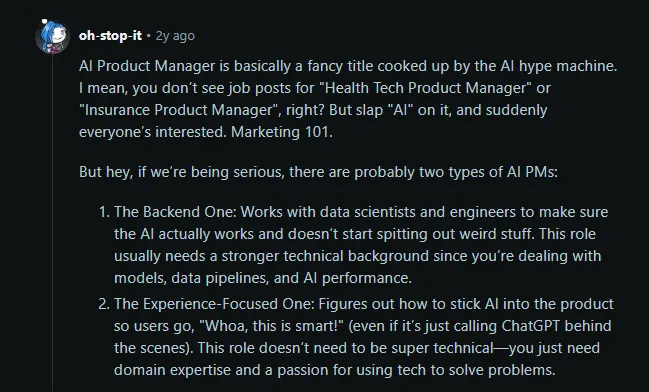
AI Product Manager is not one fixed role. The work varies by company and product. A discussion among product professionals on Reddit highlights two common AI product manager career paths: experience-focused AI PMs and technical or builder AI PMs.
Source: Reddit
1. AI Experience Product Manager
This role focuses on customer-facing AI features. You may build products using existing models and APIs rather than developing models from scratch.
Typical responsibilities include:
● Deciding where AI adds value
● Designing AI interactions
● Handling poor or uncertain responses
● Improving prompts and workflows
● Defining evaluations and guardrails
Best suited for: Product Managers and UX professionals with practical AI knowledge.
2. AI Platform or Builder Product Manager
This role works closer to data and AI infrastructure. You may partner with ML engineers and data scientists on model platforms, evaluation systems or internal AI tools.
You should understand areas such as:
● Model selection and inference
● Data pipelines and RAG
● Model evaluation
● Drift and retraining
● Latency and cost
● Monitoring and infrastructure
Best suited for: Technical Product Managers and professionals with ML or data experience.
The Reddit discussion also gives a useful hiring signal. One participant hiring for an AI workflow automation PM said they look for experience with LLMs, evaluation systems, RAG, prompt engineering and practical experimentation with AI agents.
Also Read - Top 70+ Product Manager Interview Questions and Answers
Essential skills for AI Product Managers
An AI Product Manager (AI PM) needs a strong mix of core product management skills and practical knowledge of artificial intelligence and machine learning. The following are the essential skills for AI Product Manager roles.
1. Core product management
Learn user research, problem discovery, product strategy, prioritization, PRDs, roadmaps, metrics and experimentation. You should be able to take a user problem from discovery to a clear product requirement. AI knowledge cannot compensate for weak product fundamentals.
2. AI and machine learning literacy
Understand training, inference and the difference between traditional ML and generative AI. Learn LLMs, prompting, context windows, embeddings, RAG, fine-tuning and AI agents. Know the basics of APIs and tool calling so you understand how AI models connect with products and external systems. Hands-on prototyping with AI tools can also help you test ideas before development.
3. Data and evaluation
Learn how teams test AI quality using evaluation datasets, golden datasets, quality thresholds and human evaluation. Understand precision and recall where relevant, plus offline and online evaluation, regression testing and model drift. A key skill is defining what a “good enough” AI output looks like before launch.
4. AI product sense
Learn to judge where AI creates real value and what happens when it fails. Think through wrong answers, uncertainty, guardrails, fallback options and human review. Good AI product sense means knowing when AI improves the experience and when a simpler solution is better.
5. Model and product trade-offs
Understand how model choices affect quality, latency, cost, reliability and privacy. You should be able to work with technical teams to choose an approach that meets the product’s needs rather than simply selecting the most powerful model.
6. Responsible AI and risk management
Understand privacy, bias, safety, security and responsible data use. Learn to identify risks such as hallucinations, harmful outputs and misuse. Know how red teaming helps uncover weaknesses before launch. You should also understand human-in-the-loop systems and when human oversight or regulatory review is required.
7. Workplace skills
AI Product Managers work across product, engineering, data science, design and business teams. You need strong workplace skills to turn technical complexity into clear product decisions.
● Communication and collaboration
● Critical thinking
● Decision-making
● Stakeholder management
● Business thinking
● Presentation skills
AI Product Manager roadmap: How to become an AI Product Manager
This AI Product Manager roadmap takes you from building the right foundation to applying for AI PM roles. Each step shows what to work on next so you can build the experience employers expect.
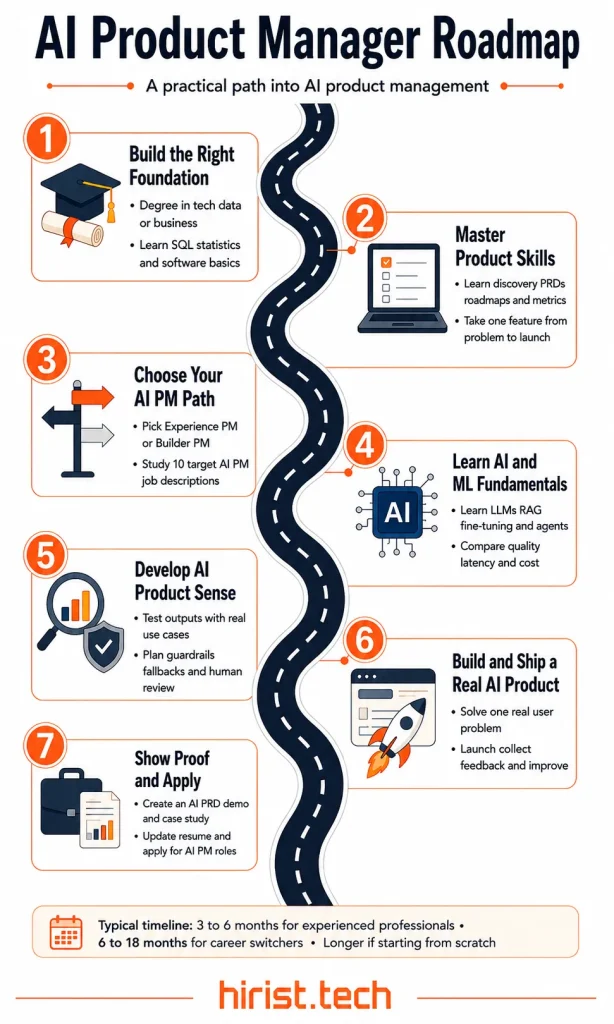
1. Build the right educational foundation
A bachelor’s degree in a technical or business field is a good starting point for AI Product Managers. Relevant options include computer science, engineering, data science, IT and business. You do not need an AI-specific degree or an MBA to enter the field.
If you come from a non-technical background, learn basic statistics, SQL and software concepts. Courses and certifications can help you fill these gaps. You do not need engineering-level expertise, but you should understand technical concepts well enough to work with engineers and data scientists.
2. Master core product management skills
The next step is to learn how a product moves from a user problem to a real launch. Before specializing in AI, learn how good products are built.
Focus on user research, problem discovery, product strategy, prioritization, PRDs, roadmaps, product metrics and experimentation.
A useful exercise is to choose a normal software feature and write a complete PRD for it. Define the user problem, target users, requirements, success metrics and edge cases. Do not add AI to the feature. This forces you to answer an important question first: Can you solve the user problem without AI?
3. Choose your AI Product Manager path
Once you understand the basics of product management, decide what kind of AI PM role you want to target. Some roles focus on customer-facing AI features. Others work closer to ML platforms, data systems and infrastructure. You can also specialise in a domain such as fintech, healthcare or SaaS.
Then study the market. Collect around 10 AI Product Manager job descriptions you would genuinely consider applying for. Track the requirements that appear repeatedly.
For example:
| Requirement | Frequency |
|---|---|
| Product management experience | 8/10 |
| AI/ML knowledge | 9/10 |
| GenAI/LLMs | 7/10 |
| SQL/data skills | 4/10 |
| ML infrastructure | 3/10 |
This gives you a clear picture of what your target roles actually expect. You can then spend more time on the skills that appear repeatedly instead of trying to learn every AI topic.
4. Learn practical AI and ML fundamentals
Now build enough technical knowledge to make AI product decisions.
Understand training and inference, how models generate outputs and why hallucinations happen. Learn LLMs, prompting, embeddings, RAG, fine-tuning and AI agents. Then test these concepts yourself using AI tools or model APIs. Compare models on quality, latency and cost.
Be ready to explain choices such as prompting vs RAG, RAG vs fine-tuning and larger vs smaller models. You do not need to train neural networks. You need to understand how these choices affect the product.
5. Develop AI product sense and evaluation skills
This is where AI product management becomes different from traditional product management.
Take a simple AI feature and start testing it like a Product Manager. Suppose you build an AI support assistant. Create 20 to 50 realistic customer questions and record what happens. Which answers are correct? Where does it hallucinate? When does it refuse a valid request? How long does an answer take? What does each interaction cost?
Then decide what should happen when the model fails. Should it ask for clarification, show uncertainty or hand the user to a human?
Run the same tests whenever you change the prompt, model or retrieval setup. This gives you practical experience with evals, guardrails, fallback behaviour and failure handling.
6. Build and ship a real AI product
Courses can teach concepts. A shipped product shows that you can make AI product decisions. Take one useful idea beyond a demo. You could build a support copilot, document Q&A tool, research assistant, onboarding tool or ticket classifier.
Keep the first version small and make sure it solves a real problem. Then let a few people use it. Watch where they struggle and where the AI performs poorly. Use their feedback to improve the prompt, workflow, model or interface.
Avoid building a generic chatbot only for your portfolio. A small AI product used by real people gives you much stronger evidence of your product decisions and hands-on experience.
7. Show proof of work and apply for AI PM roles
Do not stop once the product works. Turn the project into a simple portfolio piece that shows how you think as an AI Product Manager.
Include a one-page AI PRD, working demo and short case study that explains the problem, why you used AI, how you tested it and what you improved.
Update your resume with this work and start applying for roles such as AI Product Manager or ML Product Manager. You can find relevant openings on tech job platforms such as Hirist.
Use the same project in interviews to explain how you handled evaluation, errors, cost, latency and safety.
How long does it take to become an AI Product Manager?
Professionals already working in product or engineering may need around 3 to 6 months to build AI product knowledge and prepare for AI PM roles.
Career switchers may need around 6 to 18 months to learn product management and build a strong portfolio.
Students starting after Class 12 usually need 3 to 4 years for a relevant degree and 2 to 5 years of work experience. Direct entry into AI PM roles straight from college is possible but less common.
AI Product Manager certifications and free courses
AI Product Manager certifications are optional. They can be useful if you do not have a relevant degree or want a structured way to learn product management and GenAI.
| Certification / Program | Provider | Best for | Cost |
|---|---|---|---|
| AI Product Manager Professional Certificate | IBM | Beginners learning PM and AI | Paid |
| AI Product Management Specialization | Duke | ML products and evaluation | Paid |
| AI Product Management Certification | Product School | Existing PMs adding AI skills | Paid |
| Product Management Programme | ISB | Professionals in India who need PM training with AI | Paid |
| AI Product Management Program | AIPMM / ProductDive | AI product lifecycle | Paid |
| AI Product Management Certification | Maven / Product Faculty | Hands-on AI product development | Paid |
| AI Product Management Expert Certification | Pragmatic Institute | Applied AI product management | Paid |
Free learning options
● OpenAI Academy: AI basics, prompting, agents and workflows
● Google Machine Learning Crash Course: ML concepts, embeddings and LLMs
● Microsoft Learn: GenAI, prompting and AI agents
● Hugging Face LLM Course: Transformers, inference and fine-tuning
AI Product Manager career path by starting point
AI Product Manager is usually not a first job. Many professionals enter the role after gaining experience in product management or another related field.
Common starting roles include Product Manager, Associate Product Manager, Software Engineer, ML Engineer, Data Analyst, Data Scientist and Product Analyst.
Common career paths include:
1. Fresh graduate route
Graduate → APM, Product Analyst or junior product role → AI product experience → AI Product Manager
2. Existing PM route
Product Manager → Own AI features or products → AI Product Manager
3. Software engineering route
Software Engineer → Technical Product Manager or Product Manager → AI Product Manager
4. ML route
ML Engineer → ML Product Manager or AI Platform Product Manager → AI Product Manager
5. Data science route
Data Scientist → Data Product Manager or ML Product Manager → AI Product Manager
6. Data analytics route
Data Analyst or Product Analyst → Product Manager or Data Product Manager → AI Product Manager
There is no single AI Product Manager career path. The easiest route is usually to build on the experience you already have and add the missing product or AI knowledge.
Is AI Product Manager in demand? (Job outlook in India)
Yes. Demand for AI Product Managers is growing in India. A 2026 LinkedIn analysis by Aakash Gupta found that 27% of open Product Manager roles mentioned AI compared with 10% two years earlier.
This demand is also visible on major Indian job platforms. At the time of writing, Naukri lists 1,445 AI Product Manager openings and Hirist lists 1,405.
What is AI Product Manager salary?
According to AmbitionBox, the average AI Product Manager salary in India is ₹29.4 lakh per year. The typical salary range is ₹27.9 lakh to ₹30.9 lakh per year. Estimated monthly take-home pay is around ₹2 lakh to ₹2.03 lakh.
Here is how reported pay changes across experience levels:
| Experience | Average annual pay |
|---|---|
| 0 to 1 year | ₹18.2 LPA |
| 3 to 6 years | ₹24.3 LPA |
| 6 to 9 years | ₹31.9 LPA |
| 9 to 12 years | ₹36.2 LPA |
| 12+ years | ₹38.9 LPA |
AmbitionBox also shows that the highest-paid 10% cross ₹45.9 lakh annually, while the top 1% earn above ₹70.2 lakh.
What AI Product leaders recommend for aspiring AI PMs
We reviewed advice from experienced AI Product Managers and hiring leaders. Here are four lessons that can help you build a strong career:
1. Jaclyn Konzelmann: Build something you can explain
Jaclyn Konzelmann is Director of Product Management at Google Labs and works on 0-to-1 AI products. She says one of the strongest hiring signals is whether a candidate has actually built something and can explain the decisions behind it. Build a small AI product and be ready to discuss what you changed, rejected and learned. (Source)
2. Diego Granados: Choose your AI PM path
Diego Granados is a Senior AI Product Manager at Google. He separates AI PM roles into Builder PMs who work closer to models and infrastructure and Experience PMs who focus on user-facing AI products. Decide which path fits you before choosing what technical skills to learn. (Source)
3. Ty Geri: Become more hands-on
Ty Geri is a Product Manager at OpenAI and previously worked at Google. His experience shows that PMs can now prototype and experiment more directly with AI tools. Use AI regularly and test your own product ideas instead of relying only on technical teams. (Source)
4. Sam Bobo: Use AI without replacing product judgment
Sam Bobo is a Product Manager with experience at IBM Watson and Microsoft. He recommends using AI to speed up research, prototyping and documentation while keeping problem discovery and product decisions human-led. (Source)
Conclusion
Learning how to become an AI Product Manager takes strong product skills and practical AI knowledge. You also need practical work experience with real AI products. Choose the path that fits your background, build proof of work that shows skills, and find the best job opportunities.
Looking for AI Product Manager job or related IT job positions? Find current openings on Hirist.
FAQs
Not always. AI Experience PMs can work without deep coding skills, while AI Builder or Platform PMs usually require stronger technical knowledge due to their closer work with models and infrastructure.
Yes. Product Managers, designers, analysts, and domain experts can enter the field. You need sufficient technical knowledge to understand models, data, APIs, and evaluation methods.
You can enter the field by learning product management and AI through courses, building and shipping an AI product, and creating a portfolio that includes a PRD, evaluation results, and a case study.
Yes, but they are not required. Certifications provide structured training and are most useful when you apply what you learn through a real project or case study.