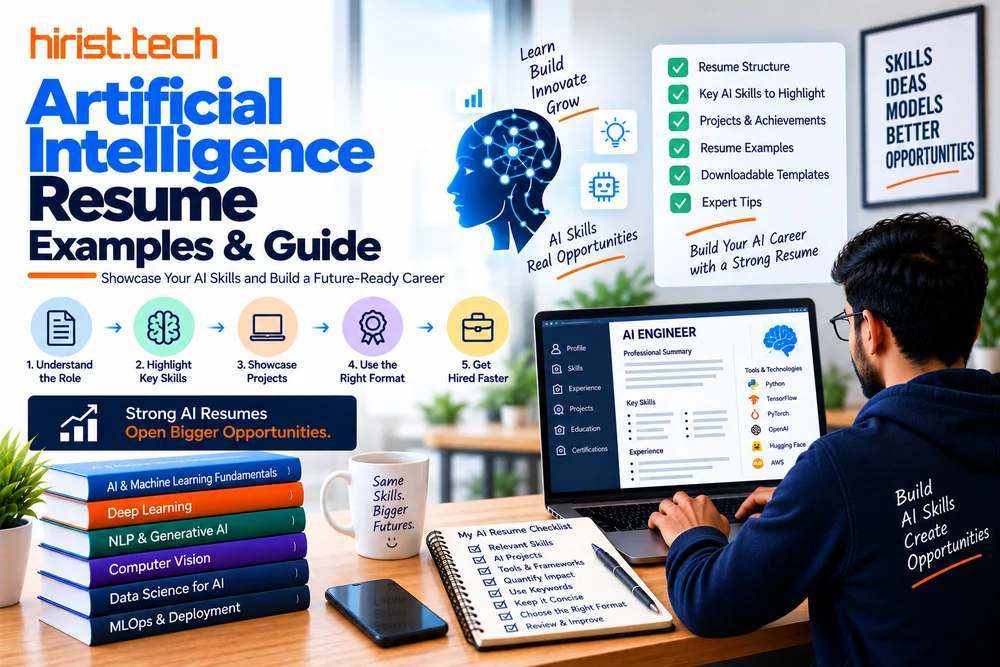
A government report shows that India will need around one million Artificial Intelligence (AI) professionals by 2026, so now is the right time to build a strong Artificial Intelligence resume and secure your dream job. In this guide, you will learn step by step how to write a strong AI resume for freshers and experienced professionals. We have also included Artificial Intelligence resume samples for common roles like – AI Engineer, AI Specialist, and AI Developer, along with the best AI resume templates to make the process easier for you.
AI Resume Example
Before we go step by step on how to write your Artificial Intelligence resume, take a quick look at this example. It will help you understand what a strong AI resume looks like in action.
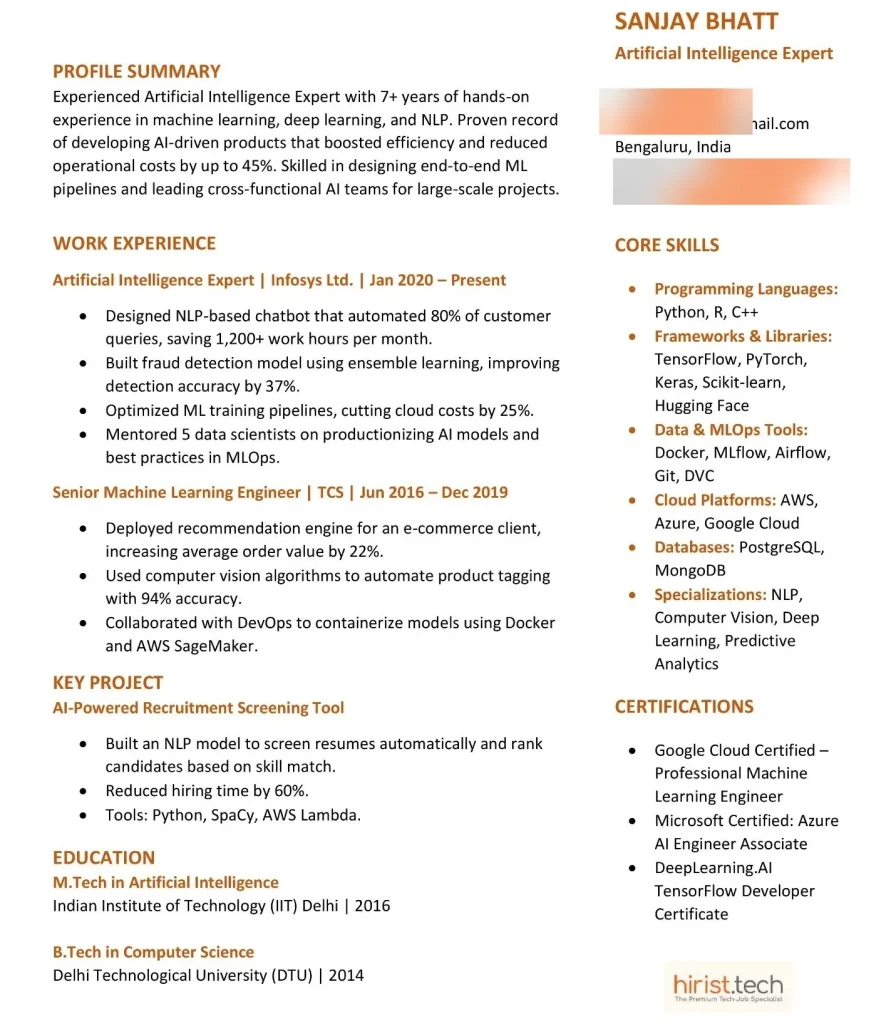
Why does this artificial intelligence resume sample work?
- Shows real results with numbers
- Highlights the right AI tools
- Uses short bullet points for easy reading
- Lists certifications that add credibility
- Keeps the layout professional and ATS-friendly
Artificial Intelligence Resume Writing Guide – At a Glance
Here is a quick and simple summary to help you create the perfect Artificial Intelligence resume. From choosing the right format to highlighting your most important AI skills, this table gives you everything you need before you start writing.
| Category | Details |
|---|---|
| Resume length | • Freshers: 1 page• Experienced professionals: Up to 2 pages |
| Best Artificial Intelligence resume format | • Reverse Chronological – Best for experienced AI professionals• Functional – Great for freshers or career switchers• Combination (Hybrid) – Ideal for mid-level AI roles or team leads |
| Font style & size | Use simple fonts like Calibri, Arial, or Helvetica.Main text: 10–12 pt; Headings: 14–16 pt |
| Essential sections to include | • Header (Name, Contact, LinkedIn, GitHub)• Resume Summary or Career Objective• Technical & Soft Skills• Work Experience or AI Projects• Education• Certifications• Awards or Publications (optional) |
| Top AI skills for resume | • Machine Learning Algorithms• Deep Learning & Neural Networks• Python, TensorFlow, PyTorch• NLP & Computer Vision• Data Preprocessing & Model Evaluation• MLOps, Cloud Platforms (AWS, Azure, GCP) |
| Popular AI certifications | • Google Professional Machine Learning Engineer• Microsoft Certified: Azure AI Engineer Associate• IBM AI Engineering Professional Certificate• AWS Certified Machine Learning – Specialty |
| ATS optimization tip | Use keywords from the job post like machine learning, deep learning, data science, model deployment, and AI solutions. Avoid complex designs or text boxes. |
| Resume writing tips | • Start bullets with action words• Show impact with numbers• Keep layout clean and sections clear• Tailor your resume to each role |
| Common mistakes to avoid | • Using technical jargon without context• Writing long paragraphs instead of bullets• Skipping measurable results• Ignoring soft skills like teamwork or communication |
| Average salary range | ₹4 LPA – ₹44 LPA depending on experience and role (AmbitionBox) |
| Top job portals | Hirist, LinkedIn, Naukri |
Also Read - How to Become a Machine Learning Engineer: Skills & Roadmap
Artificial Intelligence Resume Samples
Here are some artificial intelligence resume sample examples to guide you. They will help you understand what a professional AI resume looks like and how to structure yours effectively.
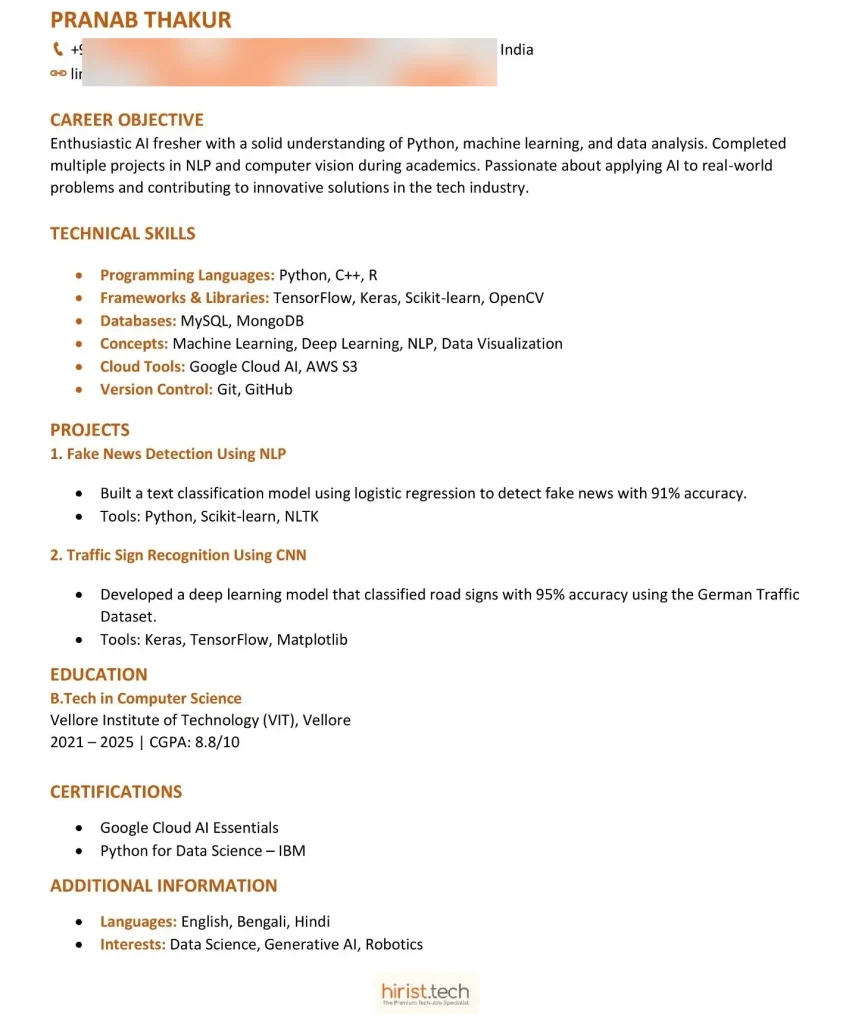
Example 1: Artificial Intelligence Resume for Freshers
This artificial intelligence sample resume is perfect for freshers and entry-level professionals who want to highlight their AI skills and certifications clearly.
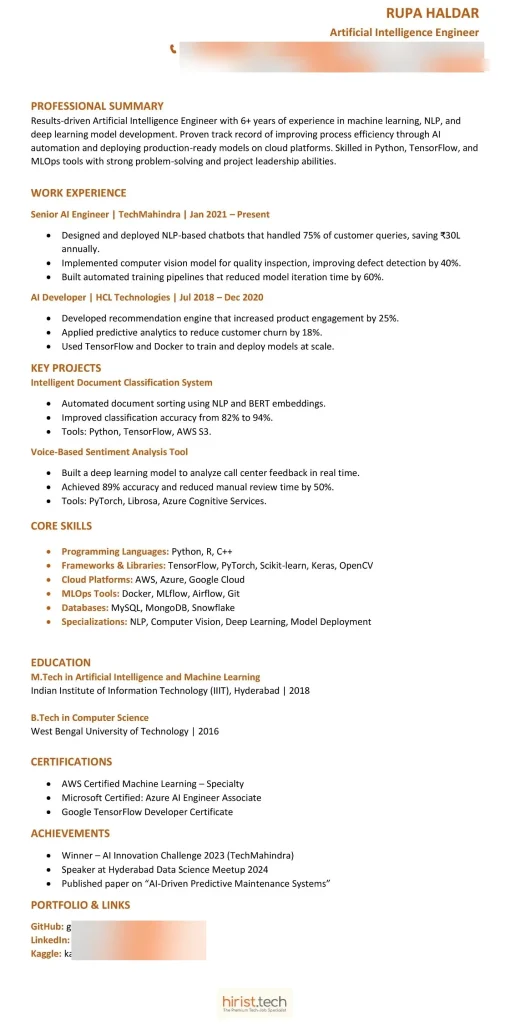
Example 2: Artificial Intelligence Resume for Experienced
Here is a sample resume for artificial intelligence professionals with experience. You can use this to show your advanced skills and measurable results from past AI projects.
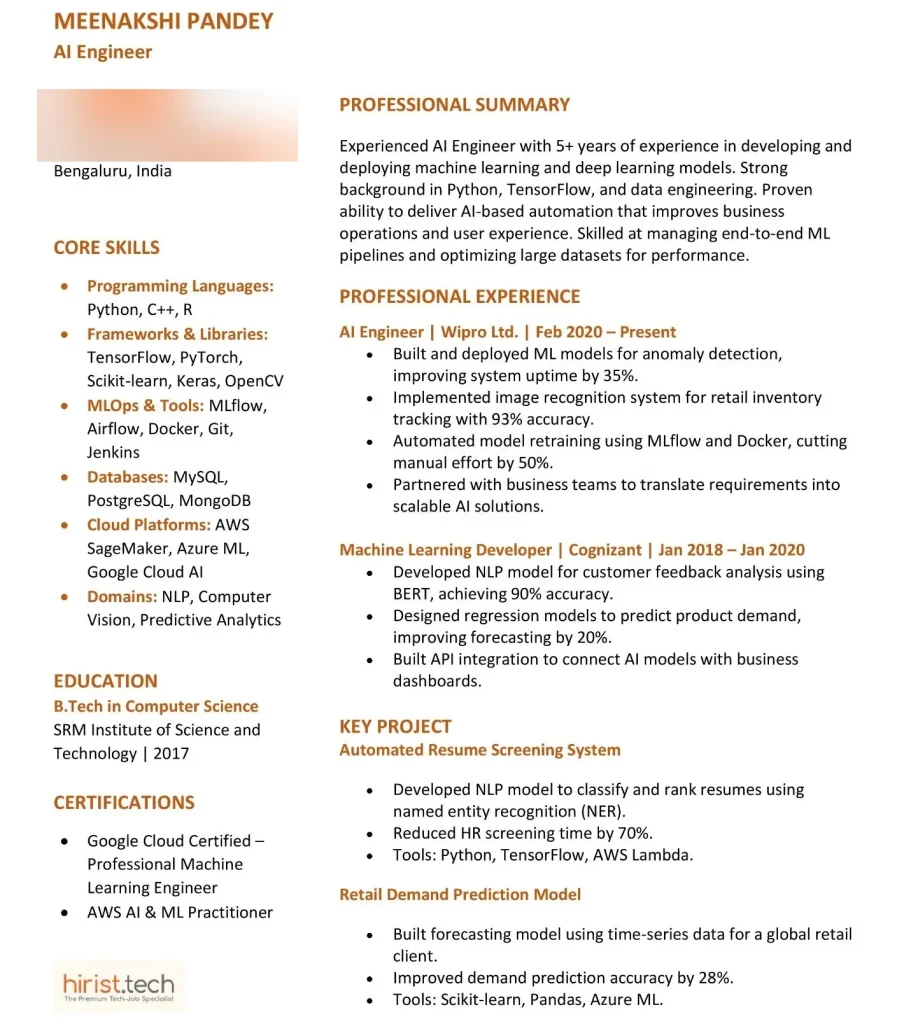
Example 3: Artificial Intelligence Engineer Resume
This AI Engineer resume sample shows how to highlight your hands-on experience that matters to hiring managers. You can also use this as a reference when creating your AI Engineer CV to present your career progress and project results.
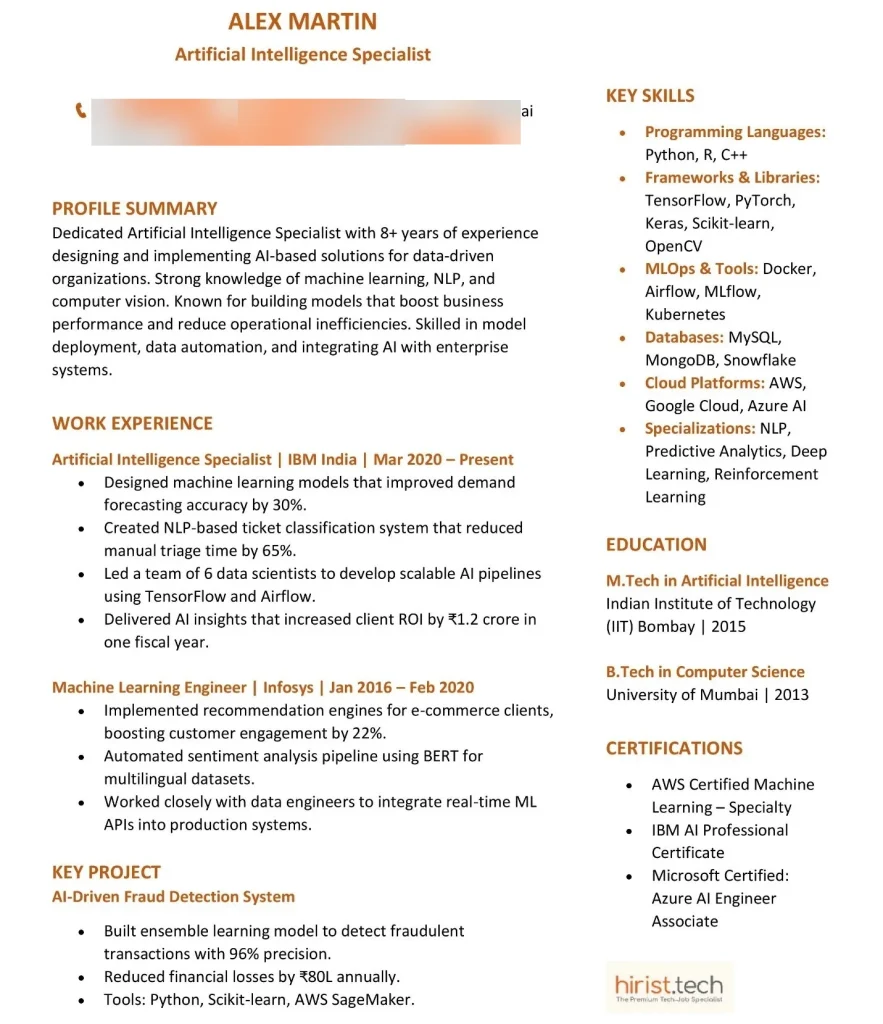
Example 4: Artificial Intelligence Specialist Resume
This Artificial Intelligence Specialist resume sample is ideal for professionals who want to show their expertise in machine learning and AI-driven solutions.
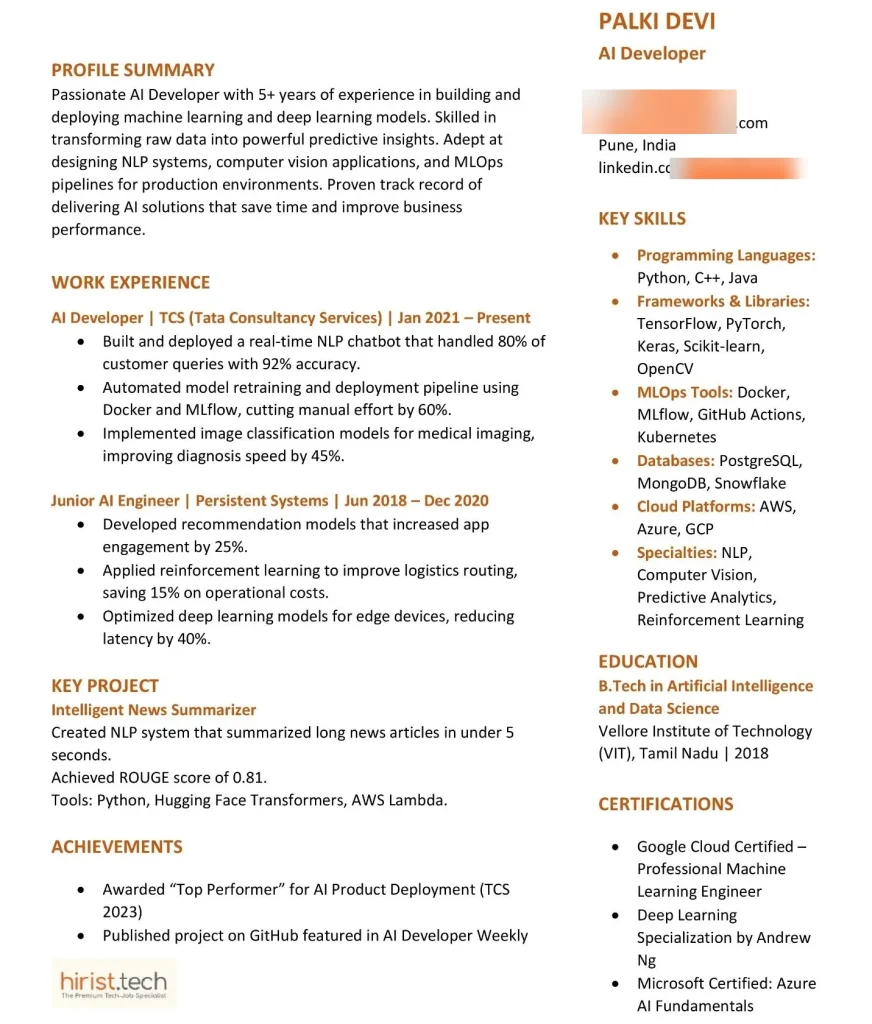
Example 5: AI Developer Resume
Here is an AI Developer resume example you can use as an inspiration to highlight your skills in AI model development and deployment.
How to Write an Artificial Intelligence Resume – Step by Step with Examples
Here is a step-by-step path to write a professional Artificial Intelligence resume. It works for anyone with AI skills and experience – engineers, specialists, developers, researchers, analysts, and more. These are general guidelines. You must customize your resume to your target job role and description.
Step 1: Choose the right AI resume format
Your Artificial Intelligence resume should be easy to read and show your growth clearly. The right format depends on your career stage:
- Reverse Chronological – Best for experienced professionals who want to show steady progress and strong project experience. You can use our AI resume example number 2 to follow this format.
- Functional Format – Great for freshers or career changers. Focuses on your AI skills, tools, and academic projects instead of job history. We used this format in our Artificial Intelligence resume for freshers.
- Combination (Hybrid) – Perfect for mid-level professionals. It highlights both your hands-on technical skills and your work experience. We used this format to create our artificial intelligence engineer resume example.
Step 2: Create a clear and professional resume header
Your header is the first thing hiring managers see on your Artificial Intelligence resume, so keep it clean and professional. It should include all essential contact details in a simple format.
What to include:
- Full name (bold and slightly larger font)
- Job title (AI Engineer or Machine Learning Developer)
- Phone number
- Professional email address
- LinkedIn profile
- GitHub or portfolio link (if you have done AI projects)
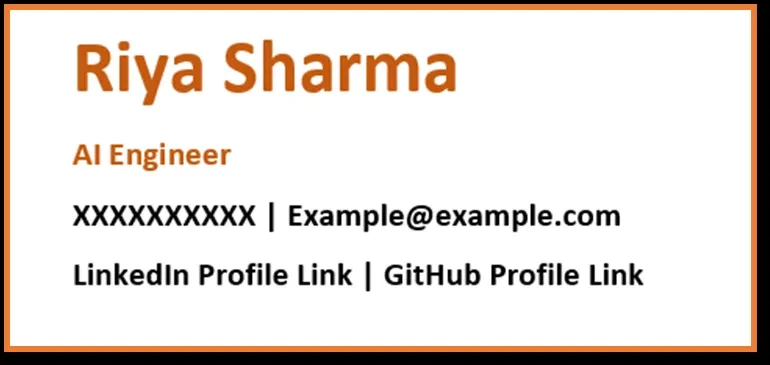
Example Header:
Tips:
- Use your real name and not a username.
- Avoid adding photos or unnecessary details like full address, age, or marital status.
- Make sure your LinkedIn and GitHub are updated before including them.
Step 3: Write a sharp 3 to 4 line AI resume summary
Your AI professional summary is your short introduction. It should tell recruiters who you are, what you’ve done, and what you do best. Keep it short (3–4 lines) and focus on your title, years of experience, main tools or skills, and one measurable result or achievement.
Here are some AI resume summary examples:
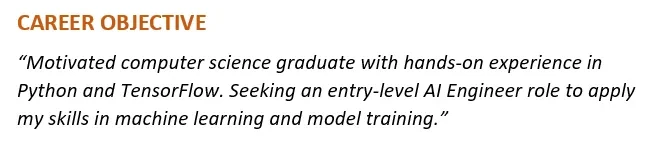
When to write a career objective
Use an objective if you are a fresher or a student. You can also use it when switching careers.
Example:
When to write an AI professional summary
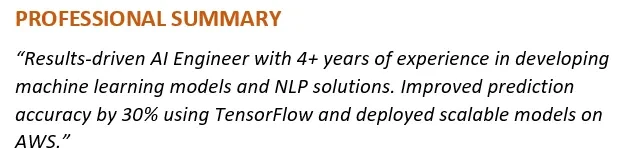
Use a summary if you already have some experience in AI or related roles. It should highlight your work experience and your biggest measurable impact.
Example:
Tip: Look at a few AI resume summary examples before writing yours – they will help you strike the right balance.
Step 4: List your artificial intelligence skills in resume
Your skills section is where recruiters quickly decide if you are a fit for the role. So, make it easy to read and role-specific. Don’t just list tools – show a mix of technical and soft skills that reflect your ability to build and deploy AI solutions.
Example skill section:
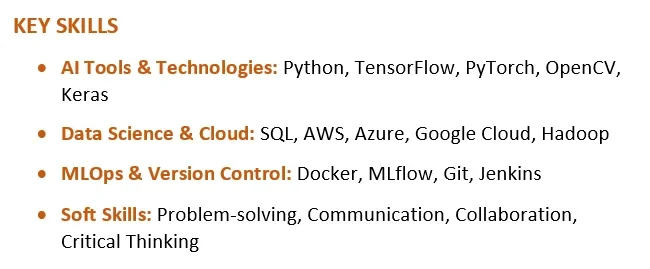
Group your skills under short and clear categories. Here is how to showcase artificial intelligence skills on your resume.
Also Read - Top 30 LangChain Interview Questions and Answers
Top skills for an AI resume
Here are the top skills for an AI resume that employers look for.
| Category | Skills to Include |
|---|---|
| Programming Languages | Python, R, Java, C++, Julia |
| Machine Learning Frameworks | TensorFlow, PyTorch, Scikit-learn, Keras |
| Deep Learning & NLP | Transformers, BERT, GPT, spaCy, NLTK |
| Computer Vision Tools | OpenCV, YOLO, Detectron2 |
| Data Handling & Analysis | SQL, Pandas, NumPy, Matplotlib, Power BI |
| Cloud & Deployment | AWS, Azure, Google Cloud, Docker, Kubernetes |
| MLOps Tools | MLflow, Airflow, Kubeflow, Jenkins |
| Big Data Tools | Hadoop, Spark, Snowflake, Databricks |
| AI Domains | Predictive Analytics, Reinforcement Learning, Generative AI, Robotics |
| Model Optimization | Quantization, Pruning, Transfer Learning |
| Version Control | Git, GitHub, Bitbucket |
| APIs & Integrations | REST, FastAPI, Flask, LangChain |
| Soft Skills | Problem-Solving, Collaboration, Analytical Thinking, Communication |
| Ethical AI & Governance | Bias Mitigation, Explainable AI, Data Privacy |
| Project Tools | JIRA, Trello, Asana, Notion |
Tip: Always match the skills you include with the tools and technologies mentioned in the job description – it helps your resume pass ATS scans.
Also Read - Top 10 AI Skills to Learn in 2026: In-Demand Skills for AI Careers
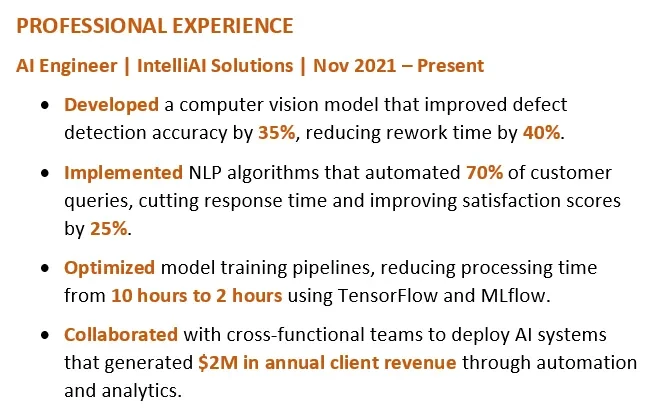
Step 5: Add your AI experience with numbers
Your experience section is the most important part of your Artificial Intelligence resume. This is where you prove your impact. Employers want to see how your AI work reduced costs or increased efficiency.
Start every bullet with a strong action verb (like Developed, Optimized, Designed, Implemented, Deployed, Automated).
Then, add numbers or results to show your work’s real value.
Example of experience section:
Step 6: Highlight 2–4 artificial intelligence projects
Projects are one of the strongest sections on your Artificial Intelligence resume, especially if you are a fresher or mid-level professional. They prove that you can apply AI knowledge to real-world problems – not just study the theory.
Example format:
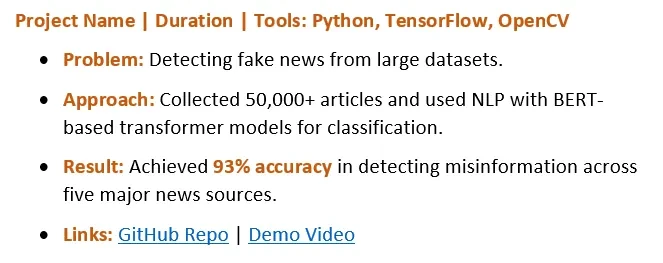
Tip: Always add your GitHub, demo link, or Colab notebook so recruiters can see your work in action.
Step 7: Education and AI certifications
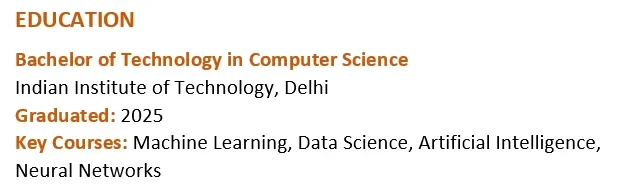
Your education and certifications section shows your foundation in Artificial Intelligence and how actively you are upgrading your skills. List your highest qualification first, followed by any AI-related courses or certifications.
Also Read - Top 40+ Generative AI Interview Questions & Answers
Top AI certifications to boost your resume
Here are some of the top Artificial Intelligence certifications that can make your resume stronger and more credible.
| Certification Name | Issued By | Best For |
|---|---|---|
| IBM Professional Certificate in Artificial Intelligence (AI) | IBM | Beginners and professionals starting in AI |
| AWS Certified Machine Learning – Specialty | Amazon Web Services (AWS) | Building and deploying scalable ML models |
| Microsoft Certified: Azure AI Engineer Associate | Microsoft | Cloud-based AI solution design and operations |
| Google Professional Machine Learning Engineer | Google Cloud | ML engineers focusing on model development and evaluation |
| Deep Learning Specialization | DeepLearning.AI (Andrew Ng) | Learning neural networks and deep learning fundamentals |
| Certified Artificial Intelligence Practitioner (CAIP) | CertNexus | Advanced AI practitioners and applied AI professionals |
| NVIDIA Deep Learning Institute Certification | NVIDIA | GPU-based AI, deep learning, and applied ML projects |
| AI & ML Specialization Certificate | IIT Madras / IIT Roorkee (NPTEL) | Students and entry-level professionals |
Example of education section:
Example of certification section:
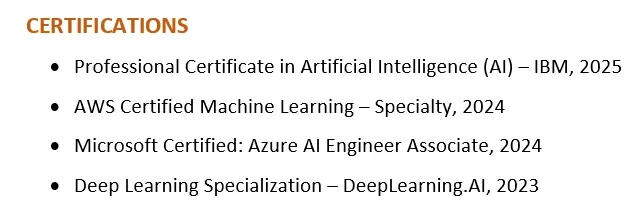
Tip: Always keep your certification section updated. Recruiters value professionals who show continuous learning, especially in a fast-evolving field like AI.
Step 8: Customize your AI resume for the job post
Every Artificial Intelligence resume should be customized to the specific job you are applying for. Recruiters and Applicant Tracking Systems (ATS) scan resumes for keywords that match the job description, so using the right language can make all the difference.
How to do it:
Mirror keywords from the listing: Read the job post carefully and use the same terms for skills, tools, and responsibilities. For example, if it says “TensorFlow and NLP experience,” make sure those words appear in your resume (if relevant).
Tip: Save each version separately. For example – Aarav_Sharma_AI_Engineer_Resume.pdf. It helps track which version you sent for which job.
Also Read - Top 25+ TensorFlow Interview Questions and Answers
Step 9: Add portfolio links
Your portfolio is proof of your real-world skills. Adding links to your professional profiles gives them a quick way to verify your projects and contributions.
What to include:
- GitHub
- Kaggle
- Personal website or portfolio
Tip: Always add clickable URLs (like github.com/username) or hyperlink text in your PDF resume. Recruiters appreciate quick access to your work.
Step 10: Final checks before sending your AI resume
Before you send your Artificial Intelligence resume, do one last review. A clean and error-free resume reflects attention to detail – a skill every AI professional needs.
Quick checklist:
- Length: Keep it one page if you are a fresher or early in your career. Go up to two pages only if you have several years of experience.
- Layout: Use a simple and consistent format with clear section headings. Avoid images or design-heavy templates that confuse ATS scanners.
- Proofread: Double-check for grammar errors or inconsistent punctuation.
- Test your links: Make sure all GitHub, LinkedIn, or project URLs open correctly.
Artificial Intelligence Resume Templates
You can use these artificial intelligence resume sample templates to create a clean and professional-looking resume.
Template 1: Artificial Intelligence Fresher Resume
This artificial intelligence resume template is ideal for beginners who want to showcase their academic or internship projects clearly.
NAME
Phone | Email | Location
LinkedIn | GitHub/Portfolio Link
PROFESSIONAL SUMMARY
Enthusiastic computer science graduate with hands-on experience in [key tools or areas]. Strong interest in [AI sub-field]. Looking to apply knowledge in [desired role or industry].
TECHNICAL SKILLS
- Programming Languages: Python, R, C++
- Frameworks & Libraries: TensorFlow, Keras, PyTorch, Scikit-learn
- Databases: MySQL and MongoDB
- Concepts: Machine Learning, Deep Learning, NLP, Computer Vision
- Tools & Platforms: Google Cloud, AWS, Git, Docker
PROJECTS
Project Title 1
Short line describing what the project does.
Mention tools, techniques, and results.
Project Title 2
Describe the goal, your contribution, and the outcome.
Mention datasets or frameworks used.
EDUCATION
B.Tech/B.E./M.Sc. in Computer Science or related field
University Name | Year
CGPA
CERTIFICATIONS
- Certification Name – Issuing Organization
- Certification Name – Issuing Organization
ADDITIONAL INFORMATION
Languages: English, Hindi
Interests: AI Research, Data Visualization, Robotics, etc.
Template 2: Artificial Intelligence Engineer Resume for Experienced
This artificial intelligence engineer resume template is perfect for professionals with hands-on AI experience.
FULL NAME
Job Title
Phone | Email | Location | LinkedIn | GitHub/Portfolio
PROFESSIONAL SUMMARY
AI Engineer with [X years] of experience in developing scalable ML models and NLP solutions. Skilled in [key tools/technologies]. Proven success in improving [metric or business outcome].
CORE SKILLS
Programming Languages: Python, Java, R
Frameworks & Libraries: TensorFlow, PyTorch, Keras, Scikit-learn
MLOps Tools: MLflow, Docker, Kubernetes, Git
Databases: PostgreSQL, MongoDB, Snowflake
Cloud Platforms: AWS, Azure, Google Cloud
Specializations: Computer Vision, NLP, Reinforcement Learning, Deep Learning
PROFESSIONAL EXPERIENCE
Job Title | Company Name | Start Date – End Date
- Developed [specific AI model or system] that improved [result/metric] by [percentage].
- Collaborated with cross-functional teams to deploy models in production environments.
- Automated data pipelines and reduced processing time using [tool].
- Mentored junior team members in model training and validation best practices.
KEY PROJECTS
Project Title 1
- Problem: Briefly state challenge.
- Approach: Explain your method or model used.
- Result: [Mention measurable results.
- Tools: Frameworks/Technologies.
EDUCATION
B.Tech/M.Tech
University Name | Year
CERTIFICATIONS
- Certification – Provider
- Certification – Provider
ACHIEVEMENTS
- Award, Recognition, or Leadership Role
- Publication, Patent, or Open-Source Contribution
How to Use These AI Resume Templates?
- Pick the template that matches your experience level
- Replace all placeholders with your real details
- Save and upload in PDF format for easy sharing and ATS compatibility
Tips to Make Your AI Resume ATS-Friendly
Many resumes get filtered out before reaching a recruiter. Here’s how to make sure yours passes the ATS check:
- Use simple section headings: Stick to clear titles like Summary, Skills, Experience, and Education.
- Avoid images or fancy designs: ATS can’t read graphics or tables. Keep your layout clean.
- Save as PDF or DOCX: These formats keep your formatting safe and ATS-readable.
- Match job keywords: Use exact terms from the job post like TensorFlow or NLP.
- Keep formatting consistent: Use one font, same bullet points, and even spacing.
- Avoid columns or boxes: Stick to a single column layout.
- Write full forms once: Say “Natural Language Processing (NLP)” before using short forms.
- Test your resume online: Use free tools to check if your resume passes ATS scans.
Add a Cover Letter with Your Artificial Intelligence Resume
Data shows that 83% of employers prefer a cover letter with your resume. So if you want to improve your chances of getting an interview, include a short cover letter with your AI resume.
A cover letter helps you go beyond the bullet points on your resume. It is your space to show personality and connect your AI skills to the company’s goals.
Here’s how to write a good cover letter for your Artificial Intelligence resume:
- Start with a clear introduction
- Highlight key skills and achievements
- Quantify your results
- End confidently with a call to action
Example of cover letter for AI resume
Wrapping Up
Building a great Artificial Intelligence resume takes effort, but it can open doors to incredible opportunities. Use simple language and match your resume to the exact role you want. Keep updating it as you gain new projects or certifications.
If you are ready to start your AI career, find the latest and best AI jobs in India on Hirist.
FAQs
A resume is usually one page and focused on skills and experience. A CV (Curriculum Vitae) is longer and includes detailed academic achievements, research work, and publications. Resumes are best for job applications, while CVs are preferred for research or academic positions.
AI professionals usually work on developing, testing, and deploying machine learning or deep learning models. Common responsibilities include –
- Data preprocessing
- Feature engineering
- Algorithm selection
- Performance tuning
Many also collaborate with software and data teams to integrate AI solutions into products, automate workflows, and create predictive models that solve real-world problems.
- Writing long paragraphs instead of bullet points.
- Listing every tool you have heard of instead of tools you have actually used.
- Using fancy resume designs that break ATS readability.
- Forgetting to use numbers.
- Skipping proofread.
Use a reverse chronological format – start with your latest job or project and work backward. Keep your resume clean and easy to scan with clear section headings. Use consistent fonts like Arial or Calibri, 10–12 pt for text, and 14–16 pt for headings. Save it as a PDF to preserve formatting and keep it ATS-friendly.
A sample resume for Artificial Intelligence helps you understand how to organize information and highlight impact. It also gives you clarity on formatting and tone – saving time and avoiding common resume mistakes.