SRE interview questions usually cover system reliability, Linux, networking, incident handling and automation. This guide explains each of these important areas.
A site reliability engineer (SRE) is an IT professional who uses software engineering and automation to keep websites and large systems running smoothly. They connect development teams with operations teams while improving uptime and resolving system failures. It is a lucrative career in India, with an average salary of around ₹15.5 lakh according to AmbitionBox. Some of the top-paying IT companies for this role include Google, Amazon, Apple, Microsoft and LinkedIn. At the time of writing, Hirist lists more than 2,000 active vacancies for site reliability engineers.
This guide covers 54 commonly asked SRE interview questions and answers to help you prepare effectively. We have divided them into basic, intermediate and advanced levels. You will also find questions frequently asked by leading IT companies.
SRE Interview Experience (Common Rounds)
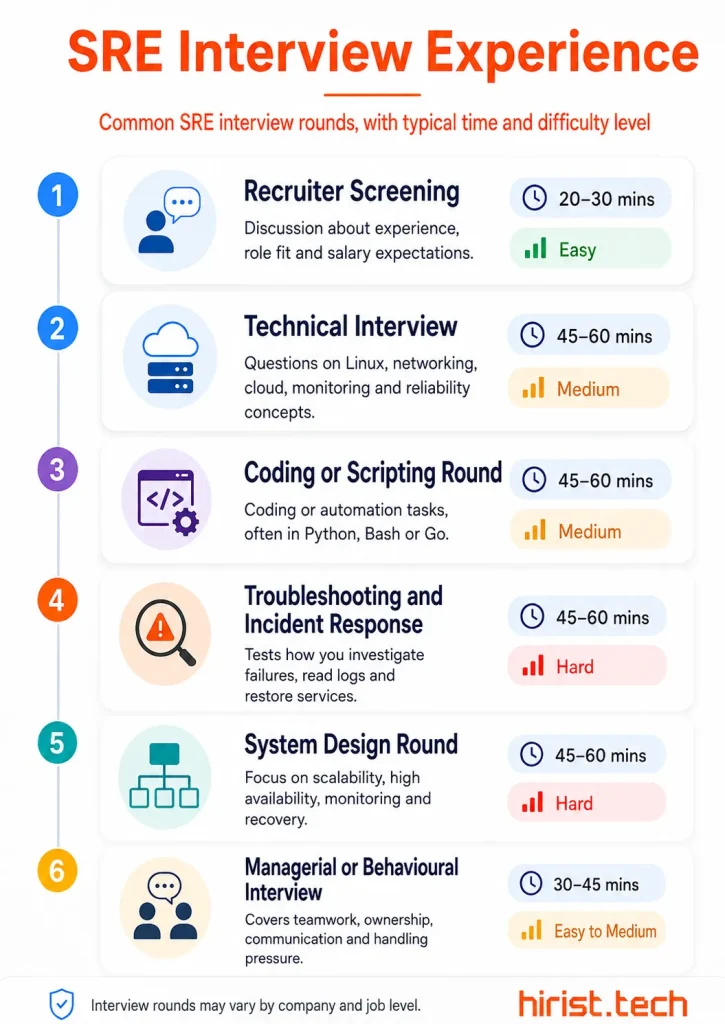
The SRE interview experience can differ for every candidate. It depends on the company and job level. Some companies complete the process in three rounds, while larger companies may conduct five or more. The rounds below are based on experiences shared by candidates on Reddit and LinkedIn. Your actual interview may follow a different order.
- Recruiter Screening
- Technical Interview
- Coding or Scripting Round
- Troubleshooting and Incident Response
- System Design Round
- Managerial or Behavioural Interview
Basic Site Reliability Engineer Interview Questions
Freshers and junior candidates can begin with these SRE interview questions and answers. They usually appear in the first technical screening and cover Linux commands, networking basics, monitoring, SLIs, SLOs and simple incident scenarios.
1. How is Site Reliability Engineering different from DevOps?
Answer:
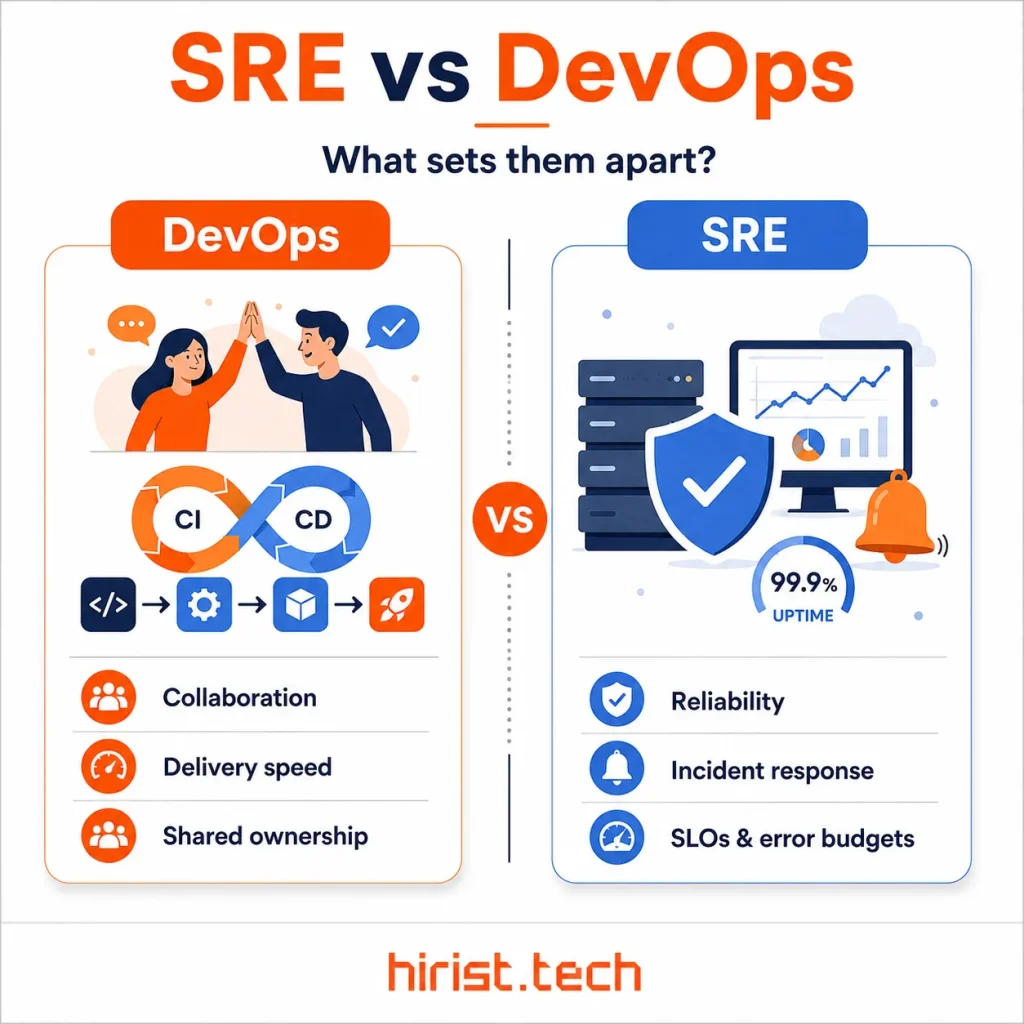
DevOps is a broad culture that promotes collaboration between development and operations teams. SRE is a specific engineering approach to running reliable services. It turns DevOps ideas into practical methods through SLOs, error budgets, automation, incident management and toil reduction.
2. What do SLI, SLO and SLA mean, and how are they connected?
Answer:
- An SLI is a metric that measures service performance, such as availability or latency.
- An SLO is the target set for that metric.
- An SLA is a commitment made to users and usually includes consequences if the agreed target is missed.
In simple terms, the SLI measures performance, the SLO sets the goal and the SLA defines the promise.
3. Why do you want to work as a Site Reliability Engineer?
Answer:
I am interested in SRE because I enjoy both building systems and figuring out why they fail. The role gives me a chance to solve real production problems, reduce repetitive work through automation and make services more dependable for users.
4. How do you define and measure the reliability of a service?
Answer:
Reliability is the ability of a service to perform as expected for its users. It can be measured through SLIs such as successful request rate, availability, latency, error rate, throughput and data durability. Teams then set SLOs for the most important indicators and track performance over a fixed period.
5. What is an error budget, and how does an SRE team use it?
Answer:
An error budget is the amount of failure allowed by an SLO. For example, a service with a 99.9% availability target has a 0.1% error budget. Teams use it to balance new releases with reliability work. If the budget is being consumed too quickly, they may reduce risky changes and focus on fixing stability problems.
6. What is the difference between TCP and UDP? When would you choose each protocol?
Answer:
TCP creates a connection and provides ordered, reliable data delivery. It retransmits lost data and manages congestion. UDP sends independent datagrams without promising delivery, order or duplicate protection.
| Feature | TCP | UDP |
|---|---|---|
| Full Form | Transmission Control Protocol | User Datagram Protocol |
| Connection | Connection-oriented | Connectionless |
| Delivery | Reliable and ordered | No delivery or order guarantee |
| Error handling | Retransmits lost data | Does not retransmit lost data |
| Speed | Slower due to added checks | Faster with less overhead |
| Best used for | SSH, file transfers and web applications | DNS, streaming, gaming and real-time calls |
7. What happens between entering a URL in a browser and seeing the webpage?
Answer:
The browser reads the URL and uses DNS to find the server’s IP address. It opens a network connection and negotiates encryption when HTTPS is used. The browser then sends an HTTP request. After receiving the response, it parses the HTML, downloads resources such as CSS and JavaScript, calculates the page layout and displays the content.
8. What does a load balancer do? How do Layer 4 and Layer 7 load balancers differ?
Answer:
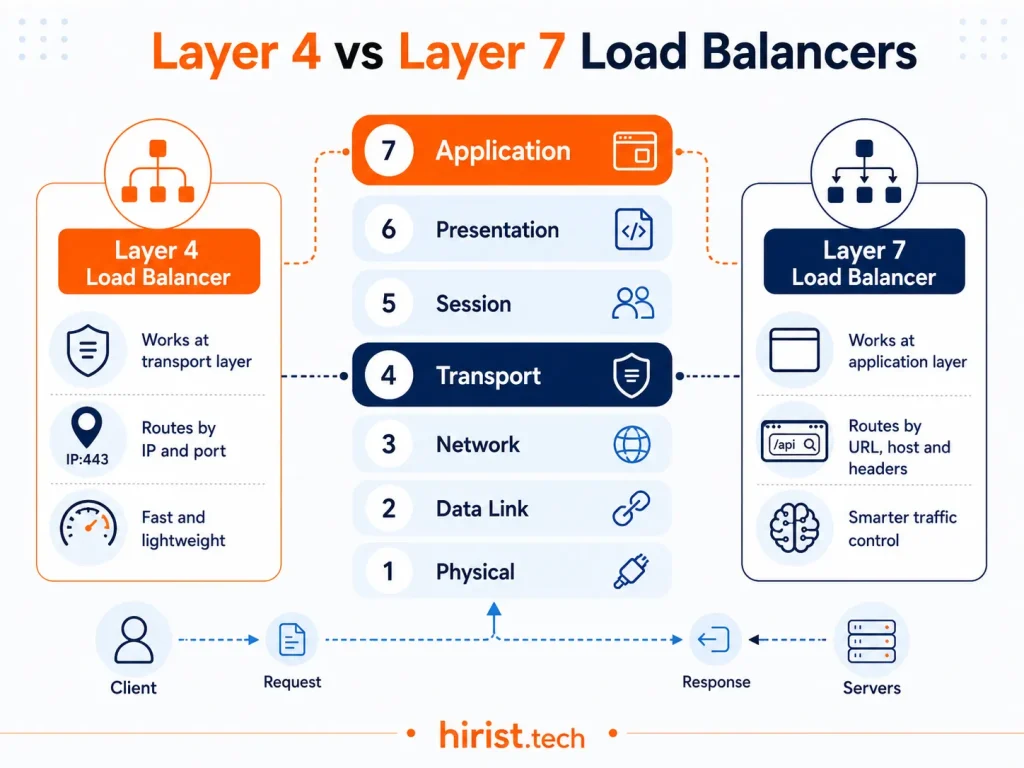
A load balancer distributes incoming traffic across healthy servers so that one server does not handle every request. A Layer 4 load balancer routes traffic using transport details such as IP addresses and ports. A Layer 7 load balancer understands HTTP or HTTPS and can route requests by hostname, URL path or header.
9. How would you investigate high CPU usage on a Linux server?
Answer:
Start with top or htop to identify the process using the most CPU. Use pidstat to examine the process and its threads over time. Check whether the problem began after a deployment, traffic increase or configuration change. Review application logs and use profiling tools or strace when deeper analysis is needed. Also check CPU wait time, memory pressure and container limits.
Intermediate SRE Interview Questions
These SRE interview questions and answers for experienced professionals are generally asked during technical and troubleshooting rounds. They cover production incidents, automation, cloud platforms, containers, observability and practical reliability problems.
10. Which tools have you used in an SRE role?
Answer:
To answer this SRE interview question, you can name these commonly-used tools:
- Monitoring and metrics: Prometheus, Grafana and CloudWatch
- Logging: ELK Stack and Loki
- Tracing: OpenTelemetry and Jaeger
- Containers: Docker and Kubernetes
- Infrastructure as code: Terraform and Ansible
- CI/CD: Jenkins, GitHub Actions and Argo CD
- Incident management: PagerDuty and Opsgenie
- Scripting and troubleshooting: Bash, Python, Git, tcpdump and strace
11. How would you reduce noisy alerts and prevent alert fatigue?
Answer:
I would remove alerts that do not require immediate action and focus paging alerts on problems that affect users or SLOs. I would also tune thresholds, add time windows, group related alerts and route them to the correct team. Regular alert reviews help find duplicate, outdated and frequently false alerts.
12. What is a runbook? What information should it contain?
Answer:
A runbook is a step-by-step guide for handling a known incident or operational task. It should include the alert or symptom, initial checks, useful commands, mitigation steps, rollback instructions, escalation contacts and recovery checks. It should also show the owner and the date it was last reviewed.
13. How would you monitor a distributed system using metrics, logs and traces?
Answer:
Metrics show patterns such as latency, traffic, errors and resource usage. Logs provide details about individual events. Traces show how a request moves across services and where delays or failures occur. I would connect them through timestamps, service names and trace IDs so engineers can move from an alert to the related logs and request path.
14. What is your approach to incident response after receiving a production outage alert?
Answer:
First, confirm the alert and check the user impact. Declare the incident and assign clear roles if several teams are involved. Focus on reducing the impact through rollback, failover, traffic control or another safe action. Share regular updates while investigating the cause. After recovery, verify the service and complete a blameless postmortem with follow-up tasks.
15. Tell us about a repetitive operational task you automated and the result it produced.
Answer:
In one project, I automated post-deployment checks that were previously completed by hand. The script tested service health, checked important endpoints and collected logs when a check failed. This reduced manual work and helped the team find failed deployments much earlier.
16. A Kubernetes service appears healthy, but users are receiving HTTP 500 errors. How would you troubleshoot it?
Answer:
I would first identify whether the error comes from the ingress, application or an upstream dependency. I would check pod logs, events, restarts and recent deployment changes. Next, I would test the service from inside the cluster and inspect its EndpointSlices to confirm traffic is reaching the expected pods. I would then check resource limits, configuration, secrets, database connections and external APIs. If the issue started after a release, I would consider a rollback. Passing a readiness probe does not prove that every application request will succeed.
Advanced SRE Interview Questions
Here are some commonly asked Senior Site Reliability Engineer interview questions. They are often asked during system design and senior technical rounds.
17. How would you design a highly available service that can survive a regional failure?
Answer:
Run the service in at least two regions with independent compute resources. Place a global load balancer in front and route traffic only to healthy regions. Replicate data based on the required consistency and data-loss limits. Remove single-region dependencies and keep enough spare capacity for failover. Test regional failover and recovery regularly.
18. How do RTO and RPO differ? How would you set them for a critical service?
Answer:
| Term | Meaning |
|---|---|
| RTO | Recovery Time Objective, the longest acceptable time for restoring a service |
| RPO | Recovery Point Objective, the largest acceptable amount of data loss measured in time |
For a critical service, set both targets after reviewing user impact, revenue loss, compliance needs and recovery cost. Lower targets require faster failover, frequent replication and regular recovery testing.
19. How can AI support incident detection, root-cause analysis and remediation? What decisions should remain under human control?
Answer:
AI can group related alerts, analyse logs and metrics, suggest likely causes and recommend recovery steps. AI agents can also run approved low-risk tasks such as collecting diagnostics or checking service health. Human approval should remain required for major production changes, data deletion, regional failover and other actions with a large or uncertain impact.
20. How would you plan infrastructure capacity for a service with rapidly growing traffic?
Answer:
Start with current traffic, resource use and peak-load patterns. Forecast growth and seasonal demand. Use load tests to find the system’s real limits and identify bottlenecks. Add capacity headroom for traffic spikes and failures. Configure autoscaling where suitable, check cloud quotas and compare forecasts with actual demand regularly.
21. How would you define SLIs and SLOs for a platform used by teams with different reliability needs?
Answer:
Begin with the user journeys that matter to each team. Select SLIs such as availability, latency, correctness, throughput or durability. Set separate SLOs for workloads with different needs. For example, an interactive service may focus on latency while a data pipeline may focus on completion time and throughput. Keep the number of SLOs small and give each one a clear target and measurement window.
22. What would you do if a service exhausted its error budget while the product team wanted to release a major feature?
Answer:
Follow the agreed error budget policy. Pause risky releases and focus on the problems that caused the SLO miss. Review recent incidents, fix major reliability gaps and define clear conditions for restarting releases.
Security fixes and urgent production corrections may still proceed through a controlled process.
23. A slow dependency causes retries and a cascading failure across several services. How would you stabilise and redesign the system?
Answer:
First, reduce the immediate load by limiting retries, shedding low-priority traffic or disabling the affected feature. Roll back a recent change if it caused the problem. For the long term, add strict timeouts, exponential backoff with jitter, retry limits and circuit breakers. Use fallbacks or graceful degradation where possible. Load-test the dependency and track its latency, saturation and error rate.
SRE Interview Questions Asked At Top IT Companies (Bonus)
These Site Reliability Engineer interview questions are based on common topics asked by leading IT companies. They may include coding tasks, system design problems, troubleshooting scenarios and behavioural questions related to ownership and teamwork.
PhonePe Site Reliability Engineer Interview Questions
PhonePe SRE interview questions often cover high-traffic systems and payment platform reliability.
- A payment API starts timing out during peak traffic. How would you find the cause across the network, application and database layers?
- How would you design a highly available payment service while preventing duplicate transactions?
- How do DNS, DHCP and the OSI model relate to a request sent from a mobile app to a backend service?
- Which Linux commands and MySQL checks would you use when a production server becomes slow?
- Tell us about an outage you handled while on call. How did you prioritise recovery and communicate with others?
You can find more PhonePe Site Reliability Engineer interview questions and answers on AmbitionBox.
Also Read - How to Become DevOps Engineer: Skills & Roadmap
Google SRE Interview Questions
A Google site reliability engineer interview may test coding, system design, troubleshooting, and reliability principles.
- Given a dependency graph, how would you find the fastest valid path while handling cycles?
- A text editor consumes more memory the longer it runs. How would you diagnose the problem and write a memory-efficient fix?
- A service has intermittent connection failures. How would you trace the issue across DNS, TCP, load balancers and application servers?
- How would you design a reliable system for distributing configuration updates to thousands of machines?
- Tell us about a serious production incident you handled. What did you change after the postmortem?
Find additional SRE Google interview questions and answers on AmbitionBox.
Apple Site Reliability Engineer Interview Questions
An Apple SRE interview commonly includes infrastructure troubleshooting and behavioural questions.
- A Linux server reports that its disk is full, but the visible files do not account for the used space. How would you investigate?
- How would you extract a specific error pattern from millions of log lines using shell commands or Python?
- A containerised service starts failing after a deployment. How would you isolate whether the problem is in the application, container, host or network?
- How would you design a reliable backend service that receives requests from millions of devices?
- Tell us about a time you had to communicate a complex production problem while working under pressure.
Media.net SRE Interview Questions
Media.net SRE interview questions may focus on Linux, cloud infrastructure, and production issue management.
- How would you write a Python client and server that communicate through UDP and exchange heartbeat messages?
- How do HTTP and HTTPS differ, and what happens during the TLS handshake?
- An ad-serving request has high latency and occasional packet loss. How would you troubleshoot the network path?
- How would you design a low-latency ad-serving system that can handle sudden traffic spikes?
- When would you use multithreading instead of multiprocessing in a network service?
Nutanix SRE Interview Questions
Nutanix SRE interview questions often assess virtualization, cloud platforms, Kubernetes and incident response skills.
- How do virtual machines differ from containers, and when would you use each?
- What is the difference between kernel space and user space, and how does a system call cross between them?
- A virtual machine on a hyperconverged cluster has high latency. How would you check the host, storage and network layers?
- How does traffic travel from an external client to a pod inside a Kubernetes cluster?
- Why did you choose Site Reliability Engineering instead of a software development role?
You can visit AmbitionBox to find more Nutanix SRE interview questions with answers.
Microsoft SRE Interview Questions
Microsoft site reliability engineer interview questions can include coding, Azure, and troubleshooting scenarios.
- You see an unfamiliar production error with little documentation. How would you investigate it?
- How would you explain SLIs, SLOs and error budgets to a non-technical manager?
- How would you design a multi-region Azure service with failover, monitoring and disaster recovery?
- How would you implement a queue using two stacks, and what would be the time complexity of each operation?
- Tell us about a mistake you made during a technical project. How did you resolve it, and what did you learn?
Use these additional Microsoft Corporation Site Reliability Engineer interview questions and answers for preparation.
Also Read - Top 5 DevOps Engineer Resume Samples & Templates (2026 Guide)
SRE Interview Preparation Tips
Here are practical ways to prepare for technical and behavioural SRE interview rounds:
- Practise commonly asked SRE interview questions and answers aloud. Keep definition-based answers under one minute. For scenarios, explain the impact, checks, mitigation, root cause and prevention.
- Create five real examples from your work: a production incident, an automated task, a failed deployment, a reliability improvement and a difficult team decision. Include numbers where possible.
- Study the Google SRE Workbook. Focus on SLOs, error budgets, alerting, incident response and postmortems. Draft an SLO and error budget for a sample web service.
- Practise Kubernetes troubleshooting. Break a test deployment using an incorrect selector, failed readiness probe or missing configuration. Then debug it with logs, events, EndpointSlices and kubectl debug.
- Use the OpenTelemetry Demo to follow one request through metrics, logs and traces. Be ready to explain how you would find a slow or failing service.
- Run timed Linux and networking drills using tools such as top, pidstat, ss, dig, curl, tcpdump and strace. Focus on explaining what each command tells you.
Also Read - Top 25+ DevOps Interview Questions and Answers
Wrapping Up
These SRE interview questions and answers can help you understand what employers look for across technical, troubleshooting, system design and behavioural rounds. Focus on practical examples and strong basics rather than memorising replies. Ready to find more job opportunities? Visit Hirist to find IT jobs, including Site Reliability Engineer roles from companies across India.
FAQs
You can find valuable SRE interview questions and detailed candidate experiences on platforms like Reddit and LinkedIn. These sources often feature direct insights from interviewers and candidates who have recently completed interviews at companies like Google and PhonePe, offering specific examples of questions asked and topics assessed.
DevOps SRE interviews typically focus on deployments, infrastructure automation, and production security. Common questions involve building CI/CD pipelines, managing Terraform state, understanding blue-green versus canary deployments, and handling secrets and configuration management across different environments.
In an interview context, an SLA (Service Level Agreement) refers to a contractual commitment regarding service uptime and response times, often including penalties for breaches. In contrast, KPIs (Key Performance Indicators) are internal metrics used to measure performance, such as availability, mean time to repair, and incident volume.
According to AmbitionBox’s 2026 data, the average Site Reliability Engineer salary in India is ₹15.6 lakh per year. Professionals with 1 to 10 years of experience typically earn between ₹14.8 lakh and ₹16.4 lakh, while the top 10% of earners make approximately ₹25.8 lakh annually.
AWS SRE interviews focus on cloud troubleshooting, observability, and service recovery. Candidates are often asked to demonstrate knowledge of troubleshooting latency across services like ALB and RDS, setting up CloudWatch metrics and alarms, managing IAM permissions with least privilege, and using Route 53 for health checks during failures.