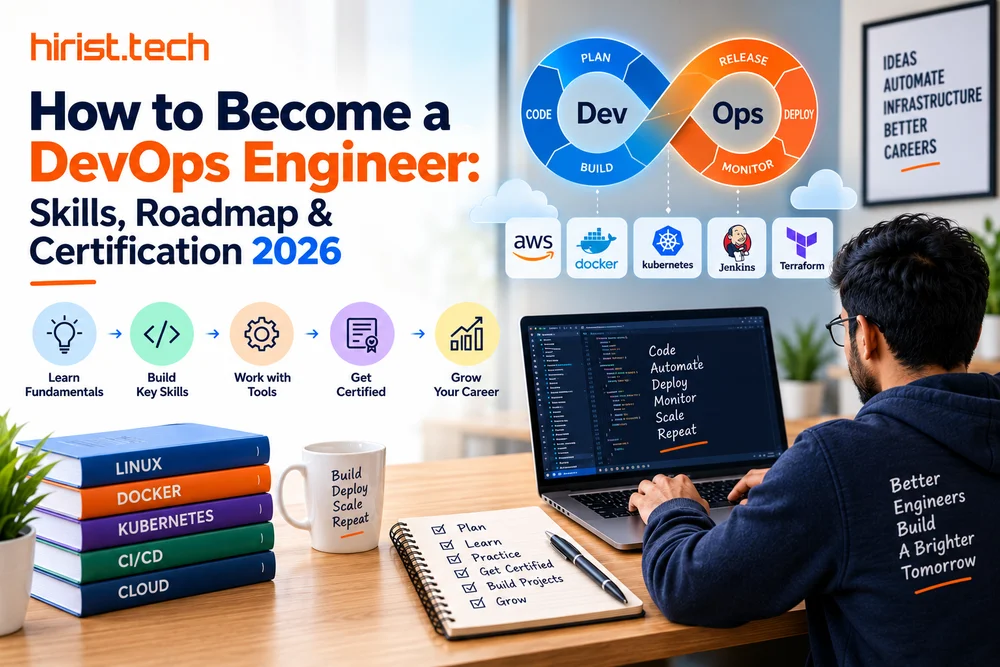
Becoming a DevOps engineer is a smart move right now because the field is growing fast and companies need people who can build and manage software in a smooth and reliable way. The demand keeps rising each year. A report by Global Market Insights shows the DevOps market growing at more than 20 percent every year. The pay is strong as well. As per AmbitionBox, DevOps engineers in India earn around ₹8.8 lakh per year on average. DevOps sits right between development and operations, so you learn how both sides work. It is a practical role and suits people who like solving problems. In this guide, we will show you how to become DevOps engineer by sharing a complete roadmap with key skills and certifications.
What is a DevOps engineer?
A DevOps engineer is an IT professional who connects the work of developers and the work of operations teams. Instead of treating coding and system management as separate jobs, a DevOps engineer brings them together.
The goal is to make software move from idea to deployment in a smooth and reliable way. They focus on teamwork, automation, faster delivery, and building systems that run without constant manual effort. DevOps engineers help remove the usual gaps between teams so products reach users quickly and with fewer problems.
What does a DevOps engineer do?
A DevOps engineer helps teams deliver software faster by automating tasks and improving workflows. They work across development and operations to make everything run smoothly.
What a DevOps engineer does:
- Builds and manages CI/CD pipelines
- Automates repetitive tasks and deployments
- Monitors system performance and fixes issues
- Works with developers to improve code delivery
- Manages cloud infrastructure and servers
- Handles configuration and version control
- Supports security practices within the workflow
How to become DevOps engineer – Roadmap with Timeline
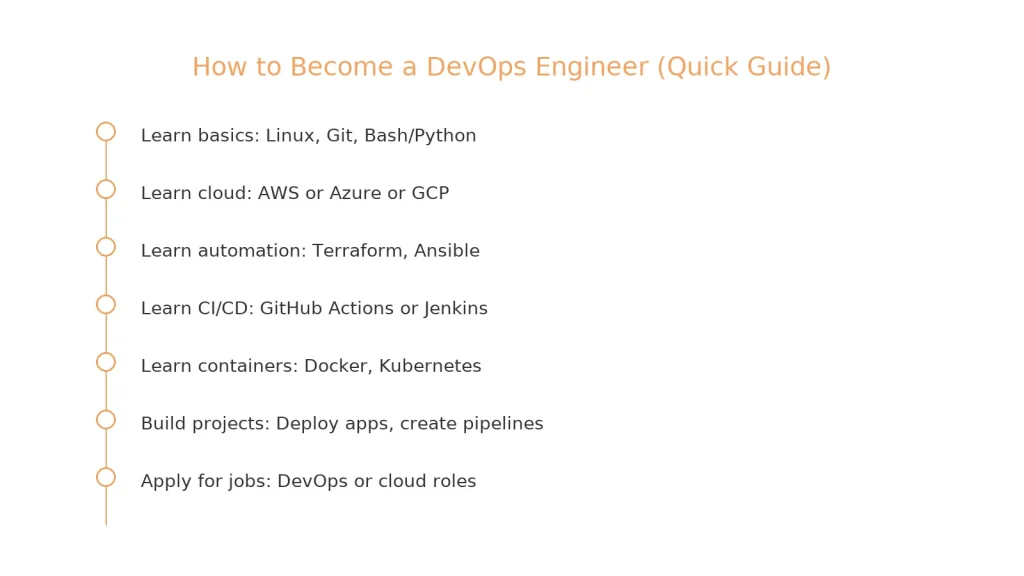
Now, we will show you how to become a DevOps engineer from scratch by sharing a complete roadmap with timeline with you.
1. Start with the basics (1 to 3 months)
Before touching tools like Docker or Kubernetes, you need strong foundations. These basics will help you understand how systems work behind the scenes. Without them, DevOps feels difficult and confusing.
a) Learn Linux
Linux is the heart of DevOps. Almost every application, server, and container you will handle runs on Linux. Learn how to:
- Navigate the terminal
- Manage files, folders, and permissions
- Check logs when something breaks
- Understand CPU, memory, and running processes
These skills give you a stable base to learn automation, cloud, and containers later.
b) Learn Git
Git is used in every DevOps job. It helps teams work together and keeps code organized. You only need the basics in the beginning:
- Commit changes
- Push them to GitHub
- Create branches
- Merge work safely
Once you learn this, building CI/CD pipelines becomes much easier.
c) Learn one scripting language
Automation is the core of DevOps. Scripting allows you to remove repetitive manual work. Start with:
- Bash for simple server tasks
Then move to:
- Python for more powerful automation and cloud scripts
You will use scripting in pipelines, cloud automation, container setup, and debugging.
Timeline
- Complete beginner = 2 to 3 months
- IT or coding background = 3 to 4 weeks
2. Understand education and qualification options (1 to 2 weeks)
You do not need a computer science degree, but it can help.
According to Zippia, 75% of DevOps engineers hold a bachelor’s degree, mostly in:
- Computer Science
- IT
- Software Engineering
But many DevOps engineers are self-taught. Here’s what actually helps you get hired:
- Hands-on practice
- Projects on GitHub
- Cloud labs
- Certifications (not mandatory but helpful)
If you already work in IT or software, you can switch to DevOps without going back to college.
3. Learn cloud fundamentals (1 to 2 months)
Modern DevOps revolves around cloud platforms. Every company, even small startups, uses AWS, Azure, or Google Cloud for their applications. Pick one cloud provider and stick with it long enough to feel comfortable.
Most beginners choose:
- AWS – Biggest job market
- Azure – Popular in Indian enterprises
- Google Cloud – Strong in AI and data
Focus on understanding:
- Virtual machines
- Networking inside the cloud
- Storage options
- IAM permissions (very important)
- Serverless basics
- Monitoring tools
Once you learn how cloud services work, you will automate them later using Terraform. This step makes future learning much easier.
4. Move into automation with IaC (3 to 5 weeks)
After learning cloud basics, the next step is Infrastructure as Code (IaC). This is where DevOps becomes powerful. IaC lets you create servers, networks, and cloud resources using code instead of clicking in a dashboard.
Start with:
- Terraform – Creates cloud resources
- Ansible – Configures servers and installs software
Companies want engineers who can deploy entire environments automatically, not manually repeat the same tasks. Most beginners understand Terraform fundamentals in one week, and Ansible in another week.
5. Learn CI/CD and the software delivery process (3 to 4 weeks)
This is where you understand how software moves from code to testing to deployment. Learn the following things:
- How pipelines work
- How to automate testing
- How to automate deployments
- How to catch errors early
Tools to explore:
- GitHub Actions
- Jenkins
- GitLab CI
You do not need to master every tool. Understanding the workflow is more important than memorizing commands.
6. Learn Containers and Kubernetes (4 to 6 weeks)
Most modern applications run inside containers. DevOps engineers handle these containers every day. Start with Docker and learn these things:
- Images
- Containers
- Volumes
- Networks
Then move to Kubernetes
Kubernetes manages large numbers of containers. It handles scaling, health checks, updates, and rolling deployments.
Companies expect DevOps engineers to know at least the basics of Kubernetes, even for beginner roles.
7. Learn monitoring and logs (2 to 3 weeks)
After deploying an application, you must keep it healthy. Monitoring tools help you track:
- CPU and memory usage
- Slow requests
- Errors
- System failures
Here are the common tools you can use:
- Prometheus
- Grafana
- ELK Stack
Even basic knowledge is enough for a beginner.
8. Build small real projects (Ongoing)
Learning tools is not enough because you must know how to apply them. That’s why it is important to build projects. It helps you secure better job opportunities. Start with simple yet practical projects:
- Deploy a small website on AWS
- Build a CI/CD pipeline for a demo app
- Put a Python script inside a Docker container
- Use Terraform to create cloud servers
- Create a Kubernetes deployment for a sample app
Push every project to GitHub. Your GitHub becomes your portfolio and replaces “experience” for beginners.
Also Read - Top 25+ DevOps Interview Questions and Answers
DevOps roadmap timeline
| Stage | Time Required |
|---|---|
| Basics: Linux, Git, Scripting | 1 to 3 months |
| Education + Qualification | 1 to 2 weeks |
| Cloud Fundamentals (AWS/Azure/GCP) | 1 to 2 months |
| Infrastructure as Code (Terraform, Ansible) | 3 to 5 weeks |
| CI/CD Pipelines | 3 to 4 weeks |
| Containers + Kubernetes | 4 to 6 weeks |
| Monitoring + Logging | 2 to 3 weeks |
| Real Projects (GitHub Portfolio) | Ongoing |
How long does it take to become a DevOps engineer?
The time needed to become a DevOps engineer depends on your background and learning speed.
| Learner Type | Estimated Time | Why This Timeline Works |
|---|---|---|
| Beginner with no IT background | 9 to 12+ months | You start from zero, learn Linux, Git, scripting, cloud, automation, containers, and monitoring step by step. |
| With IT or coding experience | 4 to 6 months | You already understand systems or code, so you can skip fundamentals and focus on DevOps tools faster. |
| Full-time intensive learner | 2 to 3 months | Works if you dedicate 50 to 80 hours weekly and already know Linux or basic coding; you move through tools at high speed. |
Also Read - Rate Limit: What It Is, How It Works & Best Practices
What are the key DevOps engineer skills?
A DevOps engineer needs a blend of technical and practical skills that help them build reliable systems and work smoothly with development and operations teams. These skills form the core of everyday work in a DevOps environment.
| Hard Skills | Soft Skills | Tools |
|---|---|---|
| Linux fundamentals | Problem-solving | Terraform |
| Networking basics (DNS, firewalls, subnets) | Communication | Ansible |
| Scripting (Bash, Python) | Collaboration | Jenkins |
| Git and version control | Curiosity and continuous learning | GitHub Actions |
| Cloud platforms (AWS, Azure, GCP) | Attention to detail | GitLab CI |
| Containerization (Docker) | Adaptability | Docker |
| Kubernetes | Time management | Kubernetes |
| CI/CD concepts | Ownership mindset | Prometheus, Grafana, ELK |
Also Read - How to Become Cloud Engineer: Skills & Roadmap
What are the top DevOps certifications?
A good DevOps certification strengthens your skills and makes your profile more credible. These certifications make your job application more appealing, especially when applying for cloud or automation roles.
| Certification Name | Provider | Best For |
|---|---|---|
| AWS Certified DevOps Engineer | Amazon Web Services | Cloud + automation roles on AWS |
| Microsoft Certified: DevOps Engineer Expert | Microsoft Azure | Azure-focused DevOps careers |
| Google Professional Cloud DevOps Engineer | Google Cloud | GCP-based DevOps and SRE roles |
| Certified Kubernetes Administrator (CKA) | CNCF | Kubernetes and container orchestration |
| Docker Certified Associate (DCA) | Docker | Containerization fundamentals |
| HashiCorp Terraform Associate | HashiCorp | Infrastructure as Code (IaC) automation |
| Red Hat Certified Engineer (RHCE) | Red Hat | Linux and automation-heavy DevOps roles |
| DevOps Leader (DOL) | DevOps Institute | Leadership-focused DevOps careers |
How to get a DevOps job?
Here are some practical ways to secure a DevOps job, even if you are new or switching from another IT role.
- Build 5 to 7 projects and upload them on GitHub
- Create a clean resume that highlights Git, Linux, cloud, pipelines, and IaC
- Apply for junior cloud, Linux, or support roles if DevOps openings need experience
- Contribute to open-source projects to strengthen credibility
- Practice common DevOps interview questions daily
- Network on LinkedIn and join DevOps communities and meetups
- Target companies that hire beginners instead of aiming only for big tech firms
- Search for DevOps engineer vacancies at dedicated IT job portals like Hirist
Also Read - Top 5 DevOps Engineer Resume Samples & Templates (2026 Guide)
Wrapping up
Learning how to become a DevOps engineer takes steady practice and clear steps. Once you understand Linux, cloud basics, automation, and build a few real projects, the path becomes easier. Keep improving your skills at a slow and steady pace. When you feel ready to enter the job market, you can find some of the best DevOps engineer roles in India on Hirist.
FAQs
Begin with Linux, Git, a scripting language (commonly Python), and basic cloud concepts. Then add containerization (Docker), orchestration (Kubernetes), CI/CD tools, and Infrastructure‑as‑Code (Terraform or ARM/Bicep).
Yes. Employers prioritize proven skills, project portfolios, and certifications over formal degrees. Self‑learning, online courses, and hands‑on GitHub projects can demonstrate competence.
If you already know Linux or coding and study full‑time, you can acquire basics in 3 months, but most candidates need 6‑12 months of focused learning, project work, and networking to secure a role.
No. AI automates repetitive tasks, but DevOps still requires human expertise to design pipelines, troubleshoot complex issues, and make strategic decisions. AI acts as a tool, not a replacement.