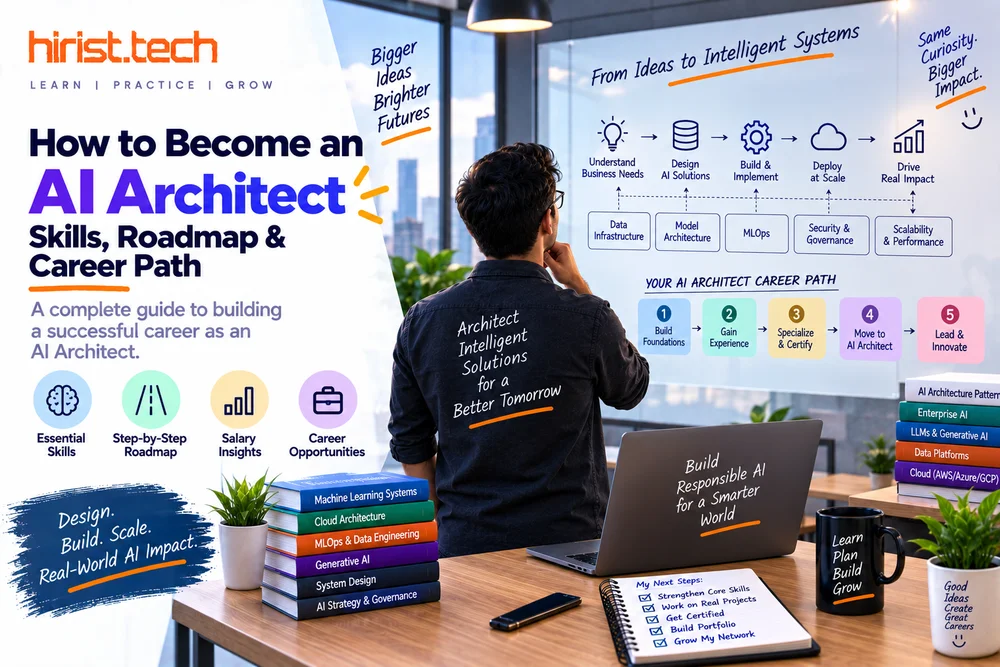
How to become an AI Architect (Quick answer)
AI architect is not an entry-level role. Most people do not become one straight after graduation. The usual path starts with technical education and engineering work experience before taking on architecture work. Here is a simple roadmap to become an AI Architect:
- Get the right technical education
- Start in an engineering role
- Master one cloud platform
- Build strong AI and ML expertise
- Earn a relevant AI or cloud certification
- Own a production AI system end to end
- Take on architecture responsibilities
- Move into an AI Architect role
Becoming an AI Architect usually takes 6 to 10 years. This includes a 4 year technical degree plus around 2 to 5 years of engineering experience and AI training.
AI Architects are becoming one of the fastest-growing roles in the IT sector. According to Randstad Digital research based on more than 35 million global job postings, demand for AI Architects grew 152% between 2021 and 2026.
The reason is simple. Companies are moving from testing AI to using it in real business systems. This creates a bigger challenge. They need someone who can decide how models connect with company data and existing software. They also need the right cloud setup and strong security as these systems grow. That is the job of an AI Architect.
In this blog, we explain how to become an AI Architect in 2026 with an 8-step roadmap you can follow.
What does an AI Architect actually do?
An AI architect designs the complete technical system needed to turn an AI use case into a reliable production solution. They guide the system from planning through deployment and work closely with software engineers and data scientists.
Common duties of an AI Architect include:
· Designing the AI architecture. Decide how models and applications should work together.
· Choosing the right technology. Compare models, cloud services and tools based on the business need.
· Planning data flow. Decide how data will be collected and made available to AI systems.
· Managing deployment. Define how AI models will reach production and how updates will be handled.
· Connecting AI with existing systems. Plan APIs and integrations with company software.
· Managing risk. Work with security teams on privacy, access control and responsible AI.
· Planning for scale. Make sure the system can handle more users without poor performance or uncontrolled costs.
· Guiding technical teams. Work with ML engineers, data scientists and business leaders throughout the project.
An AI architect decides how the entire AI system should be built and operated.
AI Architect vs Other AI roles: Clearing up the confusion
AI Architects work alongside several technical teams on the same project. This can make their responsibilities seem similar to other AI roles. Here is a simple comparison.
| Role | Main focus | Usually owns |
|---|---|---|
| AI Architect | Designs how the full AI system works together | End-to-end AI architecture |
| AI Developer | Builds and tests software that uses AI | AI application code |
| AI Engineer | Builds AI features and connects models with applications | AI features and integrations |
| ML Engineer | Deploys and maintains machine learning models | Model pipelines and serving |
| Data Scientist | Uses data to build and evaluate predictive models | Data analysis and model development |
| Solutions Architect | Designs the wider technology solution for a business need | Overall solution architecture |
The main difference is scope. Other AI professionals usually focus on one part of the system. An AI Architect is responsible for how the complete AI system is designed and works in production.
AI Architect qualifications and requirements
There is no single AI architect qualification that guarantees the role. Employers usually look at two things: your technical education and your engineering experience.
Education
A bachelor’s degree is the usual starting point to become an AI Architect in India. Common degree options include:
· B.Tech or B.E. in Computer Science
· B.Sc in Computer Science
· BCA
· Other related technical degrees
A master’s degree in AI or computer science can help for specialised roles. It is not required for most AI Architect positions.
Experience
This is where the AI architect requirements become more demanding. Current job postings show that employers expect several years of real engineering work.
· HCLTech: 5+ years of cloud and AI architecture experience plus software development experience.
· D2R AI Labs: 8 to 12 years of experience for a Senior AI Solutions Architect role.
There is no fixed requirement across companies. Around 5 to 10 years of technical experience is a realistic range for many AI Architect roles.
Essential AI Architect skills you need
Based on our analysis of current AI Architect job descriptions, these are the essential AI architect skills recruiters value most.
1. Machine learning and deep learning
Build a strong base in machine learning. Understand how models are trained and evaluated. Learn key concepts such as inference and model accuracy. Focus on Python and SQL for programming and data work. You should also know Git and frameworks such as PyTorch, TensorFlow and Scikit-learn.
2. LLM and RAG architecture
Learn how large language models work inside real applications. This includes prompt engineering, embeddings, vector databases and Retrieval-Augmented Generation (RAG). You should also understand when to use RAG and when fine-tuning makes more sense. Knowledge of AI agents is useful too. Learn tool calling, agent workflows and multi-agent systems.
3. Cloud and AI infrastructure
Build deep knowledge of one major cloud platform such as AWS, Microsoft Azure or Google Cloud. Learn how computing and storage work. Understand networking and identity access management. You should also know Docker and Kubernetes for running AI workloads at scale.
4. Data architecture and governance
AI systems depend on reliable data. Learn how data is collected and prepared before it reaches a model. Important areas include data pipelines, ETL/ELT, data lakes and data warehouses. You should also understand data quality and access control. Privacy and governance become especially important when company data is used in AI systems.
5. DevOps and MLOps
Learn how AI systems are deployed and maintained after development. You should understand CI/CD, model deployment, versioning and monitoring. MLOps adds AI-specific needs such as model drift, retraining and model lifecycle management. Logging and observability also help teams track problems once the system is live.
6. Scalable system design and security
AI Architects need to design systems that keep working as usage grows. Learn distributed systems and APIs. Understand real-time processing and event-driven architecture. Security must be built into the system from the start. Learn IAM, role-based access control and API security. You should also understand AI risks such as prompt injection and data leakage.
7. Architecture and systems thinking
AI Architects make decisions that affect the entire system. They balance accuracy with speed and performance with cost. They also compare build-versus-buy options and choose the best approach for the business need. Architecture diagrams and Architecture Decision Records (ADRs) help document these choices and explain the reasoning behind them.
8. Business and workplace skills
Technical knowledge alone does not make someone an architect. You also need strong workplace skills to work with teams and guide technical decisions.
· Communication and collaboration
· Critical thinking
· Leadership
· Decision-making
· Stakeholder management
· Presentation skills
· Change management
AI Architect roadmap: How to become an AI Architect (8 steps)
Here is a practical AI architect roadmap from education to securing the role. Your starting point will decide how quickly you can complete each stage.
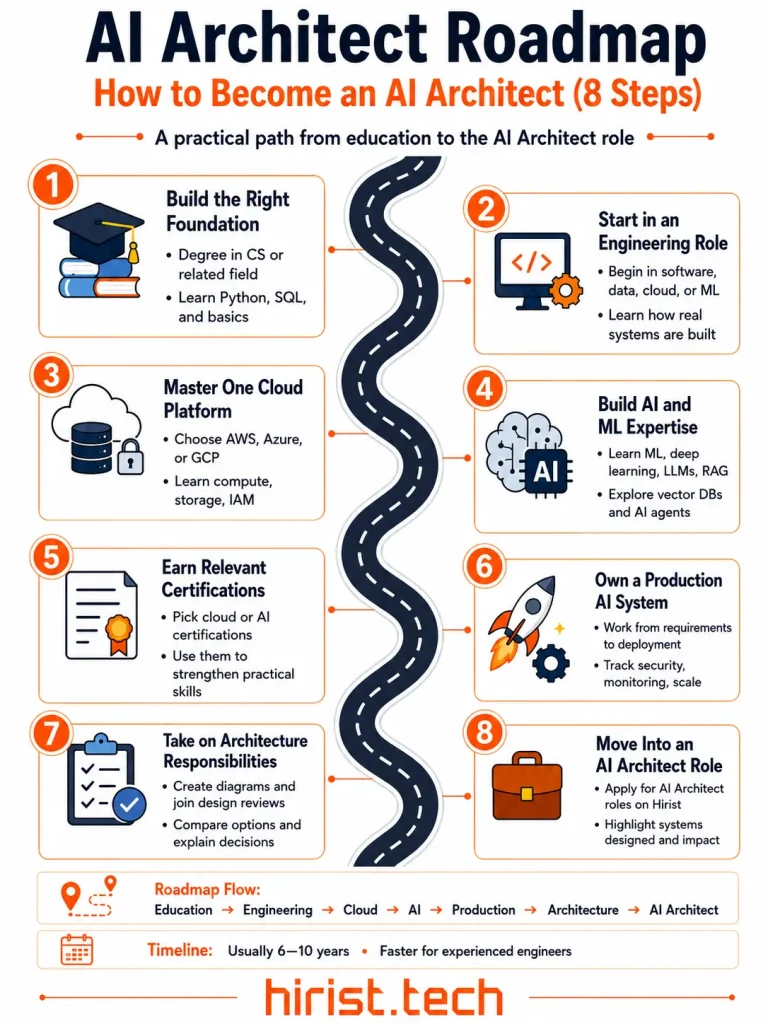
1. Build the right educational foundation (0 to 4 years)
Start with a technical degree such as Computer Science or Software Engineering. Learn Python and SQL. Build a strong understanding of databases and data structures. Statistics is also important. By the end of this stage, you should be able to build a small application and qualify for an entry-level technical role.
2. Start in an engineering role (2 to 5 years)
Software engineering is a common starting point. Cloud engineering and data engineering can also lead to AI architecture. ML engineering is another route. Focus on one field first. Work on systems that real users depend on. Learn how teams handle deployments and failures. Get comfortable reviewing other people’s code and technical designs.
3. Master one cloud platform
Choose AWS or Azure based on the companies you want to work for. Google Cloud is another option. Learn compute and storage first. Then cover networking and IAM. Build and deploy at least one application yourself. Set up monitoring and basic security. You should be able to draw its cloud architecture and explain why you chose each service. Go deep on one platform instead of learning all three at once.
4. Build strong AI and ML expertise
Add AI skills to your engineering foundation. Start with machine learning and deep learning. Then learn LLMs and RAG. Build practical knowledge of vector databases and AI agents. You should also understand MLOps so you know how AI systems work after deployment. Do not build five versions of the same chatbot. Try different problems such as recommendation systems or document search.
5. Earn a relevant AI or cloud certification
Choose a certification that supports your career path. An AWS or Azure certification may suit cloud-focused professionals. An AI architecture or ML certification may fit someone already working with AI systems. Use certifications to improve your skills rather than treating them as a substitute for experience.
6. Own a production AI system end to end
Look for a project where your responsibility goes beyond model development. Get involved from requirements through deployment. Understand where the data comes from. Know how the model is served. Learn how access is controlled and how failures are monitored. You should also know what happens to performance and cost when usage increases.
7. Take on architecture responsibilities
Start doing the work of an architect before applying for the title. Create architecture diagrams. Join design reviews. Write Architecture Decision Records. Compare build-versus-buy options. Present technical choices to senior engineers or business teams. At this stage, you should be able to answer one important question: Why was this system designed this way?
8. Move into an AI architect role
Apply once your experience already shows architecture-level responsibility. Use specialized IT job portals like Hirist to find open positions. Your resume should highlight: systems designed + architecture decisions owned + scale handled + business problems solved. Target roles such as AI Architect or AI Solutions Architect. An internal promotion can also be a practical route when you already handle architecture work.
How long does it take to become an AI Architect?
Becoming an AI Architect usually takes around 6 to 10 years if you start after Class 12. This includes a 4 year technical degree plus 2 to 5 years of engineering experience before taking on architecture-level work.
The timeline is shorter if you already work in tech. A software engineer or ML engineer may need around 1 to 3 years to build the missing cloud and architecture skills.
AI Architect certifications: Which ones are worth getting?
There is no single mandatory AI architect certification. The right choice depends on your experience and the type of AI systems you want to work with.
| Certification | Platform | Best for | Cost |
|---|---|---|---|
| Microsoft Certified: Agentic AI Business Solutions Architect | Microsoft | Experienced AI/Solution Architects | Paid |
| AWS Certified Solutions Architect – Associate | AWS | Professionals building cloud architecture skills | Paid |
| Professional Machine Learning Engineer | Google Cloud | Experienced ML and cloud professionals | Paid |
| AI+ Architect Practitioner | AI CERTs | Beginners learning AI architecture | Paid |
| Certified Kubernetes Administrator (CKA) | CNCF / Linux Foundation | Cloud and infrastructure specialists | Paid |
| OCI AI Foundations Associate | Oracle | Beginners learning AI basics | Free |
| Agentic AI Foundations Associate | Oracle | Beginners exploring agentic AI | Free |
Free learning options
Not every useful learning path leads to a formal AI solution architect certification. These free options can help you build the right foundation before paying for an exam:
· AWS Skill Builder: Free cloud and AI learning paths with selected digital badges.
· Microsoft Learn: Free learning paths for agentic AI and solution architecture.
· Databricks Generative AI Fundamentals: Free course with an accreditation badge covering GenAI basics and RAG.
AI Architect certifications can validate your knowledge, but they do not replace practical architecture experience. Choose one that matches the platform or specialisation you plan to use at work.
AI Architect career path
AI Architect is generally not an entry-level role. Most professionals first build experience in software engineering or another technical field before taking on system-level architecture work.
Common starting roles include Software Engineer, ML Engineer, Data Engineer, Cloud Engineer, DevOps Engineer and Solutions Architect.
Common career paths include:
Software route
Software Engineer → Senior Engineer → AI/Cloud Specialisation → AI Architect
Data route
Data Engineer → Senior Data Engineer → Data/AI Platform Engineer → AI Architect
ML route
ML Engineer → Senior ML Engineer → ML Platform or System Design → AI Architect
Cloud route
Cloud Engineer → Cloud/Solutions Architect → AI Specialisation → AI Solutions Architect
Existing architect route
Solutions Architect → AI/ML Specialisation → AI Solutions Architect
There is no single career path to becoming an AI Architect. As you gain experience, your responsibility grows from owning one part of a system to designing the complete system around business and technical needs.
AI Architect salary in India in 2026
According to AmbitionBox, the average AI Architect salary in India is ₹46.4 lakh per year for experienced professionals. The Monthly in-hand pay is around ₹2.95 lakhs – ₹3.01 lakhs.
Salary rises with experience:
| Experience | Average annual salary |
|---|---|
| 6 to 9 years | ₹32.1 LPA |
| 9 to 12 years | ₹46.4 LPA |
| 12+ years | ₹47.3 LPA |
The top 10% earn more than ₹66.3 lakh per year, while the top 1% earn over ₹1.2 crore.
Top-paying companies include Google at ₹60.3 LPA, Technodysis at ₹55 LPA, and Capgemini at ₹52.6 LPA.
What experienced AI Architects recommend
We went through AI Architect roadmaps and first-hand experiences shared by professionals who work directly with AI architecture. Here are four lessons worth noting.
Greg Coquillo: Learn the layers beyond AI models
Greg Coquillo works on AI Platforms and Infrastructure at Microsoft and previously spent over 6 years at Amazon and AWS. His AI Architect roadmap shows that models are only one layer. Architects also need cloud, data, MLOps, security and governance skills. (Source)
Nuno Roberto: The role changes once systems reach production
Nuno Roberto is a Chief AI & Data Architect with more than 20 years of enterprise technology experience. His first-year experience as an AI Solutions Architect shows that real production systems force architects to rethink designs as business needs and technical limits become clearer. (Source)
Heeki Park: Decide what AI should actually control
Heeki Park is a Principal Solutions Architect at AWS with around 9 years at the company. His advice is practical: keep predictable tasks in normal code and use AI when the problem genuinely requires reasoning or flexibility. (Source)
Toby Fotherby: Learn to work with unclear requirements
Toby Fotherby is a former Senior AI/ML Specialist Solutions Architect at AWS with more than a decade of technology experience. He stresses that architects must make decisions when quality, latency and cost are not yet clear and explain those trade-offs to stakeholders. (Source)
Conclusion
Understanding how to become an AI architect starts with one key shift: from completing individual technical tasks to owning how the entire AI system is designed. Build experience with production systems. Learn to evaluate trade-offs in performance and security. Then take responsibility for architecture decisions that affect cost and business outcomes.
Looking for AI Architect jobs? Hirist can help you find AI Architect and related AI roles that match your skills and experience.
FAQs
An AI Architect designs the complete technical system behind an AI solution. They decide how models will connect with data, software and cloud infrastructure. They also plan deployment, security, monitoring and scalability so the system can work reliably in production.
Start with a technical degree such as B.Tech or B.E. in Computer Science. Then gain 2 to 5 years of engineering experience. Build cloud and AI skills during this time. Most students starting after Class 12 can expect the full path to take around 6 to 10 years.
Yes. AI Architects need enough coding knowledge to understand how systems are built and review technical work. Python and SQL are especially useful. Knowledge of APIs and Git also helps.
No. A master’s degree is not required for most AI Architect roles. A bachelor’s degree plus strong engineering experience and production AI work is usually more important.
An AI Architect usually defines the broader AI architecture across systems or teams. An AI Solutions Architect focuses more on designing a solution for a specific business problem or client. The roles overlap, but the Solutions Architect role is usually more project-focused.
It is possible but harder. Build the same technical foundation through structured courses and certifications. Then gain hands‑on engineering experience and work on real production systems. A strong portfolio becomes especially important when you do not have a technical degree.
Yes. AI Engineering is one of the strongest starting points. The next step is to take responsibility beyond individual AI features. Build experience in cloud architecture and system design. Then start owning production systems and architecture decisions.
Build projects that show system‑level thinking. Good options include a real‑time fraud detection system, an enterprise AI assistant, and a recommendation platform. For each project, include the architecture diagram, data flow, security plan, scaling approach, monitoring setup, estimated cost, and the reasons behind your main technology choices.