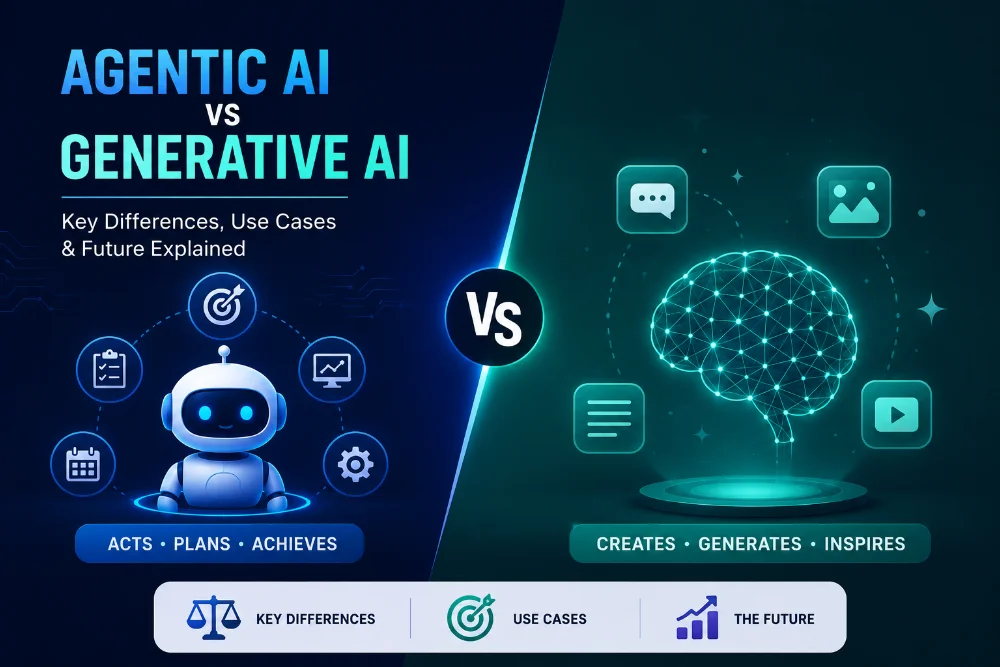
Artificial intelligence is moving beyond content creation and entering a new era of automation. Businesses are no longer using AI only to write emails, generate images, or create code. They are increasingly adopting AI systems that can plan, make decisions, and complete tasks with minimal human involvement. This shift has brought two important concepts into focus: Agentic AI and Generative AI. While the terms are often used interchangeably, they are designed for very different purposes. Generative AI creates content in response to prompts, whereas Agentic AI takes action to achieve specific goals. Understanding these differences is becoming essential as organizations explore AI-powered automation, AI agents, and multi-agent systems.
In this guide, we will break down agentic AI vs generative AI, explain how each technology works and compare their key differences.
Agentic AI vs Generative AI: Key Differences
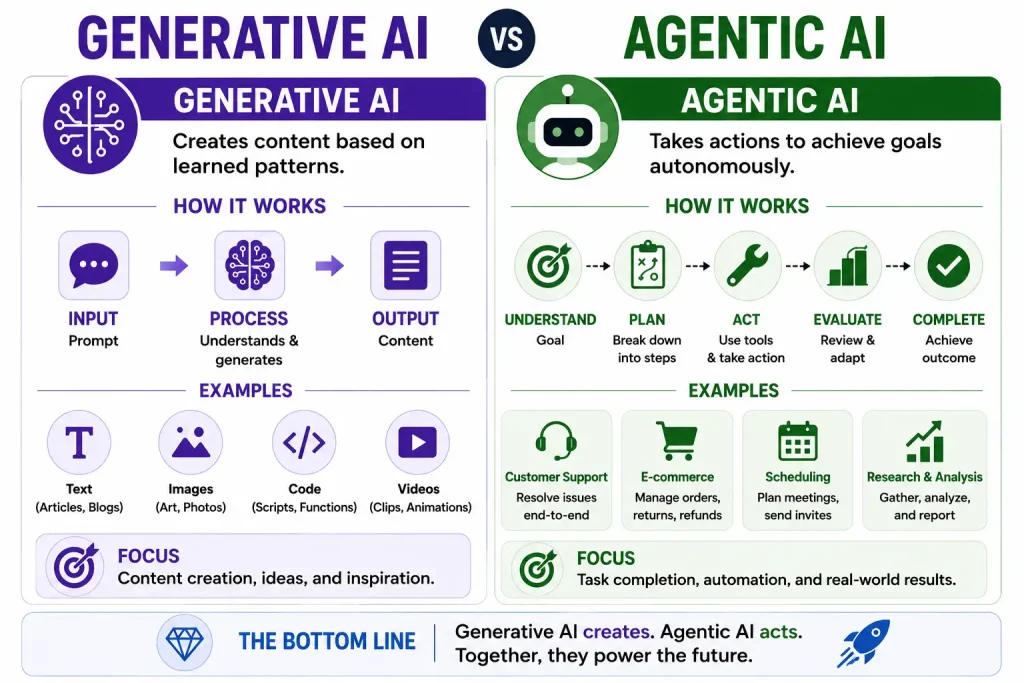
Although both technologies fall under the umbrella of artificial intelligence, they are designed for different purposes. The discussion around agentic AI vs generative AI is not about which one is better but about which one is better suited for a specific task. Generative AI specializes in creating content based on user prompts, while Agentic AI focuses on achieving goals by planning, making decisions, and executing multiple actions. This distinction also explains the growing interest in autonomous AI vs generative AI, as businesses seek AI systems that can automate entire workflows rather than just produce outputs.
| Feature | Generative AI | Agentic AI |
|---|---|---|
| Purpose | Creates content such as text, images, code, and videos | Executes tasks and achieves predefined goals |
| Nature | Reactive; responds to prompts | Proactive; takes initiative to complete objectives |
| Human Involvement | High; requires continuous prompts and guidance | Lower; operates with minimal supervision |
| Memory | Limited conversational context | Persistent memory that retains context and past actions |
| Planning | No independent planning | Breaks goals into multiple actionable steps |
| Tool Usage | Rarely interacts with external tools | Uses APIs, databases, applications, and software tools |
| Decision Making | Does not make autonomous decisions | Evaluates options and makes decisions based on context |
| Workflow | Typically single-step: Prompt → Response | Multi-step: Plan → Act → Evaluate → Execute |
| Examples | ChatGPT, Claude, Gemini, Midjourney | AutoGPT, Devin, enterprise AI agents |
In short, Generative AI acts as a creative assistant that generates information or content, whereas Agentic AI behaves more like a digital employee capable of completing complex workflows. As organizations adopt intelligent automation, the future will likely combine the strengths of both technologies, with Generative AI creating content and Agentic AI orchestrating actions to achieve business goals.
What Is Generative AI?
Generative AI is a type of artificial intelligence that creates new content such as text, images, videos, music, and even computer code based on user instructions. Instead of simply retrieving existing information, it generates original outputs by identifying patterns learned from massive datasets during training.
At its core, Generative AI is powered by Large Language Models (LLMs) and other deep learning models that predict the most likely next word, pixel, or sequence based on context. This follows a simple Prompt → Response model: a user provides an instruction, and the AI produces a relevant answer or piece of content. Popular examples include ChatGPT for text generation, Claude for reasoning and writing, Gemini for multimodal tasks, and Midjourney for AI-generated images.
The biggest strengths of Generative AI are its speed, creativity, and ability to automate content creation, brainstorming, coding, and summarization. It can significantly improve productivity across industries.
However, it also has limitations. It depends on user prompts, lacks true decision-making capabilities, and may sometimes produce inaccurate or fabricated information. While generative AI agents combine generative models with additional tools and workflows, pure Generative AI primarily focuses on creating content rather than autonomously planning or executing complex tasks.
What Is Agentic AI?
Agentic AI is an advanced form of artificial intelligence that is designed to achieve a goal rather than simply generate an answer. Unlike traditional AI systems that wait for user prompts, Agentic AI can plan, reason, make decisions, and execute multiple actions with minimal human intervention. This capability is one of the biggest distinctions in the debate around agentic AI vs generative AI.
A typical Agentic AI system combines several components, including planning, memory, tool usage, decision-making, and execution. It first breaks a complex objective into smaller tasks, remembers previous actions and context, accesses external tools or applications, evaluates different options, and then completes the workflow.
Instead of simply answering a question, Agentic AI focuses on completing a task from start to finish. For example, if you instruct it to “Book my trip,” an AI agent can:
- Search available flights
- Compare prices and schedules
- Book a suitable hotel
- Update your calendar with travel details
- Send a complete itinerary to your email
Rather than stopping after generating suggestions, it coordinates multiple steps to accomplish the objective. This goal-driven approach makes Agentic AI ideal for workflow automation, customer service, research, software development, and enterprise operations where independent execution delivers greater efficiency.
Agentic AI vs AI Agents: Are They the Same?
Many people use the terms agentic AI vs AI agents interchangeably, but they are not the same. Agentic AI is the broader concept or framework that enables autonomous decision-making and goal-oriented execution, while an AI agent is the implementation that performs a specific task within that framework.
A simple analogy is an Operating System vs an App. The operating system provides the environment and rules that allow applications to function, while each app performs a particular job. Similarly, Agentic AI provides the intelligence, planning, and coordination, whereas AI agents are specialized workers that execute individual tasks.
Another way to think about it is a company and its employees. The company represents the overall strategy and objectives, while employees handle research, planning, marketing, or execution. One employee alone does not represent the entire company. Likewise, one AI agent does not equal an Agentic AI ecosystem.
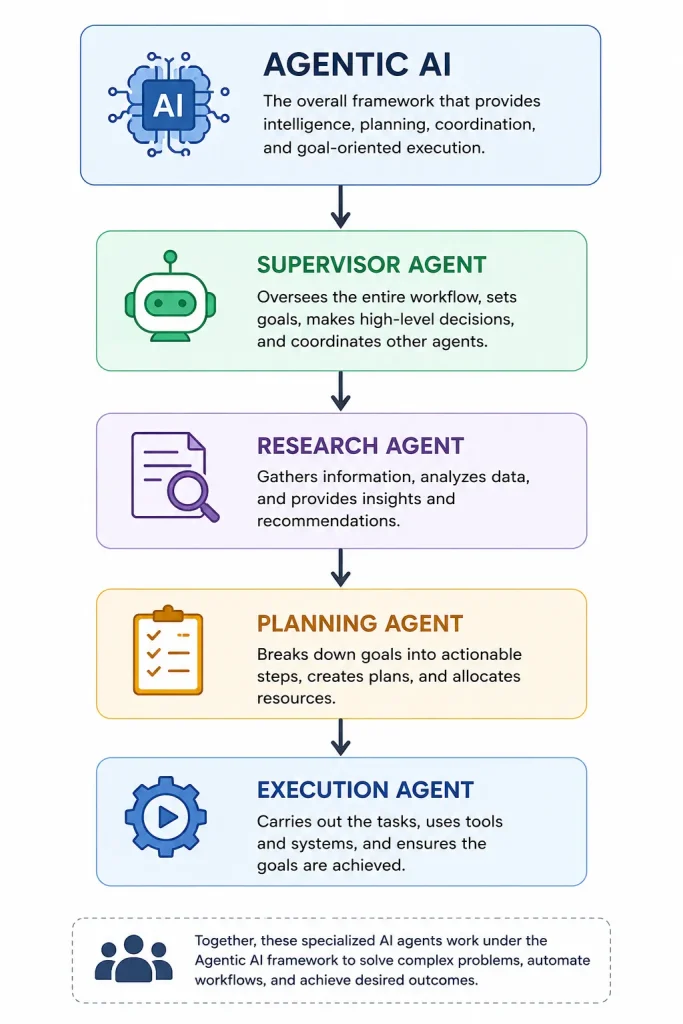
In real-world applications, multiple AI agents collaborate under an Agentic AI framework to solve complex problems, automate workflows, and achieve goals that a single standalone agent cannot accomplish efficiently.
What Are LLM Agents?
Many people assume that a Large Language Model (LLM) and an AI agent are the same, but they are fundamentally different. An LLM is designed to understand and generate human-like text based on a prompt, whereas an AI agent uses an LLM as its “brain” and combines it with additional capabilities to complete tasks independently. In other words, LLM ≠ Agent.
An LLM agent can be understood as:
LLM + Memory + Planning + Tools + Reasoning + Actions
- LLM: Understands instructions and generates responses.
- Memory: Remembers previous conversations and context.
- Planning: Breaks a complex goal into smaller steps.
- Tools: Connects with APIs, databases, browsers, or software applications.
- Reasoning: Evaluates options and decides the best course of action.
- Actions: Executes tasks instead of simply providing suggestions.
This combination transforms a language model into an intelligent assistant that can work with minimal human intervention.
Today, LLM agents are being used across industries. A coding assistant can write, debug, and test code, a research assistant can gather information from multiple sources and summarize findings, and a travel assistant can compare flights, recommend hotels, build itineraries, and even make bookings. As AI technology evolves, LLM agents are becoming the foundation for more autonomous and productive digital workflows.
What Are Conversational AI Agents?
Traditional chatbots are designed to follow a simple Question → Answer model. They respond to a user’s query but usually cannot perform actions beyond providing information. Conversational AI agents, however, are far more intelligent. They combine natural language understanding with reasoning, memory, and task execution to solve problems rather than just answer questions. Their workflow typically looks like this:
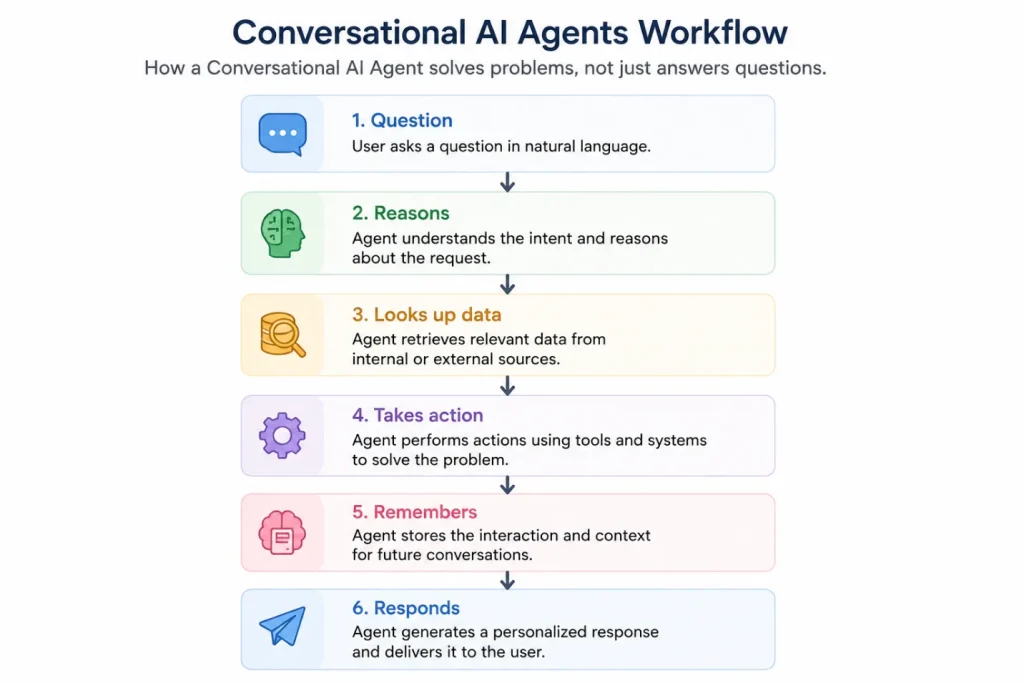
For example, if a customer asks about a delayed order, a conversational AI agent can check the order status, access shipping information, initiate a replacement or refund if needed, remember the interaction, and then provide a personalized response.
Today, conversational AI agents are transforming multiple industries. In customer support, they resolve issues without human intervention. In banking, they assist with account inquiries and transactions. In HR, they answer employee questions, schedule interviews, and manage onboarding tasks. In healthcare, they help book appointments, retrieve patient information, and guide users through routine administrative processes, delivering faster and more personalized experiences.
Understanding Multi-Agent AI Systems
A single AI model can perform many tasks, but it has limitations when handling complex workflows that require different skills. This is where multi agent AI comes into play. Instead of relying on one AI system, multiple specialized agents work together, with each agent responsible for a specific task while coordinating toward a common goal.
For example, consider an AI-powered marketing campaign:
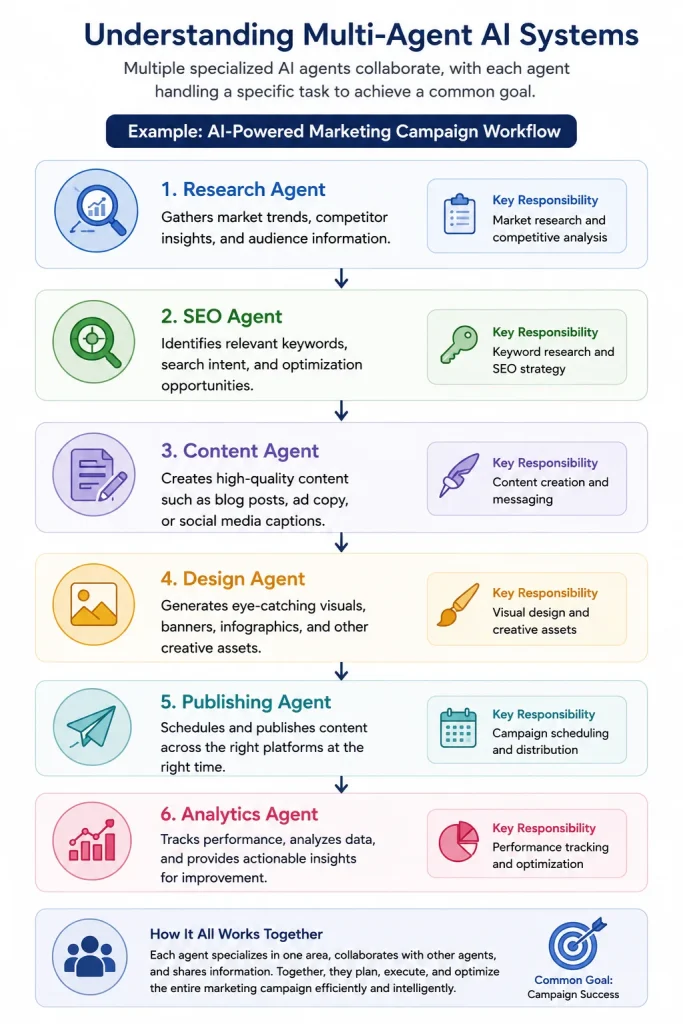
- Research Agent – Gathers market trends and competitor insights.
- SEO Agent – Identifies relevant keywords and optimization opportunities.
- Content Agent – Creates articles or ad copy.
- Design Agent – Generates visuals.
- Publishing Agent – Schedules and distributes the campaign across platforms.
- Analytics Agent – Tracks performance and recommends improvements.
This collaborative approach makes multi agent AI systems far more efficient than a single AI model. Their key benefits include:
- Scalability: Multiple agents can handle larger and more complex projects.
- Specialization: Each agent focuses on a dedicated task, improving quality.
- Parallel Execution: Several tasks can run simultaneously, reducing completion time.
- Better Accuracy: Specialized agents validate and complement each other’s work, leading to more reliable outcomes.
As businesses adopt autonomous workflows, multi-agent AI systems are expected to become the foundation for enterprise automation, software development, customer service, and marketing operations.
Use Cases of Agentic AI vs Generative AI
Although both technologies improve productivity, they solve different business problems. Generative AI focuses on creating content, while Agentic AI is designed to execute tasks and automate entire workflows. The table below highlights their most common real-world applications.
| Generative AI | Agentic AI |
|---|---|
| Creates blogs and articles from prompts | Automates sales prospecting and follow-ups |
| Drafts personalized emails and marketing copy | Handles procurement by comparing vendors and placing orders |
| Generates images, graphics, and creative designs | Schedules meetings, appointments, and reminders |
| Assists developers by writing and debugging code | Resolves customer support requests by accessing multiple systems |
| Summarizes lengthy documents, reports, and meetings | Manages software development workflows such as testing and deployment |
| Produces social media posts, product descriptions, and scripts | Automates end-to-end business workflows with minimal human intervention |
The key difference is that Generative AI produces an output and waits for the next instruction, whereas Agentic AI continues working until a goal is achieved. For example, Generative AI can draft a sales email, but an Agentic AI system can identify a lead, collect customer information, generate the email, send it, and update the CRM automatically.
This is also where generative AI agents are gaining attention. They combine the creative capabilities of Generative AI with additional planning and tool integrations, making them more capable than standalone content-generation models. However, fully agentic systems go even further by independently coordinating and executing complex, multi-step workflows.
Can Agentic AI and Generative AI Work Together?
The debate around agentic AI vs generative AI often suggests that businesses must choose one over the other. In reality, the greatest value comes when they work together. Generative AI excels at creating content, while Agentic AI manages the overall process by planning, making decisions, and executing tasks.
Consider a customer complaint about a delayed order. An Agentic AI system can handle the entire workflow:
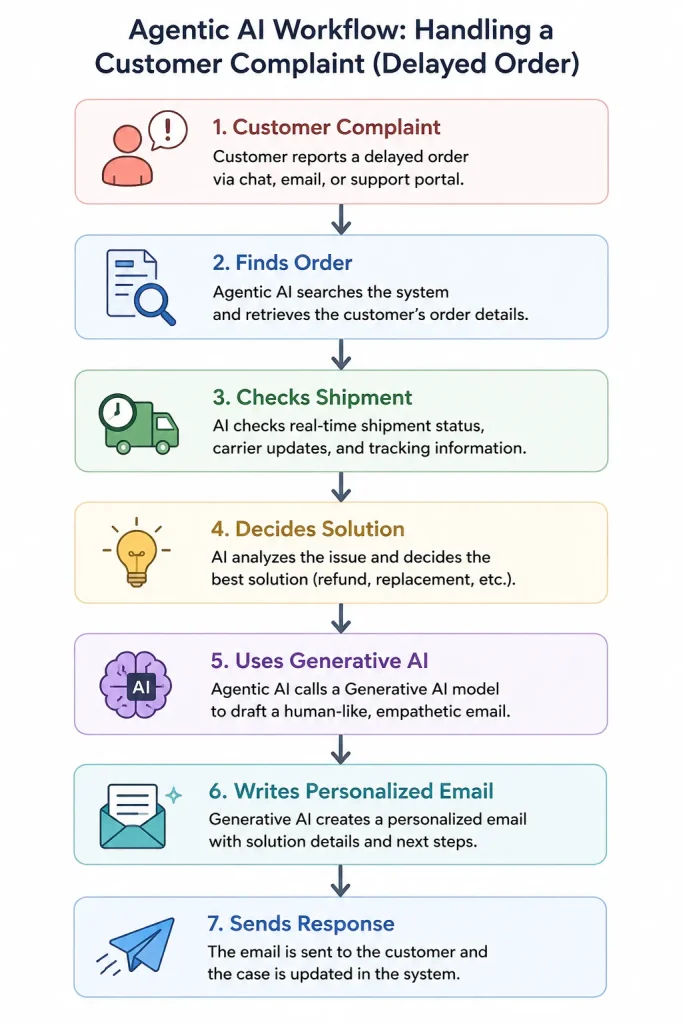
Consider a customer complaint about a delayed order. An Agentic AI system can handle the entire workflow: it first retrieves the customer’s order details, checks the shipment status, and determines the appropriate resolution. It then calls a Generative AI model to draft a personalized and empathetic email. Finally, it sends the response and updates the CRM or support ticket automatically.
Together, these technologies form a powerful combination — AI automation frameworks increasingly rely on both Generative AI for content creation and Agentic AI for orchestrating end-to-end workflows.
Wrapping Up
Generative AI and Agentic AI are transforming the future of work in different yet complementary ways. While Generative AI creates content, Agentic AI plans, decides, and executes tasks autonomously. Together, they enable smarter automation, higher productivity, and better business outcomes. As AI adoption accelerates, organizations that leverage both technologies will gain a significant competitive advantage.
To explore these technologies further, read our guides on agentic AI explained, types of AI agents, and AI marketing automation. Looking to build a career in AI and technology? Visit Hirist, an online job portal where you can find the top IT jobs in India and connect with leading tech companies.
FAQs
Yes, small businesses can also benefit from Agentic AI. It can automate repetitive tasks such as lead management, appointment scheduling, customer support, and email follow-ups, allowing teams to focus on strategic work without hiring additional staff.
Not necessarily. Some Agentic AI systems can operate using internal databases and predefined workflows. However, connecting to external tools, APIs, and applications significantly expands their capabilities and enables real-time decision-making.
Many Agentic AI systems use memory and feedback mechanisms to retain context and improve future decisions. This allows them to personalize responses and optimize workflows over time, although the level of learning depends on the system’s design.
Industries such as finance, healthcare, e-commerce, software development, manufacturing, and customer service are rapidly adopting Agentic AI to automate complex processes, improve efficiency, and reduce operational costs.
gentic AI is more likely to automate repetitive and time-consuming tasks rather than replace humans entirely. It enables employees to focus on creativity, strategy, problem-solving, and decision-making while AI handles routine operational work.