Businesses are under constant pressure to improve efficiency, reduce costs, and deliver better customer experiences. This is where AI automation is making a significant impact. By combining automation and AI technologies such as machine learning, natural language processing, and robotic process automation (RPA), organizations can automate repetitive tasks while enabling systems to analyze data, make decisions, and continuously improve outcomes.
Unlike traditional automation, which follows fixed rules, AI automation can adapt to changing situations, process unstructured information, and handle more complex workflows. From customer support and marketing to finance and manufacturing, companies are increasingly using AI in automation to streamline operations and boost productivity. In this guide, we will learn how AI automation works, how it differs from RPA and intelligent automation, its key benefits, and the top use cases shaping businesses in 2026.
What Is AI Automation?
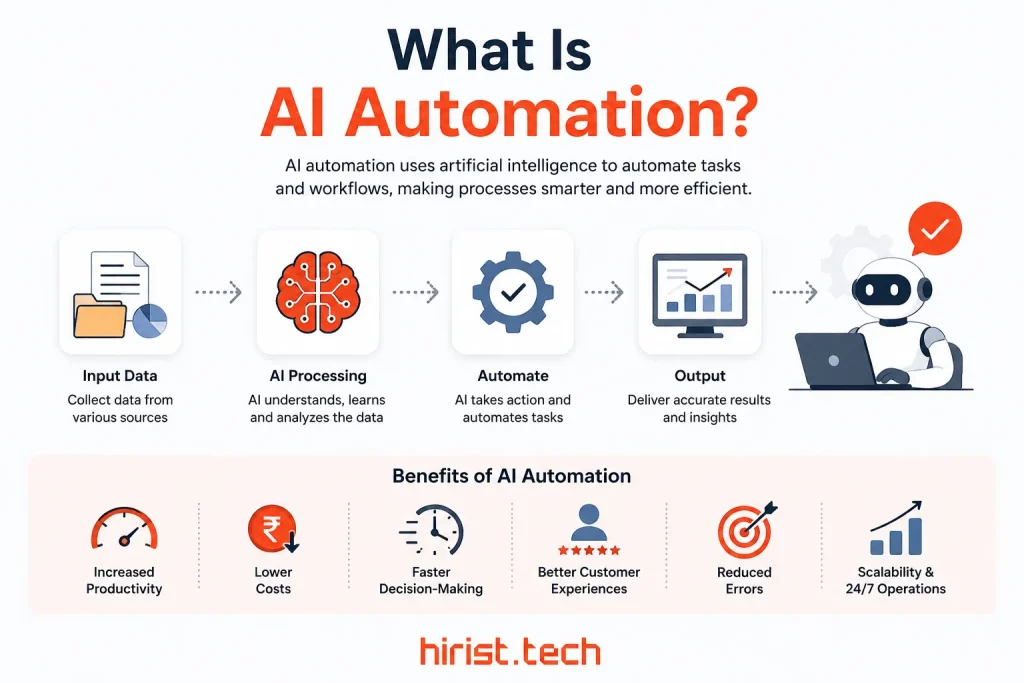
AI automation is the use of artificial intelligence to automate tasks, workflows, and business processes with minimal human intervention. Unlike traditional automation, which follows fixed rules, AI automation can analyze data, learn from patterns, and make decisions in real time.
It combines artificial intelligence, machine learning, natural language processing (NLP), and automation tools such as RPA to handle both routine and complex tasks. This allows businesses to automate customer support, document processing, data analysis, and decision-making processes more effectively.
The key difference between traditional automation and automation with AI is adaptability. Rule-based workflows can only perform predefined actions, while artificial intelligence driven automation can understand context, process unstructured data, and improve over time. As a result, AI automation helps organizations increase efficiency, reduce manual effort, and scale operations faster.
Evolution of Automation – From RPA to AI Automation
Automation has evolved significantly over the past decade. What started as simple rule-based workflows has progressed into intelligent systems capable of learning, reasoning, and making decisions.
Traditional Automation
Traditional automation relies on fixed rules, scripts, and predefined workflows. It can automate repetitive tasks but cannot adapt when conditions change.
Robotic Process Automation (RPA)
RPA introduced software bots that mimic human actions across digital systems. It became widely used for tasks such as data entry, form filling, invoice processing, and report generation. However, RPA works best with structured data and rule-based processes.
RPA + AI
The combination of RPA and AI expanded automation capabilities beyond repetitive tasks. By integrating machine learning and NLP, RPA AI solutions can understand documents, extract information, make decisions, and learn from historical data. This shift marked the rise of robotic process automation artificial intelligence in modern businesses.
AI Agents
Today, businesses are moving toward AI agents that can reason, plan, and execute tasks autonomously. Unlike traditional bots, RPA and AI together enable systems to analyze situations, interact with multiple applications, and complete entire workflows with minimal human involvement. This evolution from artificial intelligence robotic process automation to autonomous AI agents is shaping the future of business automation.
How AI Automation Works
AI automation follows a structured process that combines data, intelligence, and execution to automate business tasks efficiently.
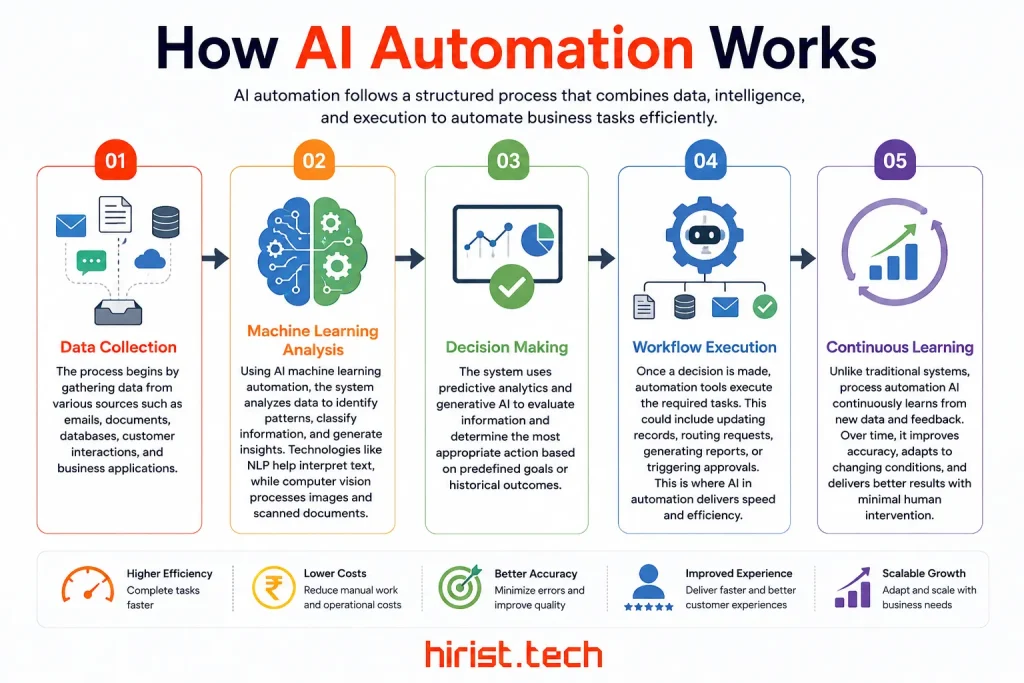
- Data Collection: The process begins by gathering data from various sources such as emails, documents, databases, customer interactions, and business applications.
- Machine Learning Analysis: Using AI machine learning automation, the system analyzes data to identify patterns, classify information, and generate insights. Technologies like NLP help interpret text, while computer vision processes images and scanned documents.
- Decision Making: The system uses predictive analytics and generative AI to evaluate information and determine the most appropriate action based on predefined goals or historical outcomes.
- Workflow Execution: Once a decision is made, automation tools execute the required tasks. This could include updating records, routing requests, generating reports, or triggering approvals. This is where AI in automation delivers speed and efficiency.
- Continuous Learning: Unlike traditional systems, process automation AI continuously learns from new data and feedback. Over time, it improves accuracy, adapts to changing conditions, and delivers better results with minimal human intervention.
AI Automation vs RPA vs Intelligent Automation
Although these terms are often used interchangeably, they represent different stages of automation maturity. Understanding the differences between RPA, intelligent automation RPA, and AI automation helps businesses choose the right approach for their needs.
| Feature | RPA | Intelligent Automation | AI Automation |
|---|---|---|---|
| Rules Based | Yes | Partial | No |
| Learning Capability | No | Yes | Yes |
| Unstructured Data | No | Yes | Yes |
| Decision Making | No | Limited | Advanced |
| Adaptability | Low | Moderate | High |
| Human Intervention | Frequent | Occasional | Minimal |
RPA is ideal for repetitive, rule-based tasks such as data entry and invoice processing. Intelligent automation RPA extends these capabilities by combining automation with AI technologies like machine learning and NLP to handle more dynamic workflows.
The main difference between intelligent automation and artificial intelligence is that intelligent automation enhances existing workflows, while AI automation can independently analyze information, make decisions, and optimize processes over time.
Core Technologies Behind AI Automation
AI automation is powered by several advanced technologies that enable systems to understand information, make decisions, and execute tasks with minimal human involvement.
Machine Learning
Machine learning helps systems identify patterns in data, make predictions, and improve performance over time. It is the foundation of modern AI for process automation.
Natural Language Processing (NLP)
NLP allows machines to understand, interpret, and generate human language. It powers chatbots, virtual assistants, document analysis, and automated customer support.
Computer Vision
Computer vision enables systems to analyze images, videos, and scanned documents. It is widely used for quality inspections, document processing, and facial or object recognition.
Generative AI
Generative AI creates content such as text, emails, reports, code, and summaries. It helps automate knowledge-intensive tasks and enhances productivity across departments.
AI Agents
AI agents can reason, plan, and take action across multiple systems. They represent the next stage of AI led automation, enabling businesses to automate entire workflows rather than individual tasks.
Predictive Analytics
Predictive analytics uses historical and real-time data to forecast outcomes, identify risks, and support smarter business decisions. Combined with machine learning, it plays a key role in AI cognitive automation by helping systems make intelligent recommendations and decisions.
10 AI Automation Use Cases
Organizations across industries are using AI automation to improve efficiency, reduce manual work, and make faster decisions. Here are some of the most common applications.
1. Customer Service
AI-powered chatbots and virtual agents can answer customer questions, resolve common issues, and provide 24/7 support without human intervention.
2. Sales Automation
AI helps sales teams prioritize leads through predictive lead scoring, allowing representatives to focus on prospects most likely to convert.
3. Marketing Automation
Businesses use AI to optimize campaigns, personalize content, and improve targeting based on customer behavior and engagement data.
4. HR Automation
AI streamlines recruitment by screening resumes, matching candidates to job requirements, and reducing time spent on manual evaluations.
5. Finance Automation
Invoice processing, expense management, fraud detection, and financial reporting can be automated to improve accuracy and efficiency.
6. Healthcare
Healthcare providers use AI to process medical records, assist with diagnosis, and automate administrative workflows.
7. Manufacturing
AI-powered quality control systems inspect products, identify defects, and improve production efficiency with greater accuracy than manual inspections.
8. Supply Chain Management
Demand forecasting and inventory optimization help businesses predict market needs and reduce supply chain disruptions.
9. IT Operations
AI automates incident detection, root cause analysis, and system monitoring, enabling faster issue resolution and improved uptime.
10. Ecommerce
Online retailers use AI to deliver personalized product recommendations, improve customer experiences, and increase sales.
These examples highlight how business process automation AI is transforming operations across departments. The growing adoption of AI in process automation is helping businesses improve productivity, accuracy, and scalability at every level.
Machine Learning Automation Examples Across Industries
Machine learning is helping businesses automate decisions, improve accuracy, and uncover insights from large datasets. Here are some practical machine learning automation examples used across industries today.
Fraud Detection
Banks and financial institutions use machine learning models to analyze transaction patterns and identify suspicious activities in real time, helping prevent fraud before it occurs.
Predictive Maintenance
Manufacturers use machine learning to monitor equipment performance and predict potential failures, reducing downtime and maintenance costs.
Demand Forecasting
Retailers and supply chain teams leverage machine learning to forecast customer demand, optimize inventory levels, and improve planning accuracy.
Customer Churn Prediction
Businesses analyze customer behavior and engagement data to identify customers at risk of leaving, allowing teams to take proactive retention measures.
Automated Document Processing
Organizations use RPA and machine learning to extract, classify, and process information from invoices, contracts, forms, and other business documents with minimal manual effort.
These applications demonstrate how AI ML RPA solutions combine intelligent decision-making with automation to streamline operations, reduce costs, and improve business outcomes.
Benefits of AI Automation for Businesses
Businesses across industries are adopting AI automation to improve efficiency, reduce costs, and stay competitive. By combining intelligence with automation, organizations can streamline operations and achieve better outcomes at scale.
Increased Productivity
AI automates repetitive and time-consuming tasks, allowing employees to focus on strategic work, innovation, and customer engagement.
Lower Operational Costs
By reducing manual effort and optimizing workflows, AI automation helps businesses lower labor costs, minimize rework, and improve resource utilization.
Faster Decision-Making
AI analyzes large volumes of data in real time, providing insights and recommendations that support quicker and more informed decisions.
Better Customer Experiences
Businesses can deliver personalized interactions, faster support, and more relevant recommendations through the combined power of automation and AI.
Reduced Errors
Automated processes improve consistency and accuracy, reducing the risk of human mistakes in data entry, reporting, and operational tasks.
Scalability
As workloads increase, AI automation can handle larger volumes of tasks without requiring significant increases in staff or infrastructure.
24/7 Operations
Unlike human teams, AI systems can operate around the clock, ensuring continuous support, monitoring, and workflow execution without interruptions.
Challenges of Implementing AI Automation
While AI automation offers significant benefits, organizations often face several challenges during implementation and adoption.
- Data Quality Issues: AI systems rely on accurate and relevant data. Poor-quality, incomplete, or outdated data can lead to inaccurate predictions and unreliable outcomes.
- Legacy Systems: Many businesses still use older software and infrastructure that may not integrate easily with modern AI solutions, making implementation more complex.
- Security Concerns: As AI systems process large amounts of business and customer data, organizations must ensure strong security measures, data privacy controls, and regulatory compliance.
- Employee Resistance: Employees may be concerned about job displacement or changes to existing workflows. Successful adoption requires training, transparency, and effective change management.
- AI Bias: If training data contains biases, AI models can produce unfair or inaccurate results. Businesses must continuously monitor and refine systems to reduce bias and improve fairness.
- Cost of Implementation: Deploying AI in automation often requires investments in technology, infrastructure, integration, and employee training. While the long-term ROI can be substantial, the initial costs may be a barrier for some organizations.
Despite these challenges, businesses that plan carefully and adopt the right strategy can successfully implement AI automation and unlock significant operational improvements.
Future of AI Automation in 2026 and Beyond
The future of automation is moving beyond task execution toward intelligent systems that can reason, adapt, and act independently. As technology advances, businesses are increasingly adopting artificial intelligence driven automation to handle complex workflows that once required constant human involvement.
Agentic AI
Agentic AI systems can analyze goals, make decisions, and take actions autonomously, making automation more dynamic and outcome-focused.
Autonomous Workflows
Future automation platforms will manage entire business processes from start to finish, reducing the need for manual oversight and intervention.
Hyperautomation
Organizations are combining AI, RPA, analytics, and workflow tools to automate as many business processes as possible, creating highly efficient digital operations.
Digital Workers
AI-powered digital workers can perform repetitive, administrative, and knowledge-based tasks around the clock, helping businesses scale without increasing headcount.
Human-in-the-Loop Systems
While AI becomes more capable, human oversight will remain essential for handling exceptions, ensuring compliance, and making strategic decisions.
Enterprise AI Agents
The next generation of AI led automation will be powered by enterprise AI agents that can collaborate across departments, interact with multiple systems, and continuously optimize business outcomes.
Getting Started with AI Automation
Implementing artificial intelligence automation doesn’t have to be complicated. A phased approach helps businesses minimize risk while maximizing results.
- Identify Repetitive Tasks: Start by identifying manual, time-consuming processes such as data entry, invoice processing, report generation, or customer support tasks that can benefit from automation.
- Start with RPA: Use robotic process automation (RPA) to automate rule-based workflows. This creates a strong foundation before introducing more advanced AI capabilities.
- Add AI Capabilities: Enhance workflows with machine learning, NLP, and predictive analytics. Integrating AI for automation enables systems to process unstructured data, make decisions, and improve performance over time.
- Measure ROI: Track key metrics such as productivity, cost savings, processing speed, and error reduction to evaluate the success of your automation initiatives.
- Scale Gradually: Once initial projects deliver results, expand AI automation across departments and business functions. A gradual rollout ensures smoother adoption and long-term success.
Wrapping Up
AI automation is transforming how businesses operate by combining intelligence with efficiency. From streamlining repetitive tasks to enabling data-driven decisions and autonomous workflows, it helps organizations improve productivity, reduce costs, and scale faster. To go deeper into how intelligent agents power these systems, read our guides on agentic AI explained and types of AI agents. As demand for AI, automation, and technology professionals grows, companies need skilled talent to drive these initiatives. Whether you are an employer hiring for automation roles or a professional exploring opportunities in this space, Hirist helps connect top tech talent with some of the best IT jobs in India.
FAQs
I automation is the use of artificial intelligence technologies such as machine learning, natural language processing (NLP), and predictive analytics to automate tasks, workflows, and business processes.
RPA (Robotic Process Automation) automates repetitive, rule-based tasks by following predefined instructions. AI automation goes a step further by enabling systems to understand data, learn from patterns, process unstructured information, and make intelligent decisions. In short, RPA follows rules, while artificial intelligence automation can learn and adapt.
Intelligent automation combines RPA with AI technologies such as machine learning, NLP, and computer vision. It allows businesses to automate more complex processes that involve decision-making, document understanding, and data analysis, rather than just repetitive tasks.
Not entirely. AI and RPA work best together. RPA remains highly effective for structured, rule-based processes, while AI handles tasks that require learning, reasoning, and decision-making. Most organizations use a combination of both technologies to achieve end-to-end automation.
I automation is widely used across industries including healthcare, finance, manufacturing, retail, logistics, customer service, human resources, and IT. Any industry with repetitive workflows, large volumes of data, or customer interactions can benefit from AI-powered automation.
Businesses should begin by identifying repetitive and time-consuming tasks, implementing RPA for simple workflows, and then adding AI capabilities such as machine learning and NLP. Starting with small automation projects and gradually scaling them helps ensure successful adoption and measurable ROI.