Including the right list of quantifiable achievements in your resume can make your profile very appealing to recruiters. Achievements show the results of your work, such as the improvements you have made or the goals you have reached. This is what recruiters actually look for when scanning resumes. They help hiring managers quickly understand your contribution in previous roles or academic projects. Achievements in resume also give context to your skills and experience. Many candidates struggle to write them because they are unsure what counts as an achievement or how to quantify the results.
This guide explains how to write achievements in your resume clearly and includes practical resume achievements examples for different roles and experience levels.
What are achievements in resume?
Achievements in a resume refer to specific outcomes you achieved through your efforts or skills in a role or academic setting. They focus on results rather than responsibilities and show how your actions led to growth or success. List of achievements for resume often include,
- Targets or goals achieved
- Processes or workflows improved
- Projects or assignments completed successfully
- Time or cost saved
- Skills applied to solve a problem
Clear achievements help employers assess how you apply your abilities in practical situations and the value you can add in a similar role.
Note: The terms achievement and accomplishment in resume mean the same thing. There is also no difference between achievements in CV and resume. You may see them listed as accomplishment in CV as well. Regardless of the term used, the purpose remains the same: to highlight results and outcomes rather than routine tasks.
What’s the difference between awards, achievements, and accomplishments in a resume?
On a resume, section headings such as Achievements, Awards, and Accomplishments are often used interchangeably to list similar information. So, let’s understand achievements vs awards vs accomplishments and how each one fits.
- Achievements refer to the results you produced through your work or studies, such as targets reached or measurable progress.
- Accomplishments mean the same thing as achievements. The terms are commonly used interchangeably, which is why you may see achievement and accomplishment in resume without any difference in meaning.
- Awards are formal recognitions given by an institution or third party for performance or excellence.
If you want to list both professional achievements and formal awards together under one section, use the heading “Awards and Accomplishments” on your resume.
Example of a resume with achievements
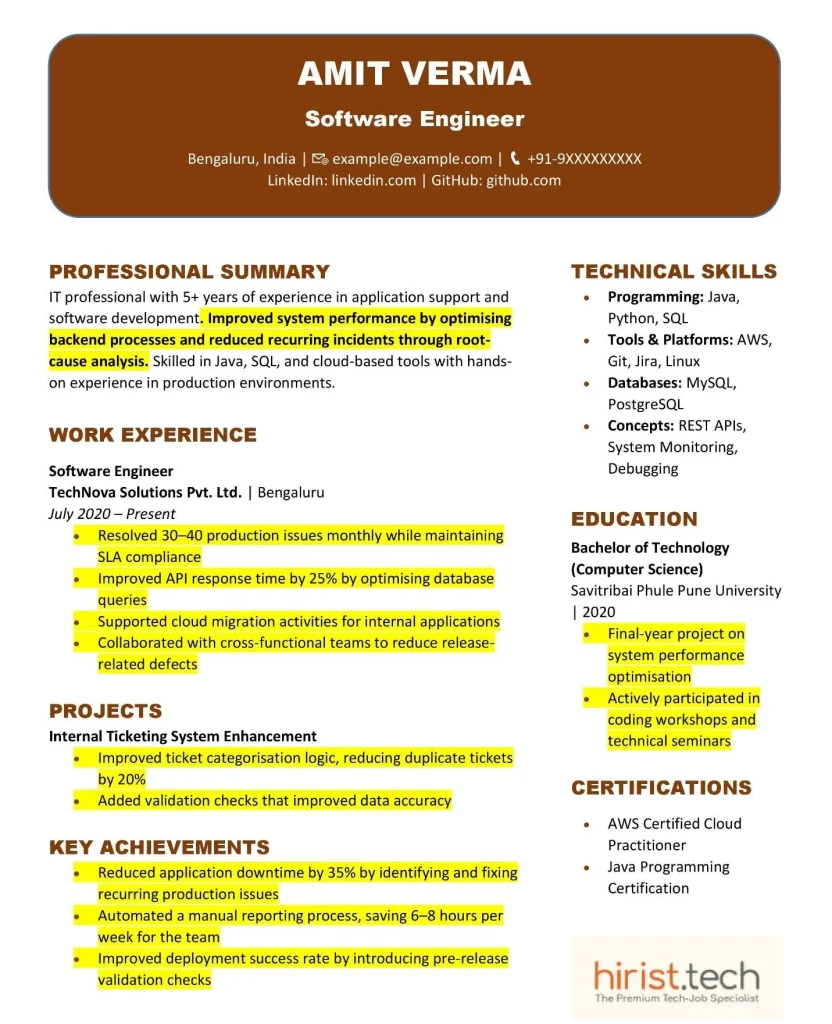
It is best to look at a full accomplishments in resume sample to understand how achievements are written. In the example below, resume achievements examples appear in the summary, work experience, education, and a separate achievements section to show different placement options. We have highlighted the achievements in yellow.
Why list achievements on your resume?
Listing achievements on your resume helps employers understand your actual strengths and how you perform in workplace situations.
- Shows real work outcomes: Measurable results explain what changed or improved because of your work and help recruiters judge performance.
- Highlights professional impact: Clear professional achievements examples show how your efforts led to specific improvements or results.
- Makes skills easier to assess: Achievements give context to your skills by showing how they were applied at work or during projects.
- Supports quick resume screening: Recruiters often scan resumes quickly, and clear outcomes make it easier to evaluate relevance.
- Strengthens work experience sections: A strong example of accomplishments at work adds clarity to job roles and avoids generic descriptions.
Is it necessary to put achievements on a resume?
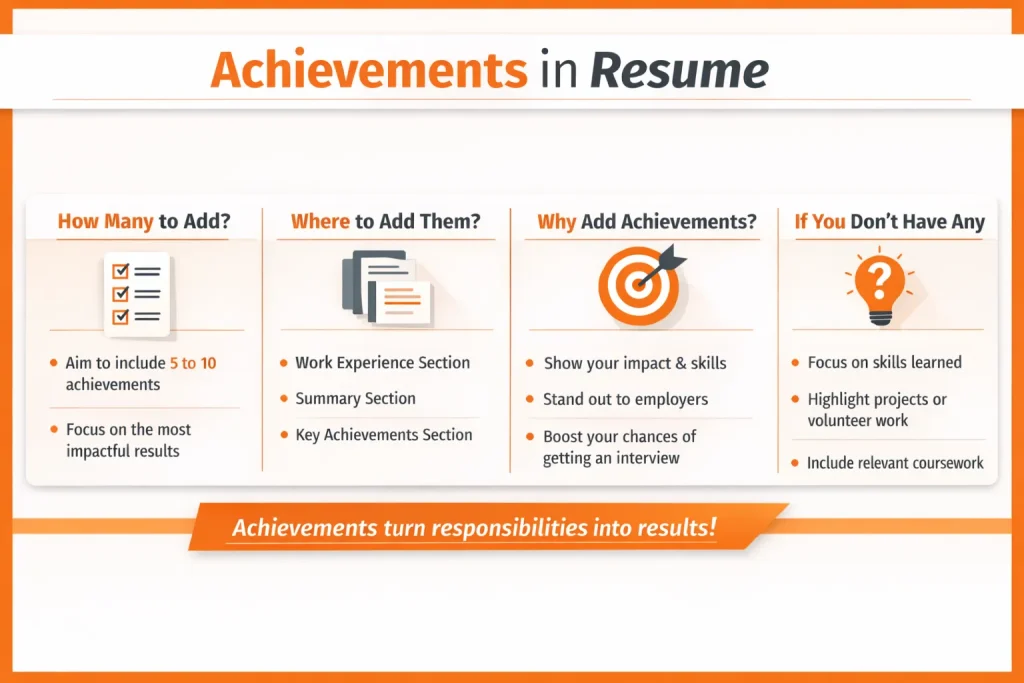
Adding achievements in resume gives you an advantage over other candidates, but a separate achievements section is not required for every resume. Its usefulness depends on your experience level and whether you have strong results to highlight.
When to add achievements in resume
- You have measurable results or clear outcomes to show
- Your role involved targets, improvements, or project-based work
- Professional achievements examples support your skills and experience
- You want to strengthen a resume with limited work history
- Your achievements help differentiate your profile from similar job roles
When not to add achievements in resume
- The points only repeat job duties without showing results or impact
- Outcomes are unclear or cannot be explained meaningfully
- Space is limited and achievements fit better under job descriptions
- The role is very recent and you have not yet produced measurable outcomes
- The achievements are outdated or not relevant to the current role
If you do not have enough space for a separate section, include a key achievement in resume under the relevant work experience or education entry.
Types of Achievements to Add in a Resume
Adding achievements becomes easier when you understand the main types to include in a resume. The best achievements are relevant to the job you are applying for. Below are the most common types of accomplishments used in resumes.
- Quantitative achievements
Quantitative achievements use numbers to show impact clearly. This is the most effective type of achievement because numbers make results easy to understand and compare.
Quantifiable achievements examples:
- Increased productivity by 25%
- Reduced processing time by 30%
- Managed a budget of ₹5 lakh
- Closed 40+ client requests monthly
- Improved accuracy by 15%
- Reduced costs by ₹1 lakh annually
- Qualitative achievements
Qualitative achievements focus on quality, improvement, or contribution when numbers are not available. These work well when outcomes are visible but not easily measurable.
Examples:
- Improved team communication
- Strengthened client relationships
- Improved documentation clarity
- Resolved recurring issues effectively
- Earned positive feedback from stakeholders
- Contributed to a positive work environment
- Professional achievements
These come from jobs, internships, or freelance work. Strong professional achievements examples explain how your work led to improvements or results.
Examples:
- Increased monthly sales by 20%
- Reduced customer complaints by improving response handling
- Helped retain long-term clients
- Reduced manual work using simple tools
- Managed workload during peak periods
- Maintained consistent performance under deadlines
- Academic achievements
Academic achievements come from school or college and work well for students and freshers. Academic achievements on resume include rankings, project outcomes, research work, or leadership roles.
Examples:
- Graduated with distinction
- Ranked among top students in class
- Completed a final-year project successfully
- Improved grades over semesters
- Led a group academic project
- Presented research in college events
- Personal achievements
Personal achievements reflect discipline, consistency, or initiative outside formal work. These are useful when work experience is limited, especially for freshers or interns.
Here are 10 personal achievements examples:
- Learned a new skill independently and applied it in 2 to 3 projects
- Completed 2 online certifications related to the field
- Set personal goals and followed them consistently for 6+ months
- Volunteered for a social cause for over 50 hours
- Organised a small college event with 20+ participants
- Improved communication skills through 5+ presentations
- Managed time effectively while handling 3 parallel commitments
- Took initiative in group activities by coordinating small teams
- Balanced studies with part-time work across multiple semesters
- Built daily habits that improved focus and productivity over time
Tip: A strong resume uses a mix of quantitative and qualitative achievements to show both results and contribution.
Also Read - Resume Format for Freshers – Samples & Templates for IT Freshers
Where to Write Accomplishments in a Resume
Where you place accomplishments in your resume depends on your experience level and how strong your results are. Looking at accomplishments in resume sample can help, but there is no single fixed rule. Here are the most common places to add achievements in your resume:
- Resume summary
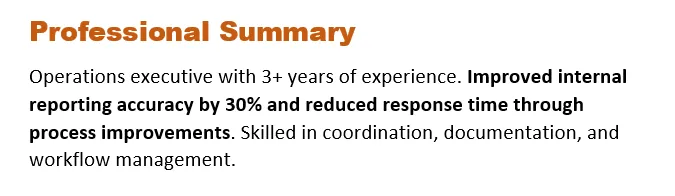
You can include accomplishments in the resume summary because it is the first section recruiters read. Adding one or two strong results here helps them quickly understand your profile. This works best when you have clear outcomes that define your experience. Keep these points brief and focused so they set context for the rest of the resume.
Example of how to list achievements in resume summary:
- Work experience section
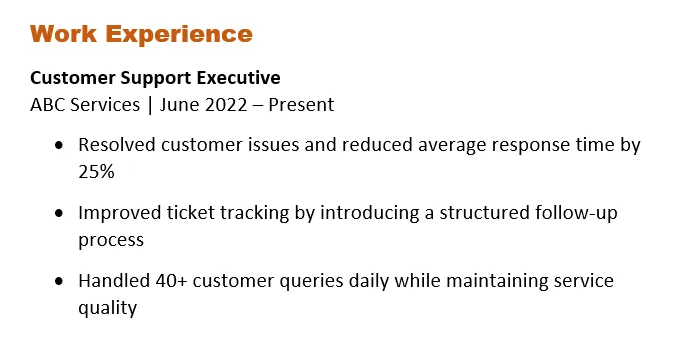
The work experience section is the most common place to add accomplishments. This works well because it connects results directly to a role. Listing outcomes under each job helps recruiters see how you performed, not just what you were responsible for.
Example of how to add achievements in work experience section:
- Education section
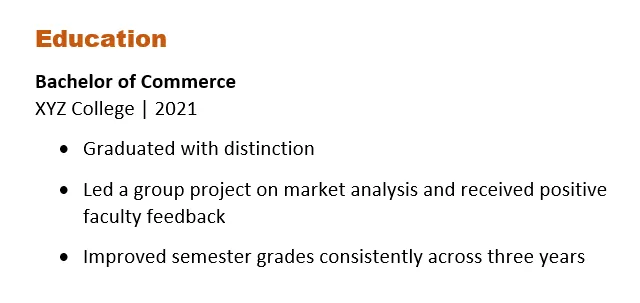
Students and freshers often include achievements under education. This helps highlight academic performance, projects, or leadership roles when work experience is limited. It also gives more meaning to degrees and qualifications listed.
Example of achievements in education section:
- Separate achievements section
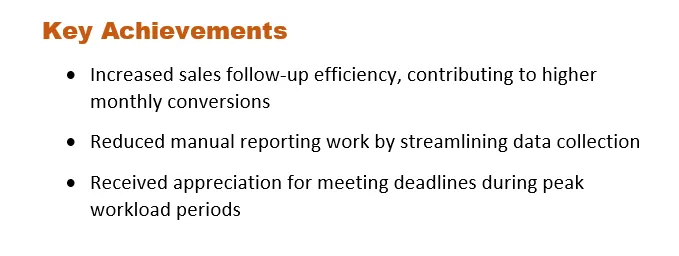
You can create a separate achievements section if you have several strong results to highlight or limited work history. This approach groups key accomplishments in one place and makes them easy to scan.
Example of a separate achievements section:
- Projects or skills section
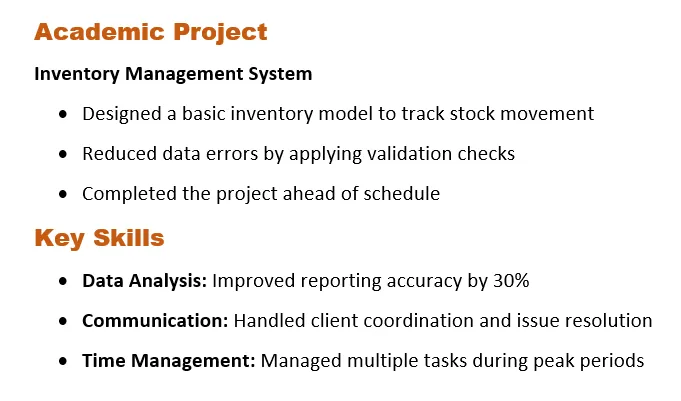
For technical, IT, or project-based roles, accomplishments fit naturally under projects or skills. This placement shows how you applied your abilities in actual situations. It is commonly used in technical resumes and CVs.
Example of how to list achievements in projects or skills section:
Also Read - What is Video Resume? Video Resume Script, Samples and Ideas
How to Include Achievements in Your Resume
Tip: You don’t need achievements in every section. Choose the placement that gives the clearest context and keeps the resume easy to read. Follow the same rule when adding accomplishments or achievements in CV.
Including achievements in resume works best when you follow a clear process. Instead of adding points randomly, you should select the right achievements based on the role. This approach helps recruiters quickly see relevant results. Below are the practical steps you can take to include achievements correctly.
- Read and understand the job description
- Research the company and role expectations
- Make a complete list of your achievements
- Shortlist achievements that fit the role
- Decide where to place them in your resume
- Write achievements clearly and concisely
- Review and proofread carefully
Also Read - Sample Resume for Internship with Template and Examples
Formula to Write Resume Achievements
Writing strong achievements becomes easier when you follow a simple formula. Listing key achievements in resume works best when each point follows a clear and consistent structure. A well-written achievement focuses on what you used, what you did, and what came out of it.
Formula = Skill → Action → Result
Key components of a strong achievement statement:
- Skill applied: The ability or knowledge you used to handle a task or situation.
- Action taken: What you actually did using that skill.
- Result achieved: The outcome of your action, preferably shown through numbers.
Achievement structure example:
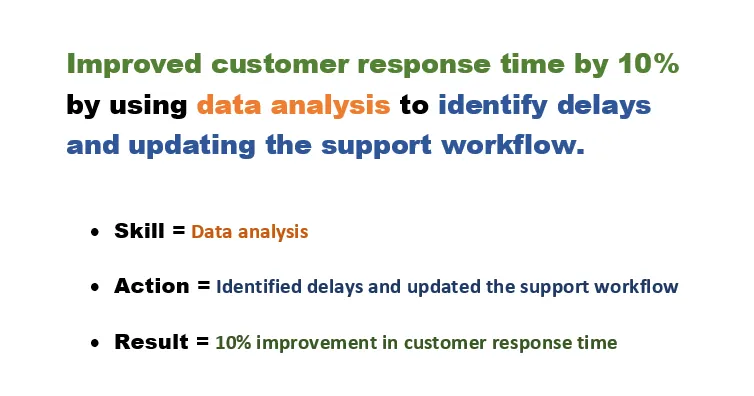
When you use this formula consistently, key accomplishments in resume become easy for recruiters to understand and evaluate.
Also Read - Top 3 Android Developer Resume Examples, Samples & Guide
Good vs Bad Resume Achievements Examples
Looking at good and bad accomplishments examples for resume side by side makes it easier to understand what works and what doesn’t.
| Bad Achievement Example | Good Achievement Example |
|---|---|
| Worked on monthly sales reports and client follow-ups. | Improved monthly sales reporting accuracy by 30% by standardising data collection and follow-up processes. |
Why this doesn’t work:
- Too general
- No outcome or improvement mentioned
- Reads like a routine responsibility
Why this works:
- Shows a clear result
- Includes a measurable outcome
- Explains how the result was achieved
Also Read - Top 5 Business Analyst Resume Examples, Samples & Guide
Resume Achievements Examples – 70+ Samples
Looking at real examples makes it easier to understand how strong achievements are written in practice. This section brings together the best examples of achievement statements for resume. We have covered samples based on different experience levels and job roles.
A. Resume Achievements Examples Based on Experience Level
This section helps you choose achievements that match where you are in your career. The goal is to show growth and contribution at each stage.
1. Examples of Achievements in Resume for Freshers
- Completed a 3-month internship and supported daily operational tasks.
- Assisted in preparing 10+ reports and presentations for academic or project work.
- Contributed ideas to a group project that was shortlisted for final evaluation.
- Met all academic and project deadlines across multiple semesters.
- Helped organise a college event attended by 100+ participants.
2. Professional Achievements Examples for Experienced Candidates
These examples reflect ownership, consistency, and measurable contribution expected from professionals with experience.
- Managed end-to-end execution of recurring tasks, meeting 100% delivery timelines.
- Reduced internal follow-up cycles by improving coordination across 3 teams.
- Handled 20 to 30 client or stakeholder interactions weekly with consistent follow-through.
- Identified process gaps and implemented changes that reduced rework efforts.
B. Achievements examples for different professions and job roles
This section groups accomplishments examples for resume by profession, making it easier to find role-specific inspiration. Each subsection focuses on common outcomes expected in that role and includes practical example of accomplishments at work.
1. Examples of sales and marketing achievements in resume
- Achieved 110% of quarterly sales targets.
- Generated 45+ qualified leads through targeted outreach campaigns.
- Improved lead conversion rate by 18% through follow-up optimization.
- Managed 30+ client accounts with consistent engagement.
- Improved email open rate by 22% by rewriting subject lines and segmenting audiences.
- Launched a campaign that increased website enquiries by 30% in 6 weeks.
2. Customer support and service achievements examples
- Resolved 95% of tickets within SLA for 4 consecutive months.
- Handled 50 to 60 customer queries daily while maintaining quality checks.
- Reduced repeat tickets by 20% by improving first-response troubleshooting steps.
- Increased CSAT from 4.1 to 4.6 by improving response clarity and follow-ups.
- Cut average resolution time by 18% by using better tagging and priority rules.
- Built 25+ help articles that reduced common “how-to” queries.
3. IT and technical achievements examples
- Reduced recurring incident volume by 25% by identifying root causes and fixing configs.
- Automated a manual reporting task, saving 6 hours per week for the team.
- Improved application load time by 30% by optimising queries and caching settings.
- Closed 35+ support tickets weekly with consistent documentation and resolution notes.
- Reduced deployment errors by 40% by improving pre-release checks and rollback steps.
- Supported a data migration of 50K+ records with minimal issues.
4. Examples of operations and administration achievements in resume
- Reduced processing delays by 20% by improving coordination and approval flow.
- Managed 100+ records weekly with accurate documentation and tracking.
- Cut turnaround time from 3 days to 1 day by streamlining handoffs.
- Improved vendor follow-up process, reducing pending items by 30%.
- Organised schedules and logistics for 15+ meetings per month without clashes.
- Created a tracking sheet that improved visibility for leadership reviews.
5. Examples of finance and accounting achievements in resume
- Processed 250+ invoices per month with accurate entries and timely closures.
- Reduced reconciliation mismatches by 18% by improving checks before submission.
- Closed monthly reporting 2 days earlier by improving data collection flow.
- Identified and corrected billing issues, preventing revenue leakage.
- Improved accuracy of expense tracking by implementing a category structure.
- Supported audit preparation by organising documents and reducing missing files.
6. Example of HR and recruitment achievements in resume
- Shortlisted 80+ candidates in a month by improving screening criteria.
- Reduced time-to-schedule interviews from 3 days to 1 day through better coordination.
- Supported onboarding of 20+ new hires in a quarter with complete documentation.
- Improved offer acceptance rate by 12% by improving candidate communication.
- Helped close 10 roles in 6 weeks by improving tracking and follow-ups.
- Reduced document errors by 30% by standardising onboarding checklists.
7. Examples of academic and research achievements in resume
- Completed a research project and presented findings to a panel successfully.
- Published a paper or submitted research work within the academic timeline.
- Led a group project of 4 to 6 members and managed submissions on time
- Scored among top performers in a subject across the semester.
- Conducted surveys with 100+ responses and analysed the findings.
- Built a final-year project that solved a real use case and earned strong evaluation.
8. Examples of management and leadership achievements in resume
- Led a team of 6 to complete a project 2 weeks ahead of schedule.
- Improved team delivery consistency by setting weekly goals and clear ownership.
- Reduced escalations by 20% through better planning and early risk checks.
- Managed cross-team coordination for 3 departments to meet shared deadlines.
- Trained and coached 4 team members, improving quality and confidence.
Bonus: Modern resume achievements for today’s job market
This section highlights achievements that reflect current work trends, including digital tools, remote collaboration, self-learning, and adaptability in modern job roles.
- Worked with remote teams across 2 to 3 time zones and met delivery timelines.
- Used tools like Jira/Trello/Notion to track tasks and improve visibility.
- Completed 2 to 3 job-relevant certifications to upgrade skills.
- Automated routine tasks using simple tools, saving 20+ hours monthly.
- Used AI tools to speed up research, drafting, or reporting while maintaining accuracy.
- Improved meeting efficiency by creating agendas and action tracking.
- Built dashboards or trackers that reduced follow-up effort.
- Delivered outcomes in hybrid work settings without close supervision.
- Improved collaboration by setting clear communication routines.
- Adapted quickly to new tools and workflows during organisational changes.
What to do if you cannot think of any accomplishments?
Many freshers struggle to identify achievements because they associate accomplishments only with full-time jobs. In reality, most accomplishments in resume for freshers come from academics, projects, internships, and learning experiences.
- Review your academic work and projects
Many freshers overlook academic achievements because they feel “normal.” In reality, these are often the strongest accomplishments available early in a career.
- Final-year or major academic projects
- Group assignments where you handled a key role
- Research work, presentations, or seminars
- Consistent performance or improvement over time
- Use internships and training programs
Even short internships or training programs offer real accomplishments. Focus on what you worked on, not the job title. Examples of what to look for:
- Tasks you handled independently
- Tools or systems you learned
- Support you provided to teams or seniors
- Feedback or appreciation you received
- Turn responsibilities into outcomes
If everything feels like a responsibility, take one step further and ask:
- What did this responsibility help achieve?
- What improved because I did this task?
This helps convert responsibilities into achievements by highlighting improvement or contribution.
- Include certifications and skill-building efforts
Completing certifications, online courses, or workshops shows initiative and discipline. These are especially useful when experience is limited.
- Relevant certifications
- Skill-based courses
- Practical assignments completed during training
- Use personal and extracurricular activities
Activities outside academics also count when they involve commitment or leadership. Volunteering, organising events, or managing multiple responsibilities can strengthen a fresher resume when written correctly.
Final Tips to List Achievements on a Resume
Use these final pointers to make your achievements in resume clear, relevant, and easy for recruiters to evaluate.
- Start each key achievement in resume with a clear action verb.
- Show numbers, time, percentages, or volume wherever possible.
- Keep each achievement short and specific.
- Add achievements that match the job role and customise them for each application.
- Use keywords that match the job description for ATS compatibility.
- Avoid repeating the same achievement in multiple sections.
- Stay honest and avoid exaggeration.
- Prioritise recent and relevant achievements over older ones.
Following these tips helps your achievements add real value without cluttering your resume.
Common Mistakes to Avoid While Writing Achievements
Avoiding these common errors improves the clarity and credibility of your achievements for recruiters.
- Listing job responsibilities instead of results or outcomes.
- Writing vague statements without context or impact.
- Skipping numbers when results can be measured.
- Using the same achievement multiple times across sections.
- Adding outdated or irrelevant achievements.
- Overloading the resume with too many achievements.
- Exaggerating or misrepresenting achievements.
- Failing to proofread for clarity and consistency.
Also Read - Declaration in Resume: Meaning, Format & Examples
Wrapping Up
Achievements give meaning to your resume by showing how you applied your skills in real situations. When written clearly and placed correctly, they give you a very strong advantage over other candidates. Use the formula and examples in this guide to choose the right achievements based on your profile.
Once your resume is ready, find the best IT opportunities on Hirist, a trusted online job portal to find top IT jobs in India that match your skills and achievements.
FAQs
You can include achievements from work, internships, academics, projects, certifications, volunteering, or leadership roles, focusing on results and responsibilities rather than routine tasks.
Most resumes work well with 5 to 10 achievements spread across sections, with 2 to 4 strong achievements per job or role being a good rule of thumb.
Yes, achievements are more important than responsibilities as they show what you actually accomplished, while responsibilities only explain what you were supposed to do.