Find the 35 most commonly asked agentic AI interview questions and answers with practical preparation tips.
Agentic AI is a type of artificial intelligence that can make decisions and complete multi-step actions to achieve a goal with limited human oversight. Unlike traditional generative AI, which mainly responds to prompts, Agentic AI can plan and perform tasks more independently like a digital teammate. Its roots go back to intelligent agent research from the 1980s and 1990s, so the field has no single founder. Today, it supports everything from software development and customer service to research and business automation.
As roles such as Agentic AI Engineer and LLM Developer become more common, employers are looking for professionals with strong practical knowledge. The following 35 Agentic AI interview questions and answers will help you prepare for these opportunities.
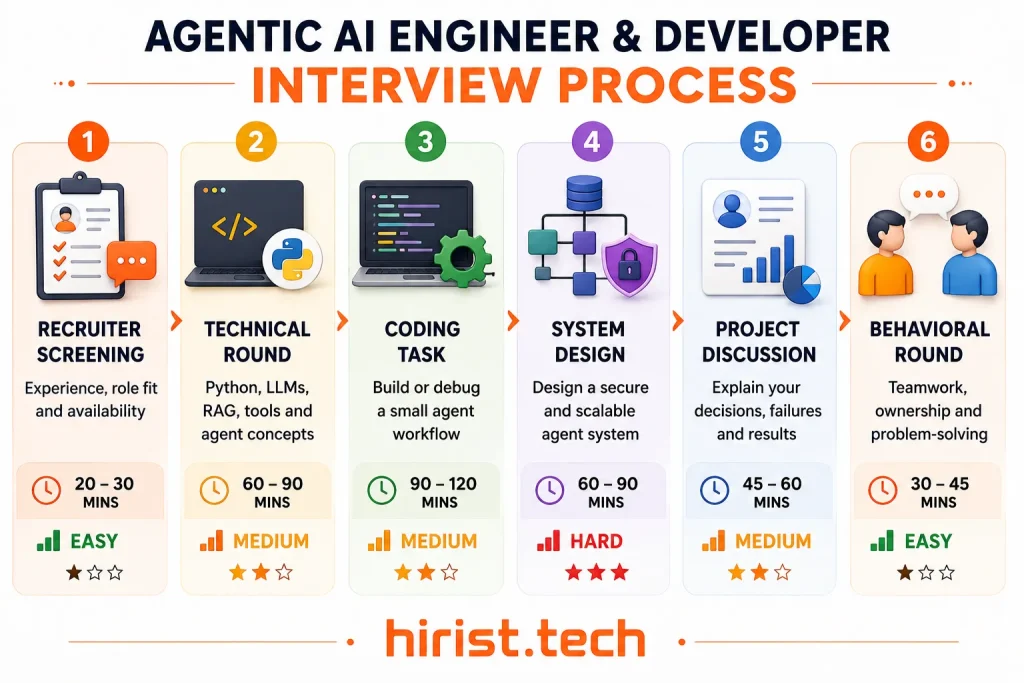
Note: We reviewed Agentic AI interview experiences and commonly reported questions shared by candidates on LinkedIn and Reddit. We also checked relevant interview reports on AmbitionBox. Based on this research, we divided the 35 questions into eight categories for easier preparation:
- Agentic AI fundamentals
- Architecture, planning, and control
- Memory, context, and Agentic RAG
- Tool use, APIs, and protocols
- Single-agent and multi-agent systems
- Safety, security, and human oversight
- Evaluation, observability, and production reliability
- Practical Agentic AI interview scenarios
Section 1: Agentic AI Fundamentals
- What is Agentic AI? How does it work?
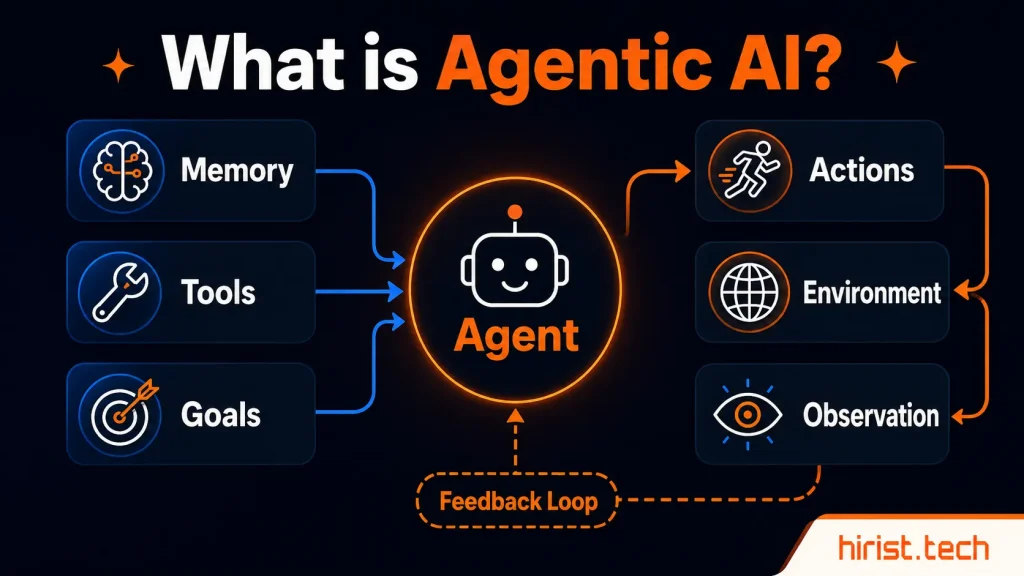
Agentic AI is a form of artificial intelligence that can independently work toward a defined goal. Unlike a standard chatbot that mainly responds to prompts, it can complete connected tasks with limited human guidance.
Most agentic systems follow a four-stage cycle:
- Perceive: Gather information from users, databases, applications or online sources.
- Reason: Use an LLM to understand the goal and break it into smaller tasks.
- Act: Call APIs, use software tools, search data or execute code.
- Review: Check the result, correct errors and decide what to do next.
This cycle continues until the goal is completed or a stopping condition is reached. An agent does not have unlimited freedom. Its instructions, tool permissions, guardrails and stopping rules control what it can do.
- How does Agentic AI differ from traditional generative AI?
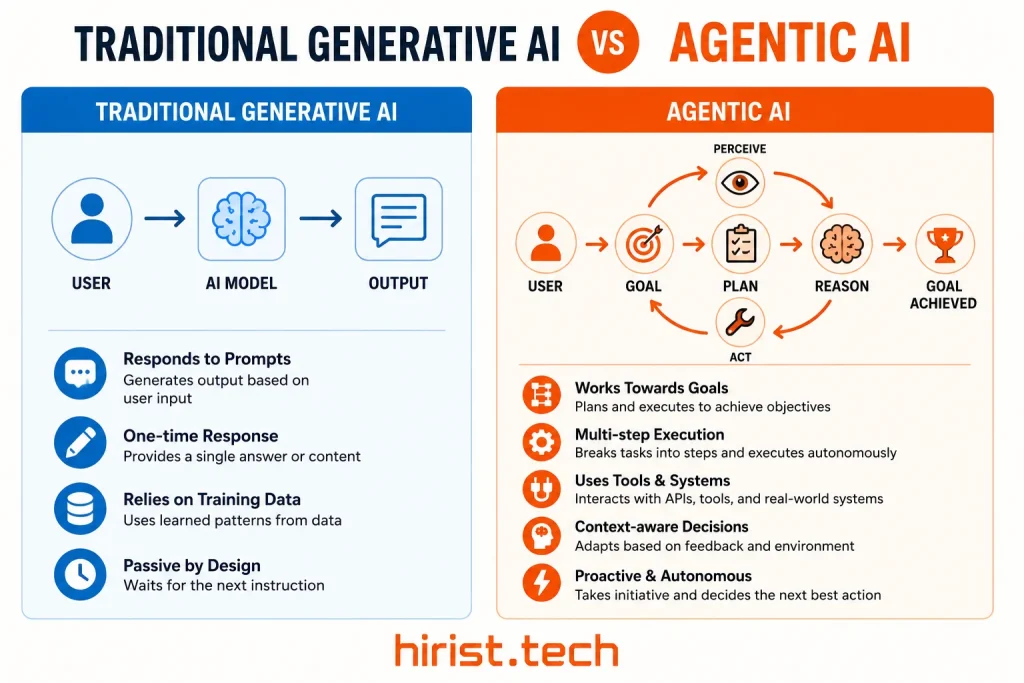
Traditional generative AI produces an output by responding to a prompt, while Agentic AI manages a multi-step process to reach the final goal.
| Traditional Generative AI | Agentic AI |
|---|---|
| Responds to a prompt | Works toward a goal |
| Usually produces one output | Can perform several actions |
| Depends mainly on model knowledge and provided context | Can access tools, APIs and external data |
| Waits for the next instruction | Can decide the next step within set boundaries |
| Focuses on content generation | Focuses on task completion |
The main difference is architectural. An agentic application often uses a generative model as its reasoning component but adds tools, state and an execution loop around it.
- How is an AI agent different from a workflow or chain?
A workflow or chain follows steps defined in advance by a developer. An AI agent can choose its next step based on the current state and tool results. Workflows are better for predictable and rule-based tasks. Agents are more useful when the path may change during execution. Many production systems combine both: code handles permissions, validation and fixed business rules, while the agent handles reasoning, routing and flexible decisions.
- What are the core components of an Agentic AI system?
A production Agentic AI system commonly includes these components:
- LLM: Understands the goal and selects actions
- Instructions: Define the role, rules and limits
- Planning and orchestration: Manage steps, routing, retries and stopping conditions
- Tools: Connect the agent to APIs, databases and software
- State and memory: Track context, progress and past information
- Feedback: Helps the agent review results and adjust its plan
- Guardrails and human approval: Control risky or sensitive actions
- Tracing and evaluation: Record activity for testing and debugging
Not every system needs all of these at the same level. The architecture should match the task’s complexity, risk and required autonomy.
Also Read - Top 40+ Generative AI Interview Questions & Answers
Section 2: Architecture, Planning, and Control
- What is a reasoning loop in Agentic AI?
A reasoning loop is the repeated cycle an agent follows while completing a task: Assess state → Choose an action → Use a tool → Observe the result → Update state
The agent continues this loop until it reaches the goal, needs human input or hits a stopping condition. This allows it to react to new information instead of following one fixed response. In production, the loop is controlled through step limits, permissions and validation rules.
- What is task decomposition? Why is it important for AI agents?
Task decomposition means splitting a complex goal into smaller and manageable subtasks. For example, an agent creating a market report may collect data, analyze trends, verify findings and prepare the final document.
It helps the agent:
- Organize steps and dependencies
- Select the right tool for each task
- Run independent tasks in parallel
- Track progress and recover from failures
- Validate results at key checkpoints
Without clear decomposition, the agent may skip steps, repeat work or lose track of the main goal.
- What is the difference between ReAct and Plan-and-Execute?
ReAct combines reasoning and action one step at a time. The agent chooses an action, observes the result and then decides what to do next. It works well when the task is uncertain or new information may change the direction.
Plan-and-Execute creates a broader plan first and then carries out each step. It is useful for structured tasks with clear dependencies.
ReAct is more flexible but may require more model calls. Plan-and-Execute can be more organized, but a weak initial plan may affect later steps.
- What role does an orchestrator or control plane play in an agentic system?
An orchestrator or control plane manages how an agentic system runs. It assigns tasks, tracks shared data, controls memory and applies security rules. It does not handle the main reasoning. Instead, it coordinates agents and tools so they work safely and in the right order. The LLM makes flexible decisions, while the orchestrator keeps execution controlled and predictable.
- Which responsibilities should be handled by the LLM, and which should be controlled through code?
The LLM should handle tasks that require language understanding and flexible judgment. Code should control deterministic and high-risk operations.
| LLM responsibilities | Code responsibilities |
|---|---|
| Interpret user intent | Handle authentication and permissions |
| Understand ambiguous requests | Validate inputs and schemas |
| Write, summarize and translate content | Execute and validate tool calls |
| Hold natural conversations with users | Control state transitions |
| Adjust plans using new information | Apply rate, cost and step limits |
| Propose the next action based on context | Manage database writes, retries, stopping rules and audit logs |
A strong production design uses the LLM for judgment and code for rules that must always be followed.
- How does an AI agent determine when a task is complete?
An agent stops when defined completion criteria are met, such as:
- All subtasks are finished
- A tool returns the expected result
- The output passes validation
- No unresolved tasks remain
It should also stop when step, time or cost limits are reached. Programmatic checks are safer than relying only on the model’s decision.
- How do you prevent an AI agent from entering an infinite reasoning or action loop?
Use hard runtime controls:
- Set step, time, token and tool-call limits
- Limit retries
- Block repeated tool calls
- Stop when the state no longer changes
- Define clear success and failure states
- Escalate repeated failures to a human
Tracing helps identify where the loop started.
- What are the trade-offs between stateful and stateless agent architectures?
A stateful agent stores conversation history, task progress and intermediate results. This supports long-running work, recovery after failures and personalized interactions. However, it adds storage, privacy, concurrency and state-management complexity.
A stateless agent treats every request independently. It is simpler to scale, test and retry, but the required context must be supplied with each request.
Many production systems use a hybrid model: the orchestrator stores task checkpoints, while individual tools or workers remain stateless.
- How do you choose between an agent framework and custom orchestration?
Choose an agent framework when you need built-in support for state, tool calling, tracing, human approvals, handoffs or durable execution. Frameworks such as OpenAI Agents SDK and LangGraph can reduce setup work for complex agents.
Custom orchestration may be better when:
- The workflow is small and predictable
- You need full control over execution
- Latency and runtime overhead must stay low
- Existing systems already manage state and retries
- Framework abstractions do not fit your security or deployment needs
The decision should be based on complexity, control, maintainability and operational requirements.
- When should you avoid using an AI agent?
Avoid an AI agent when a simpler and more predictable solution can complete the task. Common examples include:
- Fixed workflows with known steps
- Basic CRUD or rule-based operations
- Tasks that require exact and repeatable outputs
- Very low-latency applications
- High-risk actions that cannot tolerate model errors
- Processes with no useful tools or feedback signals
- Tasks where a normal API call or script is cheaper
Agents are most useful when the task involves ambiguity, changing information or decisions that are difficult to define entirely through code.
Also Read - Top 25 LLM Interview Questions and Answers
Section 3: Memory, Context, and Agentic RAG
- What types of memory do AI agents use?
AI agents commonly use:
- Short-term or working memory: Holds the current conversation, task state and intermediate results.
- Semantic memory: Stores facts, user preferences and domain knowledge.
- Episodic memory: Records past actions, outcomes and experiences.
- Procedural memory: Stores instructions, rules and learned ways of completing tasks.
Short-term memory usually lasts for one thread, while long-term memory remains available across sessions. A vector database is not a memory type. It is one method used to retrieve stored memories by meaning.
- How do you implement persistent memory for a long-running AI agent?
Use checkpoints to save the agent’s current state, completed steps and pending tasks. Store durable information such as preferences and verified facts in a database under separate user or organization IDs.
Do not save every message as permanent memory. Store compact, useful records and retrieve only what is relevant to the current task. Add timestamps, access controls, retention rules and update logic so old or incorrect memories can be replaced. This also allows the agent to resume after an interruption or system failure.
- What is the difference between traditional RAG and agentic RAG?
| Traditional RAG | Agentic RAG |
|---|---|
| Follows a fixed retrieve-then-generate flow | Treats retrieval as a tool |
| Searches once for each query | Can search several times |
| Uses a predefined data source | Can choose between multiple sources |
| Passes retrieved context directly to the LLM | Reviews results and changes the query if needed |
| Has lower cost and complexity | Supports complex and multi-step questions |
Agentic RAG is more flexible, but it can add latency, cost and more failure points.
- How do you manage context windows and long-term memory without bloating, stale information, or contradictions?
Treat the context window as a limited resource. Keep only the information needed for the current step.
Common methods include:
- Summarize old conversations
- Retrieve only relevant memories
- Remove duplicate information
- Use timestamps and versioning
- Prefer trusted and recent sources
- Keep temporary state separate from long-term memory
- Surface unresolved conflicts clearly
Smaller and high-signal context usually produces better results than sending the complete history on every call.
Also Read - Top RAG Interview Questions and Answers
Section 4: Tool Use, APIs, and Protocols
- What is function calling? How does an AI agent select the correct tool?
Function calling allows an LLM to request an approved tool using structured arguments. The application validates the request, runs the function and returns the result to the agent.
The agent selects a tool by comparing the user’s goal with each tool’s:
- Name and description
- Input schema
- Usage instructions
- Available context
- Permission rules
The model proposes the call, but application code controls whether it is executed.
- How should tool schemas and descriptions be designed for reliable tool selection?
Tool definitions should be clear, specific and easy to distinguish.
- Use descriptive names such as get_order_status
- Explain what the tool does and when to use it
- State when the tool should not be used
- Define narrow JSON schemas with correct data types
- Mark required fields clearly
- Use enums for fixed choices
- Avoid tools with overlapping purposes
- Validate all arguments before execution
Strict schemas reduce invalid arguments, while precise descriptions help the model choose the right tool.
- How do you handle tool-call failures in a production AI agent?
- Validate arguments before execution
- Use timeouts and limited retries
- Retry temporary errors with backoff
- Return structured error messages
- Add fallback tools or alternate paths
- Use idempotency keys for repeated actions
- Escalate high-risk failures
- Record errors in logs and traces
Permanent errors should not be retried repeatedly.
- What is the Model Context Protocol? Why is it important for Agentic AI systems?
The Model Context Protocol, or MCP, is an open standard introduced by Anthropic. It gives AI applications a common way to connect with tools, databases and other data sources through a client-server architecture.
MCP works like a universal connector for AI. Instead of building a separate custom integration for every tool, developers can use one consistent protocol. This makes agent systems easier to build, expand and maintain. However, access controls, authentication and user approval are still needed for secure tool use.
Section 5: Single-Agent and Multi-Agent Systems
- What is the difference between single-agent and multi-agent systems?
A single-agent system uses one agent to plan, call tools and complete the full task. A multi-agent system divides the work among specialized agents that coordinate through an orchestrator or handoffs.
| Single-agent system | Multi-agent system |
|---|---|
| Uses one agent | Uses several specialized agents |
| Easier to build and debug | Requires routing and coordination |
| Suitable for focused tasks | Suitable for complex, divisible tasks |
| Usually has lower cost and latency | May support parallel execution |
| Has fewer failure points | Introduces handoff and communication risks |
Start with one agent unless multiple agents provide a clear benefit.
- When should you use a multi-agent system instead of a single agent?
Use multiple agents when:
- The task can be divided into independent subtasks
- Different steps require specialized instructions or tools
- Subtasks can run in parallel
- One agent would receive too much context
- An independent reviewer or verifier is needed
For example, a research system may use separate agents to search sources, analyze findings and verify claims. Avoid multi-agent design when one agent can complete the task reliably, since extra agents add cost, latency and coordination failures.
- How do multiple agents route tasks, delegate work, validate outputs and combine results?
A multi-agent system commonly follows this flow:
- An orchestrator examines the request and selects the right agent.
- Each agent receives a clear task, relevant context and an expected output format.
- Specialized agents complete their work using approved tools.
- A validator, critic or programmatic check reviews important outputs.
- The orchestrator combines the results, resolves conflicts and produces the final response.
Some systems use a central manager, while others allow agents to hand work directly to one another. Clear roles and structured outputs reduce confusion between agents.
Section 6: Safety, Security, and Human Oversight
- What is prompt injection? How can an Agentic AI system defend against it?
Prompt injection happens when untrusted text tricks an LLM into treating data as instructions. It may come from users, documents, emails, webpages or tool outputs.
Defenses include:
- Treat external content as untrusted
- Separate system instructions from retrieved data
- Filter inputs and outputs
- Restrict tool permissions
- Validate actions before execution
- Require approval for sensitive tasks
No single filter is enough, so layered controls are needed.
- How do guardrails and permission boundaries control an AI agent?
Guardrails check what enters the agent, what it produces and which actions it requests. Permission boundaries limit the tools, data and operations available to it.
Common controls include:
- Input and output validation
- Tool allowlists
- Role-based access control
- Read-only access by default
- Rate, token and spending limits
- Sandboxed code execution
- Human approval for high-risk actions
The agent may propose an action, but a separate policy or execution layer should decide whether it is allowed.
- How do you prevent destructive or unauthorized actions by an AI agent?
Enforce authorization through code, not the LLM.
- Give tools minimum permissions
- Validate users, actions and arguments
- Require approval for payments, deletions or account changes
- Use idempotency keys
- Apply rate and spending limits
- Run risky actions in a sandbox
- Keep audit logs
- Add rollback options where possible
High-impact actions should wait for human approval.
- How do you detect hallucinations and validate an agent’s proposed actions?
A hallucination occurs when an agent produces a claim, decision or tool argument that appears valid but is unsupported or false.
Reduce the risk by:
- Grounding answers in trusted data
- Requiring structured outputs
- Validating tool arguments against schemas
- Checking facts with APIs, databases or known rules
- Comparing outputs with retrieved evidence
- Rejecting actions that fail programmatic checks
- Using human review for uncertain or high-risk decisions
Do not depend only on the agent’s confidence. The execution layer should independently validate the proposed action before running it.
Also Read - How to Become a Machine Learning Engineer: Skills & Roadmap
Section 7: Evaluation, Observability, and Production Reliability
- How do you build an evaluation harness for an Agentic AI system?
An evaluation harness repeatedly tests an agent on realistic tasks and scores the results.
It should include:
- Normal, edge-case and adversarial scenarios
- Clear success criteria
- Checks for outputs and tool use
- Safety, latency and cost metrics
- Code-based, LLM-based and human graders
- Saved traces for debugging
- Baselines for regression testing
The test environment should closely match production so the results reflect real agent behavior.
- What is LLM-as-Judge? What are its limitations when evaluating AI agents?
LLM-as-Judge uses a language model to score an agent’s response or execution path against a defined rubric. It is useful for qualities that are hard to check with code, such as relevance, clarity and instruction following.
Its limitations include:
- Inconsistent scores across repeated runs
- Bias toward certain writing styles or answer lengths
- Overly generous grading
- Sensitivity to the rubric and provided context
- Shared blind spots with the agent being tested
LLM judges should be compared with human ratings and combined with deterministic checks.
- How would you debug an AI agent that behaves unexpectedly in production?
Start with the execution trace. A trace shows the complete agent run, while a span represents one operation such as an LLM call, tool call or handoff.
Then:
- Find the first span where behavior changed
- Inspect the prompt, state and retrieved context
- Review tool names, arguments and responses
- Check retries, timeouts and state transitions
- Compare the failed run with a successful one
- Fix the cause and add a regression test
Logs should also record errors, latency, token use and approval decisions.
- How do you handle partial failures, checkpointing, idempotency, retries, cost, and latency in a production agent pipeline?
Treat failures as a normal part of agent execution. Use:
- Retries: Retry temporary errors with strict limits
- Checkpointing: Save progress after important steps
- Idempotency: Prevent duplicate actions with unique keys
- Fallbacks: Use alternate tools or human escalation
- Circuit breakers: Stop repeatedly failing components
- Cost controls: Trim context and use smaller models where suitable
- Latency controls: Cache results and run independent calls in parallel
Track success rate, cost, latency and retry count for every workflow.
Section 8: Practical Agentic AI Interview Scenarios
Scenario 1: Designing a Customer Support Agent
Interview question: How would you design an autonomous customer support agent for a high-volume business?
A strong answer should cover:
- Define supported requests and escalation boundaries
- Use an LLM for intent detection and reasoning
- Connect a RAG system to verified company information
- Integrate CRM and ticketing tools
- Add human approval for refunds or account changes
- Monitor accuracy, latency and resolution rates
- Apply security and compliance guardrails
What it tests: Agent architecture, tool integration, scalability and human oversight.
Scenario 2: Securing High-Risk Agent Actions
Interview question: How would you prevent an AI agent from making unsafe financial, database or account changes?
A strong answer should cover:
- Apply least-privilege tool permissions
- Use role-based access control
- Validate tool arguments before execution
- Run code and tools in sandboxed environments
- Require human approval for sensitive actions
- Use idempotency keys to prevent duplicate operations
- Maintain complete audit logs
- Add rollback or recovery mechanisms where possible
What it tests: Security, governance, reliability and safe autonomous execution.
Agentic AI Engineer Interview Questions (Bonus)
- How would you design an Agentic AI system for a high-volume production environment?
- How do you balance accuracy, latency, cost and safety when choosing models for an agent workflow?
- Tell us about an Agentic AI project you are most proud of. What was your contribution?
- Have you ever replaced a multi-agent design with a simpler workflow? What made the original architecture unnecessary?
- Tell us about a technical decision you disagreed with. How did you communicate your concerns?
Agentic AI Developer Interview Questions (Bonus)
- Tell us about a tool-calling bug where the model selected the correct tool but passed incorrect arguments. How did you fix it?
- Describe a time you discovered that an agent framework was limiting your implementation. Did you modify it, replace it or build custom logic?
- Describe a time you pushed back on releasing an agent feature because its stopping rules, permissions or human approval flow were not ready.
- How do you stay current with new Agentic AI tools, models and frameworks?
- Describe a time you had to explain a complex AI feature to a non-technical stakeholder.
How to Prepare for Agentic AI Interview?
- Study the company’s product, AI stack, job description and recent projects.
- Match each job requirement with a project or example from your experience.
- Review one agent you built and prepare to explain its architecture, tools, memory, guardrails and failures.
- Practise designing an agent for the company’s likely use case.
- Prepare stories about debugging, cost reduction, unsafe actions and production trade‑offs.
- Revisit core topics such as RAG, MCP, tool calling, evaluation and observability.
- Run a mock interview and practise answering each question in under two minutes.
Also Read - Top MCP Interview Questions & Answers: AI Agents & Tool Calling
Wrapping Up
These 35 Agentic AI interview questions and answers give you a practical way to review the concepts employers may test. Focus on how agents plan, use tools, manage memory, stay secure and recover from failure. Once you are ready to apply, visit Hirist to find IT jobs, including Agentic AI Engineer and LLM Developer roles across leading tech companies today.
FAQs
They can be challenging because interviews often cover both concepts and practical problem-solving. Candidates may be asked about tool calling, memory, RAG, agent loops, security, debugging and system design.
Yes. Reddit has discussions where candidates share interview rounds, technical questions and system design topics. These posts can help you understand common patterns, but the actual process may vary by company.
According to the AmbitionBox data shared, the typical salary range is ₹9.9 lakh to ₹10.9 lakh per year for professionals with 0 to 7 years of experience. The listed average salary is ₹8 lakh, while the top 10% earn around ₹21.5 lakh or more.
Agentic AI is easier to learn if you already understand Python, APIs and LLM basics. Start with a simple tool‑using agent before moving to memory, multi‑agent systems, guardrails and evaluation.
Important skills include Python, LLM APIs, RAG, vector databases, function calling, orchestration, memory management, evaluation, security and cloud deployment. Backend development and system design knowledge are also useful.
Python is commonly required because many AI libraries, frameworks and SDKs support it. However, some teams also use TypeScript, Java or C# for agent development and backend integration.
Candidates can start with LangGraph, OpenAI Agents SDK, CrewAI or Microsoft Agent Framework. It is better to understand one framework deeply than to learn several only at a basic level.