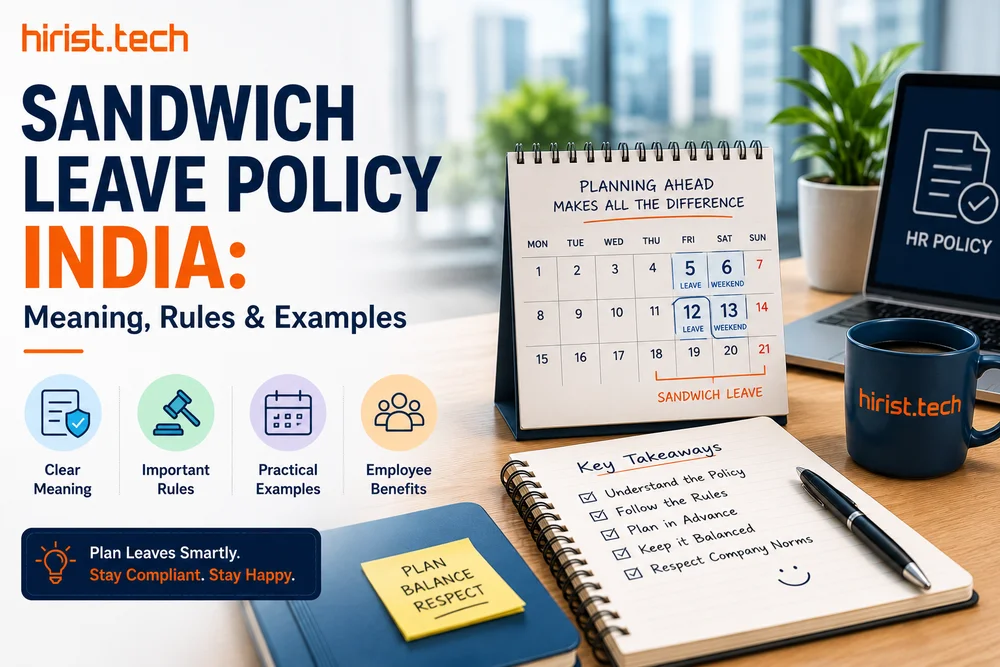
Sandwich leave policy often confuses employees and causes sudden leave deductions. Many people take leave around public holidays or weekends to enjoy a longer break. It feels natural to think that only the leave day counts. But in many companies, the holiday before and after your leave also gets added to the total.
This happens because the sandwich leave policy counts all days between two holidays as leave. So your leave balance drops faster than you expect.
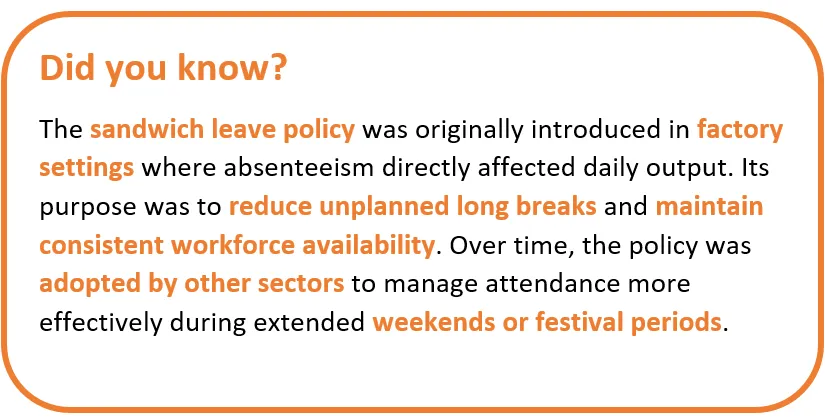
Companies follow this policy to prevent mass leave during festivals and long weekends. It helps them plan work better and avoid sudden gaps in the team.
In this guide, we will explain the meaning and rules of the sandwich leave policy in India and share examples that help you plan your leaves without unwanted deductions.
What is the sandwich leave?
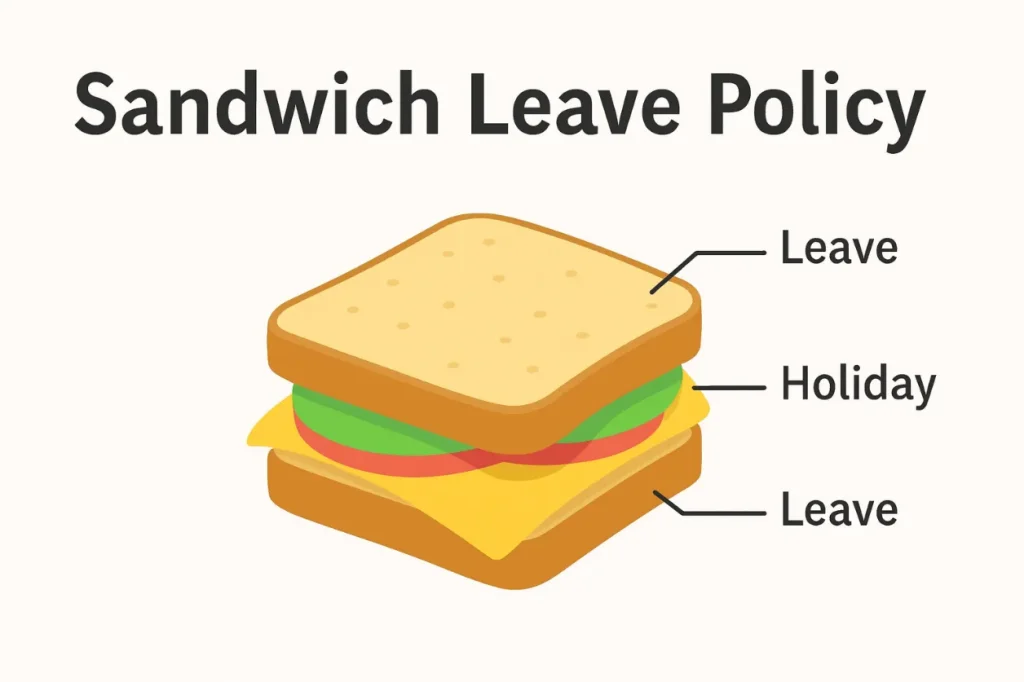
Sandwich leave comes from the idea of something placed between two similar things like an actual sandwich. In workplaces, it means a situation where your leave connects with holidays in a way that the holiday also gets counted as leave. It usually happens in two ways:
- When a leave day sits between two holidays
- Or when you take leave right before and after a weekend
In both cases, the days in between may be added to your total leave count.
This is what companies call sandwich leave.
Example:
If you take leave on Friday and Monday
Your company may count Saturday and Sunday as leave too because your leave connects with the weekend on both sides. So instead of 2 days, 4 days may get deducted.
What is sandwich leave policy?
A sandwich policy for leave is a rule that decides how companies count leave when it touches weekends or public holidays. Under this policy, if you take leave right before and right after a holiday, the day in the middle does not stay a “free holiday.” It gets added to your total leave count. The same logic applies when your leave sits on both sides of a weekend.
This policy clearly specifies three things:
- When it applies: The conditions under which weekends or public holidays will be added to the leave period.
- How days are calculated: The number of days that will be deducted when leave connects with holidays.
- What qualifies as a linked period: Situations such as taking leave before and after a holiday or on both sides of a weekend.
How does the sandwich leave policy work?
The sandwich leave policy works by counting the holidays or weekends between two leave days as part of your total leave. The main idea is simple: if your leave “touches” a holiday on both sides, the holiday becomes part of your leave.
Example of a sandwich leave policy
To understand how a sandwich leave policy works, let’s look at a simple example.
Scenario: October 2nd is a national holiday for Gandhi Jayanti, and it falls on a Thursday. October 6th is a regional holiday for Bathukamma and it falls on the following Monday.
What you do: You apply for leave on October 3rd (Friday) to enjoy a long break.
What you expect: You may think you will get a 5-day break from Thursday to Monday while using only one leave day.
How leave is counted:
- Thursday – Public holiday
- Friday – Your leave
- Saturday – Weekend
- Sunday – Weekend
- Monday – Public holiday
How sandwich leave policy applies:
If your company follows the sandwich leave policy, all 5 days above can be treated as one continuous leave period. So instead of losing 1 leave day, you may lose 5 leave days.
Also Read - Two Days Leave Application for Office: Format & Samples (2026)
Components of a sandwich leave policy
Most companies that follow the sandwich rule include a few basic parts in their policy:
- Purpose: Why the company uses the rule, usually to manage attendance during long weekends.
- Scope: Which employees the policy applies to and which leave types are covered.
- Leave calculation: How holidays and weekends will be counted when leave connects with them on both sides.
- Exceptions: Cases like medical emergencies or approved personal situations where the rule may not apply.
- Approval process: How to apply for leave, who approves it, and how the HRMS shows sandwich deductions.
Also Read - Application for 10 Days Leave: Format, Samples & Guide
Understanding the sandwich leave policy in India
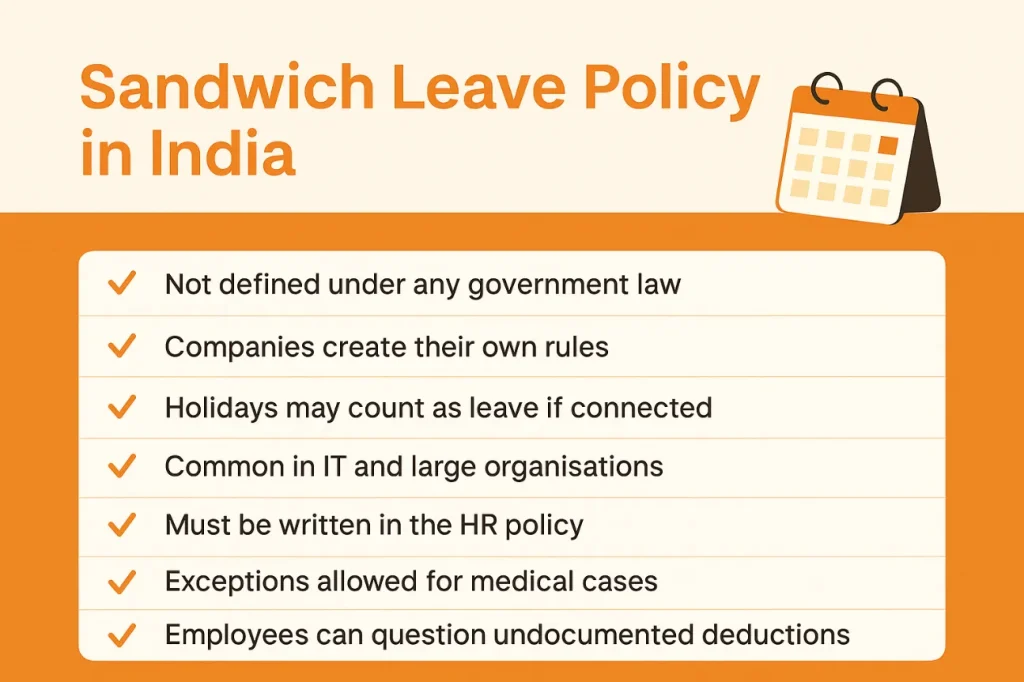
The sandwich rule in leave policy India is widely used, but many employees are unsure how it fits within labour laws.
The basic idea:
When you take one or more leaves and connect them with public holidays or weekends to get a long break, the entire set of days can count as your leave and will be deducted from your balance.
Sandwich Leave Policy Act of India
There is no separate Sandwich Leave Policy Act in India. Labour laws recognise public and paid holidays, but they do not give rules for counting sandwich leave. So companies follow their own version of the policy based on their work structure and attendance needs.
Is sandwich leave policy legal in India?
Yes, the sandwich rule in leave policy India is legal if the company clearly mentions it in the employment contract or HR policy. There is no fixed national law that forces or bans sandwich leave.
The policy is valid only when:
- It is written and shared with employees
- It is applied the same way for everyone
- It follows basic leave entitlements under labour laws
The rules of sandwich leave policy in India
Many employees want to understand the rule of sandwich leave policy, but India does not have one fixed national rule. Labour laws only state the minimum paid leave an employee must get –
- Usually 15 days a year
- Or 1.5 days of leave for every 20 days of work
Beyond this, the government does not define how sandwich leave should be counted.
Because of this, companies are free to set their own sandwich leave rules. The exact rules may also differ from state to state because leave guidelines and compliances vary.
- Leave connected to holidays may be counted together: If your leave falls before and after a holiday or weekend, all the days in between can be treated as one continuous leave block.
- The policy must be written clearly: A company can apply sandwich leave only if it has mentioned the rule in the employment contract or HR policy.
- The rule must apply equally to everyone: The policy cannot be used for some employees and ignored for others. It must be applied consistently across teams.
- Minimum leave rights stay the same: Even with sandwich leave, companies must follow basic leave entitlements under Indian labour laws.
- Companies may define exceptions: Medical emergencies, sick leave, or approved personal situations may be exempt if supporting documents are provided.
- Employees can question unclear deductions: If a company deducts leave using the sandwich rule without mentioning it anywhere, employees can question it and request clarification from HR.
Also Read - Emergency Leave Application: Format, Samples & Tips
Sandwich leave policy for earned leave (EL) and casual leave (CL)
Many companies apply the sandwich rule differently for EL and CL. This is how it usually works:
- Casual Leave (CL): Most companies apply the sandwich rule to CL. If your CL connects with holidays, the days in between may also be counted as leave.
- Earned Leave (EL): Some companies extend the rule to EL, especially during long weekends or festival breaks. Others keep EL separate and do not apply the sandwich rule unless clearly mentioned.
Also Read - Earned Leave Rules India: Policy, Calculation & Entitlements
Sandwich leave policy examples
Understanding sandwich leave becomes easy when you see how it works in real situations. Here are a few simple examples:
1. Leave between two public holidays
Scenario: Wednesday is a public holiday. Friday is another public holiday. You take leave on Thursday.
How it works: All three days, Wednesday, Thursday, and Friday can be counted as leave because your leave sits between two holidays.
2. Leave on both sides of a weekend
Scenario: You take leave on Friday and Monday.
How it works: Saturday and Sunday may also be counted as leave, forming a four-day leave block instead of two.
3. Leave before a holiday + one weekend
Scenario: You take leave on Saturday, and Monday is a public holiday.
How it works: Some companies count Saturday, Sunday, and Monday as leave because your leave connects with the holiday on one side and the weekend on the other.
4. Leave between a holiday and an optional holiday
Scenario: Tuesday is a festival holiday. Thursday is an optional holiday.
You take leave on Wednesday.
How it works: All three days may be counted as leave if the company treats optional holidays as part of the sandwich rule.
5. Multiple leave days forming one long block
Scenario: You take leave from Friday to Tuesday, and Monday is a public holiday.
How it works: The weekend and the holiday can merge with your leave, creating one continuous leave period.
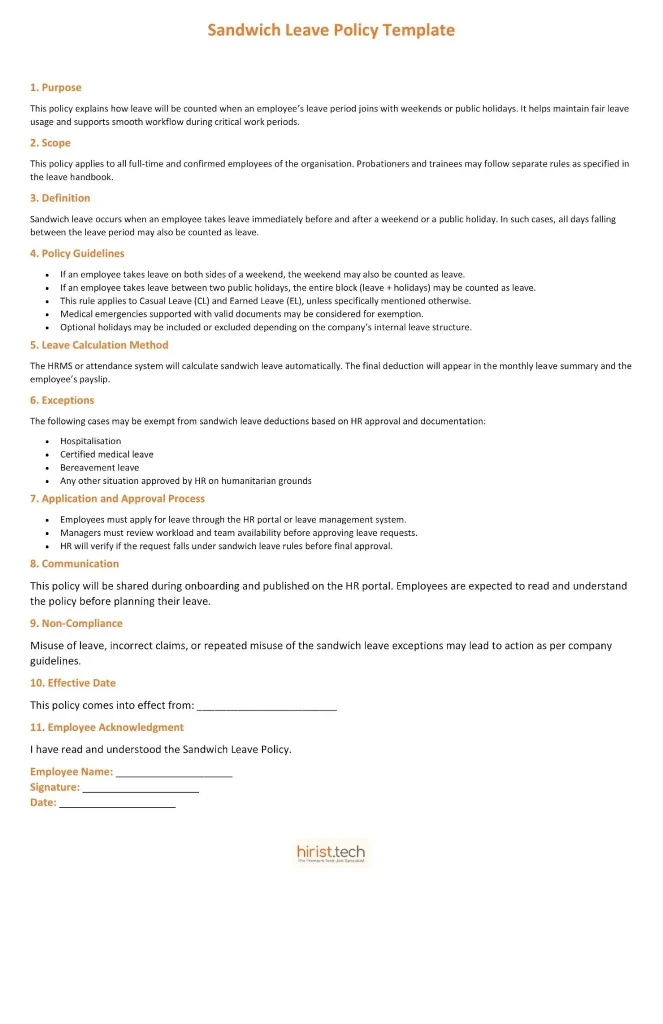
Sandwich leave policy template
A sandwich leave policy format helps companies set clear rules for eligibility, deductions, and exceptions. It also guides employees by explaining how leave will be counted, so they can plan holidays without facing unexpected cuts.
Here is a simple and sandwich leave policy template:
Benefits of sandwich leave policy
The sandwich policy for leave is mostly beneficial for employers rather than employees. Here are the key advantages of this policy:
- Reduces sudden mass leave during holidays
- Helps managers plan work and staffing in advance
- Prevents long unapproved breaks
- Keeps project timelines stable
- Maintains fair leave usage across teams
- Supports smooth workflow during peak periods
- Controls productivity loss during long weekends
- Reduces last-minute schedule changes for teams
- Encourages employees to plan leave responsibly
Disadvantages of the sandwich leave policy
The policy can feel strict for employees and may create confusion during long weekends. Here are the main disadvantages:
- Reduces flexibility in planning short breaks
- Can impact work-life balance during festival seasons
- Creates frustration when extra days get deducted
- May feel unfair if not explained clearly
- Can lower employee morale in strict workplaces
- Requires more clarification and support from HR
- Causes disputes if the rule is not mentioned in the policy
- Increases the chance of unplanned sick leave if employees avoid applying for normal leave
Also Read - Leave Application for Festival in Office with Format & Samples (2026)
Sandwich leave policy in IT companies
IT companies follow structured leave rules because their work runs on fixed sprints, client SLAs, and round-the-clock support. To avoid gaps during long weekends, many IT firms apply the sandwich leave policy. This helps them maintain stable staffing.
Most IT companies use the same approach. If your leave joins with a weekend or a public holiday, the full stretch can be counted as leave. Some apply it only to casual leave. Others apply it to earned leave too.
HR teams usually explain this rule during onboarding, and it appears clearly in the HRMS. Large organisations such as TCS, Infosys, Wipro, HCL, Tech Mahindra, Cognizant and Accenture mention this in their leave guidelines so employees know how deductions will work.
How employees can avoid sandwich leave deductions
Employees can reduce sandwich leave deductions with smart planning and by checking policy details in advance. Here are the ways to avoid extra deductions:
- Check your HRMS and leave policy before applying
- Avoid taking leave on both sides of a weekend or holiday
- Use half-day leave instead of a full day when possible
- Apply for medical leave with valid documents if sick
- Choose remote work on one of the connecting days if allowed
- Plan leave on mid-week days to avoid linking two holidays
- Ask HR for exceptions in genuine emergencies
How HR can implement a fair sandwich leave policy in IT companies
HR teams can make the sandwich rule fair by keeping the process transparent and easy for employees to understand. Here are the simple steps HR can follow:
- Explain the policy clearly during onboarding
- Add the rule in the employee handbook and HRMS
- Share examples so employees know how deductions work
- Allow exceptions for medical or emergency situations
- Inform teams before festival seasons or long weekends
- Use the HRMS to show automatic leave calculations
- Review the policy yearly and update it based on employee feedback
Sandwich leave alternatives used by modern IT companies
Many IT companies avoid strict sandwich rules and use more flexible options to support employee well-being and still maintain stable staffing. These are the common alternatives:
- Flexible leave windows: Companies allow short breaks around holidays without extra deductions.
- Optional holiday swaps: Employees can swap festival holidays based on their region or preference.
- Half-day leave options: Teams can take a half day instead of losing multiple days.
- Remote work on connecting days: Employees can work from home on one side of the weekend to avoid the sandwich rule.
- Restricted leave periods: Some companies block leave only during product releases or major deployments, not all holidays.
- Comp-off usage: Employees can use earned comp-offs to cover a connecting day instead of losing more leave.
- Automated HRMS alerts: Systems warn employees if their leave triggers sandwich rules and suggest better dates.
Wrapping up
The sandwich leave policy can feel confusing, but understanding how it works helps you plan leave better and avoid sudden deductions. Each company uses the rule differently, so always check your HRMS before applying.
Looking for a job in an IT company that offers fair and flexible leave policies? Visit Hirist, an online job portal for the best IT jobs in India.
FAQs
Yes, in most cases. If you take leave on Friday and Monday, the intervening Saturday and Sunday are often counted as leave days because the break forms one continuous block of time off.
Generally, no. Sick leave is usually exempt from the sandwich policy if you submit valid medical documents. However, HR may still review specific cases before approving any exceptions to the standard rule.
If you exhaust your available casual or earned leaves, any additional days deducted under the sandwich rule may convert into loss of pay (LOP). It is important to track your leave balance to avoid unexpected salary impacts.
You should check your offer letter, employee handbook, or HR management system (HRMS) for specific policy details. If the information is not explicitly mentioned, it is best to ask your HR department directly for clarification.