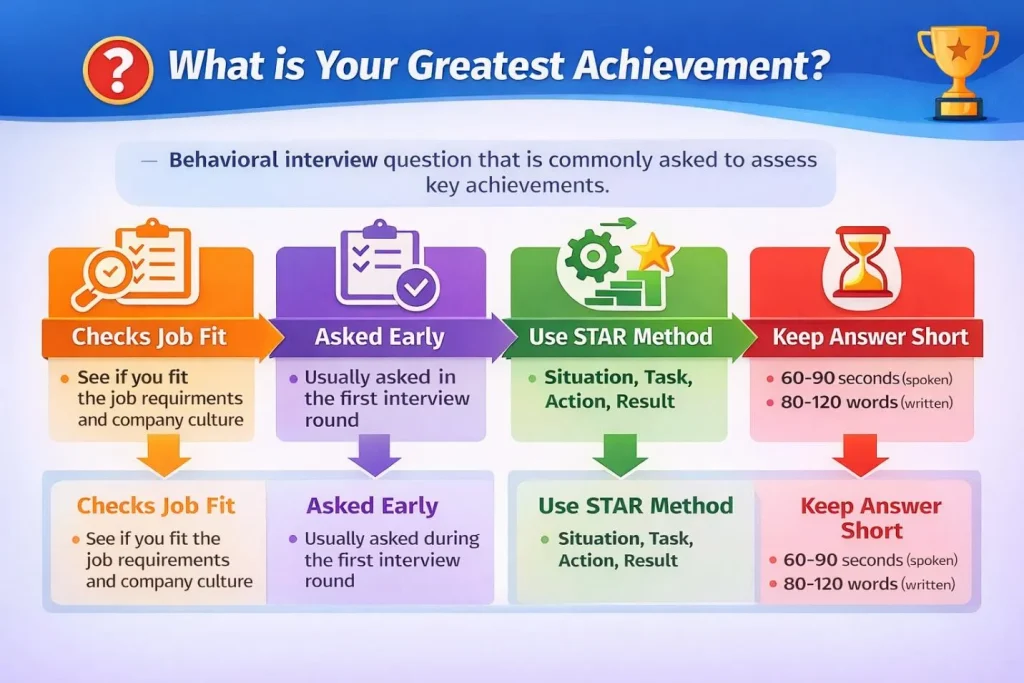
“What are your greatest achievement?” is a common behavioural interview question recruiters ask to understand your job fit. This simple question reveals a lot about you:
- What you consider important
- How you measure success
- Whether you are a strong match for the role
That is why it is important to answer this question in a smart way. For example, you need to choose an achievement that connects with the job you want. You also need the STAR method to give your answer a clear structure.
In this guide, we will show you the right steps to answer the interview question “what is your biggest achievement?”. You will also find sample answers for freshers and experienced professionals that you can easily edit for your own interview.
“What Is Your Greatest Achievement?” – Example of a Good Answer
Here is a “What is your greatest professional achievement?” answer example to show you what works and how recruiters like to hear it.
“In my last role as an IT Support Engineer, our internal app used to crash when large data reports were opened. This created delays for the team and more tickets for support. I checked the logs and found the issue was caused by repeated API calls running in a loop. I fixed the loop, optimised the API request, and tested the update for 10 days in real usage. After the fix, app crashes dropped by 65% and support tickets reduced by 19% in the next development cycle. My team lead asked me to document the solution so others could apply the same logic in similar services. This was my biggest achievement because it solved a real problem and improved the experience for both users and the IT team.”
Why this is a good answer:
- Talks about a real problem
- Shows the exact fix you made
- Shares clear results with numbers
- Highlights your personal role, not the team’s role
- Stays short and focused
- Sounds confident and well-prepared
- Does not exaggerate or sound unsure
“What Is Your Greatest Achievement?” – Example of a Bad Answer
Now let’s look at “What is my greatest accomplishment?” answers that fail and why recruiters reject them in interviews.
“In my last job, I worked on many IT tasks and fixed several computer issues. I also helped my team complete projects on time. I think my technical skills are good and I can handle pressure well. I don’t have exact numbers but my work was appreciated.”
Why this is a bad answer:
- Does not describe one real situation
- Gives no measurable result or proof
- Uses general claims instead of facts
- Does not show your direct impact
- Too broad and does not help the recruiter picture your skills
Why Do Interviewers Ask “What Are Your Greatest Achievements?”
Recruiters ask the biggest accomplishment interview question to understand how you talk about your past work. It shows what kind of success you value and how well your skills connect to the role.
Here are the main reasons they ask “What is my biggest achievement?” interview question:
- Understand your priorities: The achievement you choose tells recruiters what matters most to you. It shows if you care about results, learning, teamwork, or growth. This helps them check if your idea of success matches the job.
- See your work approach: The biggest achievement interview answer explains how you move from a goal to a result. Do you plan first? Do you test ideas? Do you adjust when needed? This question reveals your process, and that matters more than the size of the achievement itself.
- Check ownership and responsibility: Recruiters want to hear moments where you stepped up without waiting to be pushed. A strong achievement answer shows that you take responsibility and do the work with purpose.
- Judge role fit: The answer helps recruiters match your skills and strengths to the job. They want to see if your success connects to the role. This helps them decide if you are a good fit for the team and the company.
- Test how well you explain success: Even a great accomplishment can lose value if explained poorly. This question checks if you can talk about your win in a clear and confident way. Rambling or sounding unsure reduces the power of the story.
- Look for logic you can repeat: Recruiters want to know if your success came from a method. If your answer shows steps that can be repeated in another role or company, it builds trust. If it sounds random or accidental, it creates doubt.
- Spot mistakes in your answer: This question also tests what you do not do. Long answers, exaggeration, blame, or putting others down are common mistakes that make candidates lose marks. Recruiters check if you avoid these red flags while explaining your proudest moment.
Different Ways Interviewers Ask This Question
Recruiters rarely ask this question in one fixed sentence. They change the wording based on the interview stage and the response style they want from you. Here are the different ways in which recruiters ask “What is my biggest achievement?” question in interviews:
- What are your greatest achievements?
- What is your biggest achievement so far?
- What is the achievement you are most proud of?
- What is your biggest win?
- Share one accomplishment that challenged you the most.
- If I ask your manager about your best work, what would they say?
- Which achievement shows your strengths best?
- What is the result you are most proud to talk about?
- What is your greatest professional accomplishment?
- Share a success that you worked hard for.
- Describe a goal you achieved and the result.
How to Prepare for “What Is Your Greatest Achievement?” Interview Question
Answering “What is my biggest achievement?” interview question becomes easier when you prepare in advance. Here are the steps you can follow to frame your answer properly:
- Make a list of your strongest wins Start by writing down achievements that represent your strongest work. These can come from jobs, internships, academics, or side projects. The goal is to reflect on moments where you did something meaningful. This list gives you options to choose from and helps you remember your story without stress.
- Check the job description and research the company Read the job description and research the company before you lock your example. Check what skills are required. See what kind of work the company highlights publicly. Understand how they talk about success. This step stops you from choosing something unrelated or outdated.
- Choose one achievement to focus on Pick the one that best connects to the job. It does not need to be the biggest win of your life. It needs to be the one you can explain clearly. A good choice shows relevance and understanding. The interviewer should feel that your story makes sense for the role.
- Break it into STAR notes This is the most important step in preparing for the biggest accomplishment interview question. Once you choose the right achievement, you need to break the story as per the STAR method. Write 4 short notes for yourself:
- Situation: What was happening?
- Task: What was the goal?
- Action: What did you do?
- Result: What changed?
- Keep your answer within the right length Your biggest achievement interview answer should be short but interesting. Aim for 80 to 120 words if you write it. When spoken, your answer should fit into 60 to 90 seconds. This keeps the answer strong and avoids rambling.
- Practice the answer out loud “What is my greatest accomplishment?” is a question where you need to adjust your body language as well as your tone. That’s why it is important to practice the answer out loud. Speak it 4 to 5 times slowly first. Then speak naturally like you are explaining something to a person, not memorising a script.
- Prepare 2 to 3 backup achievements Sometimes interviewers may ask for more than one achievement, or they may rephrase the question like “What are your greatest achievements?” So, make sure you prepare for 2 to 3 backup examples to keep you from panicking. A second story also helps you adjust to the flow of the conversation.
- Test the realism of your result After writing your draft answer, read it again. Put yourself in the recruiter’s shoes and ask yourself: Can someone picture this happening? Is the result clear? Is it believable? If your result feels unclear, replace it with a real outcome you can explain in one line. Numbers help but only if they are real and logical.
- Remove common mistakes from your draft Many candidates lose marks here. So, make sure you avoid these errors:
- Picking achievements that are too old
- Sharing unrelated stories
- Giving vague credit like “people liked it”
- Sounding unsure about your role
- Blaming others to make your story sound better
- Check if your answer reflects repeatable skills Your achievement should show skills you can apply again in another job. Recruiters trust answers that show learning and logic. If your story feels like luck or a one-time moment, reshape it so the recruiter can see the skills behind it.
Also Read – Behavioural Interview Questions: Examples, Answers and STAR Tips
How to Answer “What Is Your Greatest Achievement?” in Interviews
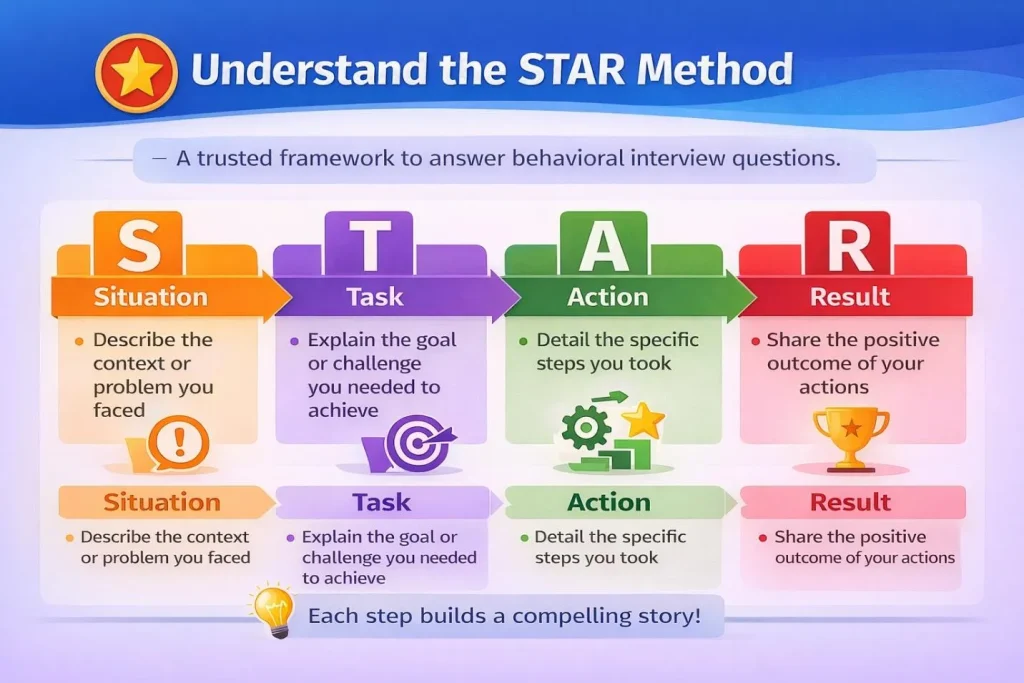
The biggest achievement interview answer should always follow the STAR methodology. This is how you should answer the question to impress recruiters:
- Explain the situation The Situation part sets the stage of your answer. This is where you briefly explain the background so the recruiter understands the moment. It should clearly describe the problem or opportunity you faced.
Example: “In my previous role, the login service failed randomly when traffic increased after feature updates. Users were logged out automatically and sessions expired too fast. The engineering team kept delaying releases because the failure risk was constant.” - Describe the task The Task part explains your role in the story. It tells the recruiter what responsibility you had at that moment. This line should be short and focused. It should show the goal you were trying to achieve or the problem you needed to solve.
Example: “My responsibility was to find the exact cause, ship a fix before the next sprint release, and improve stability without increasing server costs.” - Talk about the action you took The Action part carries the most weight in “What is your biggest accomplishment?” answer. This is where you explain the steps you took and the decisions you made. Recruiters want to hear what you did and how you did it. This part should show your involvement clearly.
Example: “I reproduced the failure in a test environment by running live-like traffic for 48 hours. This confirmed the crash pattern. I traced the root issue to an unclosed session handler and repeated validation loops. I rewrote the session logic, closed the loops, and added a guard that triggered a session reset before memory crossed the limit. I tested the fix in small batches for 10 days and reviewed logs manually every evening to confirm stability. Once tests held strong, I deployed the patch gradually using mirrored routing so users never felt disruption mid-session.” - Explain the result The Result closes your story. This is where you show the outcome of your work. Recruiters want results that change something measurable. It can be time saved, performance improved, crashes reduced, cost cut, or adoption increased. Keep it factual and use numbers to show real impact.
Example: “In the next sprint cycle, system crashes dropped by 49% and releases shipped without repeating the same instability risk again.”
Formula to Answer “What Are Your Greatest Achievements?”
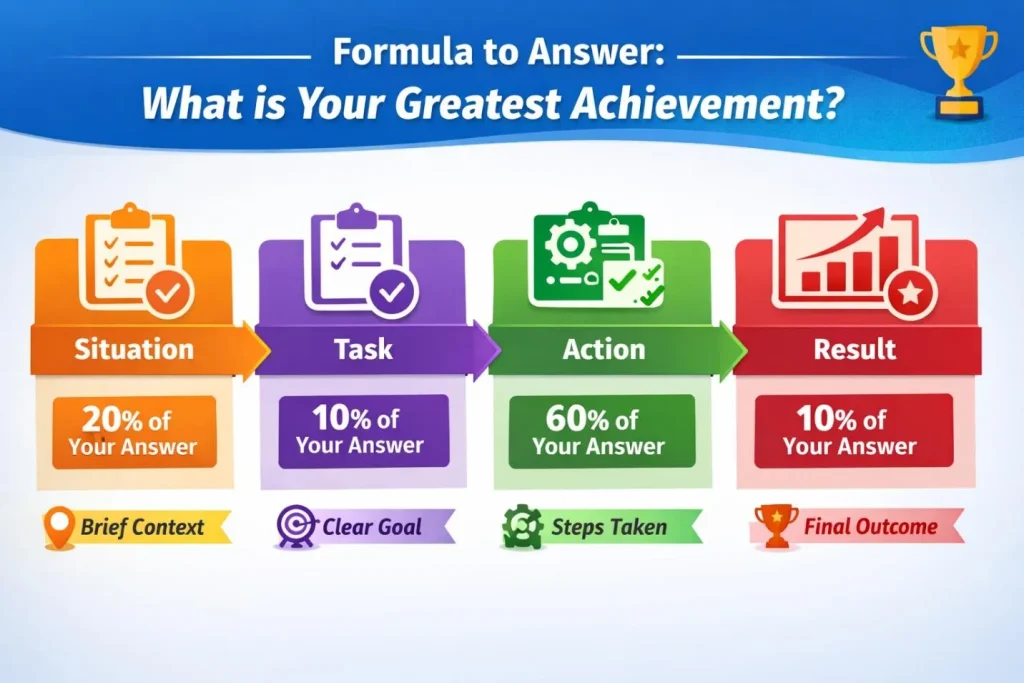
Here is a simple formula you can follow when answering “What is my biggest achievement?” interview question:
- Situation = 20% of your answer
- Task = 10% of your answer
- Action = 60% of your answer
- Result = 10% of your answer
You can use this formula to build your answer like a clear short story that feels real and easy to explain in an interview.
“What Is Your Greatest Achievement?” Answer Template
This template helps you shape one real achievement into a short interview answer that sounds natural and easy to explain.
In my role as a ___ the team faced ___ (problem or goal). My responsibility was to ___. I ___ (steps you took, keep it simple). The result was ___ (measurable or visible difference). I’m proud of this because ___ (why it mattered and what skill it proved).
Here is a “What is your biggest achievement?” sample answer based on the template:
“In my role as a QA Automation Engineer, the team faced a 27% increase in post-release bugs because testing was mostly manual. My responsibility was to automate the core regression suite before the next release cycle. I built a clean test automation flow using Selenium and API test coverage, created daily auto-triggered test runs, and validated them for 14 days using real project modules. The result was a 62% drop in regression bugs and the release cycle shipped 8 days faster than before. I’m proud of this because the improvement was measurable and the method was clear enough to repeat in another role.”
“What Is Your Greatest Achievement?” Sample Answers
Below are practical “What is your biggest achievement?” sample answers to inspire your own story. We are sharing my greatest achievement examples for freshers and experienced professionals.
“What Is Your Greatest Achievement?” Sample Answers for Freshers
Let’s take a look at “What is your biggest achievement?” sample answers for freshers.
- Sample Answer 1: “My biggest accomplishment as a fresher came from taking ownership of a critical deployment challenge. During my internship, deployment steps were scattered across messages, and key details were missed often. I converted 400+ lines of chat into a clear 12-step deployment guide, added version labels, risk flags, and rollback paths, then reviewed it with a senior engineer for one full week. In the next release, 2 major deployment failures were avoided and integration issues dropped by 28%. I’m proud of this because it showed careful planning early in my career.”
- Sample Answer 2: “In my final semester, our major project was missing proper test coverage, which led to repeated errors in every demo. I took ownership of fixing it. I created a simple test plan, mapped the most important user paths, split checks across teammates, tracked progress daily, and ran final test cycles on real modules for 12 days. The defect count fell by 46% compared to the first demo, and the professor ranked our work in the top 5 submissions.”
- Sample Answer 3: “My biggest achievement so far was earning the Top Performer Intern Award in a company challenge for spotting an emerging customer trend and presenting it with data support. I studied 3 customer groups, analysed 9 competitors, cross-checked insights with two survey data sets, and presented 5 key findings in a 7-slide brief to the leadership panel. My work was selected as the most accurate among 22 interns.”
“What Is Your Greatest Achievement?” Sample Answers for Experienced Professionals
Here is “What is your greatest professional achievement?” answer examples for your inspiration.
- Sample Answer 4: “One of my biggest achievements was delivering a product module that kept failing UAT due to unstable logic in edge cases. I rebuilt the test logic, partnered with the dev owner, ran 120+ scenario sweeps, added automated guardrails, and documented failure-proof paths. The next UAT cycle passed in the first attempt, and stakeholder sign-off came 2 weeks earlier than expected. This win mattered because it showed technical ownership and the ability to ship reliable work without supervision.”
- Sample Answer 5: “One achievement I stand behind is leading a cross-border client rollout that had 6 time zones, 14 decision makers, and a 90-day delivery contract. I created a staged rollout map, built risk mitigation flows, held structured handovers, trained internal champions, and tracked rollout accuracy every week. The launch hit 100% adoption across all planned regions and delivered 19% lower support cost than forecast. This felt important because my managers were genuinely happy with the outcome. My juniors said it inspired them to think in a clearer way and it pushed me to mentor them after the launch.”
- Sample Answer 6: “A career milestone I’m proud of started with a setback. A major client delivery failed because leadership changed suddenly and accountability was unclear. I stepped in to lead the recovery. First, I rebuilt communication channels with the client. Then I created a clear ownership plan so every dependency had a responsible backup owner. For the next 3 months, I supervised progress in weekly cycles and removed roadblocks before they grew. The project was delivered 6 days before the renegotiated deadline, all SLA penalties were waived, and the CEO panel publicly appreciated the work.”
Tips to Answer “What Is Your Biggest Achievement?”
“What is your biggest accomplishment?” answer can be your key to impress hiring managers during an interview. Here are a few tips to help you get it right.
- Pick a story you can explain without getting stuck
- Use results that show an actual difference
- Keep the focus on your role
- Highlight who benefited from your work
- Add one number or timeline to make it believable
- Keep your language calm and natural
- Avoid mixing failures into the success story
- Do not repeat the same achievement in every interview
- End with a skill that can work again in another job
- Show that the achievement connects to real work
- Keep it short enough to hold attention
Common Mistakes to Avoid When Answering “What Are Your Greatest Accomplishments?”
The biggest achievement interview answer fails when it sounds rehearsed or too generic. Avoid these common mistakes when answering “What is my greatest accomplishment?”
- Telling multiple stories in one answer
- Making the win sound accidental
- Using dramatic or emotional buildup
- Giving unclear timelines
- Repeating the same point again and again
- Turning the answer into a long speech
- Adding compliments instead of impact
- Using fake or rounded-off numbers
- Using achievements that need heavy context
- Adding negative comments about past teams
Wrapping Up
And that’s how you answer the interview question “What is your greatest achievement?” This question is very common, and there is a high chance you may hear it in your next interview. Use this guide and the sample answers to prepare better when asked “What is your biggest achievement?”
If you need more help with interview practice or want to find top IT jobs in India, visit Hirist. It is a trusted IT job portal where you can find the latest tech roles from top IT companies across India. Hirist blogs also share common interview questions, sample answers, and interview advice guides to help you prepare smarter.
Related reads: Why Should We Hire You? Best Answers | Why Do You Want to Join Our Company? | Top 10 Answers for Reason for Job Change | How to Introduce Yourself in an Interview | Weakness in Interview: Best Examples and Answers
FAQs
Here are the tips you can follow to choose the best achievement: Pick one achievement that connects to the role you want. It should show a clear result and your direct contribution. Choose something you remember well so you can explain it easily. dd one real number, timeline, or visible improvement to make it believable. The best choice is the one that shows your skills and the impact you created in a clean and confident way.
If you don’t have any professional work-related achievements, use examples from internships, college, volunteering, freelance work, or personal projects. A strong answer is still possible when you explain your role clearly and show a result that sounds real and repeatable.
Choose five accomplishments that show variety in your skills. You can mix problem-fixing, ownership, learning, teamwork, and impact. Keep each one short and real.
Your top 10 achievements should highlight different strengths and skills. Here are some examples: Planning Innovation Speed ccuracy Impact on people or process Pick achievements you can explain easily in 60 to 90 seconds if asked in interviews.
The best answer is one that tells a real story and explains your role clearly. It should clearly highlight the steps you took and end with a believable result or number without any exaggeration.
s a student, your greatest achievement can be anything like: Winning academic awards or competitions Securing scholarships through your grades Leading a college project or club Raising funds for a cause or charity Mentoring juniors or classmates Organising events on campus Volunteering and helping your community
Even if your biggest achievement isn’t impressive, you can still present it in a strong way by using the STAR method. For example, if your achievement is making a late college project successful, you can say: Situation: Project was late and unorganised Task: Took charge of final delivery ction: Split work, tracked progress, fixed gaps, supported teammates Result: Submitted 5 days early, got top 5 class rating
If you are unsure about your greatest achievement, do not overthink it. Think of moments where your work changed something. It can be small but real. Ask yourself:
Pick one moment you remember well, and turn it into a short story.
nswer with one clear story that shows what happened, your role, what you did, and what changed. Keep the result believable and add one number or timeline if possible.
fresher’s biggest achievement can come from internships, college projects, freelancing, learning a skill, leading a small team, improving a process, or finishing work before a deadline. The key is to pick one moment you can explain clearly and show one real result. You can use our “What is your greatest achievement?” sample answer for freshers to prepare your story.
If you have no job experience, your greatest accomplishment can come from internships and freelancing or volunteering and personal goals. Built something on your own Helped juniors or peers Managed an event or campaign Solved a problem in a team Learned a skill and used it Earned money for your studies Improved a process or outcome Finished work before deadline
Even if the result feels small, it can still be your biggest achievement if you explain it clearly and show the real difference your work made. Focus on the change Explain your role with clarity Share the steps dd one believable number or timeline Trim long stories into 4 short STAR lines Honest answer sounds better than big claims 13. What to do, if the interviewer asks “What are your greatest achievements?” Interviewers can frame the question differently and ask for multiple achievements instead of one. In that case, be ready with 4 solid stories that connect to the role. Make a shortlist of 4–5 achievements you can explain clearly. This protects you from last-minute stress and keeps your answer adaptable.