A team lead is a common job role in BPO and IT companies. The position bridges the gap between team members and managers by guiding daily work and supporting team performance. Team lead roles and responsibilities often vary across organizations based on team size and business goals. If you are considering this role, understanding team leader duties and responsibilities is essential.
This guide explains what a team lead does, including key duties, daily tasks, required skills, salary expectations, common challenges, and practical ways to succeed as a team leader.
What is a Team Leader?
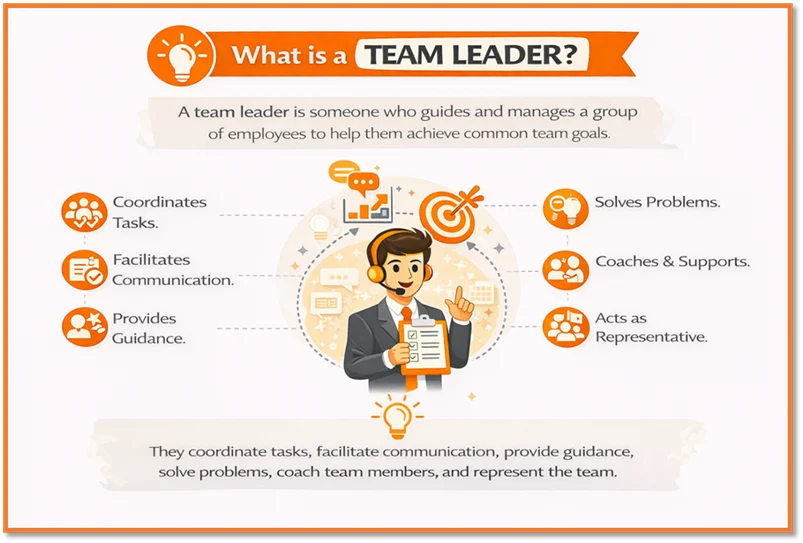
Cambridge Dictionary defines a team leader as “the person in charge of a team.” This simple definition highlights the position within an organization. A team leader is an individual responsible for leading a group of people to achieve specific goals and holds a formal or informal leadership title. The team leader plans and coordinates daily activities, guides employees, monitors performance, and supports work based on defined objectives. The role also involves acting as a link between the ground-level workforce and management to support smooth operations and effective communication.
What Does a Team Lead Actually Do?
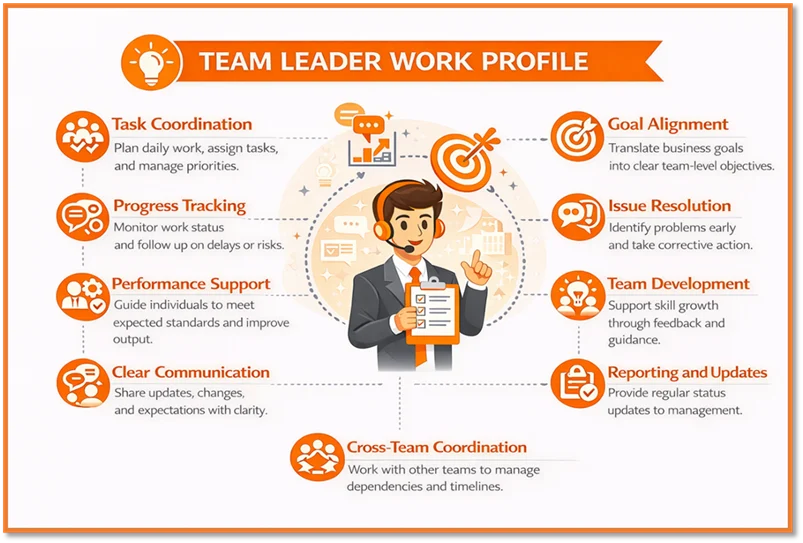
A team lead work profile centers on managing day-to-day execution while supporting people and performance. Unlike individual contributors, team leads are responsible for how work flows across the team and how goals are met within set timelines.
Core Areas of a Team Leader Work Profile
The roles and responsibilities of a team leader generally fall into three main areas:
1. Coordinating Daily Work
A team lead plans and distributes tasks, sets short-term priorities, and tracks progress to keep work moving forward. This includes adjusting workloads, handling dependencies, and addressing delays that affect delivery.
2. Supporting Team Performance
Team lead responsibilities include monitoring performance, providing guidance, and helping employees stay aligned with expectations. This often involves regular check-ins, feedback, and identifying areas where support or improvement is needed.
3. Acting as the Operational Link
A team lead serves as the point of connection between the workforce and management. They communicate updates, escalate issues, and translate higher-level goals into actionable tasks for the team.
Together, these responsibilities define the practical scope of a team leader’s role and explain why the position requires both people management and execution-focused skills.
Difference Between a Team Lead, Manager, Supervisor, and Project Manager
These roles are often confused because they work closely together, but they serve different purposes. Understanding these differences helps clarify team lead responsibilities and the overall responsibility for a team leader within an organization.
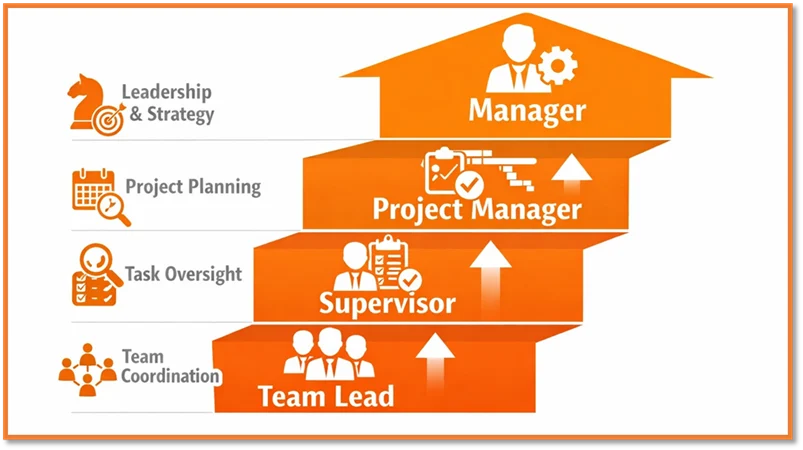
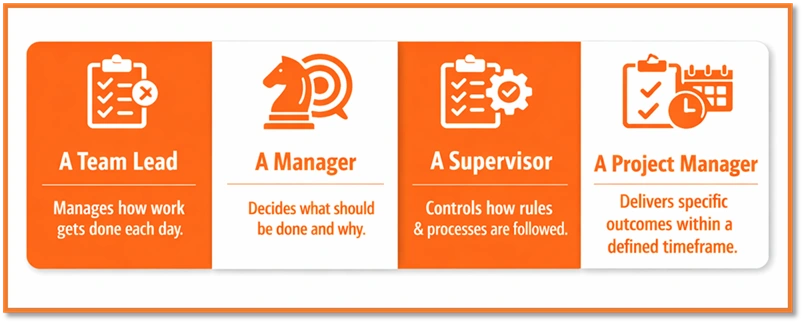
Team Lead vs. Manager vs. Supervisor vs. Project Manager
| Aspect | Team Lead | Manager | Supervisor | Project Manager |
|---|---|---|---|---|
| Primary focus | Daily execution and people coordination | Strategy, planning, and results | Operational control and compliance | Project delivery |
| Scope of work | Ongoing team work | Department or multiple teams | Shift or operational unit | Specific project |
| Authority level | Limited formal authority | High decision-making authority | Moderate authority | Authority limited to project scope |
| Accountability | Team output and performance | Business outcomes and targets | Process adherence and discipline | Timelines, budget, and deliverables |
| People management | Yes | Yes | Yes | Limited or indirect |
If you’re also exploring related roles, see our guide on Program Manager Interview Questions and Answers and Project Management Interview Questions and Answers.
6 Key Roles of a Team Lead in 2026
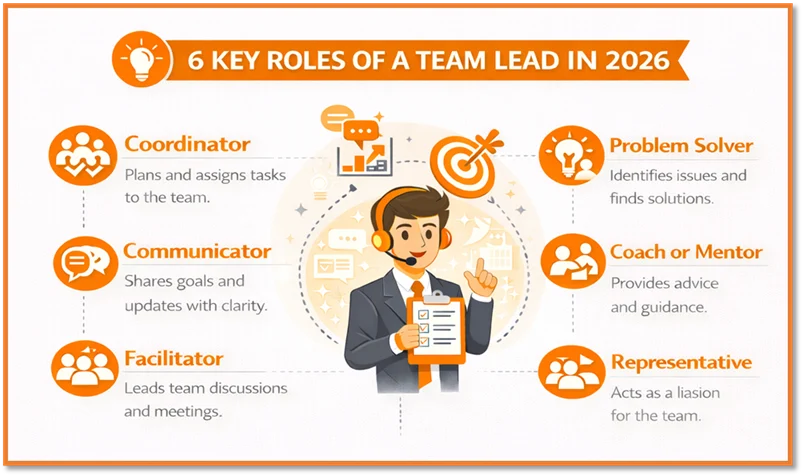
A team lead does not operate in a fixed capacity. Instead, the position requires switching between multiple functional roles depending on the situation and team needs. Understanding these roles helps clarify why team leader duties and responsibilities often feel broader than expected and why the position requires both people-focused and execution-oriented thinking.
1. Coordinator
As a coordinator, the team lead brings structure to daily work. They help align people with priorities, organize timelines, and clarify what needs attention first. When multiple tasks or dependencies exist, the team lead helps prevent confusion by keeping everyone focused on the same direction. Many team leader duties rely on coordination to keep work moving without constant supervision.
2. Communicator
In this role, the team lead becomes the main channel through which information flows. They pass expectations from management to the team and share updates or concerns in the opposite direction. Clear communication helps avoid misunderstandings and keeps work aligned, which is why communication is a core part of team lead roles and responsibilities in most organizations.
3. Facilitator
The facilitator role focuses on helping people work together effectively. Instead of making every decision, the team lead supports discussions, helps teams reach clarity, and removes friction during collaboration. Many team leader tasks involve facilitating conversations, especially when teams include experienced professionals or work across functions.
4. Problem Solver
As a problem solver, the team lead steps in when issues affect progress or teamwork. These issues may involve delays, coordination gaps, or interpersonal concerns. The focus here is on understanding the situation, identifying workable solutions, and helping the team regain momentum. This explains why team leader duties and responsibilities often require judgment rather than rigid rules.
5. Coach or Mentor
In the coaching role, the team lead helps individuals improve over time. This includes guiding employees through challenges, offering feedback, and supporting skill development. Coaching plays an important role in team lead responsibilities, especially in teams where growth and consistency matter alongside delivery.
6. Representative
As a representative, the team lead speaks on behalf of the team in discussions with management and other groups. They provide context about team progress, raise concerns, and share feedback from the team. This role helps align expectations on both sides and remains an essential part of team lead roles and responsibilities.
10 Core Responsibilities of a Team Lead (Day-to-Day Duties)
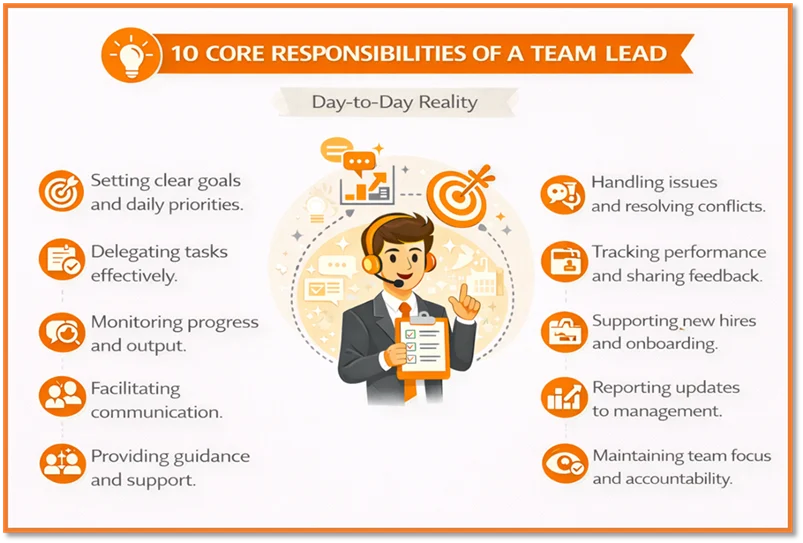
The day-to-day responsibilities of a team lead focus on execution, coordination, and people support. This section explains the actual team leader tasks and duties that differentiate strong team leads from average ones.
1. Setting Clear Goals and Daily Priorities
One of the most important team leader duties is helping the team understand what needs to be done each day. Team leads receive broad goals from management and convert them into specific actions the team can execute. This includes deciding what matters now, what can wait, and what needs clarification. Strong team leads create focus and direction without rewriting strategy.
2. Delegating Tasks Effectively
Delegation is a core part of team leader tasks. Team leads assign work based on skills, experience, and current workload rather than distributing tasks evenly. Effective delegation helps maintain productivity while also supporting learning and growth. Team leads stay involved through follow-ups and guidance without taking back ownership of tasks.
3. Monitoring Progress and Output
Tracking progress is a daily team lead responsibility. Team leaders review timelines, quality, and completion status to identify risks early. This may involve reviewing updates, checking deliverables, or having quick discussions to understand where support is needed before delays or issues escalate.
4. Facilitating Communication
Clear communication is one of the most consistent team leader duties. Team leads share updates, clarify changes, and make sure information flows smoothly between the team and management. This responsibility includes leading short meetings, addressing questions, and helping avoid misunderstandings that can slow work or create confusion.
5. Providing Guidance and Support
Team leaders regularly support employees who need direction or clarity. These team leader tasks include answering questions, offering suggestions, and helping individuals overcome challenges in their work.
Support does not mean constant supervision. It means being available when guidance is needed to keep work moving forward.
6. Handling Issues and Resolving Conflicts
Problems are part of daily work, and addressing them is a key team lead responsibility. Team leads step in when issues affect collaboration, delivery, or morale. This includes resolving misunderstandings, adjusting workloads, or facilitating discussions to restore alignment and maintain a healthy working environment.
7. Tracking Performance and Sharing Feedback
Providing regular feedback is an important team leader duty. Team leads observe performance, recognize good work, and share improvement suggestions when needed. This ongoing feedback helps individuals stay aligned with expectations and improves overall team consistency.
8. Supporting New Hires and Onboarding
Team leads often support onboarding by helping new employees understand workflows, tools, and team practices. These team leader tasks help new hires settle into the team more quickly. Early guidance reduces errors and builds confidence during the initial transition period.
9. Reporting Updates to Management
Keeping management informed is part of daily team lead responsibilities. Team leads share progress updates, raise concerns, and provide context about team performance. This responsibility helps management make informed decisions while keeping expectations realistic.
10. Maintaining Team Focus and Accountability
Team leaders help teams stay focused on priorities despite distractions or changing demands. This team leader duty involves reinforcing expectations and maintaining accountability without micromanaging. Consistency in this area helps teams perform reliably over time.
Team Lead Responsibilities in Technical and IT Teams (Tech Lead Responsibilities)
In IT and software teams, a team lead combines technical understanding with delivery ownership. An IT team lead supports engineers, keeps work on track, and helps teams deliver reliably without acting as a full-time developer or architect.
1. Guiding Technical Implementation
Core tech lead responsibilities include guiding implementation choices and validating whether the approach fits the team’s standards. This may include reviewing code changes, checking design decisions, and flagging risks before they become costly to fix.
2. Managing Software Delivery and Deadlines
In team lead roles and responsibilities in software development, delivery tracking is a daily expectation. Team leads monitor sprint progress, manage dependencies, and remove blockers so deadlines stay realistic and delivery remains predictable.
3. Supporting Developers and Engineers
Many technical lead responsibilities show up in day-to-day guidance. Team leads answer questions, review work when needed, and help less experienced engineers improve through practical support rather than constant supervision.
4. Coordinating with Product, QA, and Release Teams
Common technology lead responsibilities include aligning engineering work with product priorities and testing needs. Team leads coordinate with product, QA, and sometimes DevOps to confirm requirements, testing readiness, and release alignment.
5. Maintaining Code Quality and Basic Standards
A key part of technical lead duties is protecting code quality at a team level. This includes reinforcing basic standards around documentation, testing, and clean implementation so the codebase remains stable and easier to maintain.
6. Reporting Key Performance Indicators (KPIs)
Reporting KPIs is an important responsibility in technical teams. Team leads track delivery progress, sprint completion, defect trends, and other relevant metrics, then share updates with management to provide visibility and surface risks early.
7. Communicating Technical Risks and Handling Escalations
Many tech lead duties involve raising technical risks early, such as dependency delays, quality concerns, or scope changes. When complex issues occur, team leads escalate with context and help teams resolve problems without last-minute surprises.
If you’re moving into a technical leadership role, you may also find these useful: Top 30 System Design Interview Questions and Top 25 Incident Management Interview Questions.
Team Lead vs Tech Lead in IT Teams
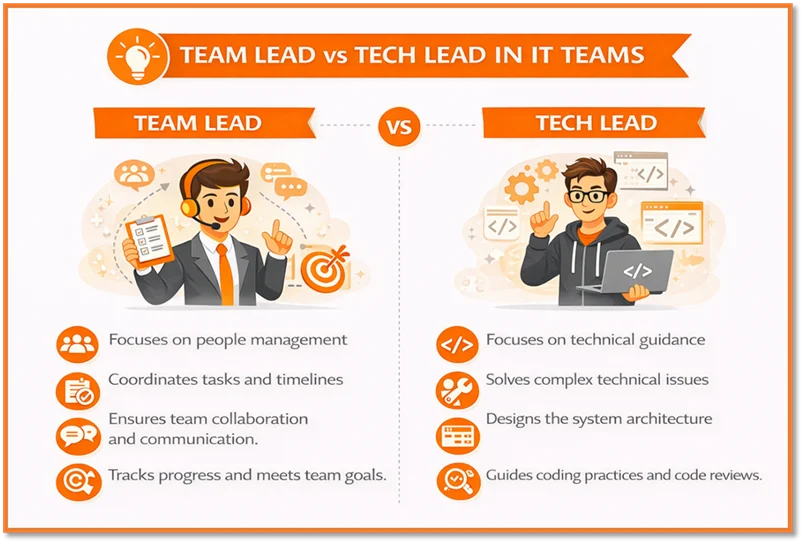
The titles team lead and tech lead are often used interchangeably, but the responsibilities and focus areas are different. Understanding this distinction helps clarify expectations and avoid role confusion, especially in growing technical teams.
| Area of Comparison | Team Lead | Tech Lead |
|---|---|---|
| Core purpose | Manage delivery and support people | Own technical direction and quality |
| Primary accountability | Team output and consistency | System design and implementation |
| Focus of daily work | Planning, coordination, follow-ups | Design reviews and technical decisions |
| People management | Regular involvement in guidance and feedback | Minimal or indirect involvement |
| Technical depth required | Working knowledge of systems | Deep expertise in architecture and code |
| Interaction with management | Frequent status and performance updates | Limited and technical in nature |
Skills and Qualities Every Successful Team Lead Needs in 2026
You need the right team leader skills to handle people and the pressure. While team leader qualities like patience and consistency shape your style, these skills determine how well you perform the role every day.
- Emotional intelligence: Understand people, manage stress, and build trust.
- Clear communication: Share goals and expectations without confusion.
- Active listening: Pay attention to concerns and respond with purpose.
- Problem-solving: Spot issues early and act with practical solutions.
- Decision-making: Make timely choices even with limited information.
- Time and priority management: Balance deadlines, meetings, and urgent tasks.
- Delegation: Assign work smartly and build team ownership.
- Analytical thinking: Use data and patterns to guide decisions.
- Continuous learning: Stay relevant as tools and work methods evolve.
- Data and KPI awareness: Track performance and explain results clearly.
- Remote and hybrid leadership: Keep distributed teams aligned and engaged.
- AI and tool adaptability: Use automation and AI to improve productivity.
Fun Fact: About 48% of employees value emotional intelligence in leaders, while 44% place importance on strong conflict management skills.
What You Are Actually Accountable for as a Team Lead (KPIs & KRAs)
The responsibility for team leader extends beyond task coordination. A team lead is accountable for outcomes, even when decisions come from higher management.
Core Accountability Areas
As a team lead, you are accountable for:
- Work delivery – Deadlines, quality, and follow-through
- Team performance – Consistency, effort, and output
- Issue handling – Early identification and resolution
- Communication flow – Clear and timely updates
- Escalation control – Raising risks with context
KRAs and KPIs That Measure This Accountability
Organizations define a KRA for team leader roles around results, not activities. These KRAs show where impact is expected, while KPIs track performance.
Common Key Result Areas (KRAs) include:
- Delivery reliability
- Team productivity and stability
- Process adherence
- Communication effectiveness
- Issue and risk management
Typical KPIs used:
- Task or sprint completion rate
- Quality or defect metrics
- Timeline adherence
- Team availability and workload balance
- Stakeholder feedback
Common Mistakes New Team Leads Make
Many first-time team leads struggle not because of lack of effort, but because they repeat avoidable mistakes during the transition from individual contributor to leader.
- Doing everything yourself
- Micromanaging the team
- Avoiding difficult conversations
- Unclear expectations
- Poor time management
- Ignoring team input
- Not escalating issues early
- Focusing only on delivery
- Leading like a senior contributor
Key Challenges Team Leaders Face in 2026
As work environments change, team leaders face new challenges that go beyond traditional people and task management, especially with changing technology and work models.
- Managing remote and hybrid teams – Keeping visibility, alignment, and engagement without physical presence.
- Balancing delivery with wellbeing – Meeting targets while preventing burnout and overload.
- Handling constant change – Adapting quickly to shifting priorities, tools, and processes.
- Using AI and automation effectively – Adopting new tools without disrupting workflows or skills.
- Managing performance without authority – Driving accountability without formal managerial power.
- Information overload – Filtering important updates from constant messages and data.
- Upskilling the team continuously – Keeping skills relevant as roles and tools evolve.
- Cross-functional dependency pressure – Relying on other teams to deliver shared outcomes.
- Maintaining team morale – Keeping motivation steady during uncertainty and change.
Read more on this topic: Hybrid Work Model in the IT Industry and Top 20 Change Management Interview Questions.
How to Succeed in Your First 90 Days as a Team Lead
The first 90 days set the foundation for your leadership credibility. Here are the tips you can follow to succeed as a team lead during the early phase of your career.
30-60-90 Day Action Plan for New Team Leads
| Timeframe | Primary Focus | What You Should Do |
|---|---|---|
| First 30 Days | Learn and observe | Understand team workflows, tools, and expectations Meet team members one-on-one Listen more than you speak Clarify goals with your manager |
| Days 31 to 60 | Build structure and trust | Start delegating work Introduce simple routines like regular check-ins Give early feedback Address small issues before they grow |
| Days 61 to 90 | Improve and optimize | Refine processes Improve delivery consistency Support skill development Align team goals clearly with business priorities |
Team Lead Salary: What to Expect
Team Lead salary overview
| Typical salary range | ₹9.5 L/yr – ₹10.5 L/yr |
| Experience range | 2 – 12 years |
| Avg. salary | ₹10 L/yr |
| Top 10% earn | ₹20.2 L/yr |
| Top 1% earn | ₹36 L/yr |
Team lead compensation varies based on experience, industry, location, and company type. Since team lead roles and responsibilities combine execution, coordination, and people management, salaries usually sit above individual contributor roles but below full management positions.
Below is a clear breakdown of what team leads can expect in India. We have taken the salary data from AmbitionBox.
Average Team Lead Salary in India
| Salary Metric | Amount |
|---|---|
| Average salary | ₹10 LPA |
| Typical range | ₹9.5 LPA – ₹10.5 LPA |
| Top 10% earners | ₹20.2 LPA |
| Top 1% earners | ₹36 LPA |
Team Lead Salary by Experience Level
| Experience | Average Salary |
|---|---|
| 1–3 years | ₹4.2 LPA |
| 3–6 years | ₹6.2 LPA |
| 6–9 years | ₹10.4 LPA |
| 9–12 years | ₹13.8 LPA |
| 12+ years | ₹15.2 LPA |
Team Lead Salary by Industry
| Industry | Average Salary |
|---|---|
| IT Services & Consulting | ₹14.5 LPA |
| Financial Services | ₹11.3 LPA |
| Banking | ₹7.7 LPA |
| Internet Companies | ₹5.6 LPA |
| BPO | ₹5.5 LPA |
Team Lead Salary at Top Companies
| Company | Average Salary |
|---|---|
| Accenture | ₹16.9 LPA |
| JPMorgan Chase & Co. | ₹11.3 LPA |
| TCS | ₹9.8 LPA |
| Tech Mahindra | ₹9.6 LPA |
| Wipro | ₹9 LPA |
Negotiating your next role? Read – Salary Negotiation: How to Negotiate Salary with HR
How to Become a Team Leader? Career Path and Progression
Becoming a team leader is usually a gradual transition, not a sudden promotion. Most organizations promote professionals who already show leadership behavior before assigning the title.
What Are the Educational Qualifications Required to Become a Team Leader?
There is no single mandatory qualification, but most employers expect a Bachelor’s degree in fields like management, engineering, commerce, IT, or business. You might also opt for professional certifications like:
- Leadership or people management courses
- Project management fundamentals
- Process or quality certifications (ITIL, Six Sigma, Agile basics)
Explore related certification guides: Top 25 ITIL Interview Questions and Answers and Top 15 Agile and Scrum Interview Questions and Answers.
Step-by-Step Career Path to a Team Lead Role
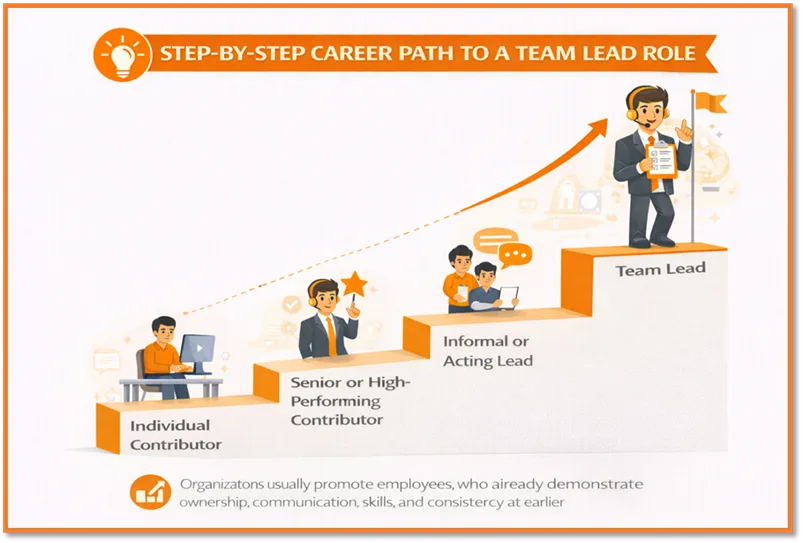
Most team leaders follow this progression:
- Individual contributor: You start in an execution-focused role such as analyst, executive, developer, or associate.
- Senior or high-performing contributor: You gain experience and become someone others depend on for guidance.
- Informal or acting lead: You begin supporting or managing small responsibilities during shifts or projects.
- Team lead: You take formal responsibility for daily execution, coordination, and people support for a defined group.
Organizations usually promote employees who already demonstrate ownership, communication skills, and consistency at earlier stages.
Quick Self-Assessment: Are You Performing Well as a Team Lead?
Use this checklist to evaluate how effectively you are handling your role. If you can answer “yes” to most of these, you are likely on the right track.
- Do your tasks and projects usually stay on schedule?
- Does your team understand priorities without repeated clarification?
- Are issues identified and addressed before they escalate?
- Do team members approach you for guidance or support?
- Is communication between your team and management clear and timely?
- Can you delegate work without stepping in to fix everything?
- Do you track performance using basic metrics or reports?
- Is your team’s workload balanced most of the time?
- Are expectations and standards consistent across the team?
Team Leader Job Description: Understanding Roles and Responsibilities
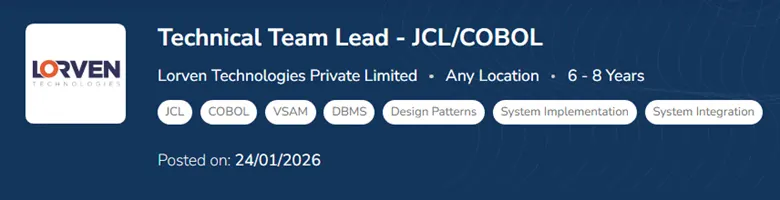
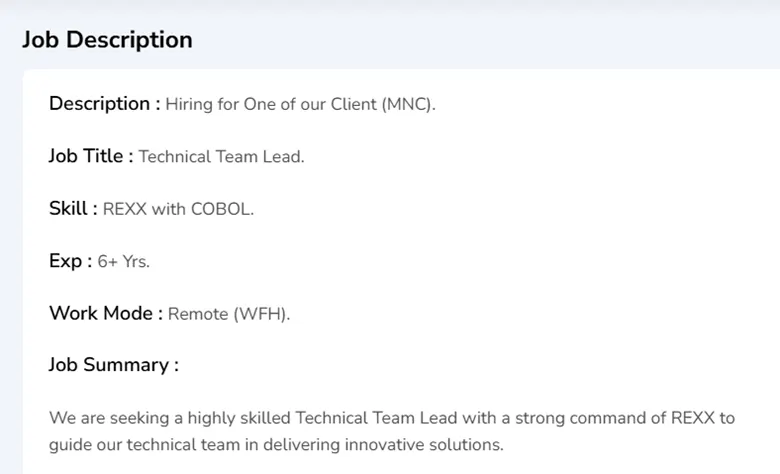
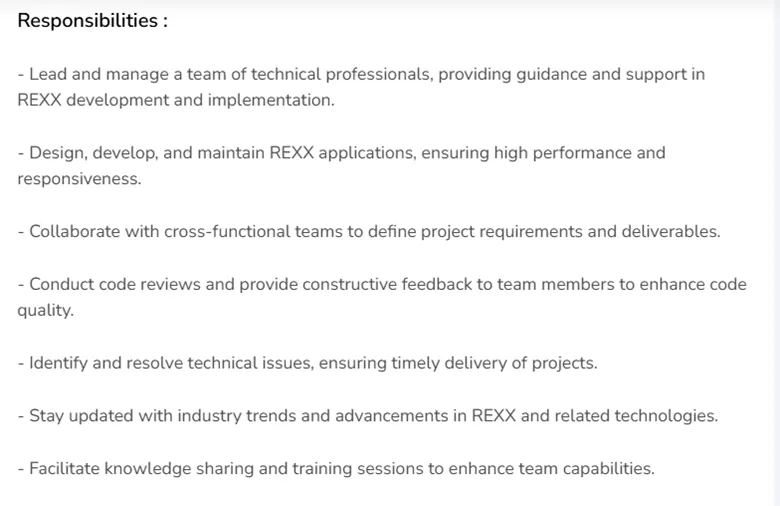
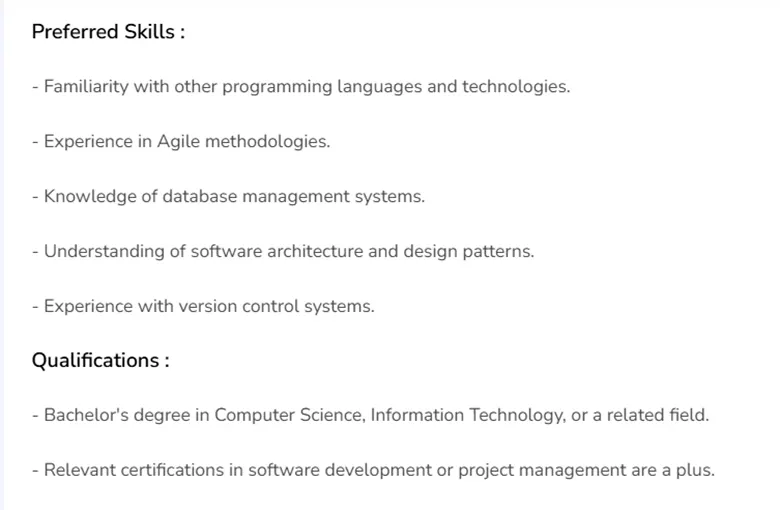
A team leader job description helps clarify what organizations expect from the role on a day-to-day basis. Since team lead roles and responsibilities vary across industries, job descriptions often outline duties, reporting structure, and performance expectations rather than rigid tasks. Below is an example of a team leader job description from a role posted on Hirist, a leading IT job portal in India.
Wrapping Up
Team lead roles and responsibilities demand clear ownership and sound judgment. The role focuses on guiding daily work, supporting people, and staying accountable for results. With clear expectations, a team lead can perform consistently and build a strong base for leadership growth.
If you are looking for team lead opportunities in technology driven roles, platforms like Hirist help connect professionals with companies hiring for high-impact leadership positions.
FAQs on Team lead roles & responsibilities
team lead is often considered an entry-level leadership role rather than full management. The position focuses on execution, coordination, and people support, while final authority usually remains with managers.
Team leader skills include strong communication, problem-solving, planning, and emotional awareness. A good team leader also knows as a team leader how to manage a team without relying on authority alone.
Here is a simplified example to help you understand how the role is presented in real hiring scenarios. “A Team Leader oversees daily operations for a small team, assigns tasks, tracks performance metrics, and acts as a point of contact between the team and management. The role involves coordinating work, supporting team members, handling escalations, and maintaining delivery timelines.”
Yes. Many professionals move from team lead to manager after showing consistency, ownership, and the ability to handle people and delivery together.
Team leader duties and responsibilities differ in scope. Duties refer to daily actions like meetings or reporting, while responsibilities focus on accountability for outcomes and team performance.
Yes. Most team leads influence work through communication, clarity, and trust rather than formal authority. This is common in IT, BPO, and operations teams.
Yes. In startups, team leads often handle broader execution and decision-making. In large organisations, the roles & responsibilities of a team leader are usually more structured and clearly defined.
Set clear boundaries early, stay fair, and focus on work outcomes. Lead through consistency and clarity rather than trying to assert authority.
Be direct and respectful. Explain context, focus on outcomes, and invite questions instead of issuing instructions without explanation.
ssign clear ownership, define expectations, and agree on checkpoints. Avoid stepping in unless progress or quality drops.
ddress issues privately and early. Focus on facts, impact, and resolution rather than intent or blame.
Professionals with consistent performance, strong communication skills, and the ability to support others can grow into a team lead role, regardless of background.