Next.js is a popular React framework used to build fast and scalable web applications. It was created by Vercel and first released in 2016 to solve common React problems like routing and performance. Today, it is widely used for websites, dashboards, and ecommerce platforms. Many companies hire developers for roles such as frontend engineer, full stack developer, and React developer with Next.js skills. That is why preparing the right Next.js interview questions is very important.
In this blog, you will find the commonly asked Next.js interview questions and answers with helpful tips.
Fun fact: According to a Statista report, Next.js is the fourth most used web framework in the world with 17.9 percent of developers using it.
Understanding the Next.js Interview Process
The Next.js interview process helps you understand the different interview rounds and what each stage focuses on.
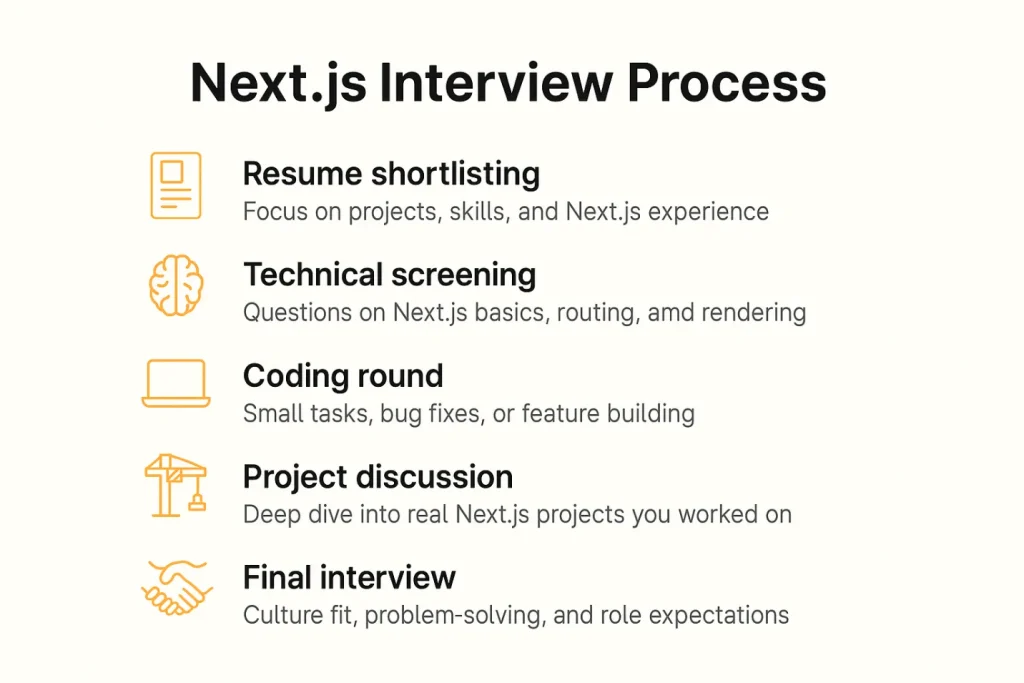
Note: We have covered examples of advanced and basic-level Next.js interview questions for both freshers and experienced professionals.
Next.js Interview Questions for Freshers
Here are the basic-level Next.js interview questions and answers that help freshers understand core concepts like routing, pages, components, and basic rendering.
1. What is Next.js and how is it different from using React alone?
Next.js is a React framework used to build fast web applications with built-in routing, server rendering, and modern deployment support.
React focuses only on the user interface. Next.js adds routing, rendering, data fetching, and performance features by default. It supports server rendering and static generation, which React does not provide on its own.
2. How does file based routing work in Next.js?
Next.js uses the folder structure to create routes automatically. Each file inside the pages or app folder becomes a route. For example, about.js maps to /about. Dynamic routes use square brackets like [id]. This removes the need for manual route setup.
3. What is the difference between server side rendering and static site generation in Next.js?
Server side rendering creates the page on every request. It is useful for dynamic data. Static site generation builds pages at build time. These pages load faster and work well for content that does not change often.
Here is a table explaining the difference:
| Feature | Server Side Rendering (SSR) | Static Site Generation (SSG) |
|---|---|---|
| When page is built | On every user request | At build time |
| Data freshness | Always up to date | Fixed until rebuild or revalidation |
| Performance | Slightly slower than static pages | Very fast |
| Use case | Dashboards, user specific pages | Blogs, landing pages |
| Next.js method | getServerSideProps | getStaticProps |
4. How do you create dynamic routes in Next.js?
Dynamic routes are created using bracket based filenames. For example, pages/blog/[slug].js handles multiple blog pages. The route parameter is accessed using the router or page props. This pattern is common in blogs and product pages.
5. What are API routes in Next.js and when would you use them?
API routes allow backend logic inside a Next.js app. Files inside pages/api or app/api become endpoints. They are used for form handling, authentication and database calls. No separate backend is required.
6. What is the purpose of the public folder in a Next.js project?
The public folder stores static files like images, fonts and icons. Files inside it are served directly by the browser. These assets do not go through the build process. This keeps loading simple and fast.
7. How do you add SEO meta tags to a page in Next.js?
In the App Router I use the metadata API to define titles and descriptions. In the Pages Router I use the Head component from next/head. This helps search engines read page content clearly.
Next.js Interview Questions for Experienced Professionals
These are intermediate and advanced-level Next.js interview questions for experienced professionals with answer examples.
8. When should you choose server side rendering over static generation in a real project?
Server side rendering is a better choice when content must change on every request. Examples include dashboards, user specific pages and authenticated views. It works well when data depends on cookies headers or session state. Static generation is not suitable in these cases because the data cannot be decided at build time.
9. How does Incremental Static Regeneration work and when is it useful?
Incremental Static Regeneration allows static pages to update after deployment. A page is rebuilt in the background after a set time using the revalidate option. Users still see a fast static page. This works well for blogs, product listings and content that changes but not every second.
10. How does the App Router differ from the Pages Router in Next.js?
The App Router and Pages Router are two routing systems in Next.js, and understanding their differences helps you choose the right approach for modern projects.
| Feature | App Router | Pages Router |
|---|---|---|
| Rendering model | Server first using React Server Components | Client focused with optional server rendering |
| Routing structure | Nested routing with layouts | Flat file based routing |
| Layout support | Built in layouts and loading files | Layouts managed manually |
| Streaming support | Supported by default | Limited support |
| Recommended usage | Preferred for new projects | Used mainly in older projects |
11. How do you handle authentication and protected routes in a Next.js application?
I handle authentication using middleware and server side checks. I protect routes by checking tokens or session data before rendering pages. For client access, I redirect unauthenticated users early. This avoids exposing protected content during page load.
12. What steps do you take to improve performance in a production level Next.js app?
Performance optimisation in Next.js focuses on reducing load time, improving rendering speed, and delivering content efficiently at scale.
- Choose static generation for pages that do not change often
- Use server rendering only when data must be fresh
- Split code with dynamic imports to reduce bundle size
- Serve images using the Image component
- Cache data at the edge for faster responses
- Reduce unnecessary client-side JavaScript
Next.js MCQs
Here are some frequently asked Next.js questions in MCQ form to help you quickly revise key concepts before interviews.
13. Which feature allows Next.js pages to be updated after build without a full rebuild?
A. Server Side Rendering
B. Client Side Rendering
C. Incremental Static Regeneration
D. Dynamic Imports
Answer: C. Incremental Static Regeneration
14. Which function runs on every request for server rendered pages?
A. getStaticProps
B. getStaticPaths
C. getServerSideProps
D. useEffect
Answer: C. getServerSideProps
15. Which folder is used to create backend endpoints in Next.js?
A. pages/components
B. pages/api
C. public/api
D. app/routes
Answer: B. pages/api
16. Which component is used for optimised image loading in Next.js?
A. img
B. ImageLoader
C. next/image
D. Picture
Answer: C. next/image
17. Which routing approach does Next.js use by default?
A. Hash based routing
B. Config based routing
C. File based routing
D. Manual routing
Answer: C. File based routing
Tips to Prepare for Next.js Interview
Here are some practical tips you can follow to prepare for Next.js interview questions and increase your chances of getting shortlisted.
- Revise how routing works in both Pages Router and App Router
- Be ready to explain one project in detail from setup to deployment
- Practice explaining SSR, SSG and ISR using real use cases, not definitions
- Know common interview mistakes, like wrong data fetching choices
- Review authentication, flow and protected routes logic
- Practice explaining performance fixes you actually used
- Take a look at common React JS interview questions
Wrapping Up
So, these are the top Next.js interview questions that can help you prepare with ease. Focus on core concepts and practical usage instead of memorising answers. Regular practice helps build confidence over time. If you are ready to take the next step, visit Hirist, where you can find the best IT jobs in India, including Next.js developer roles.
FAQs
You can find Next.js interview questions on GitHub repositories, as well as recent blogs and official documentation.
Yes, it’s essential to learn React basics before preparing for Next.js interview questions, as Next.js is built on React.
You can expect coding questions, such as building features, explaining project structures, or debugging issues, as well as questions on architecture, performance, and project decisions.