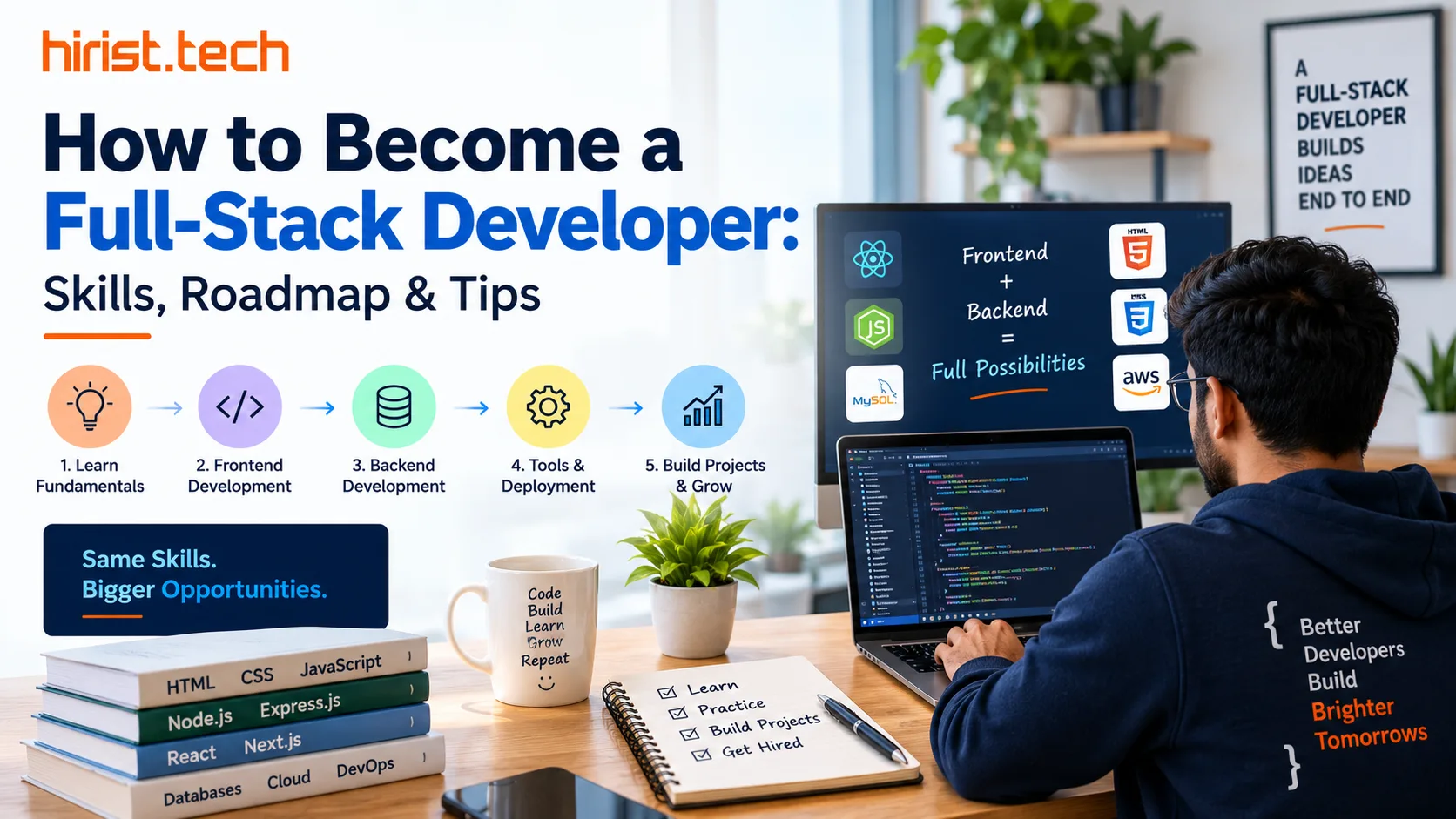
Starting a career in full-stack development can feel unclear in the beginning because there are many skills to learn and it is not always easy to know where to start. The good news is that you can follow a clear path even if you have no experience in this field. Full-stack development means you can build the parts people see on a website and the parts that run in the background. Companies value this skill because one person can manage more than one layer of work. This guide will show you how to become a full-stack developer from scratch by offering you a structured step-by-step roadmap with essential skills and practical tips.
What is a full-stack developer?
A full-stack developer is a professional who builds complete websites and applications. They work on both the frontend (the part users see) and the backend (the systems that store data and run the logic).
Full-stack developers are trained to work with multiple programming languages and tools so they can contribute to different stages of web development. This broad skill set allows them to build complete digital products from start to finish.
What full-stack developers actually do?
Full-stack developers handle both the frontend and backend to build complete digital products. Their role covers a wide range of technical tasks and collaboration.
A full-stack developer usually:
- Design and build user interfaces
- Develop server-side logic and APIs
- Work with databases to store and retrieve data
- Connect frontend and backend systems
- Test, debug, and fix performance issues
- Manage deployments and updates
- Collaborate with designers, developers, and product teams
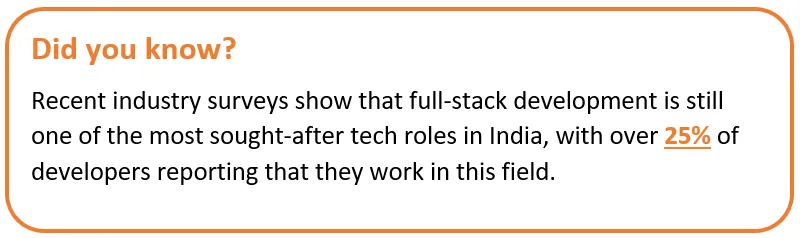
How to become a full-stack developer: Step-by-step guide
Many beginners get stuck because they try to learn everything at once. A better approach is to follow a simple path that builds your skills layer by layer. These steps give you a practical route you can follow from day one.
Step 1: Know your starting point – Degree or self-learning
You can enter this field with a computer science degree or through a structured self-learning path. Both routes work well today.
- If you have a degree: Courses like B.Tech, B.E., BCA, or BSc in Computer Science give you a strong base in programming and system design. Some employers prefer candidates with formal education because it shows you understand core computing concepts. You may also pursue higher studies later, but it is not mandatory.
- If you are self-learning: Start with one skill at a time. Use online courses, YouTube, and beginner-friendly documentation. Many working developers today began without formal education.
Step 2: Learn the basics (HTML, CSS, JavaScript)
These three skills form the foundation of everything you build on the web. You can start learning these languages through beginner-friendly courses, small practice exercises, or tutorials available online.
- HTML gives structure to a webpage.
- CSS controls the layout, spacing, and design.
- JavaScript adds movement, logic, and interactive behaviour.
Step 3: Learn a frontend framework (React)
React is the most widely used frontend framework because it is fast, flexible, and supported by a huge community. Focus on one framework.
Learning several at once slows beginners down. Build simple apps like:
- Notes app
- Weather app
- To-do list
These teach you components, state, props, and real-world UI patterns.
Step 4: Learn backend development + APIs
After learning how the user-facing side works, you need to understand what happens behind the scenes. Backend development teaches you how apps process data and handle user actions. Start with one backend language:
- Node.js (JavaScript) – Easy if you already know JS
- Python – Beginner-friendly and widely used
Learn how to:
- Build routes
- Accept data from the frontend
- Return responses through APIs
- Handle login and signup
- Add basic security
Understanding APIs helps you connect both sides of your app smoothly.
Step 5: Learn databases (SQL vs NoSQL)
Your app needs a place to store data such as users, tasks, or orders. Databases help you save this information so your app can use it whenever needed.
- SQL (PostgreSQL, MySQL) is best for structured data with clear relationships.
- NoSQL (MongoDB) works well for flexible data and fast development.
Most full-stack developers learn one SQL and one NoSQL database so they can work on different kinds of projects.
Step 6: Build beginner projects
Now it is time to apply your skills. Beginner projects help you understand how HTML, CSS, JavaScript, backend code, and databases come together. They also help you fix common mistakes early.
Try building:
- A personal portfolio website
- A notes or task app
- A simple blog page
Step 7: Build full-stack projects and deploy them
Full-stack projects show you can build complete applications from start to finish. This is the stage where everything comes together. Here are some project examples:
- A task manager with login
- A small e-commerce product listing
- A blog platform with admin access
Deployment is important because recruiters want to open your project online, not just see screenshots. Use tools like Vercel, Render, Netlify, or Railway.
Step 8: Strengthen your portfolio and start applying
A strong portfolio proves your skills better than a resume. Show your best projects and highlight what makes them useful.
Add:
- 2 to 3 full-stack projects
- A clean GitHub profile
- Short descriptions of tools used
- Simple READMEs
Then start applying for internships, junior roles, and freelance projects. Growth in this field comes through real work, real practice, and steady learning.
Also Read - Top 50+ Full Stack Developer Interview Questions and Answers
Full-stack developer roadmap – 6 to 9 months
This roadmap gives you a simple month-by-month path to follow. It will show you how to become a full-stack developer within a year.
| Phase | Timeline | What You Learn | What You Build / Do |
|---|---|---|---|
| Phase 1: Foundations | Month 1–2 | • HTML, CSS, JavaScript basics• How the web works• Git & GitHub | • Landing page• Calculator• Simple form |
| Phase 2: Frontend Deep Dive | Month 3–4 | • React fundamentals• Components, hooks• Basic UI patterns | 2–3 React apps (weather app, notes app, recipe app) |
| Phase 3: Backend + APIs | Month 5–6 | • Node.js + Express• APIs (CRUD)• Authentication basics• MongoDB or PostgreSQL | • Login + signup system• CRUD API• Connect frontend + backend |
| Phase 4: Full-Stack Projects | Month 7–8 | • Combine frontend + backend• Deploying apps• Handling real features | Build 2 full apps:• Task manager• Blog app• Mini e-commerceDeploy on Vercel/Render |
| Phase 5: Job Preparation | Month 9 | • Portfolio building• Basic DSA• Interview prep | • Clean GitHub• Add clear READMEs• Apply for internships, freelance, junior roles |
Core full-stack developer skills you need to learn
A full-stack role requires comfort on both sides of development. You need to understand how the user sees the product and how the system works behind the scenes. These skill groups build that foundation.
1. Frontend skills
Frontend skills shape the interface. They help you build everything users actually see on the screen. Strong frontend knowledge lets you create clean layouts, smooth interactions, and user-friendly features.
- HTML – Builds the basic structure of every page
- CSS – Handles layout, colours, spacing, styling
- JavaScript – Adds movement and logic to the UI
- One frontend framework – React is the most in-demand tool
- UI patterns & design basics – Helps you place elements in a simple and user-friendly way
- Optional styling tools – Tailwind CSS speeds up design work
Many full-stack developers start here because frontend gives quick results and helps you learn how websites work at a visible level.
2. Backend skills
Backend skills let you create the “brain” of an application. This includes handling data, writing logic, and building secure systems that support the frontend.
- Choose one backend language – JavaScript (Node.js) or Python
- Framework options – Express.js for Node or Django / FastAPI for Python
- Understand business logic – How your app processes data and actions
- Learn APIs – How data moves between the frontend and backend
- Understand authentication – Login, signup, sessions, JWT tokens
- Know basic error handling and routing
3. Databases
Databases store everything your app needs – user details, orders, messages, tasks. Learning how they work helps you build reliable and scalable systems.
- SQL databases (PostgreSQL, MySQL) – Best for structured data, clear rules, reporting, relationships
- NoSQL databases (MongoDB) – Good for flexible data, faster development, changing structures
Strong database knowledge helps you build stable and scalable apps.
4. DevOps basics (beginner level only)
DevOps basics help you put your project online, manage versions, and keep your app running smoothly. You do not need advanced DevOps skills early in your journey.
- Understand deployment – How your project becomes accessible online
- Learn Git and GitHub to track work and share code
- Host projects on Vercel or Render for free
- Use environment variables (.env) to hide sensitive details
- Learn Docker later for easier scaling (not needed on day one)
These basics help you showcase your work online and track your growth as a developer.
5. AI tools
AI tools have become part of a developer’s daily workflow. They help you learn faster and avoid common mistakes, but they do not replace real coding experience. Here are the useful AI tools:
- GitHub Copilot
- ChatGPT / Claude
- Cursor IDE
- Codeium
- Tabnine
The developers who use AI wisely learn faster and build better projects.
6. Other key full-stack developer skills
Full-stack developers also need a few soft skills to work well in real teams and deliver reliable work.
- Analytical thinking
- Attention to detail
- Teamwork
- Communication
- Creativity
- Time management
Common mistakes beginners should avoid
Many beginners slow down their progress by following the wrong approach. Avoid these mistakes to learn faster and build stronger skills.
- Learning too many languages at the same time
- Jumping into frameworks before basics
- Ignoring core fundamentals
- Copy-pasting code without understanding it
- Skipping GitHub and version control
- Not building projects consistently
Also Read - Top 20+ Java Full Stack Developer Interview Questions With Answers
Wrapping up
And that’s a wrap on how to become a full-stack developer for beginners. Follow the complete roadmap and keep improving your projects as your skills grow. Everyone learns at a different pace, so your journey may take a few months or even a year, and that is completely fine.
Looking for full-stack job roles? Find top IT opportunities on Hirist.
FAQs
Most learners achieve a job‑ready skill set in 6‑12 months with consistent study and project work. Fast learners may finish in 3‑6 months, while absolute beginners might need up to 2 years.
The JavaScript‑centric stack (HTML, CSS, JavaScript → React → Node.js/Express → MongoDB or PostgreSQL) is ideal because it uses a single language across front‑end and back‑end, simplifying the learning curve.
Yes. A degree is optional; practical skills, a strong portfolio, and real‑world projects are more important for hiring managers.
AI can speed up coding tasks, but it cannot design system architecture, understand business goals, or make product decisions. Developers who leverage AI become more efficient, not obsolete.