A well-written full stack developer resume can open great career opportunities in the tech industry. According to a Naukri survey, the demand for full stack developers in India has grown by 30% year-on-year. That means more openings but also tougher competition. And this is where a good resume can help you stand out to recruiters and secure interviews faster.
This guide will show you how to create a powerful full stack developer CV with practical examples and expert tips. If you are starting from scratch, you will also find free full stack developer resume templates at the end.
Did You Know?
According to a survey by TechGig, around 78% of hiring managers in Indian IT companies now prefer candidates who have full stack development skills.
Full Stack Developer Resume Sample
This is how an ideal full stack developer resume looks. It includes all key sections, follows the right format preferred by recruiters, and is fully ATS-friendly for better visibility in job applications.
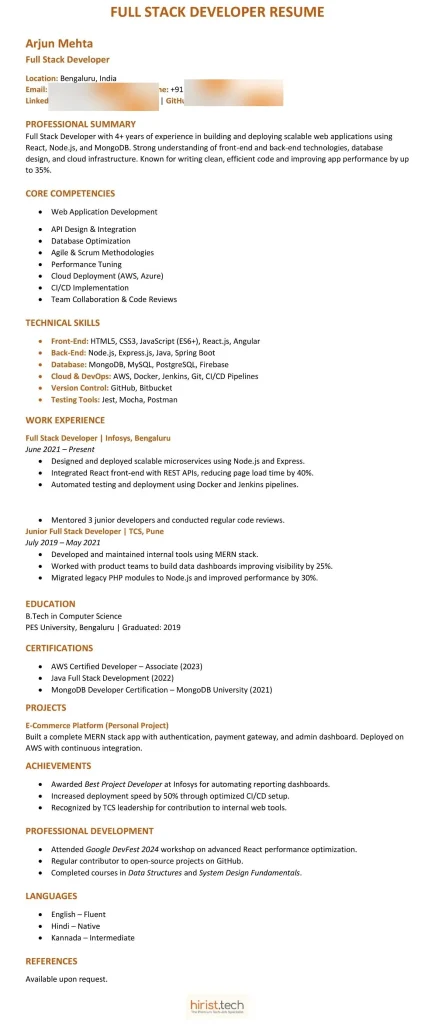
Why this full stack developer resume example works?
● It uses a clean and ATS-friendly layout that’s easy to scan.
● Starts with a clear summary showing skills, experience, and impact.
● Includes both front-end and back-end technologies to show versatility.
● Highlights measurable achievements with real numbers and results.
● Lists technical and soft skills separately for better readability.
● Features strong action verbs like developed, built, optimized, and deployed.
● Mentions tools and frameworks commonly used in full stack roles.
● Follows a reverse-chronological format preferred by recruiters.
● Adds bonus sections (achievements, development, languages) to show growth and initiative.
Also Read - How to Become a Full-Stack Developer: Skills & Roadmap
Full Stack Developer Resume Guide – Complete Overview
Before you start building your full stack developer CV, here is a complete overview of what to include, how to format it, and what recruiters expect.
| Category | Details |
|---|---|
| Ideal resume length | Freshers 1 page Experienced professionals 2 pages |
| Recommended resume format | ● Reverse Chronological (best for most candidates) ● Functional (ideal for freshers or career changers) ● Combination / Hybrid (great for mid-level or senior developers) |
| Font type | Clean professional fonts like Calibri, Arial, or Helvetica |
| Font size | 10–12 pt for text, 14–16 pt for headings |
| Key sections to include | ● Header (Name, Contact, LinkedIn, GitHub) ● Professional Summary / Objective ● Technical Skills ● Work Experience / Projects ● Education ● Certifications ● Achievements (optional but useful) |
| ATS-friendly layout | Use a single-column format with clear headings; avoid tables, images, or fancy graphics |
| Top skills to mention | ● HTML, CSS, JavaScript ● React.js / Angular ● Node.js, Express.js ● MongoDB / MySQL ● REST APIs, Git, Docker, AWS ● Problem-solving and teamwork |
| Best file format | PDF – keeps the format clean and works well with ATS systems |
| Valuable certifications | ● AWS Certified Developer – Associate ● Java Full Stack Developer Certification ● MERN Stack Certification ● Microsoft Azure Developer Associate ● Python Full Stack Developer Course |
| ATS optimization tip | Add keywords naturally from the job description like React, Node.js, MongoDB, API integration |
| Tips to follow | ● Use short action-driven bullet points ● include real results ● Tailor your resume to each job description |
| Common mistakes to avoid | ● Writing long paragraphs ● Skipping keywords ● Including outdated tech ● Using decorative designs |
| Portfolio links | Include GitHub, personal portfolio site, or deployed app URLs |
| Average salary range | ₹1.8–17.5 LPA depending on experience, skills, and location (AmbitionBox) |
| Top job platforms | Hirist, Naukri.com, LinkedIn |
| Best time to apply | Early in the week (Monday–Wednesday) and within 24–48 hours of posting |
What Makes a Strong Full Stack Developer Resume?
An ideal full stack development resume highlights your technical skills and problem-solving abilities in a structured way that proves you can build complete solutions.
Key things that make a strong full stack developer profile:
● A clear headline that defines your role (e.g., Full Stack Developer – React & Node.js Specialist).
● A short summary focused on your experience, stack, and measurable achievements.
● Technical skills divided into front-end, back-end, and database categories.
● Real project examples with tools used, problems solved, and outcomes achieved.
● Use of industry-relevant metrics like load time improvement or user growth.
● Certifications and courses proving continuous learning and tech adaptability.
● Clean layout and consistent formatting for an ATS-friendly full stack software developer resume.
● A final proofreading check to remove spelling, grammar, and formatting issues.
These are the key things that recruiters look for when shortlisting the best full stack software developer resumes.
The Best Full Stack Developer Resume Format
Choosing the right full stack developer resume format is essential. It decides how well your skills and experience catch a recruiter’s attention.
Recommended Formats:
● Reverse-Chronological: Lists your most recent experience first; ideal for experienced developers.
● Hybrid (Combination): Mixes skills and experience; best for developers with diverse project backgrounds.
Why it matters:
For recruiters, a clean full stack developer CV is easier to scan. They can quickly see your core skills, tech stack, and achievements without getting lost in design clutter.
Pro Tip: You can use an ATS-optimized full stack developer resume template to organize your details. It helps maintain structure and improve shortlisting chances.
Length & Layout:
A professional full stack web developer resume should ideally be one page long (two pages only for senior roles). Use short bullet points, clear headings, and a consistent format for the best readability.
Fun Fact:
Full stack developer continues to rank among the top five most in-demand tech roles worldwide.
Key Sections in a Full Stack Developer Resume
Recruiters spend less than 10 seconds scanning a resume, so structure matters as much as the content. Below are the seven key sections that you must include in your full stack developer resume.
1. Header
The header is where your identity and first impression come from. It is simple, but many developers still get it wrong by missing important details or using unprofessional layouts.
What to include:
● Full name (use your official name, avoid nicknames)
● Job title: e.g., Full Stack Developer, Java Full Stack Developer, or Python Full Stack Developer
● Contact details: email address and phone number (use professional email)
● Location: City and country (optional, but helps recruiters filter candidates)
● LinkedIn & GitHub links: These are crucial – they act as live proof of your work.
Pro tip: Avoid putting your photo, date of birth, or marital status – it is unnecessary and takes up space. Also, make sure you double check your email id and contact number.
2. Full Stack Developer Summary
Your full stack developer summary is the short paragraph that introduces you. It tells recruiters who you are, what you specialize in, and what you have achieved. Think of it as your “pitch.”
Keep it short – 3 to 4 lines – but impactful. It should combine your experience, technologies, and results.
Make it conversational and focused on results – not just duties. Mention improvements, optimizations, or contributions to major projects that show impact.
3. Full Stack Developer Profile
Your full stack developer profile section is where you explain your technical strength and professional highlights in a more detailed way than the summary. It bridges your skills, tools, and measurable outcomes.
Here, you can list:
● Technologies you are best at (like React, Angular, Node.js, Java, Python, etc.)
● Project domains (e-commerce, SaaS, fintech, or enterprise apps)
● Results (like “improved response time by 45%” or “reduced deployment time by 60%”)
This section helps recruiters quickly understand your strengths even before reading the experience section.
4. Technical Skills
Your skills define your toolbox. Recruiters often skim this section first, so make it organized and easy to read. Make sure you structure the skills into categories instead of adding them randomly.
Key Skills to Mention in Your Full Stack Developer Resume
| Category | Skills to Include |
|---|---|
| Front-End Development | HTML5, CSS3, JavaScript (ES6+), React.js, Angular, Vue.js, TypeScript, Bootstrap, jQuery |
| Back-End Development | Node.js, Express.js, Java, Spring Boot, Python, Django, Flask, PHP, .NET, REST APIs |
| Databases | MySQL, MongoDB, PostgreSQL, SQLite, Firebase, Oracle |
| Version Control | Git, GitHub, GitLab, Bitbucket |
| Cloud & DevOps Tools | AWS, Azure, Google Cloud, Docker, Jenkins, Kubernetes, CI/CD Pipelines |
| Testing & Debugging | Jest, Mocha, Postman, Cypress, Selenium |
| UI/UX & Design Tools | Figma, Adobe XD, Wireframing, Responsive Design |
| Build & Deployment Tools | Webpack, Babel, NPM, Yarn |
| Project Management Tools | Jira, Trello, Asana, Agile/Scrum Methodologies |
| Soft Skills | Problem-Solving, Collaboration, Communication, Attention to Detail, Analytical Thinking, Time Management, Adaptability |
Tip: Choose 10–12 of the most relevant skills for the specific role you are applying for. Tailor them to match the keywords used in the job description – this helps your full stack developer skills resume pass ATS screening easily.
5. Work Experience
This is the most powerful section in your resume – where you show proof of your capabilities. Use reverse-chronological order (latest job first). Each role should be concise but detailed enough to display impact.
Structure:
● Job title, company name, location
● Duration (month/year)
● 3–5 bullet points highlighting what you built or improved
Use action verbs (developed, implemented, optimized, integrated) and add results (percentages, time saved, users impacted). That’s what impresses hiring managers.
6. Education
Your educational background builds trust, especially for freshers or early-career developers. Keep it clean and minimal.
Example:
B.Tech in Computer Science, PES University, Bengaluru – 2019
If you are still studying or recently graduated, you can add relevant coursework such as:
● Data Structures & Algorithms
● Database Management Systems
● Web Technologies
● Software Engineering
If you have done bootcamps or certifications, include them here or in a separate section below.
7. Certifications
Certifications add credibility to your profile and show that you are serious about upskilling. They are especially valuable in roles like full stack development – where staying updated with new frameworks and tools makes a big difference.
Top Certifications to Add in Your Full Stack Developer Resume
Here is a list of top certifications that strengthen your full stack developer resume:
| Certification Name | Issuing Organization |
|---|---|
| AWS Certified Developer – Associate | Amazon Web Services |
| Microsoft Certified: Azure Developer Associate | Microsoft |
| Google Professional Cloud Developer | Google Cloud |
| Java Full Stack Developer Certification | Various Accredited Platforms |
| Python Full Stack Developer Course | Various Online Learning Platforms |
| MERN Stack Development Certification | Various Platforms |
| MEAN Stack Development Course | Various Platforms |
| Certified Kubernetes Application Developer (CKAD) | CNCF (Cloud Native Computing Foundation) |
| MongoDB Certified Developer Associate | MongoDB University |
| React.js Front-End Development Certification | Meta / Coursera |
| DevOps Engineer Certification | AWS |
Tip: Always include the certification name, platform, and year of completion. If available, add a link to your verified certificate – it builds instant trust with recruiters reviewing your full stack developer CV.
Also Read - Top 50+ Full Stack Developer Interview Questions and Answers
Optional Sections to Strengthen Your Resume
Here are some additional sections you can add in your full stack software developer resume or your full stack developer CV.
Projects:
List personal, freelance, or open-source projects with short descriptions and GitHub links.
Achievements:
Add awards, hackathon wins, or company-level recognitions. They show initiative and problem-solving.
Professional Development:
Mention any webinars, meetups, or conferences you attended – it signals continuous learning.
Languages:
If applying globally, include language proficiency (English, Hindi, regional languages).
Open-Source Contributions:
Highlight active GitHub repositories or pull requests to popular projects. This shows community engagement and real coding skills.
Full Stack Developer Resume Examples
Here are a few full stack developer resume examples to help you understand how to structure your profile. These examples cover different experience levels, tech stacks, and formats preferred by recruiters.
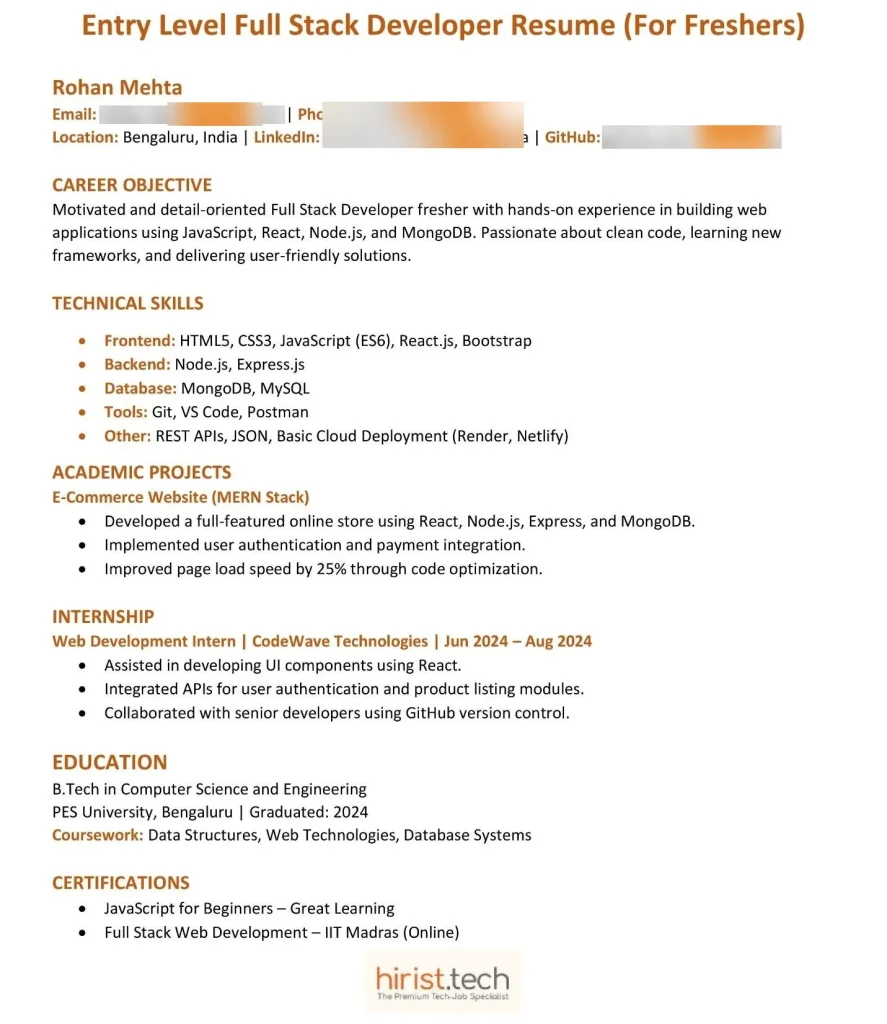
Example 1 – Entry Level Full Stack Developer Resume (For Freshers)
This resume for full stack developer fresher focuses on academic projects, internships, and core technical skills to help beginners showcase their potential and build a strong first impression.
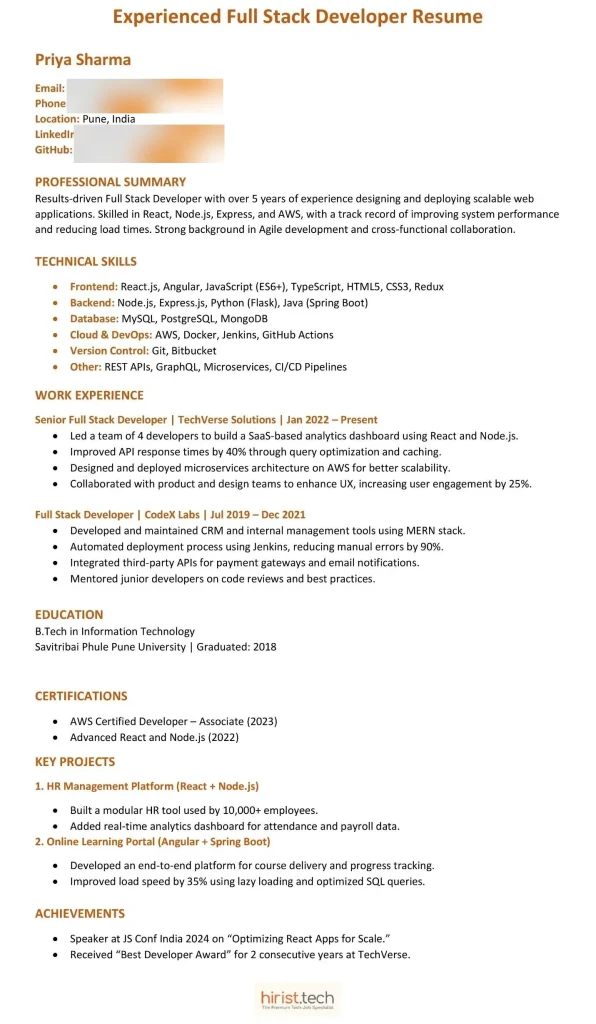
Example 2 – Experienced Full Stack Developer Resume
Here is a full stack developer resume sample for experienced professionals that shows real project results and proven ability to handle both front-end and back-end tasks.
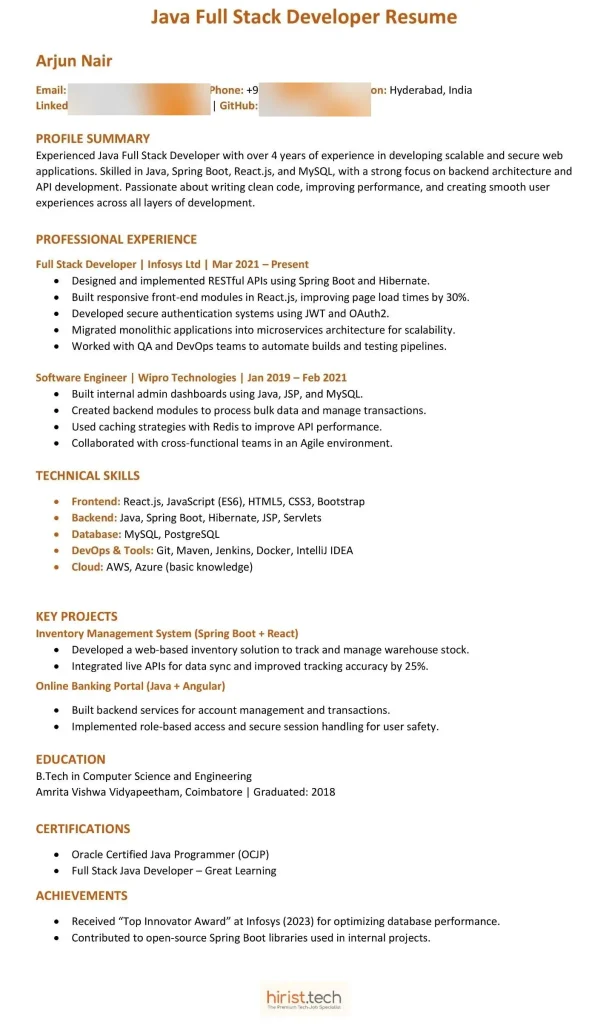
Example 3 – Java Full Stack Developer Resume
Here is a full stack developer sample resume for Java professionals that highlights experience with Spring Boot, REST APIs, and database management along with strong front-end integration skills.
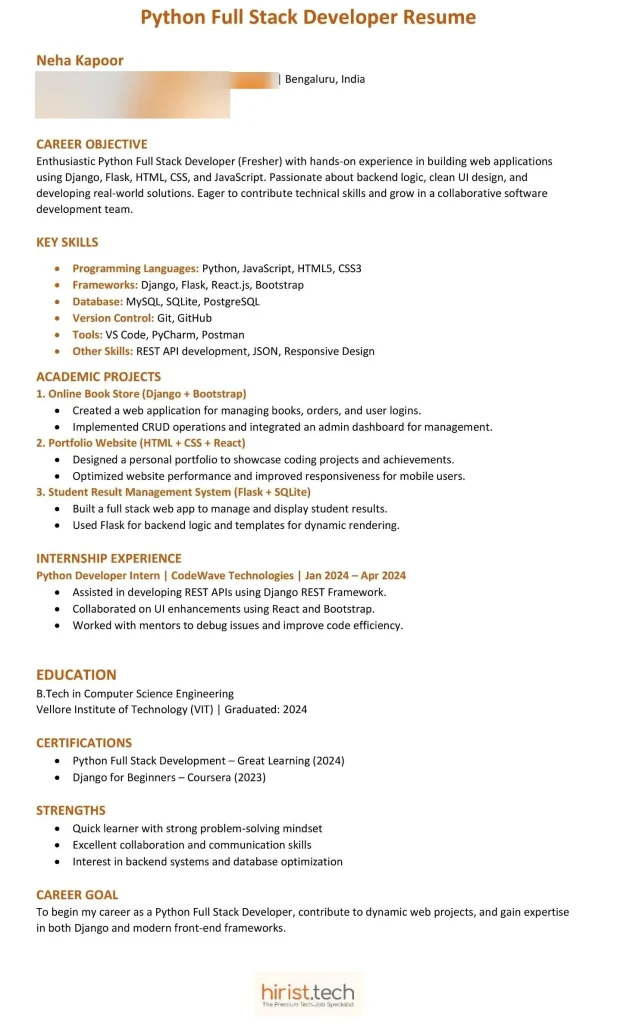
Example 4 – Python Full Stack Developer Resume
This python full stack developer resume fresher example highlights academic projects and skills in Django, Flask, and front-end technologies.
Also Read - Top 20+ Java Full Stack Developer Interview Questions With Answers
Tips to Write a Strong Full Stack Developer Resume
Follow these simple and actionable tips when creating your full stack developer resume.
● Show Measurable Results: Use numbers to highlight impact.
● Keep the Summary Short: Make your full stack developer summary focused and result-oriented.
● Update Regularly: Refresh your full stack software developer resume after each new project or certification.
● Add Portfolio Links: Include GitHub or live project links in your full stack developer CV.
● Tailor for Each Role: Customize every full stack development resume for the specific job and tech stack.
● Focus on Achievements: Write bullet points that show outcomes, not daily tasks.
● Keep It Clean: Use simple fonts, clear headings, and enough spacing for easy reading.
● Skip Buzzwords: Avoid filler or overly technical jargon that doesn’t match the job post.
● Proof Before Sending: Double-check grammar and consistency before submission.
Common Mistakes to Avoid in a Full Stack Developer Resume
Even skilled developers miss small details that can hurt their chances. Here is a quick checklist to help you avoid common resume mistakes.
● Too Many Irrelevant Skills: Don’t overload your full stack developer resume with tools you barely use.
● Cluttered Layout: Keep your full stack developer CV clean, simple, and ATS-friendly.
● Generic Descriptions: Avoid vague lines in your full stack profile – be specific about results.
● Outdated Projects: Update old work to keep your full stack software developer resume fresh.
● Same Resume for All Jobs: Customize it for each position or tech stack.
Full Stack Developer Resume Templates
Here are some easy-to-edit full stack developer resume template options you can use to create an ATS-friendly resume.
Template 1: Full Stack Developer Resume for Freshers
Here is a customizable template you can use to create your first full stack developer resume. You can edit this in Word or Google Docs.
Your Name
Full Stack Developer
City, Country | Phone Number | Email Address
LinkedIn URL | GitHub URL | Portfolio URL
PROFESSIONAL SUMMARY
Motivated full stack developer fresher with a strong foundation in front-end and back-end technologies. Skilled in HTML, CSS, JavaScript, and Node.js with hands-on project experience using React and MongoDB. Eager to contribute to real-world development teams and continue learning new technologies.
TECHNICAL SKILLS
Front-End: HTML5, CSS3, JavaScript, React.js, Bootstrap
Back-End: Node.js, Express.js, Python (Basic)
Database: MongoDB, MySQL
Tools: Git, GitHub, Postman, VS Code
Soft Skills: Problem-solving, Team Collaboration, Adaptability
INTERNSHIP (IF ANY)
Web Developer Intern | [Company Name]
Month, Year – Month, Year
● Assisted in developing and testing web applications.
● Gained hands-on experience with version control using Git and GitHub.
ACADEMIC PROJECTS
1. Portfolio Website
● Built a personal website using HTML, CSS, and JavaScript.
● Deployed on GitHub Pages with responsive design for all devices.
2. Task Management App (MERN Stack)
● Developed a simple task manager with login, create, and delete task features.
● Integrated MongoDB for data storage and Express for backend routing.
EDUCATION
Bachelor of Technology (B.Tech) in Computer Science
Your University Name, City | Year of Graduation
Relevant Coursework: Web Development, Database Management Systems, Data Structures, Software Engineering
CERTIFICATIONS
● Full Stack Web Development Certification
● JavaScript for Beginners
● Python Basics
Template 2: Full Stack Developer Resume for Experienced
Here is a professional and customizable full stack developer resume template for mid to senior-level candidates.
Name
Full Stack Developer
City, Country
Phone Number | Email Address
LinkedIn URL | GitHub URL | Portfolio URL
PROFESSIONAL SUMMARY
Experienced full stack developer with [X+] years of expertise in designing, developing, and deploying scalable web applications. Skilled in React.js, Node.js, and MongoDB with strong knowledge of REST APIs and cloud platforms like AWS. Proven ability to lead projects, collaborate with cross-functional teams, and deliver high-quality solutions that improve system efficiency and user satisfaction.
TECHNICAL SKILLS
● Front-End: HTML5, CSS3, JavaScript (ES6+), React.js, Angular, TypeScript
● Back-End: Node.js, Express.js, Java, Spring Boot, Python (Django)
● Databases: MongoDB, MySQL, PostgreSQL, Firebase
● Cloud & DevOps: AWS, Docker, Jenkins, GitHub Actions
● Version Control: Git, GitHub, Bitbucket
● Testing Tools: Jest, Postman, Mocha
● Soft Skills: Problem-Solving, Leadership, Communication, Time Management
PROFESSIONAL EXPERIENCE
Full Stack Developer | Company Name
Location | Month, Year – Present
● Developed and maintained full stack applications using React, Node.js, and MongoDB.
● Improved API performance by 35% through optimized queries and caching.
● Integrated AWS services for automated deployment and reduced downtime by 25%.
Software Engineer | Previous Company Name
Location | Month, Year – Month, Year
● Built responsive front-end interfaces using React and Bootstrap.
● Collaborated with backend teams to design REST APIs and database structures.
● Enhanced code efficiency, reducing load time by 40%.
KEY PROJECTS
E-Commerce Web App (MERN Stack)
● Designed and deployed an e-commerce platform with cart, payment, and admin modules.
● Integrated JWT authentication and handled 50K+ active users.
EDUCATION
Bachelor of Technology (B.Tech) in Computer Science
Your University Name, City | Year of Graduation
CERTIFICATIONS
● AWS Certified Developer – Associate (2023)
● MERN Stack Development Certification
● Java Full Stack Developer Certification
● MongoDB Certified Developer Associate, MongoDB University
ACHIEVEMENTS
● Awarded Best Developer of the Year at [Company Name].
● Improved site performance by 50% through API and caching optimization.
Also Read - Top 30+ MERN Stack Interview Questions and Answers
Wrapping Up
Creating a good full stack developer resume takes time, but it is worth it. Keep it simple and present your details in a way that looks appealing to the recruiters. Update it whenever you finish a new project or learn a new skill.
And when you are ready to find your next opportunity, visit Hirist – it is one of the best places to discover top full stack developer jobs that fit your experience.
FAQs
Start with a skills section and highlight college or personal projects that show you can build and deploy applications. Mention the tools and technologies used, and list any internships, coding challenges, or certifications.
Keep it to one page if you’re a fresher; expand to two pages only after three or more years of experience, focusing on quality rather than quantity.
Add tools you actually use, such as Git, Docker, Jenkins, Postman, VS Code, Figma, and Jira, to demonstrate your ability to manage code, test APIs, and work in real development environments.
Use simple formatting, standard section headers, and include relevant keywords like JavaScript, React, Node.js, and API development. Avoid tables, graphics, or complex layouts.