Building a career in cloud engineering has become a strong choice for many people as companies continue to shift their systems to the cloud. The demand is high and the career path is rewarding, with average salaries reaching up to ₹15.8 lakhs per year. If you want to enter this field, this guide will give you a clear roadmap on how to become a cloud engineer with the right skills and certifications.
What is a cloud engineer?
A cloud engineer is a technology professional who works with cloud platforms like AWS, Azure, or Google Cloud to help companies run their systems online instead of on physical hardware. They understand how cloud services work, how data moves within cloud environments, and how different tools connect together. Cloud engineers use this knowledge to plan and build systems that are stable, secure, and able to grow as the company’s needs increase.
Role and responsibilities of a cloud engineer
Cloud engineers handle the daily work needed to keep cloud systems running smoothly. Their role covers planning, setup, monitoring and solving issues. Here’s what a cloud engineer does:
- Designing cloud infrastructure for company needs
- Migrating applications and data to cloud platforms
- Setting up compute, storage, databases and networking services
- Monitoring system performance and usage
- Managing cloud security and access controls
- Automating deployments and routine tasks
- Troubleshooting issues and reducing downtime
- Managing costs and optimising cloud resources
- Working with developers, security teams and operations teams
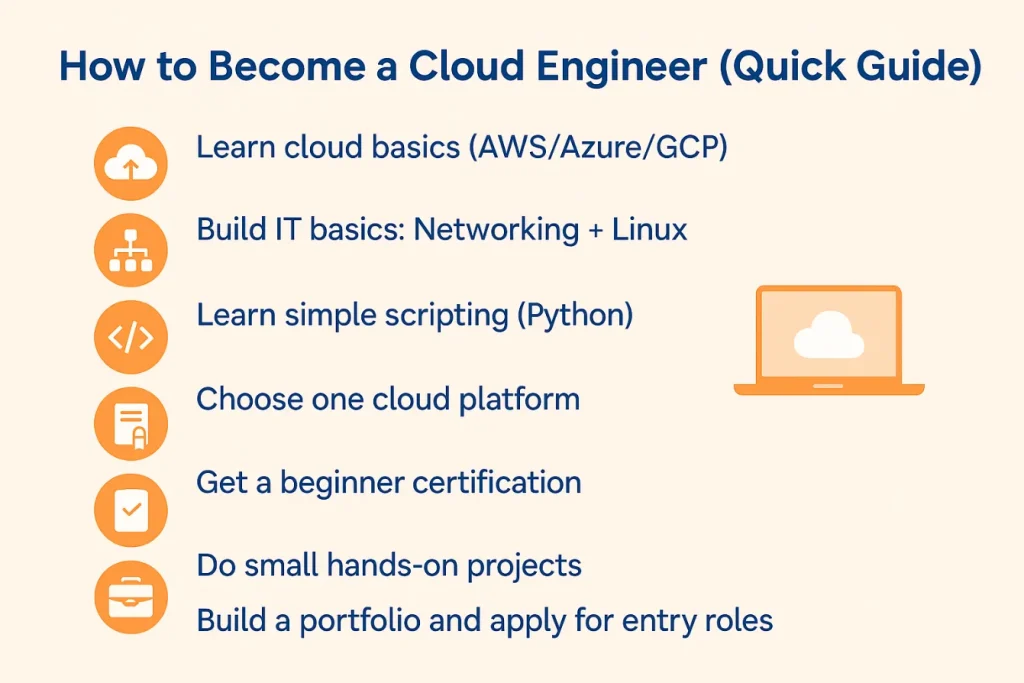
How to become a cloud engineer? A complete roadmap with timeline
Starting your journey in cloud engineering becomes much easier when you follow a clear path. Here is a complete roadmap with a practical timeline to help you understand what to learn and when to learn it.
1. Get the right education (Timeline varies by profile)
If you are a student:
A 3 to 4 year bachelor’s degree in Computer Science, IT, Electronics or Software Engineering gives you a strong base. You learn programming, operating systems, databases and networks – all of which are important in cloud careers.
If you already have a degree:
You can skip this step and move straight to cloud basics.
If you do not have a tech degree:
You can still become a cloud engineer. Follow this roadmap through online learning and hands-on projects. Many successful cloud engineers today are career switchers.
2. Learn cloud computing basics (1 to 2 months)
Before using any cloud platform, understand how the cloud works. This helps you connect concepts later.
Start with these simple topics:
- What is cloud computing?
- Types of cloud: Public, Private, Hybrid
- Core service models: IaaS, PaaS, SaaS
- Benefits of cloud over traditional servers
- Introduction to AWS, Azure and Google Cloud
This stage gives you clarity on how companies use cloud systems and why cloud engineers are needed.
3. Build core IT fundamentals (2 to 3 months)
Cloud engineering relies on strong IT knowledge. These basics make everything easier later. Focus on these three main areas:
Networking:
Learn how data moves inside a cloud environment. Start with:
- DNS
- TCP/IP
- Subnets
- Load balancers
- VPN and firewalls
Linux:
Most cloud servers run on Linux. So, you need to learn:
- Basic commands
- File permissions
- Package installation
- Users and roles
Security basics:
You should understand:
- Identity and access control
- Encryption
- Authentication vs authorisation
These fundamentals help you understand how cloud systems connect and stay secure.
4. Learn a programming or scripting language (1 to 2 months)
You do not need to become a full developer, but cloud work often involves automation. So, it is best to learn a programming or scripting language like python.
Python is the best starting point. You need to learn the following:
- Variables and loops
- Functions
- File handling
- APIs
- Writing simple automation scripts
Even basic Python gives you a strong advantage.
5. Choose one cloud platform to focus on (2 to 3 months)
Trying to learn all platforms will slow you down. Pick one and go deep. Here are the best options for beginners:
- AWS – Most popular, huge job market
- Azure – Strong in enterprise and Microsoft-based companies
- GCP – Great for data engineering and startups
Study the core services:
- Compute (EC2, Azure VM, etc.)
- Storage (S3, Blob Storage)
- Databases (RDS, Cosmos DB)
- Networking (VPC, VNets)
- IAM and security
Going deep in one platform builds confidence.
6. Earn beginner cloud certifications (1 to 2 months)
Certifications show employers that you understand cloud basics. Start with an entry-level one. Here are some beginner-friendly certifications:
- AWS Cloud Practitioner
- Azure Fundamentals (AZ-900)
- Google Associate Cloud Engineer
These certifications help you understand the platform structure, pricing, security basics and key services. They are also easy for beginners.
7. Build hands-on cloud projects (1 to 3 months)
This is the most important step. Projects make your skills real and help you stand out in job applications. Here are some strong beginner project ideas:
- Host a website on AWS S3 or Azure Storage
- Build a virtual private network (VPC) and configure subnets
- Deploy a serverless function (AWS Lambda, Azure Functions)
- Create a simple CI/CD pipeline
- Set up a monitoring dashboard using CloudWatch or Azure Monitor
Add every project to:
- GitHub
- Your resume
- A personal portfolio page
Recruiters care more about real projects than theory.
8. Apply for internships or entry-level jobs (Continuous)
Once you have some projects and a certification, start applying for roles that help you grow into cloud engineering. Good starting roles include:
- Cloud Support Associate
- DevOps Intern
- Cloud Operations Engineer
- Junior Cloud Engineer
- IT Support with cloud exposure
These roles give you real experience with cloud tools, ticketing systems, troubleshooting and deployment pipelines.
Realistic timeline summary
| Stage | Time Required |
|---|---|
| Cloud basics | 1 to 2 months |
| IT fundamentals | 2 to 3 months |
| Programming | 1 to 2 months |
| One cloud platform | 2 to 3 months |
| Certifications | 1 to 2 months |
| Hands-on projects | 1 to 3 months |
| Internship or job search | Ongoing |
Total time for a motivated beginner without a tech degree: 8 to 14 months
For freshers with a tech degree: 6 to 10 months
How to become a cloud engineer without a degree?
You can build a cloud engineering career without a formal degree if you follow the right learning path and focus on real skills. Here are the steps on how to become a cloud computing engineer without an actual degree.
1. Follow a structured learning path
Instead of learning random topics, follow a clear roadmap from cloud basics to advanced tools. A planned approach covers the gaps a degree would normally fill.
2. Build a portfolio early
Non-degree learners must show what they can do. Create small cloud projects from the beginning and grow your portfolio as you learn. Even simple projects help you look job-ready.
3. Focus on practical labs and real cloud consoles
Degree holders often have theory. You can balance that by spending more time in hands-on labs. Use free tiers from AWS, Azure or GCP to practice real tasks.
4. Use certifications as proof of skill
Certifications act as your credibility. A couple of beginner certifications show you understand the platform well enough to work in real environments.
5. Join online communities and get involved
Participate in cloud forums, Discord groups, LinkedIn discussions or GitHub projects. Community involvement helps you learn faster and discover job openings.
6. Look for skill-based entry roles
Many tech companies hire based on ability rather than degrees. Apply for roles like Cloud Support, Technical Support, NOC Technician or DevOps Intern – roles designed for practical learners.
7. Share your work publicly
Write short notes on LinkedIn, update GitHub regularly or share screenshots of what you’re learning. Recruiters often reach out when they see consistent progress.
Also Read - Top 40+ Azure Cloud Interview Questions and Answers
How to become a cloud engineer with no experience?
It is possible to become a cloud engineer with zero experience. The goal is to build practical skills that show employers you can work with real cloud tools. Here’s how to become a cloud computing engineer without any experience.
1. Start with beginner-friendly cloud courses
Pick simple intro courses that explain how cloud platforms work. This gives you the basic understanding you need before touching advanced tools.
2. Practice in free cloud accounts
AWS, Azure and GCP offer free tiers. Use them to try basic tasks like launching a server or storing files. This early practice matters more than theory.
3. Learn the essential IT basics
Even with no experience, you can learn small pieces of networking, Linux and security. These basics make cloud concepts easier to understand.
4. Earn an entry-level certification
Certifications give you credibility when you have no experience. Start with AWS Cloud Practitioner, Azure Fundamentals or Google ACE.
5. Build simple cloud projects
Create small projects such as deploying a website, automating a backup or building a serverless function. These projects act as your “experience.”
6. Keep improving your portfolio
Add every project and cloud exercise you complete. A strong portfolio makes up for lack of industry experience.
Key skills needed to become a cloud engineer
Cloud engineers work across different parts of a company’s technology stack, so they need a mix of solid technical skills and practical problem-solving ability. Here are the skills that help you grow in this field:
| Hard Skills | Soft Skills |
|---|---|
| Networking basics | Communication |
| Linux commands | Problem-solving |
| Cloud services (AWS/Azure/GCP) | Teamwork |
| Scripting (Python, Bash) | Attention to detail |
| Security fundamentals | Adaptability |
| Monitoring & troubleshooting | Time management |
| Virtualization & containers | Critical thinking |
| CI/CD basics | Learning mindset |
Networking fundamentals
You should understand how systems communicate on the internet. Concepts like DNS, subnets, routing and firewalls help you design and manage stable cloud environments.
Linux knowledge
Most cloud servers run on Linux. Basic commands, file structure and permissions are important for server management and troubleshooting.
Cloud platform knowledge
You need to know how core cloud services work on platforms like AWS, Azure or Google Cloud. This includes compute, storage, databases and identity services.
Scripting and automation
Simple scripting skills, especially in Python, help you automate cloud tasks, manage deployments and handle repetitive work more efficiently.
Security awareness
Understanding access control, encryption and safe configurations is essential because cloud systems store sensitive company data.
Monitoring and troubleshooting
Cloud engineers must detect issues early, read logs and fix problems quickly to keep systems running without interruptions.
Team communication
You will work with developers, security teams and managers, so explaining issues clearly and sharing updates is an important part of the role.
Also Read - Top 30+ Cloud Computing Interview Questions and Answers
What certifications do you need to become a cloud engineer?
You do not need every certification to start your cloud engineer career. A few core ones can make your resume stronger and help you get interviews. Here are the most valuable certifications for beginners:
| Certification | Level | Best For |
|---|---|---|
| AWS Cloud Practitioner | Beginner | Starting cloud basics with AWS |
| Azure Fundamentals (AZ-900) | Beginner | Beginners interested in Microsoft environments |
| Google Associate Cloud Engineer (ACE) | Beginner | Starting with Google Cloud or data-focused roles |
| AWS Solutions Architect – Associate | Intermediate | Designing real cloud solutions on AWS |
| Azure Administrator (AZ-104) | Intermediate | Managing Azure resources and operations |
| Google Professional Cloud Architect | Intermediate | Advanced cloud design and architecture on GCP |
Wrapping up
Becoming a cloud engineer is a strong career choice as more companies move their systems online. By following a structured roadmap from this guide you can easily learn how to become a cloud engineer without any degree or experience.
If you want to search for real openings and see where your skills can take you, Hirist is a great place to find the best cloud engineer jobs in India.
FAQs
Python and Java are the most recommended languages because they are widely used for building cloud‑native applications and have strong support across AWS, Azure, and GCP.
Start with the AWS Cloud Practitioner or the Google Associate Cloud Engineer certification; both validate foundational cloud knowledge and are recognized by employers.
Self‑studying candidates usually need 8‑14 months, while those with a technical degree can often be ready for a job in 6‑10 months.
Yes—begin with IT fundamentals like networking and Linux, take a beginner cloud certification, and build projects through online courses or a tech degree to enter the field.