The first twenty seconds of a group discussion are very important because they show how clearly you think and confidently you speak. This moment often decides who leads the conversation and who stays in the background. A weak or confusing start can make others overlook you, while a strong and clear opening can draw positive attention immediately. That is why every college graduate and job seeker should know how to start a group discussion the right way.
In this guide, you will learn how to start a GD (group discussion) with clear examples. You will also find effective group discussion opening lines along with practical tips you can actually use.
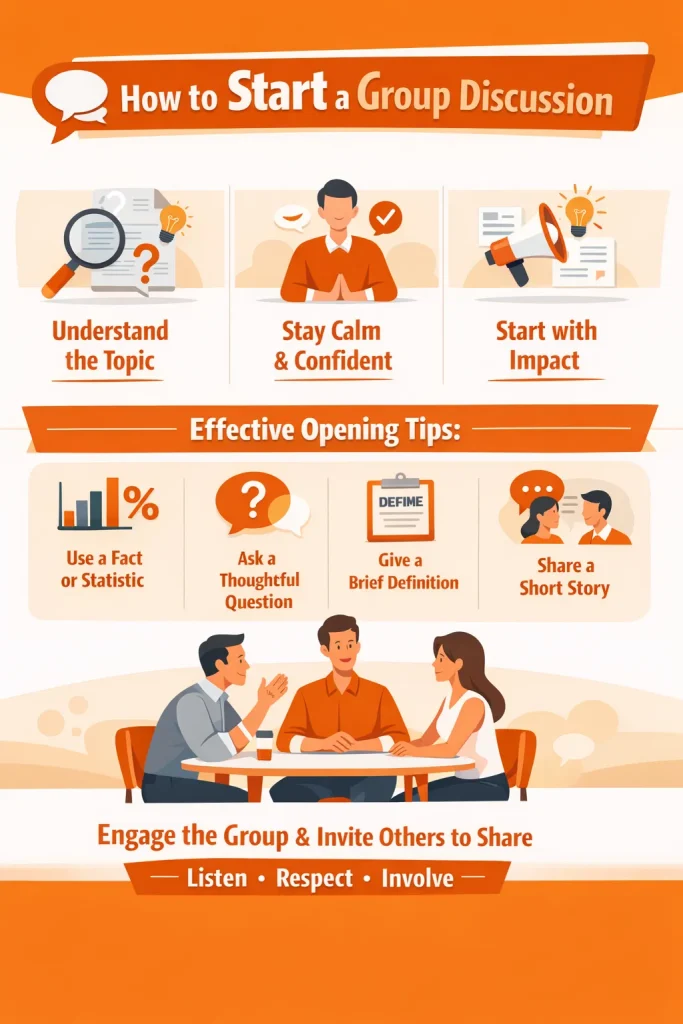
Example of a Strong GD Introduction
A strong GD introduction briefly explains the topic and sets a balanced tone that invites others to join the discussion.
Topic: Is Artificial Intelligence a Threat to Human Jobs?
GD Introduction Example:
“Stephen Hawking often spoke about how rapid technological progress could reshape human work and society. With artificial intelligence now becoming part of everyday industries, the question is whether it replaces jobs or changes how people work. Looking at both sides can help us understand its real impact.”
How to Start a Group Discussion: 7 Best Techniques with Examples
Starting a group discussion becomes easier when you choose the right opening style for the topic. Here are 7 best techniques to show you how to start group discussion with examples.
- Start with a simple definition (Best for abstract topics)
Use this method when the topic feels broad or unclear. Abstract topics often confuse people at the start. A simple definition gives everyone the same base before opinions begin. This helps you control the direction of the discussion early.
Example:
Topic: What is Artificial Intelligence?
“Artificial intelligence refers to machines that can learn from data and make decisions without constant human input. With this understanding, we can discuss how AI is influencing different industries today.”
- Start with a question (Best for nervous speakers)
Questions reduce pressure as well as open the discussion and encourage multiple viewpoints. This technique works best for people who easily get nervous. This method works because you invite others to think with you. But make sure you choose the right question.
Example:
Topic: Data Privacy in the Digital Age
“With more personal data stored online, an important question arises. Are digital platforms doing enough to protect user privacy, or are users expected to take responsibility themselves?”
- Starting with a fact or statistic
Facts help when the topic is practical or current. It sets context and shows awareness without sounding forced. This method works for current issues GD topics. You can use small and relatable facts, but make sure you avoid large numbers that sound memorised. Speak the fact naturally and only when you know it.
Example
Topic: Remote Work Culture
“Recent surveys show that more than half of working professionals now prefer hybrid or remote work. This shift has changed how teams communicate, collaborate, and stay productive.”
- Starting with a real-life situation
Real-life situations make topics easier to relate to because people recognise them instantly. This method helps the group feel involved from the start. Keep the situation short and within two lines, and make sure it connects directly to the topic.
Example
Topic: Impact of Social Media on Students
“Many students reach for their phones as soon as they wake up and scroll again before sleeping. This everyday habit brings up an important question about how social media affects focus and mental health.”
- Starting with a balanced statement
A balanced opening shows maturity. It tells the group that you are open to both sides. This works well for controversial or opinion-based topics because it keeps the discussion calm and encourages equal participation.
Example
Topic: Use of Artificial Intelligence in Healthcare
“Artificial intelligence has improved diagnosis accuracy and reduced workload for doctors. At the same time, it raises concerns about data privacy and over-dependence on machines. Both sides need careful discussion.”
- Starting with an expert quote (When you want authority)
Use this approach when the topic is serious or opinion-driven. An expert quote adds credibility and shows awareness. Keep the quote short and explain it in your own words so it does not sound memorised.
Example
Topic: Role of Education in Society
“Albert Einstein once said, ‘Education is not the learning of facts, but the training of the mind to think.’ This quote fits well with today’s discussion on whether education should focus more on understanding than rote learning.”
- Starting with numbered points
Why Starting a Group Discussion Gives You an Advantage
Starting a group discussion gives you early visibility and helps you set the direction before others step in.
- You get a few uninterrupted seconds to speak clearly.
- You shape how others understand the topic from the start.
- You appear confident even if you feel nervous inside.
- Evaluators notice the person who opens the discussion more easily.
How to Start a Group Discussion in Interviews: Step-by-Step Guide
Starting a group discussion becomes easier when you break it into two clear stages. The first stage is planning, which happens silently in your head. The second stage is execution, where you speak and guide the discussion.
Stage 1: Planning Before You Start a Group Discussion (30 Seconds)
Before you speak, take a moment to organise your thoughts. These first thirty seconds play a big role in how to start a group discussion with clarity and control.
- Decode the topic quickly
- Find the core issue
- Choose your opening style
Stage 2: Executing the GD Introduction (30–60 Seconds)
You have already learned how to plan in the first thirty seconds. Now let us look at how to execute your introduction in the next thirty to sixty seconds. This is the moment when you speak.
- Enter the discussion at the right moment
- Introduce yourself only if required
- State the topic clearly in one line
- Point out the key dimensions of the topic
- Use your hook to make the opening stronger
- Share your initial view in a balanced way
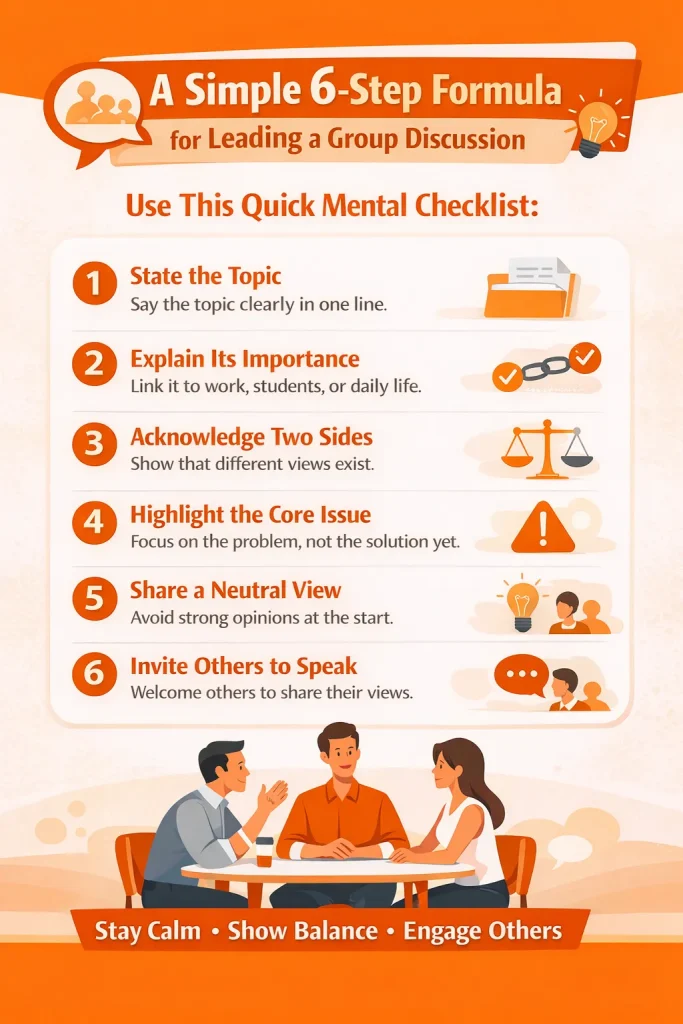
A Simple 6-Step Formula You Can Use in Any Ground Discussion
If you are wondering how to lead a group discussion, use this simple structure as a quick mental checklist.
- State the topic in one line. Say it plainly so everyone knows the focus.
- Explain why it matters now. Link it to work, students, technology, or daily life.
- Acknowledge two sides. Show that different views exist.
- Point out the core problem. Focus on the issue, not the solution yet.
- Share a neutral or light view. Avoid strong claims at the start.
- Invite others to join. This keeps the discussion open and collaborative.
Best Group Discussion Starting Lines Examples and Templates
If you don’t know how to start a GD, use this template to frame your introduction. “Today’s topic is [state the topic clearly]. This is relevant because [why it matters now]. There are different views on this issue, with [briefly mention two sides]. The main concern here is [identify the core problem]. From a balanced point of view, [share a neutral or light opinion]. I would like to hear what others think about this.”
These starting lines and templates help you begin a group discussion smoothly when you need quick and natural openings.
- Definition-based: “Before we begin, it helps to define what we mean by this topic.”
- Question-based: “An important question to consider here is whether this approach actually solves the problem.”
- Fact-based: “Recent reports show a clear change in how this issue affects people today.”
- Real-life situation: “Many of us have seen this situation in daily life, which makes this topic relevant.”
- Balanced view: “This topic has both advantages and challenges, and both deserve discussion.”
- Numbered points: “I would like to start by focusing on two points related to this topic.”
- Invite participation: “Before forming opinions, it would be useful to hear different views on this.”
Top Group Discussion Tips and Strategies for Interviews
Now that you know how to start a group discussion, here are some tips and strategies to help you stay effective and confident throughout the GD.
- Listen with intent: Pay close attention to what others say so your response adds value instead of repeating points.
- Speak at the right time: Wait for a pause or a natural break before speaking to avoid interruptions.
- Keep points crisp: Use short and clear sentences so the group can easily follow your thoughts.
- Acknowledge others before adding your point: Briefly refer to what someone said before sharing your view to show listening and respect.
- Stay calm during disagreement: Disagree politely and focus on ideas rather than people.
- Use simple examples: Small and relatable examples make your point clearer and more convincing.
- Stay consistent with your viewpoint: Avoid changing opinions too often, as it can weaken your arguments.
- Watch your body language: Sit upright, maintain eye contact, and avoid gestures that show impatience.
- Know when to stop: Say what is needed and pause. Clear points work better than speaking too often.
Common Mistakes to Avoid While Starting a GD
Here are the common mistakes candidates make while starting a group discussion, often without realising how it affects their first impression.
- Apologising before speaking: Beginning with “sorry” or “I may be wrong” makes you sound unsure.
- Speaking too fast: Rushing through your opening reduces clarity and confidence.
- Sounding aggressive: A loud or forceful tone can discourage others from engaging.
- Using memorised lines: Rehearsed openings often sound unnatural and scripted.
- Trying to sound “intelligent”: Overusing complex words can confuse listeners and weaken your point.
Also Read - Top 20+ Most Common GD Interview Topics with Answers
Wrapping Up
Knowing how to start a group discussion can change how others see you in those crucial first moments. A clear opening and simple structure help you speak with confidence and guide the discussion naturally. With regular practice, this skill becomes easy to use. For more career guidance, visit Hirist, an online job portal for top IT jobs in India. The Hirist blog also offers helpful resources to prepare for group discussions and interviews.
FAQs
Start by understanding the topic clearly, waiting for the right moment to speak, and opening with a calm and relevant point such as a short definition, a question, or a balanced statement.
Speak clearly, stay on topic, listen to others, avoid interruptions, and respect different opinions to ensure a productive and respectful discussion.
You can practice by speaking in front of a mirror, recording your opening on your phone, or writing short introductions for common GD topics and reading them aloud.