A complete guide to the most asked generative AI interview questions and answers for freshers, experienced candidates and anyone preparing for AI or LLM-based roles.
Going through commonly asked Generative AI interview questions and answers is a smart way to prepare before your AI or LLM interviews. Generative AI refers to artificial intelligence systems that can create original content such as text, images, code, audio and video by learning patterns from large datasets. Its origin comes from decades of AI and machine learning research. The field gained major attention after GANs were introduced by Ian Goodfellow in 2014 and transformer models became popular after 2017.
You can expect Generative AI questions when applying for roles like AI engineer, Gen AI developer, prompt engineer and machine learning specialist. This guide covers 40+ commonly asked Gen AI interview questions and answers, along with MCQs for a quick revision.
One of the biggest breakthroughs in Generative AI came from a paper with a surprisingly simple title: Attention Is All You Need. Published in 2017, it introduced the Transformer model that later became the backbone of many advanced AI systems.
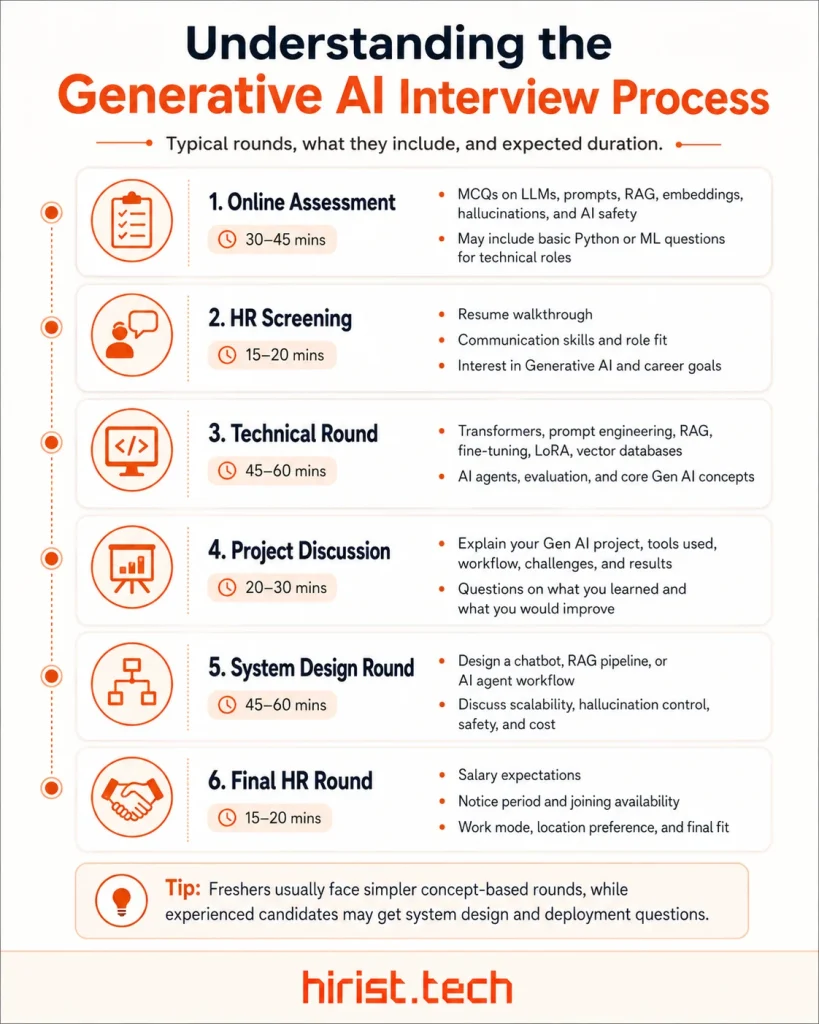
Understanding the Generative AI Interview Process
The Generative AI interview process usually includes multiple rounds to test your basic concepts and technical skills.
- Online Assessment
- HR Screening
- Technical Round
- Project Discussion
- System Design Round
- Final HR Round
Section 1: Basic Generative AI Interview Questions for Freshers (Foundational Concepts)
Let’s start with the basic Generative AI interview questions for freshers. These questions are often asked to the beginners during the first HR or screening round of the interview.
1. What is Generative AI?
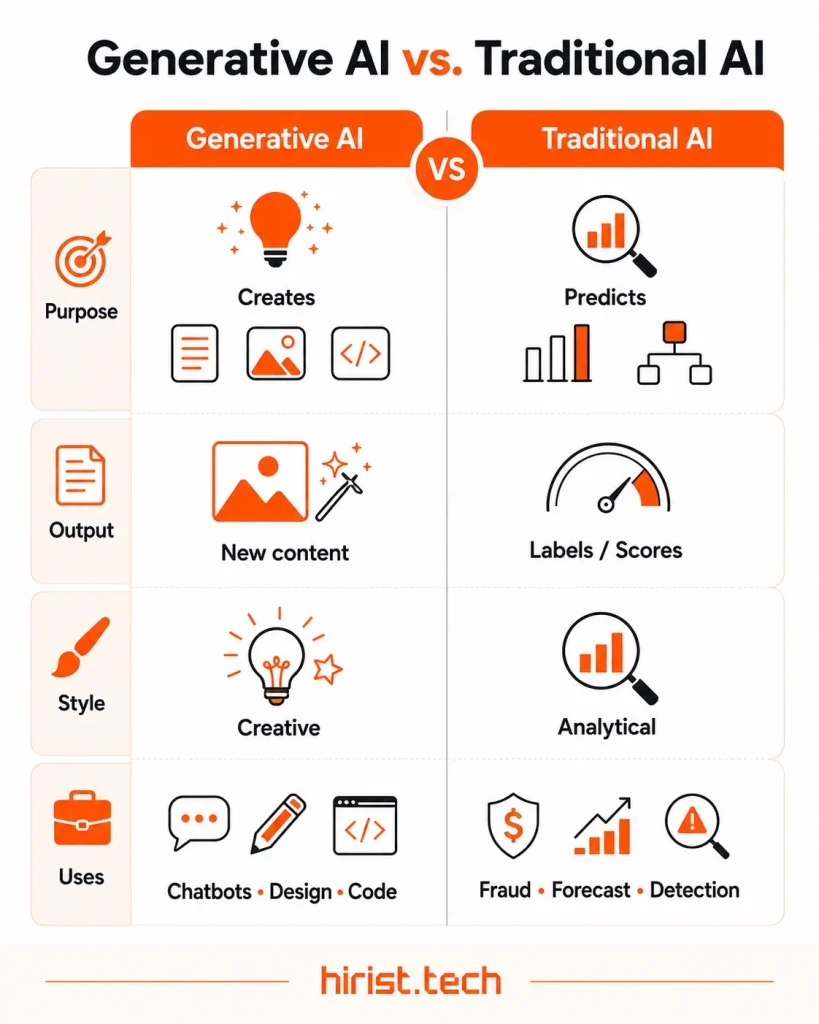
Generative AI is a type of artificial intelligence that can create new content from patterns learned in large datasets. It can produce text, images, code, audio, video and other outputs.
In interviews, you can say: “Generative AI does not only classify or predict data. It learns the structure of existing data and uses that learning to create new content that looks or sounds similar.”
2. How is Generative AI different from traditional AI?
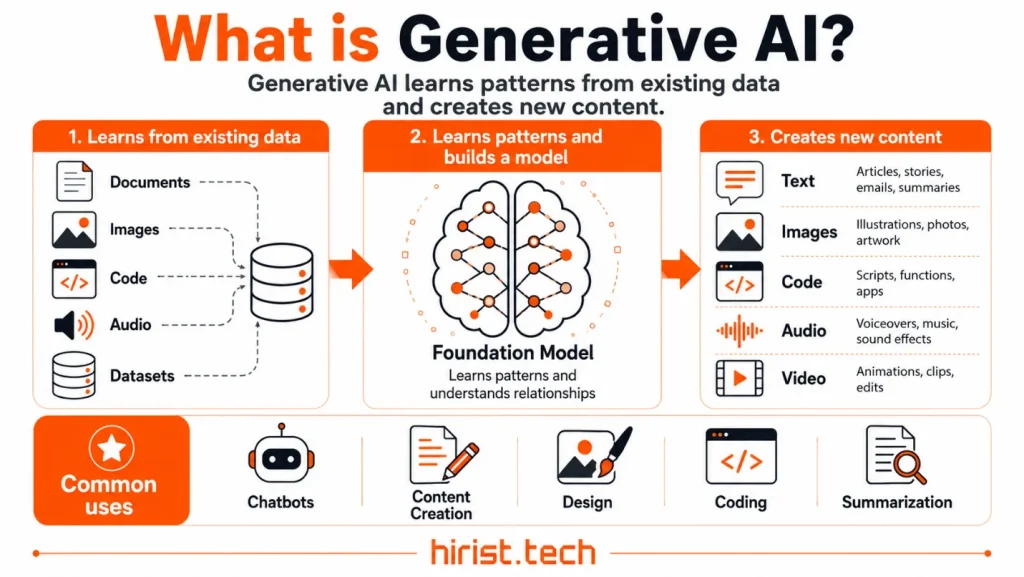
Traditional AI is mainly used to analyze data, follow rules, classify information or predict outcomes. Generative AI goes a step further by creating new content.
| Basis | Traditional AI | Generative AI |
|---|---|---|
| Main purpose | Analyzes, classifies or predicts data | Creates new content from learned patterns |
| Output | Decision, label, score or prediction | Text, image, code, audio, video or design |
| Example | Detects spam emails | Writes a new email response |
| Common use | Fraud detection, recommendation, diagnosis, classification | Chatbots, content creation, coding, image generation, summarization |
You can use this line in the interview: Traditional AI answers “What is this?” or “What may happen?” Generative AI answers “What can be created?”
3. What is a Large Language Model?
A Large Language Model, or LLM, is an AI model trained on huge amounts of text data to understand and generate language. It works by predicting the next token based on the context it has already seen. LLMs are commonly used for writing, summarization, translation, coding, question answering and chatbots. Most modern LLMs are based on Transformer architecture.
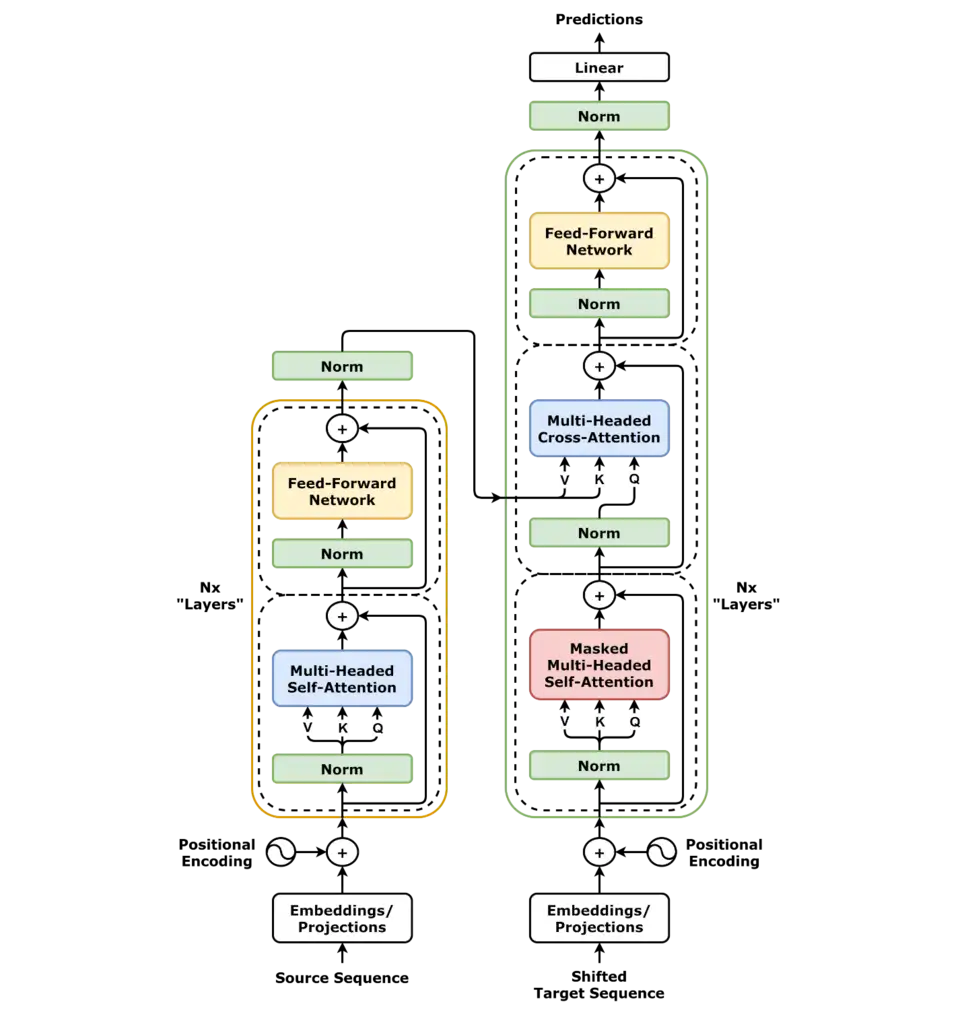
4. What is Transformer architecture?
Transformer architecture is a deep learning architecture introduced in the paper Attention Is All You Need. It uses attention mechanisms instead of reading text only in sequence. Its key parts include:
- Self-attention
- Multi-head attention
- Positional encoding
- Feed-forward layers
- Encoder-decoder blocks
In many modern LLMs, decoder-only Transformer models are used for text generation.
Also Read - Top 40+ Deep Learning Interview Questions and Answers
5. Why are Transformers better than RNNs for modern NLP tasks?
RNNs process text step by step, which makes them slower and weaker at handling long contexts. Transformers process tokens in parallel and use self-attention to understand relationships between words across a sequence. This makes Transformers better for long-range dependencies, large-scale training, faster computation and modern NLP tasks like translation, summarization, coding and question answering.
6. How are reasoning models different from standard chat-based LLMs?
Reasoning models spend more computation on complex problems, while standard chat-based LLMs are usually faster and better for direct language tasks.
| Basis | Reasoning Models | Standard Chat-Based LLMs |
|---|---|---|
| Main focus | Solving complex problems step by step | Giving quick and fluent responses |
| Best for | Math, coding, logic, planning and multi-step tasks | Writing, summarizing, rewriting, Q&A and general chat |
| Response style | More deliberate and problem-solving focused | Faster and more conversational |
| Computation | Uses more processing before the final answer | Usually responds with less computation |
| Strength | Better for tasks that need deeper reasoning | Better for simple or open-ended language tasks |
In interviews, you can say: “Reasoning models are useful when accuracy and multi-step thinking matter. Chat-based LLMs are useful when speed and natural conversation matter.”
Also Read - Top 25 LLM Interview Questions and Answers
Section 2: Prompt Engineering and Optimization Questions
Here are some practical Gen AI interview questions on prompt engineering and response optimization. These are intermediate-level questions.
7. What is prompt engineering?
Prompt engineering is the process of writing clear instructions that guide an AI model toward the right output. A good prompt tells the model what to do, gives useful context, defines the format and adds limits when needed. It helps improve response quality without changing the model’s training or internal parameters.
8. What are zero-shot prompting and few-shot prompting?
Zero-shot prompting means asking the model to perform a task without giving any example. Few-shot prompting means giving a few sample inputs and outputs before asking the model to complete a similar task.
| Basis | Zero-Shot Prompting | Few-Shot Prompting |
|---|---|---|
| Examples given | No examples | A few examples |
| Best for | Simple or familiar tasks | Tasks with a specific pattern |
| Prompt length | Shorter | Longer |
| Example | “Summarize this paragraph.” | Give 2 summaries first, then ask for a new one |
9. What is chain-of-thought prompting?
Chain-of-thought prompting is a technique where the model is guided to break a complex task into smaller reasoning steps before giving the final answer. It is useful for math, logic, coding and multi-step problem solving. Chain-of-thought prompting is widely discussed for tasks that need multi-step reasoning.
10. What makes a prompt effective?
An effective prompt is clear, specific and complete enough for the model to understand the task. A strong prompt usually includes the goal, background context, audience, format, tone and constraints. If the task has a fixed pattern, adding one or two examples can also improve the response.
11. Why do LLMs sometimes give different answers to the same prompt?
LLMs can give different answers because text generation is probabilistic. The model does not always pick the same next token every time. Settings like temperature, Top-k and Top-p can change how random or focused the output becomes. The wording of the prompt, available context and model version can also affect the response.
12. How do Top-k and Top-p sampling control the output of an LLM?
Top-k and Top-p sampling control which next tokens the model can choose during text generation. Top-k limits the model to a fixed number of the most likely tokens. Top-p, also called nucleus sampling, chooses from the smallest group of tokens whose combined probability reaches a set threshold. Lower values usually make answers more focused. Higher values can make answers more varied.
| Sampling Method | Meaning | Effect |
|---|---|---|
| Top-k | Considers only the top “k” likely tokens | Controls the number of choices |
| Top-p | Considers tokens within a probability limit | Controls the probability range |
| Lower value | Fewer token choices | More focused output |
| Higher value | More token choices | More varied output |
13. What is context engineering and how is it different from prompt engineering?
Context engineering is the practice of giving an AI system the right information, tools and format so it can complete a task more reliably. Prompt engineering focuses on writing a good instruction. Context engineering is broader. It includes the prompt, chat history, retrieved documents, tool outputs, memory, user data and system rules. This is becoming important in AI agents because agents often need dynamic context from many sources, not just one well-written prompt.
Also Read - Top 90+ Machine Learning Interview Questions and Answers
Section 3: Retrieval-Augmented Generation Questions
This section covers Retrieval-Augmented Generation, also known as RAG. Both freshers and experienced professionals may face these Generative AI interview questions.
14. What is Retrieval-Augmented Generation?
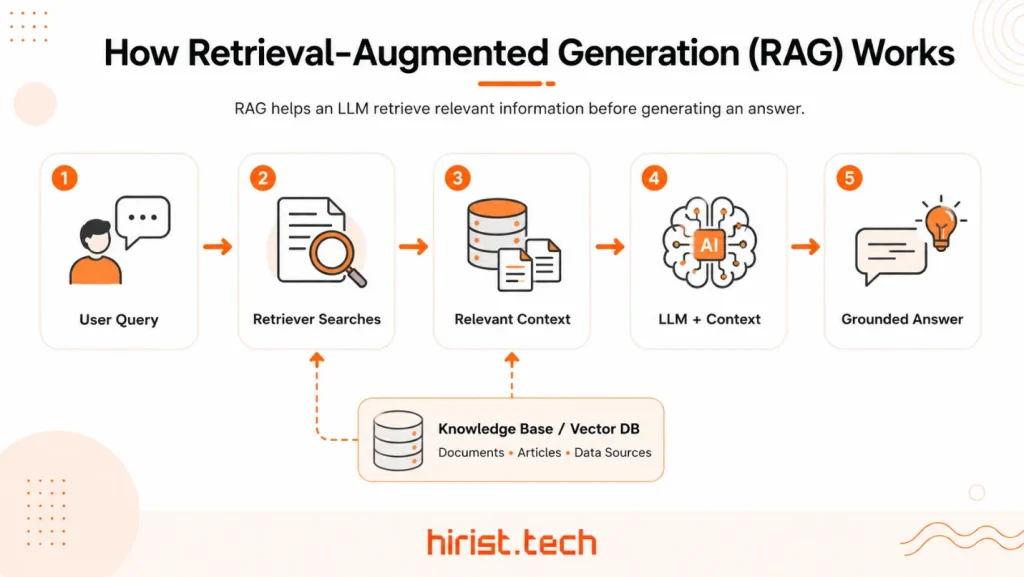
Retrieval-Augmented Generation, or RAG, is a technique where an LLM retrieves relevant information from external sources before generating an answer. Instead of depending only on training data, the model retrieves relevant information from documents, databases or knowledge bases and then creates a more grounded response.
15. Why is RAG used in Generative AI applications?
RAG is used when an AI system needs accurate, updated or private information. For example, a company chatbot can use RAG to answer from internal HR policies, product manuals or legal documents. It also helps reduce hallucinations because the model gets relevant source material before writing the final answer.
16. How does a basic RAG pipeline work?
A basic RAG pipeline works in five main steps:
- Collect data: Gather documents, FAQs, web pages, manuals or internal files.
- Create chunks: Split large documents into smaller sections so the system can search them easily.
- Generate embeddings: Convert each chunk into numerical vectors that capture meaning.
- Store and retrieve: Save the embeddings in a vector database and retrieve the most relevant chunks when a user asks a question.
- Generate the answer: Send the retrieved chunks with the user’s query to the LLM so it can create a grounded answer.
17. What are embeddings and vector databases in RAG?
Embeddings are numerical representations of text that capture meaning. They help the system compare a user question with stored document chunks based on semantic similarity. A vector database stores these embeddings and retrieves the most relevant chunks quickly. In RAG, embeddings and vector databases help the model find the most relevant document chunks for a user query.
| Term | Meaning |
|---|---|
| Embeddings | Text converted into meaning-based vectors |
| Vector database | Stores and searches embeddings |
| Similarity search | Finds content close to the user query |
18. What is chunking and why does chunk size matter?
Chunking means splitting large documents into smaller parts before storing them in a RAG system. Chunk size matters because very small chunks can miss context. Very large chunks can bring extra information. A good chunk size helps the system retrieve focused and useful content.
19. What is GraphRAG and when is it better than normal vector-based RAG?
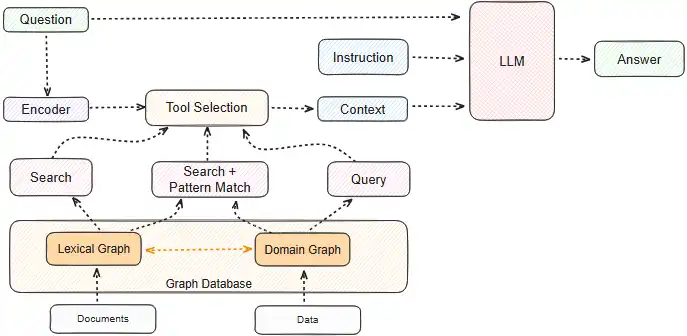
GraphRAG is a RAG approach that uses a knowledge graph to connect entities, facts and relationships before generating answers. Normal vector-based RAG is good for finding similar text. GraphRAG is better when the answer depends on relationships between people, events, products, documents or concepts.
| Basis | Vector-Based RAG | GraphRAG |
|---|---|---|
| Search style | Finds similar text | Finds connected facts |
| Best for | Direct document Q&A | Relationship-based questions |
| Example | “What is the refund policy?” | “Which vendors are linked to delayed orders?” |
Section 4: Fine-Tuning and Model Customization Questions
These Generative AI interview questions focus on model customization. You may face these questions in a technical round for advanced roles.
20. What is fine-tuning in LLMs?
Fine-tuning is the process of training a pre-trained LLM on a smaller and task-specific dataset. It helps the model adapt to a specific domain, tone, format or use case. For example, a healthcare company may fine-tune a model on medical support conversations.
21. When should you use RAG instead of fine-tuning?
Use RAG when the model needs updated, private or source-based information. RAG is better when the answer should come from documents, policies, manuals or databases. Fine-tuning is better when you want to change the model’s behavior, style or task pattern.
22. What is supervised fine-tuning?
Supervised fine-tuning, or SFT, trains a model using labeled prompt-and-response examples. The model learns how it should answer by studying correct examples. SFT is often used to make a base model better at following instructions.
23. What is RLHF and why is it used?
RLHF means Reinforcement Learning from Human Feedback. It is used to align model responses with human preferences. In RLHF, people compare model outputs, a reward model learns from those choices and the LLM is trained to produce more helpful and safer answers.
24. What are LoRA, QLoRA and PEFT?
LoRA, QLoRA and PEFT are efficient ways to customize large models without training all model parameters.
| Term | Meaning |
|---|---|
| PEFT | Parameter-Efficient Fine-Tuning. It updates only a small part of the model |
| LoRA | Low-Rank Adaptation. It adds small trainable matrices to the model |
| QLoRA | Quantized LoRA. It uses quantization with LoRA to reduce memory needs |
25. What is Direct Preference Optimization and how is it different from RLHF?
Direct Preference Optimization, or DPO, aligns LLMs with human preferences by training directly on chosen and rejected responses, while RLHF usually uses a separate reward model and reinforcement learning.
| Basis | RLHF | DPO |
|---|---|---|
| Full form | Reinforcement Learning from Human Feedback | Direct Preference Optimization |
| Training method | Uses human feedback, reward model and reinforcement learning | Uses preference pairs directly |
| Reward model | Required | Not required |
| Reinforcement learning step | Usually required | Not required |
| Data used | Ranked or preferred human feedback | Chosen response and rejected response pairs |
| Complexity | More complex to train | Simpler and lighter in many cases |
Also Read – AI Automation Explained: RPA, Intelligent Automation & Use Cases
Section 5: Evaluation, Hallucinations and Safety Questions
This section covers the risks and quality checks involved in Generative AI. These questions explain hallucinations, guardrails and safe AI practices.
26. What are hallucinations in LLMs?
Hallucinations are incorrect or unsupported answers generated by an LLM with confidence. The answer may sound natural and convincing, but it may not be based on real facts, given context or verified sources.
27. Why do LLMs hallucinate?
LLMs hallucinate because they predict the most likely next tokens instead of checking facts like a database. Hallucinations can happen due to missing context, outdated training data, unclear prompts, weak retrieval and questions that ask for information the model does not know.
28. How can hallucinations be reduced?
Hallucinations can be reduced by giving the model better context and adding checks around the output. Common methods include:
- RAG
- Source grounding
- Clear prompts
- Fact-checking
- Confidence scoring
- Human review and guardrails
29. How do you evaluate Generative AI outputs?
Generative AI outputs can be evaluated by checking accuracy, relevance, factual grounding, clarity, safety, bias, latency and cost. For text tasks, metrics like BLEU, ROUGE and BERTScore may be used. Human review is also important because many Gen AI answers do not have only one correct response.
30. What are guardrails in Generative AI?
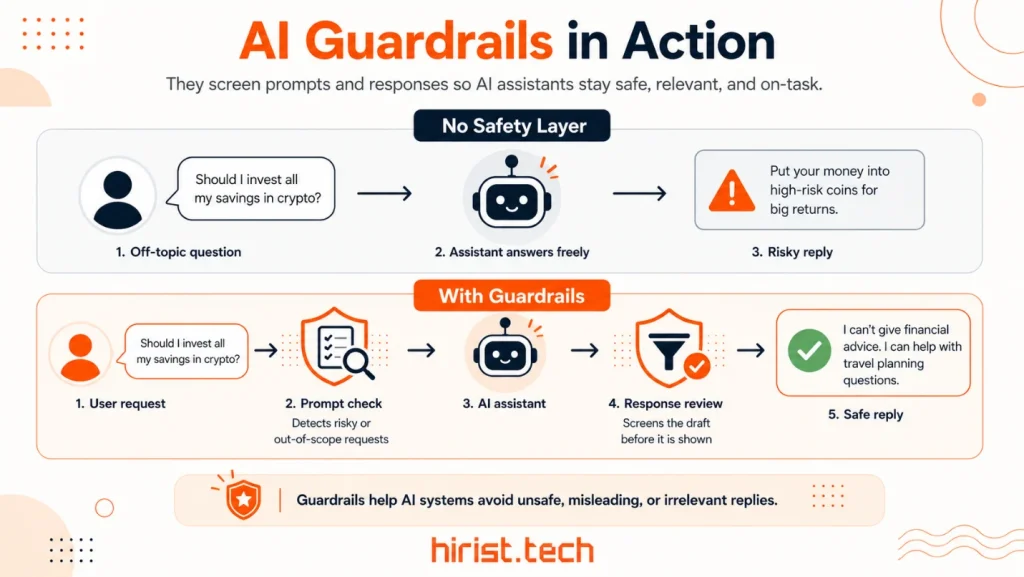
Guardrails are safety controls that help keep AI outputs safe, relevant and policy-friendly. They can block harmful prompts, filter unsafe responses, reduce bias, protect private data and stop the model from giving answers outside allowed limits.
31. How would you test a Gen AI application for safety risks before deployment?
To test a Gen AI application for safety risks, you would check both inputs and outputs before release. Key steps include:
- Testing harmful prompts
- Checking for hallucinations
- Reviewing bias
- Testing data leakage
- Checking prompt injection attacks
- Validating guardrails
- Using human review for high-risk cases
Also Read - Types of AI Agents: Architecture, Examples & Systems
Section 6: AI Agents and Gen AI Tools Questions
Here are important Generative AI interview questions and answers on AI agents and popular Gen AI tools.
32. What is an AI agent?
An AI agent is a system that can understand a goal, plan steps, use tools and take actions with limited human input. Unlike a basic chatbot, an agent can call APIs, search data, use memory and complete multi-step tasks.
33. How is Agentic AI different from Generative AI?
Generative AI creates content. Agentic AI uses AI to make decisions, plan tasks and take actions.
| Basis | Generative AI | Agentic AI |
|---|---|---|
| Main role | Creates text, images, code or audio | Plans and acts toward a goal |
| Human input | Usually needs a prompt | Can continue across steps |
| Output | Content or response | Action, workflow or completed task |
| Example | Writes an email | Finds data, drafts email and sends it after approval |
Also Read - Agentic AI vs Generative AI: Differences, Uses & Future
34. What is memory in AI systems?
Memory in AI systems helps the model keep useful information across a task or conversation. Short-term memory stores recent context. Long-term memory stores past details, preferences or knowledge in an external system like a database or vector store.
35. What is LangChain used for?
LangChain is used to build LLM-powered applications and AI agents. It helps developers connect models with prompts, tools, memory, retrievers and workflows. It is useful for chatbots, RAG apps, tool-using agents and multi-step AI systems.
36. What is LlamaIndex used for?
LlamaIndex is used to connect LLMs with private or external data. It helps with data ingestion, indexing, retrieval and building agents over documents, PDFs, databases and other data sources. It is widely used for RAG and knowledge-based AI applications.
37. What is Model Context Protocol and why is it important for AI agents?
Model Context Protocol, or MCP, is an open standard that helps AI applications connect with external tools, apps and data sources. It is important for AI agents because agents need current data and tool access to complete tasks. MCP reduces the need for custom integrations and gives agents a more standard way to work with external systems.
Also Read - AI vs Data Science: Differences, Skills & Career
Section 7: Gen AI MCQs for Quick Revision
We have also added Gen AI MCQs to help you revise the key concepts for the initial online assessment.
- A company wants an AI chatbot to answer questions from its latest internal policy documents. Which approach is most suitable?
- A. Fine-tuning only
- B. Retrieval-Augmented Generation
- C. Increasing temperature
- D. Zero-shot prompting only
- You want an LLM to give more predictable and factual answers. Which temperature setting is usually better?
- A. High temperature
- B. Low temperature
- C. Random temperature
- D. No temperature setting
- A model gives confident but incorrect answers even when the topic is factual. What is this called?
- A. Overfitting
- B. Hallucination
- C. Tokenization
- D. Embedding drift
- Your RAG system retrieves irrelevant document chunks. What should you check first?
- A. The font size of the document
- B. Chunking strategy and embedding quality
- C. The model’s logo
- D. The user’s browser
- When should fine-tuning be preferred over RAG?
- A. When the model needs updated company documents
- B. When the model must learn a consistent domain-specific style or behavior
- C. When the model needs fewer tokens
- D. When the prompt is short
- Which technique helps customize large models with fewer trainable parameters?
- A. LoRA
- B. BLEU
- C. Top-p
- D. WordPiece
- A prompt includes two sample inputs and outputs before asking the model to solve a new task. Which prompting method is this?
- A. Zero-shot prompting
- B. Few-shot prompting
- C. Random prompting
- D. Negative prompting
- Which metric is more useful for checking semantic similarity instead of exact word overlap?
- A. BERTScore
- B. Character count
- C. File size
- D. Token limit
- What is the main purpose of guardrails in a Gen AI application?
- A. To increase model size
- B. To prevent unsafe, biased or policy-violating outputs
- C. To remove all prompts
- D. To replace vector databases
- An AI agent needs to use external tools, remember context and complete multi-step tasks. What makes it different from a basic chatbot?
- A. It only generates imagesB. It can plan, use tools and act toward a goalC. It does not use language modelsD. It works without any input
Also Read - Top 45+ Artificial Intelligence (AI) Interview Questions and Answers
Generative AI Interview Preparation Tips
Follow these practical steps to turn your Gen AI knowledge into clear interview answers.
- Prepare a 30-second intro: Be ready to explain your Gen AI interest, skills and project work clearly.
- Create one project story: Pick one Gen AI project and explain the problem, tools, steps, result and challenges.
- Use the “why this method” approach: For every answer, explain why you would choose RAG, fine-tuning, prompting or agents.
- Practice whiteboard explanations: Draw a simple RAG pipeline, agent workflow or fine-tuning flow and explain it aloud.
- Prepare failure examples: Learn what can go wrong in RAG, prompts, agents and model outputs.
- Revise interview keywords: Keep short definitions ready for LLM, embeddings, context window, hallucination, LoRA and guardrails.
- Answer with examples: Connect each technical answer to a real case like HR chatbot, support bot or document search.
- Know your tools lightly: Do not just name LangChain or LlamaIndex. Know what problem each tool solves.
- Practice scenario questions: Prepare answers for cost control, slow responses, wrong answers and unsafe outputs.
Also Read - AI Marketing Automation: Tools, Use Cases & Benefits
Wrapping Up
So these are 40+ of the most frequently asked Generative AI interview questions with answers. Go through these questions and use the MCQs to test your knowledge. Follow the tips we have shared to prepare smarter.
Are you looking for Generative AI jobs? Visit Hirist, an IT job portal where you can find the best IT jobs in India with the latest AI and ML job openings.
FAQs
Yes, some interviews may include basic coding questions, especially for AI engineer, ML engineer or Gen AI developer roles.
Generative AI Engineer interview questions usually test both concepts and practical application. Common questions include:
You can use LLM documentation, beginner AI courses, research paper summaries, GitHub projects, YouTube explainers and hands-on tools like OpenAI APIs, LangChain, LlamaIndex, FAISS and Pinecone. Also practise with Gen AI MCQs given in this guide.
Yes, basic machine learning knowledge helps. You should understand training data, models, tokens, embeddings, overfitting, evaluation and APIs.
Good project ideas include a document-based Q&A chatbot, customer support bot, resume screening assistant, text summarizer, SQL query generator, content generation tool or RAG-based knowledge assistant.