Artificial intelligence and data science are two of the most in-demand fields for tech students and IT professionals. Both work with large volumes of data collected from apps and digital systems. Yet their goals and job outcomes are different. Data science focuses on studying data to find patterns and useful insights. Artificial intelligence uses data to train systems that can learn and act on their own. This guide explains the key similarities and differences between Artificial Intelligence vs Data Science. You will also understand how they differ in skills, salary, and career options to make a smarter choice.
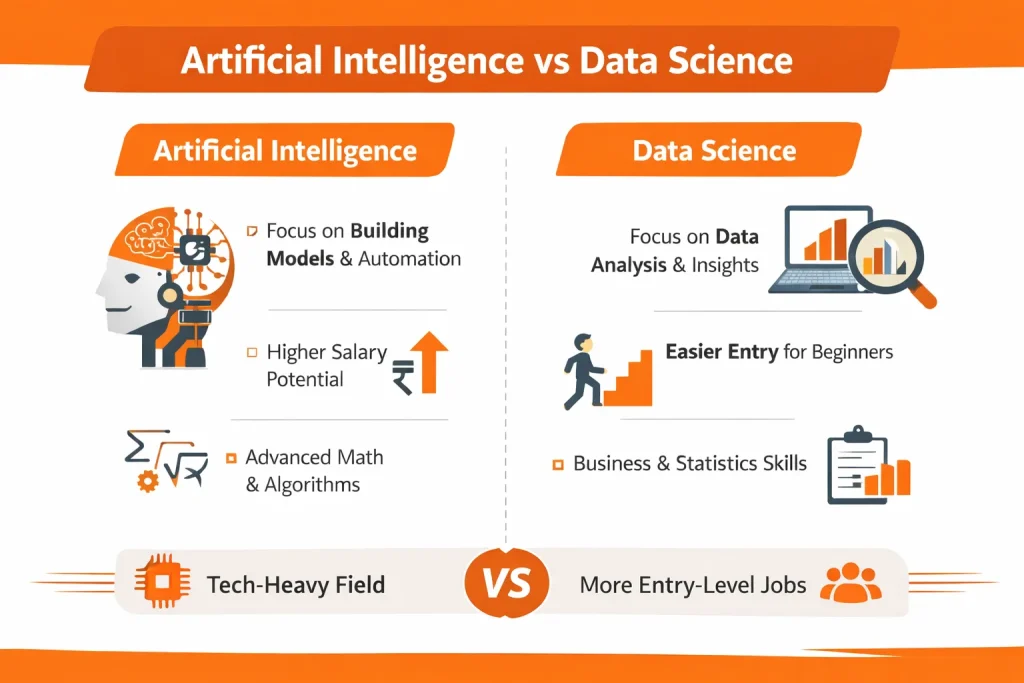
Artificial Intelligence vs Data Science – 10+ Key Differences
Understanding the difference between AI and Data Science helps you choose the right path by clarifying how each field works and the career outcomes they offer.
| Aspect | Data Science | Artificial Intelligence |
|---|---|---|
| Core Idea | Focuses on understanding data and extracting insights. | Focuses on building systems that can think or act intelligently. |
| Primary Goal | The main goal is to help humans make better decisions using data. | The main goal is to enable machines to make decisions or perform tasks automatically. |
| Types of Data | Works with raw and processed data in many formats such as tables, text, and logs. | Uses processed and transformed data such as features, vectors, and embeddings for model learning. |
| Scientific Processing | Heavy use of statistics and exploratory analysis. | Heavy use of algorithms and computational learning. |
| Build | Builds analytical models to explain patterns, trends, and relationships in data. | Builds intelligent systems that can learn patterns and act based on them. |
| Key Technique Used | Data analysis, statistical modeling, visualization. | Machine learning, deep learning, reinforcement learning. |
| Model Purpose | Models explain what is happening and why it is happening. | Models learn behavior patterns and act on them. |
| Human Involvement | Humans interpret results and take action. | Systems act with minimal human input. |
| Typical Outputs | Reports, dashboards, insights, forecasts. | Predictions, recommendations, automated actions. |
| Examples of Tools | Python, R, SQL, Tableau, Power BI. | TensorFlow, PyTorch, Keras, Scikit-learn. |
| Educational Path | Requires a strong foundation in statistics, mathematics, and data analysis. | Requires deep knowledge of algorithms, machine learning, and computer science. |
| Essential Skill Sets | Data cleaning, analysis, visualization, and domain understanding. | Model building, training, tuning, and system integration. |
| Applications | Sales forecasting, fraud analysis, customer insights. | Chatbots, recommendation engines, autonomous systems. |
| Career Roles | Data Analyst, Data Scientist, BI Analyst, Data Engineer. | AI Engineer, ML Engineer, AI Researcher, Robotics Engineer. |
| Average Salary | ₹15 Lakhs – ₹16.6 Lakhs. | ₹16.7 Lakhs – ₹18.5 Lakhs |
| Career Entry Level | Easier entry with analyst roles. | Higher barrier to entry in most roles. |
Artificial Intelligence vs Data Science – The Similarities Between the Two Fields
Now that we have covered the difference between AI and Data Science, let’s take a look at the common foundations that often make them appear closely related.
- Both are Data-Driven: Each field depends on large amounts of data to work.
- Both Use Predictive Thinking: Data Science forecasts outcomes like sales or demand, while AI predicts actions such as braking in self-driving cars. In both cases, past data guides future behavior.
- Machine Learning Connects Them: Machine learning sits at the intersection. It is used in many data science tasks and powers many AI systems, though neither field relies on it all the time.
- Shared Tools and Skills: Both often use programming languages like Python and similar libraries to solve real problems.
What is Data Science?
Data Science is a field within artificial intelligence that focuses on analyzing data to support decisions and solve complex problems. It involves collecting large volumes of structured and unstructured data and studying them using statistical methods, algorithms, and logical analysis. The focus of Data Science is not prediction alone but understanding behavior and trends so businesses can make informed choices based on evidence.
Key Fundamentals of Data Science
Data Science follows a systematic process where each step helps turn raw data into usable insight.
- Data Collection: Sourcing data from databases and external sources.
- Data Processing and Cleaning: Handling missing values and inconsistencies.
- Exploratory Data Analysis: Understanding patterns and relationships.
- Statistical Modeling: Testing ideas and measuring outcomes.
- Visualization: Presenting findings in charts and dashboards.
- Insight Communication: Explaining findings so non-technical teams can understand results.
Applications of Data Science
Data Science is used wherever decisions depend on evidence rather than intuition.
- E-commerce and Retail: Studying customer behavior to recommend products and manage inventory.
- Healthcare: Supporting diagnosis, patient risk analysis, and medical research.
- Finance: Detecting fraud, assessing risk, and improving credit decisions.
- Transportation: Optimizing routes, forecasting demand, and reducing delays.
- Technology: Improving search results, voice systems, image analysis, and ads.
- Entertainment: Recommending content and analyzing user engagement.
What is Artificial Intelligence?
Artificial Intelligence is a field of computer science focused on creating systems that can perform tasks normally requiring human intelligence. These tasks include learning from data, recognizing patterns, understanding language, and making decisions. AI relies heavily on techniques like machine learning and deep learning to improve performance over time. Artificial intelligence is widely used in everyday tools such as Google Assistant, Amazon recommendations, YouTube content suggestions, and facial recognition features on modern smartphones.
Key Fundamentals of Artificial Intelligence
Artificial Intelligence is built on a set of technologies that allow machines to learn and respond intelligently.
- Machine Learning: Helps systems learn from data and improve over time.
- Deep Learning: Uses layered neural networks to process images, speech and signals.
- Natural Language Processing (NLP): Helps systems understand and reply to human language.
- Computer Vision: Allows machines to read and understand images and videos.
- Decision Models: Help systems choose actions based on past learning.
Applications of Artificial Intelligence
Artificial Intelligence is used where automation and intelligent responses are required.
- Virtual Assistants: Responding to voice commands and queries.
- Recommendation Systems: Personalizing movies, music and products.
- Healthcare Tools: Assisting with diagnosis and medical imaging.
- Autonomous Technologies: Used in vehicles and robotics.
- Customer Service Systems: Handling large volumes of requests automatically.
Also Read - AI Automation Explained: RPA, Intelligent Automation & Use Cases
Artificial Intelligence (AI) vs Data Science – Skills Comparison
The skills required for Data Science and Artificial Intelligence may overlap at the surface, but they diverge quickly once you move beyond basics. Here’s what you actually need to learn:
Data Science Skills
- Ability to work with Python and SQL to collect and clean data.
- Knowledge of statistics and probability to test ideas and validate results.
- Experience with data cleaning and preparation.
- Ability to use Pandas and NumPy for data manipulation.
- Creating clear insights using Tableau, Power BI, Matplotlib, or Seaborn.
- Basic use of machine learning models for analysis and prediction.
- Domain knowledge to connect data patterns with business or industry problems.
Artificial Intelligence Skills
- Machine learning concepts and model training.
- Deep learning basics and neural networks.
- Practical experience with TensorFlow, PyTorch, and Keras.
- Strong Python and algorithmic thinking.
- Skills in natural language processing or computer vision.
- Model evaluation and optimization methods.
- System design for automated decision-making.
- Experience deploying models into real applications.
Also Read - Agentic AI Explained: Meaning, Benefits & Examples
Careers in Artificial Intelligence vs Data Science
AI and Data Science lead to different kinds of jobs because the nature of work in each field is different. While both work with data and may collaborate on projects, the roles and responsibilities are usually different.
Careers in Data Science
- Data Analyst
- Data Scientist
- Business Intelligence Analyst
- Data Engineer
- Data Visualization Specialist
- Quantitative Analyst
- Analytics Consultant
- Data Architect
Careers in Artificial Intelligence
- AI Engineer
- Machine Learning Engineer
- Data Scientist
- AI Researcher
- Robotics Engineer
- Computer Vision Engineer
- AI Product Manager
- AI Ethics Specialist
- AI Architect
Data Science vs AI Salary and Job Outlook
Salary is one of the biggest deciding factors for students and professionals choosing between Data Science and Artificial Intelligence. Here is the recent salary data from AmbitionBox.
Average Salary Expectations
| Category | Data Scientist Salary | Artificial Intelligence Salary |
|---|---|---|
| Average Annual Salary | ₹15.8 Lakhs | ₹17.6 Lakhs |
| Most Professionals Earn | ₹15 Lakhs – ₹16.6 Lakhs | ₹16.7 Lakhs – ₹18.5 Lakhs |
| Typical Experience Range | 1–8 years | 0–8 years |
Salary Based on Job Roles
| Role | Estimated Range |
|---|---|
| Data Analyst | ₹6.6 Lakhs – ₹7.2 Lakhs |
| Data Scientist | ₹15 Lakhs – ₹16.6 Lakhs |
| Data Engineer | ₹11.3 Lakhs – ₹12.5 Lakhs |
| Business Intelligence Analyst | ₹9.2 Lakhs – ₹10.1 Lakhs |
| AI Engineer | ₹17.2 Lakhs – ₹19.1 Lakhs |
| Machine Learning Engineer | ₹11.2 Lakhs – ₹12.4 Lakhs |
| AI Researcher | ₹24.4 Lakhs – ₹31.1 Lakhs |
| Robotics Engineer | ₹4.7 Lakhs – ₹5.2 Lakhs |
Note: Exact figures vary by company and location.
Artificial Intelligence vs Data Science Job Outlook
- Demand Continues to Grow: Both fields are expanding as companies use data and automation for smarter decisions and products.
- Data Scientist Roles: Projected to grow by around 34% from 2024 to 2034.
- AI Roles: Expected to grow at nearly 15% per year until 2027 in India.
- AI Skills Pay a Premium: Roles involving machine learning and deep learning tend to have higher salaries than pure analytics positions.
- Cross-Function Skills are Valuable: Professionals who combine domain knowledge with technical ability are highly sought after.
Data Science or Artificial Intelligence – Which is Better?
There is no universal answer to which field is better. The right choice depends on your interests and long-term career goals.
Data Science is a better fit if you enjoy working with data and helping businesses make informed decisions. It offers broader entry-level opportunities and is widely used across industries like finance, healthcare, retail, and consulting.
Artificial Intelligence is more suitable if you prefer building systems and working with algorithms. It demands deeper technical expertise and has a steeper learning curve, but it often comes with higher pay.
If you are ready to find real job roles in both fields, visit Hirist. It is an online job portal where you can find verified IT jobs, including roles in data science and artificial intelligence.
FAQs
Here are the key differences between AI, ML, and Data Science: ● Data Science focuses on analyzing data to generate insights. ● Machine Learning is a technique where systems learn from data without explicit rules. ● Artificial Intelligence is the broader field that uses machine learning and other methods to build systems that act intelligently. In simple terms, machine learning sits between data science and AI.
No, AI depends heavily on data science. Data must be collected, cleaned, and analyzed before AI systems can learn from it. Instead of replacement, the two fields work together in most real-world projects.
Both fields offer strong career opportunities. Data Science is usually easier to enter, while Artificial Intelligence roles often offer higher salaries. The right choice depends on your interests and technical comfort level.
rtificial Intelligence is commonly grouped into two broad categories based on capability. ● Narrow AI is designed to perform specific tasks such as voice recognition or recommendations. ● General AI is a theoretical form that aims to match human-level reasoning and understanding.
No. Data Science is not disappearing. While some tasks are becoming automated, the need for people who can understand data, ask the right questions, and explain insights remains strong.
Yes. Many professionals start with Data Science and later move into AI or Machine Learning. A strong foundation in data, statistics, and Python makes this transition easier.
Basic math is required for both. Data Science needs statistics and probability. AI requires a deeper understanding of linear algebra, optimization, and algorithms.
Yes. Python is essential for both Data Science and AI. Data Science also relies heavily on SQL, while AI requires stronger programming and algorithmic skills.