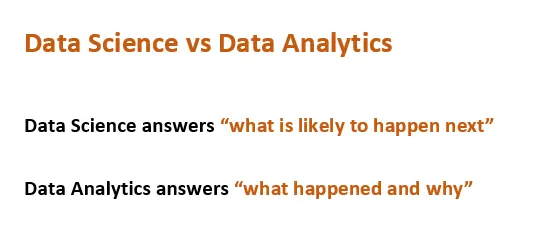
Data Science and Data Analytics are closely related fields that often confuse people entering the IT industry. Since both roles work with data, many assume they involve the same work. That’s not true. Data science is a broader field that works with data at a deeper level. It involves building models and predicting future outcomes using large sets of structured and unstructured data. Data analytics, on the other hand, focuses on understanding past and current data to support decisions. In this guide, we break down Data Science vs Data Analytics to help you understand the differences and choose the right career path.
Key highlights – Data Science vs Data Analytics
- Data science covers advanced work like handling large data sets, identifying trends, and creating machine learning models.
- Data analytics sits within data science and focuses on analyzing available data and presenting findings using charts and reports.
- Data scientists often carry out data analysis as part of their daily work.
- Many analytics outcomes depend on machine learning models developed by data science teams.
- Data analytics job postings in India have risen by around 52% over the last five years.
- Experts estimate that jobs roles linked to data science and mathematical sciences may grow by 31.4% by 2030.
- In India, data scientists generally earn higher salaries than data analysts at the same experience level.
What is the difference between Data Science and Data Analytics?
While both roles work with data, there is a clear difference between Data Analysis and Data Science in the problems they solve and the decisions they support. Let’s look at the comparison.
Data Science vs Data Analytics – Key differences table
| Point | Data Science | Data Analytics |
|---|---|---|
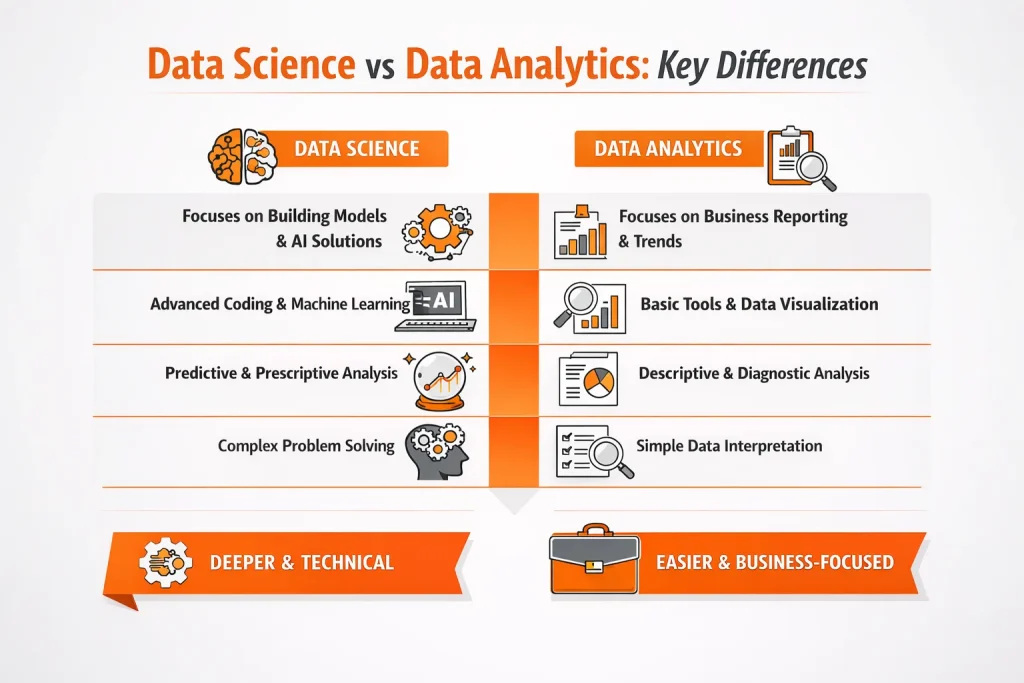
| Core Purpose | Data Science focuses on solving complex problems and predicting future outcomes using data. | Data Analytics focuses on understanding existing data to support business decisions. |
| Approach | The approach is research-driven and experimental. | The approach is analysis-driven. |
| Nature of Work | Involves experimentation, testing ideas, and refining models over time. | Involves studying data, finding patterns, and presenting insights. |
| Scope | Data Science has a broad scope. | Data Analytics has a narrower scope. |
| Data Type | Works with large volumes of structured and unstructured data like text, images, and logs. | Mostly works with structured data from databases, reports, and spreadsheets. |
| Technical Depth | High technical depth with strong focus on algorithms and logic. | Moderate technical depth with stronger focus on interpretation. |
| Applications | Data Science is used in fraud detection, demand forecasting, and AI-driven products. | Data Analytics is used in sales analysis, customer behavior tracking, and market analysis. |
| Key Skills | Requires strong math, statistics, programming, and problem-solving skills. | Requires strong analytical thinking, data interpretation, and visualization skills. |
| Machine Learning Use | Machine learning is a core part of the role and used regularly. | ML is rarely used directly and often comes from pre-built tools. |
| Programming Level | Data Science needs advanced programming skills for model building and data processing. | Data Analytics need basic to intermediate programming knowledge. |
| Statistical Knowledge | Strong statistics knowledge is essential for model accuracy and validation. | Basic statistics is enough for most analysis tasks. |
| Tools Used | Python, ML libraries, big data platforms, and cloud tools. | SQL, Excel, Power BI, Tableau, and reporting tools. |
| Output Delivered | Predictive models, automated systems, and data-driven solutions. | Dashboards, reports, and insights for business teams. |
| Key Roles | Data Scientist, ML Engineer, AI Specialist. | Data Analyst, Business Analyst, BI Analyst. |
| Career Progression | Can grow into AI Architect, Data Architect, or research roles. | Can grow into Senior Analyst, BI Manager, or strategy roles. |
| Average Salary | ₹15 Lakhs – ₹16.6 Lakhs | ₹6.6 Lakhs – ₹7.2 Lakhs |
Is Data Science and Data Analytics the same? The similarities
Data Science and Data Analytics are not the same, but they do share several important similarities. This overlap is also why many people confuse the two.
- Both roles work with data to support decision-making.
- Both require skills in data cleaning, preparation, and analysis.
- Statistics and basic mathematics are important in both fields.
- Both use programming and query languages like SQL and Python, though at different levels.
- Both are used across industries like IT, finance, healthcare, e-commerce, and marketing.
What Is Data Science?
Data Science is a multidisciplinary field that involves collecting, processing, and analyzing large volumes of data to extract meaningful insights. It combines programming, statistics, mathematics, and machine learning to work with both structured and unstructured data. The purpose of data science is not only to analyze data but also to build models that can identify patterns and make predictions to support automated decision-making across business and research use cases.
Understanding the Data Science process
The data science process follows a structured approach to convert raw data into meaningful insights and predictive solutions.
- Problem definition: Identify the business or research objective to be solved.
- Data collection: Gather data from internal systems, applications, or external sources.
- Data preparation: Clean, transform, and organize data for analysis.
- Data exploration: Study the data to discover trends, patterns, and relationships.
- Model building: Develop statistical or machine learning models using tools like Python or R.
- Model evaluation: Test and refine models to improve performance and accuracy.
- Deployment and communication: Share insights through reports or dashboards and deploy models for real use.
What Is Data Analytics?
Data Analytics is a part of Data Science. It involves examining existing data to understand trends, patterns, and outcomes. It is more goal-oriented and usually starts with specific questions that need clear answers. Data analytics helps organizations turn raw data into insights that support daily decision-making in areas like sales analysis, customer behavior, performance tracking, and operational planning.
Understanding the Data Analytics process
The data analytics process follows a practical flow to convert data into insights that support business decisions.
- Define the objective: Clearly state the question or problem to be answered.
- Data collection: Collect relevant data from databases or business tools.
- Data cleaning and organization: Fix errors, remove duplicates, and structure the data.
- Data analysis: Analyze data to identify trends and meaningful insights.
- Insight sharing: Present results through dashboards, charts, or reports.
- Decision support: Use insights to guide actions, planning, and improvements.
Data Scientist vs Data Analyst – Roles and responsibilities
The main Data Scientist and Data Analyst difference comes down to how they work with data and what outcomes they are responsible for. So, let’s take a look at what they actually do.
Role and responsibilities of a Data Scientist
- Collect and process large amounts of structured and unstructured data
- Own the end-to-end development of predictive and ML models
- Decide which data and features are useful for modeling.
- Design experiments and evaluate model performance.
- Build systems that automate decisions at scale.
- Collaborate with engineering teams to put models into production.
Role and responsibilities of a Data Analyst
- Translate business questions into data requirements.
- Collect data from internal and external sources.
- Monitor performance metrics and trends over time.
- Identify gaps, risks, and opportunities using data.
- Build dashboards that teams rely on daily.
- Help teams track performance and improve operations.
Data Analyst vs Data Scientist – Required qualification
In the Data Scientist vs Analyst career comparison, qualification requirements differ mainly in specialization and academic focus.
Qualifications for a Data Scientist
- Bachelor’s degree in Data Science, Computer Science, or Engineering.
- Many roles prefer a Master’s degree in Data Science, AI, or Machine Learning.
Qualifications for a Data Analyst
- Bachelor’s degree in Computer Science, Statistics, Mathematics, or Data Analytics.
- Certifications or short analytics courses are often sufficient for entry-level roles.
Data Science vs Data Analytics – Key skills required
The difference between Data Science and Analytics becomes clearer when you look at the skills and tools used in each role.
Data Science skills
- Strong programming skills in Python and sometimes R.
- Solid knowledge of statistics, probability, and mathematics.
- Experience with machine learning models and algorithms.
- Skills in data preprocessing, feature engineering, and model evaluation.
- Tools commonly used: Python libraries (NumPy, Pandas), ML frameworks, big data and cloud platforms.
Data Analytics skills
- Good skills in SQL, Excel, and basic Python or R
- Understanding of descriptive statistics
- Data cleaning, validation, and reporting skills
- Ability to create dashboards and reports
- Tools commonly used: Excel, SQL, Power BI, Tableau
Data Science vs Data Analytics – Career path
Understanding how these careers progress helps you decide which role fits your goals better.
Career path in Data Analytics
- Entry-level roles usually start as Data Analyst or Business Analyst.
- With experience, professionals move into Senior Data Analyst or BI Analyst roles.
- Further growth can lead to Analytics Manager or Strategy-focused roles.
Career path in Data Science
- Entry-level roles include Junior Data Scientist or Associate Data Scientist.
- Mid-level roles include Senior Data Scientist or Machine Learning Engineer.
- Advanced roles include AI Specialist, Data Architect, or Research-focused positions.
Data Science vs Data Analytics – Salary comparison and future scope
The salary difference between Data Analyst and Data Scientist is huge, which is why many people compare the two roles. So, which pays more, Data Science or Data Analytics? Here is what data from AmbitionBox reveals.
| Salary Details | Data Analyst Salary | Data Scientist Salary |
|---|---|---|
| Experience Range | 0–6 years | 1–8 years |
| Average Annual Salary | ₹6.9 Lakhs | ₹15.8 Lakhs |
| Typical Salary Range (Annual) | ₹6.6 – ₹7.2 Lakhs | ₹15 – ₹16.6 Lakhs |
Future scope – Data Science vs Data Analytics
Both data science and data analytics have strong future demand in India.
- Data analytics jobs have grown by around 52% in the last five years, showing steady demand across industries.
- Data science and mathematical science roles are expected to grow by 31.4% by 2030, driven by AI and automation.
- Data analytics will continue to support everyday business decisions.
- Data science will play a bigger role in advanced technology and predictive systems.
Also Read - Top 50+ Data Science Interview Questions and Answers
Data Science or Data Analyst – Which is better?
Many beginners ask, “Which is better, data science or data analytics?” The honest answer depends on your learning comfort and career goals. There is no single right choice for everyone.
Data analytics is a good option if you want a quicker entry into the data field and enjoy working with business data and reports. Data science is a better fit if you like coding and solving complex problems using models and automation.
If you prefer stability and faster results, start with data analytics. If you are ready for a steeper learning curve and want higher technical growth and pay, data science is the better choice.
Looking for jobs? You can find top Data Science and Data Analytics roles on Hirist, an IT job portal that lists some of the best tech opportunities in India.
Also Read - Top 35+ Data Analyst Interview Questions and Answers
FAQs
There are four main types:
Descriptive analytics: Explains what happened in the past
Diagnostic analytics: Explains why something happened
Predictive analytics: Uses past data to estimate future outcomes
Prescriptive analytics: Suggests actions based on data insights
Data Scientists usually earn more. This is because the role requires deeper technical skills and machine learning knowledge. Data Analysts earn less on average but have easier entry and steady growth.
If you are a beginner, start with Data Analytics. It helps you build a strong base in data, tools, and business thinking. You can move to Data Science later once you are comfortable with coding and statistics.
Yes, but it is rare. Salaries close to 1 crore are usually offered to highly experienced professionals working in senior roles, global companies, or specialized AI and ML positions.
No. Data Science is evolving, not disappearing. While tools are becoming easier, the need for people who understand data, models, and decision-making will continue to grow.
oth roles are in demand across:
IT and software
Banking and finance
E-commerce
Healthcare
Retail and manufacturing
Marketing and digital platforms
Data Analysts are more common across industries, while Data Scientists are more concentrated in tech and AI-driven companies.
Yes, many professionals do. Starting in Data Analytics helps you understand data deeply. With additional learning in programming, statistics, and machine learning, moving into Data Science is very achievable.