If you have landed on this blog, you are probably a data analyst looking for ideas to write a strong data analytics resume. If that’s the case, you are in the right place.
Your data analyst CV can decide whether you get the interview or not. Many skilled analysts miss great jobs because their resume doesn’t show what they can actually do. Recruiters don’t just want to see Python, SQL, or Tableau – they want to see what you achieved with them. This guide will show you exactly how to do that.
Here, you will learn how to write a powerful data analytics resume from scratch. You will also find professional data analyst resume samples and templates for both freshers and experienced professionals to help you get started.
Did You Know?
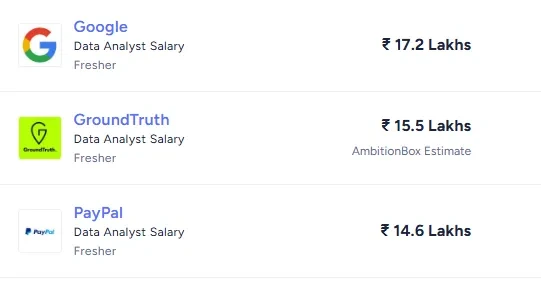
According to AmbitionBox, top companies in India like Google and PayPal pay anywhere between ₹14.6 lakhs to ₹17.2 lakhs per year to data analyst freshers.
To land such jobs, you need a strong data analytics resume.
Data Analytics Resume Basics – Everything You Need to Know
Before you start writing your data analyst curriculum vitae, it is important to know the basics. Here is a quick breakdown of everything that helps your resume look professional and effective.
| Category | Details |
|---|---|
| Data analytics CV length | Freshers: 1 pageExperienced professionals: Up to 2 pages |
| Resume format | Reverse Chronological: Best for most candidatesFunctional: Suitable for freshers or career changersCombination / Hybrid: Ideal for mid-level or senior analysts |
| Font type | Use professional fonts like Calibri, Arial, or Helvetica |
| Font size | 10–12 pt for body text and 14–16 pt for section titles |
| Key sections to include | Header (Name, Contact, LinkedIn, Portfolio)Professional Summary or ObjectiveTechnical SkillsWork Experience or ProjectsEducationCertificationsAchievements (optional) |
| Data analyst profile summary tip | Keep it short in 2–3 lines highlighting experience, top skills, and measurable outcomes |
| Top skills for data analyst resume | SQL, Python, RTableau, Power BI, ExcelData Cleaning, Visualization, Statistical AnalysisMachine Learning Basics, Predictive ModelingBusiness Communication, Problem-Solving |
| Best file format | PDF – keeps layout intact and ATS-friendly |
| Valuable certifications | Google Data Analytics Professional CertificateMicrosoft Certified: Data Analyst AssociateTableau Desktop SpecialistIBM Data Science Professional Certificate |
| ATS optimization tip | Add relevant keywords naturally – e.g., data visualization, SQL, dashboard creation, Python, business insights |
| Tips to follow | Use short, action-based bullet pointsAdd results with numbersCustomize for each jobInclude personal or academic projects |
| Common mistakes to avoid | Overloading with toolsUsing fancy layouts that break ATSWriting long paragraphsMissing measurable results |
| Portfolio links | Add your GitHub, Tableau Public, or Kaggle profiles to show real work |
| Average salary range | ₹2 LPA – ₹14.2 LPA (AmbitionBox) depending on experience and company |
| Top job platforms | Hirist, LinkedIn, Naukri |
Data Analytics Resume Example
Want to see how an ideal data analyst resumes should look? Here is a simple data analytics resume example to help you understand what works best.
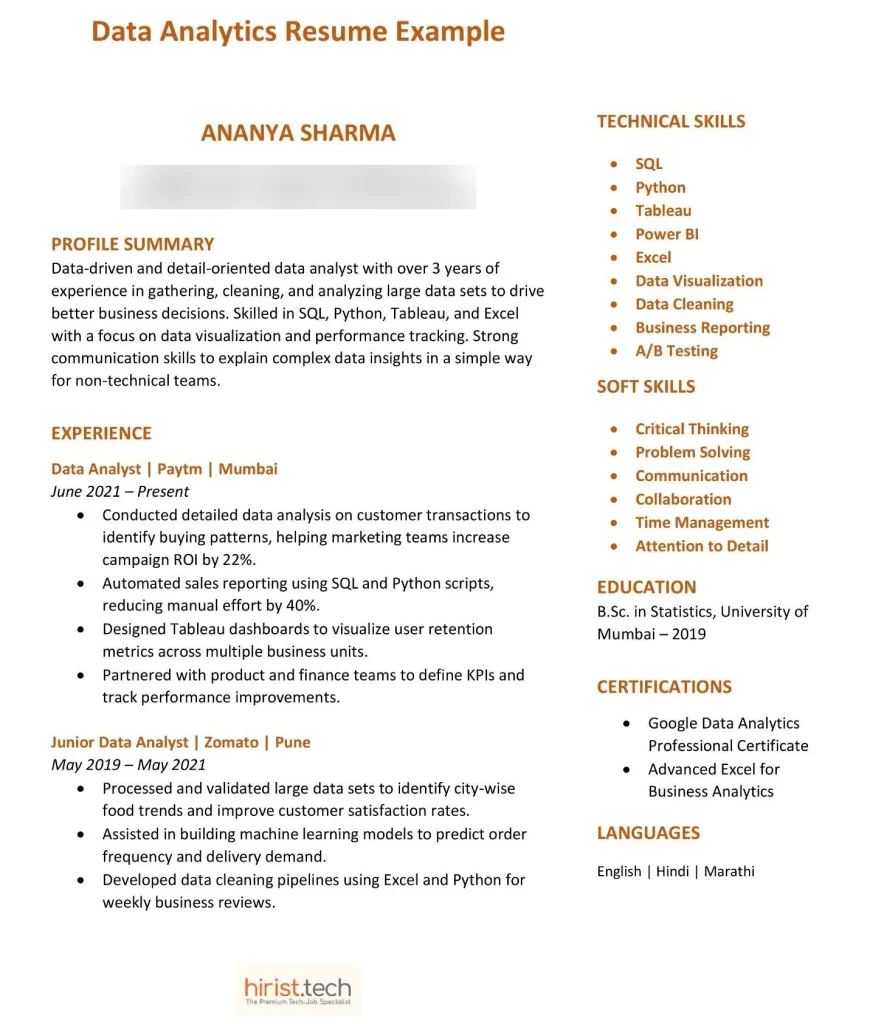
Why this sample resume for data analyst works?
- Highlights measurable results instead of generic job duties.
- Includes strong action verbs like analyzed, automated, and improved.
- Uses clean formatting that’s easy to scan in under 10 seconds.
- Covers real data analysis on resume through projects and tools.
- Includes relevant keywords for ATS.
- Balances technical skills with soft skills.
- Adds certifications to build credibility.
- Keeps each section short and purposeful.
- Feels human and professional, not robotic or overloaded.
What is Data Analytics?
Data analytics is the process of collecting, organizing, and examining data to find useful patterns or insights. It helps businesses make better decisions and improve performance by predicting trends. As an analyst, you have to use tools like SQL, Python, Excel, and Tableau to clean and interpret data. So, make sure you always include these important keywords in your resume.
Who is a Data Analyst?
A data analyst is a professional who cleans and studies data to help organizations make smarter decisions. Your main job is to turn raw data into clear insights that guide business growth.
Main roles and responsibilities of a data analyst:
You should mention key data analyst responsibilities in your resume to show what you can actually do.
- Collect and organize large sets of data
- Clean and prepare data for analysis
- Use tools like SQL, Python, Excel, or Tableau
- Create dashboards and visual reports
- Identify trends and patterns for better business strategies
Always pair these duties with measurable results. Showing the impact of your work highlights strong data analysis on resume.
How Is Your Data Analyst Resume Processed?
Writing a data analyst resume becomes easier when you know how your resume actually gets processed. Before your application reaches a recruiter, your data analytics resume goes through several steps that decide if it gets shortlisted or not.
Here is how the process works:
1. You upload your resume or CV
This is the first thing a company sees about you. Your CV data analyst should look well-formatted and easy to read. Avoid clutter or fancy designs. Use a simple layout so recruiters can quickly find your skills and contact details.
2. ATS screening
Many companies now use an Applicant Tracking System (ATS). It scans data analyst resumes to find specific keywords related to the job. If your resume doesn’t have those words or has poor formatting, it may never reach a human. That’s why it is important to use words from the job description and keep your file ATS-friendly.
3. Recruiter review
Once your data analytics CV passes the ATS, a recruiter reads it for a few seconds to check key details. They look for the following things:
- Clear achievements
- Results backed by numbers
- Tools you have used like Python, SQL, or Tableau
Your resume should show real impact and make it easy for them to say, “Yes, this person fits the role.”
Writing your resume with this process in mind improves your chances of standing out early.
Key Elements of a Data Analyst Resume
It is good to know what makes strong data analyst resumes. These are the main elements recruiters always look for:
- Header: Include your full name, contact info, and LinkedIn profile.
- Professional Summary: A short data analyst summary (2–3 lines) highlighting your experience, top tools, and achievements.
- Technical Skills: List your main skills for data analyst resume such as SQL, Python, Excel, Power BI, or Tableau.
- Experience or Projects: Show results with numbers and explain what impact your work created.
- Education: Mention your degree, major, and any analytics courses.
- Certifications: Add relevant courses like Google Data Analytics or Tableau Specialist.
A good data analytics CV includes all these elements in a simple and clear format that is easy to scan.
How to Write a Data Analytics Resume – Step-by-Step Guide
A strong data analytics resume starts with intent. Think like a recruiter and notice what they value most. If that feels overwhelming, don’t worry – just follow these simple steps to build a resume that passes ATS and impresses real people.
1. Read the job description and collect keywords
Before you start writing your data analytics resume, carefully read the job description of the role you are applying for. Most candidates skip this step and end up submitting a generic resume that doesn’t match what the recruiter wants.
Here is what you should do:
- Study the job description word by word. Note all the skills, tools, and responsibilities mentioned.
- Identify keywords. These are the exact words the company’s ATS (Applicant Tracking System) looks for. If the description says “data cleaning” or “dashboard reporting,” those words should be included in your data analyst job description resume.
- Where to add? Add these keywords in the profile summary, skills section, certifications, and work experience section.
By collecting the right keywords early, you will create a resume that easily passes ATS filters.
Example of job description:
Here is an example of an actual data analyst job description posted by Cognizant on Hirist. It is one of the best places to find IT jobs in India.
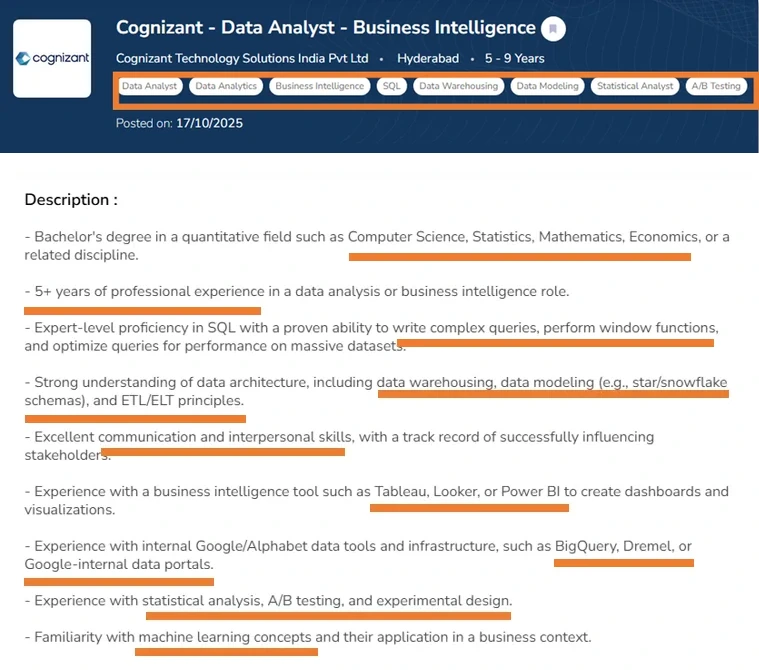
Note: We have highlighted all the keywords in the job description in orange lines. It will help you understand what to look for.
2. Choose the right data analyst resume format
Once you have gathered the right keywords, the next step is choosing the right data analytics resume format. The format is the first thing recruiters notice because it shapes how your resume looks and reads. A good structure makes your experience easy to follow and keeps the focus on your strengths.
Here are the three main types you can use:
Reverse chronological format (Best for experienced analysts)
This resume format is best for professionals with experience. It lists your latest job or project first and shows clear career growth.
Example of reverse chronological resume format:
- Header
- Professional Summary or Objective
- Work Experience (latest to oldest)
- Key Skills
- Education
- Certifications
- Projects or Achievements (optional)
Functional format (Best for freshers and career changers)
This type is ideal as a resume format for data analyst fresher. It focuses on your skills, tools, and academic projects instead of work history.
Example of functional resume for data analyst fresher:
- Header
- Career Objective or Summary
- Technical Skills
- Tools and Technologies
- Academic Projects or Internships
- Education
- Certifications
Combination/hybrid format (Best for mid-level analysts)
This resume format is great for mid-level candidates. It balances technical skills with relevant experience.
Example of combination resume format:
- Header
- Professional Summary
- Key Skills and Tools
- Work Experience
- Major Projects
- Education
- Certifications and Awards
Extra Tips: Keep your layout clean. No fancy designs or multiple columns. Use clear headings and short bullet points.
Note: You can use our resume examples for data analyst to get the right structure when building your own. They show exactly how to organize sections.
3. Write your data analyst resume summary or objective
Your data analytics resume objective or summary is the short pitch that decides if the recruiter reads further. It sits right below your name and contact details and gives a quick idea of who you are.
For freshers: Career objective
Write a short career objective of data analyst that explains your learning goals and the skills you want to apply.
Example:
“Motivated data analyst fresher with strong skills in SQL, Excel, and Python, seeking to apply analytical thinking to solve real business problems.”
For experienced professionals: Profile summary
Your data analyst summary should highlight years of experience, tools you have used, and measurable impact. You can add keywords here.
Example:
“Data analyst with 4+ years of experience in predictive analytics and dashboard creation. Improved reporting accuracy by 25% through Power BI automation.”
Keep your data analyst profile summary short in just 3 to 4 lines. Also, make it specific to the role you are applying for.
4. Build a focused data analyst skills section
Your skills section is where you show what you can actually do. This is the best place to mention the keywords from the job description. A strong skills for data analyst resume section helps your profile stand out. But make sure you organize your skills into clear categories to make them easy to scan.
Top skills for data analyst resume:
| Category | Skills for Data Analyst Resume |
|---|---|
| Programming & Tools | SQL, Python, R, SAS, Excel, Power BI, Tableau, Google Sheets |
| Database Management | MySQL, PostgreSQL, Oracle, MongoDB, Hadoop, Snowflake, BigQuery |
| Data Cleaning & Preparation | Data wrangling, missing value handling, data validation, normalization, transformation |
| Statistical & Analytical Skills | Descriptive and inferential statistics, hypothesis testing, regression, clustering, forecasting |
| Data Visualization | Creating charts, dashboards, and reports using Tableau, Power BI, or Matplotlib |
| Machine Learning Basics | Linear regression, decision trees, classification, model evaluation (for experienced analysts) |
| Business Intelligence & Reporting | KPI tracking, report automation, business performance analysis, storytelling with data |
| ETL & Data Pipelines | Data extraction, transformation, and loading (ETL), API integration, workflow automation |
| Soft Skills | Problem-solving, communication, teamwork, logical thinking, curiosity, presentation skills, adaptability |
| Other Useful Tools | Excel VBA, Google Data Studio, Jupyter |
Keep this section concise. You can also create two separate sections for technical skills and soft skills. Focus on the tools and abilities you can confidently talk about in an interview.
5. Add data analytics work experience with impact
This is the most important part of your data analytics resume because it shows what you have actually achieved. Recruiters look for results, not just duties.
Here’s how to structure it:
- Start with your role, company name, and dates.
Example: Data Analyst | Paytm | Jan 2022 – Present
- Use action verbs to list your data analyst roles and responsibilities in resume. Example: Analyzed customer behavior using SQL and Tableau to improve retention by 15%.
- Quantify everything. Numbers make impact clear – mention growth percentages, cost savings, or time reduced.
- Focus on value, not tasks. Show how your work improved decisions, saved money, or made reports faster.
Example of data analyst resume experience section
Work Experience
Data Analyst | Paytm | Jan 2022 – Present
- Analyzed customer purchase data using SQL and Power BI to identify churn patterns, improving retention by 15% in one quarter.
- Automated weekly sales reporting with Python scripts, saving 10 hours per week for the analytics team.
- Collaborated with product teams to test new pricing strategies, resulting in a 7% increase in conversion rates.
In short, make your data analyst responsibilities in resume reflect real outcomes. Adding measurable results turns plain bullet points into powerful proof of your skills.
Good action verbs you can use in data analyst resume
Here is a useful list of action verbs you can use to highlight your expertise in data analysis on resume:
| Category | Action Verbs for Data Analyst Resumes |
|---|---|
| Data Collection and Cleaning | Collected, Extracted, Gathered, Compiled, Validated, Filtered, Cleaned, Processed, Transformed |
| Data Analysis and Interpretation | Analyzed, Evaluated, Interpreted, Assessed, Investigated, Explored, Segmented, Mapped, Correlated |
| Reporting and Visualization | Visualized, Reported, Presented, Illustrated, Communicated, Shared, Explained, Summarized, Highlighted |
| Optimization and Automation | Automated, Streamlined, Improved, Optimized, Enhanced, Simplified, Standardized, Reduced |
| Modeling and Forecasting | Modeled, Predicted, Forecasted, Estimated, Simulated, Tested, Validated |
| Strategy and Decision-Making | Recommended, Designed, Proposed, Supported, Developed, Executed, Implemented, Advised |
| Collaboration and Impact | Partnered, Coordinated, Collaborated, Led, Mentored, Contributed, Supported, Delivered, Achieved |
6. Showcase practical projects for data analyst resume
If you are a fresher or switching careers, this section can help you create a good impression. Real or academic projects show that you can apply your skills to real problems. This section proves you understand tools, workflows, and outcomes – even without full-time experience.
Here is how to show your projects in data analyst resume:
Project Title | Tools Used (SQL, Python, Tableau, Excel)
- Explain what the project was about in one line.
- Mention what problem you solved and how.
- End with a measurable result or finding.
Example of project section in data analyst entry-level resume:
Customer Churn Prediction | Python, Pandas, Scikit-learn
- Analyzed 10,000+ customer records to identify churn patterns.
- Built a predictive model that achieved 92% accuracy, helping design better retention campaigns.
7. Add education and certifications
Education and certifications show your foundation and credibility as a data analyst. If you are a fresher, this section becomes even more important since it highlights your learning background and technical readiness. For data analyst resume for freshers, this section helps recruiters see your potential when you lack full-time experience.
Here is how to structure it:
EDUCATION:
Bachelor of Science in Data Science – Delhi University (2025)
- Relevant Coursework: Statistics, SQL, Machine Learning, Data Visualization
CERTIFICATIONS:
- Google Data Analytics Professional Certificate (2024)
- Microsoft Certified: Power BI Data Analyst Associate – 2023
- IBM Data Analyst Professional Certificate – 2024
Tip: Keep this section short and clear in your data analyst curriculum vitae. Include only recent or relevant certifications that directly strengthen your resume – avoid adding unrelated courses.
Top certifications to add in your data analyst resume
Here is a list of top certifications you can include in your data analyst resume to boost credibility and show your technical expertise.
| Certification Name | Issued By | Best For |
|---|---|---|
| Google Data Analytics Professional Certificate | Coursera | Beginners and freshers learning end-to-end analytics |
| Microsoft Certified: Power BI Data Analyst Associate | Microsoft | Analysts working with Power BI dashboards and reports |
| IBM Data Analyst Professional Certificate | IBM | Building foundational skills in SQL, Excel, and visualization |
| Tableau Desktop Specialist | Tableau | Data visualization and dashboard creation |
| SAS Certified Specialist: Base Programming | SAS | Working with statistical data and analytics programming |
| AWS Certified Data Analytics – Specialty | Amazon Web Services | Cloud-based data processing and analytics |
| Certified Analytics Professional (CAP) | INFORMS | Experienced professionals validating advanced analytics expertise |
| Excel to MySQL: Analytic Techniques for Business | Coursera (Duke University) | Business analytics and database integration |
Tip: Pick certifications that match your target role. For instance, if you are applying for BI or reporting-heavy jobs, Power BI and Tableau certifications stand out more.
8. Proofread and run ATS checks
Your data analytics resume is only effective if it is clear, error-free, and optimized for the systems that scan it. Most companies use Applicant Tracking Systems (ATS) to filter resumes before a human even sees them. So, proofreading and formatting are not just nice-to-haves – they are essential.
Here is how to do it right:
- Proofread for errors: Check spelling, grammar, and consistency in headings and bullet points. Even one small typo can look careless.
- Use simple formatting: Stick to a clean layout with standard fonts like Calibri or Arial. Avoid columns, tables, and graphics that ATS may not read.
- Include keywords naturally: Use skills and tools mentioned in the job post throughout your resume. This helps your CV data analyst pass the initial screen.
- Save as PDF: It keeps your structure intact and looks professional when opened on any device.
Tip: Run your data analytics CV through a free ATS checker online before applying. It will tell you how well it matches the job description and if any sections are missing.
Data Analytics Resume Examples
Now that we have covered the steps to create data analyst resumes, let’s look at some resume examples for data analyst roles that show how everything fits together.
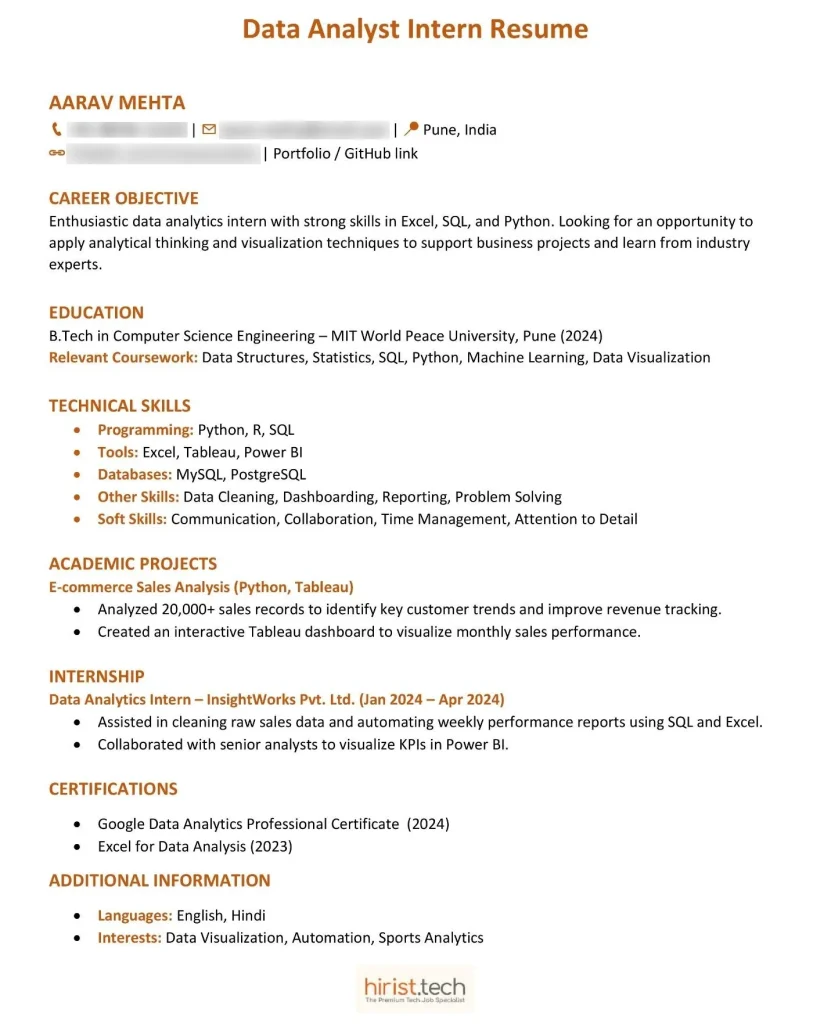
Example 1: Data Analyst Intern Resume
This is a perfect data analyst entry-level resume example for students or freshers.
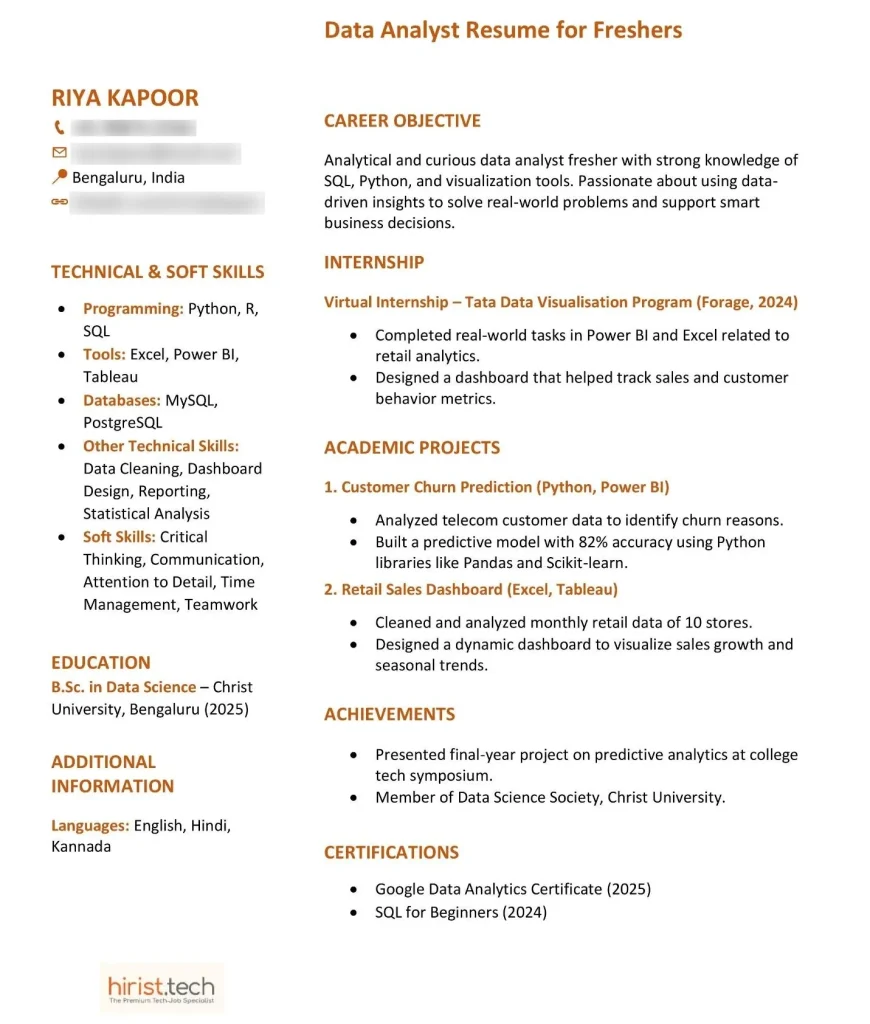
Example 2: Data Analyst Resume for Freshers
Here is a great sample resume for data analyst fresher roles. You can use this example of resume for data analyst freshers to highlight certifications and beginner projects effectively.
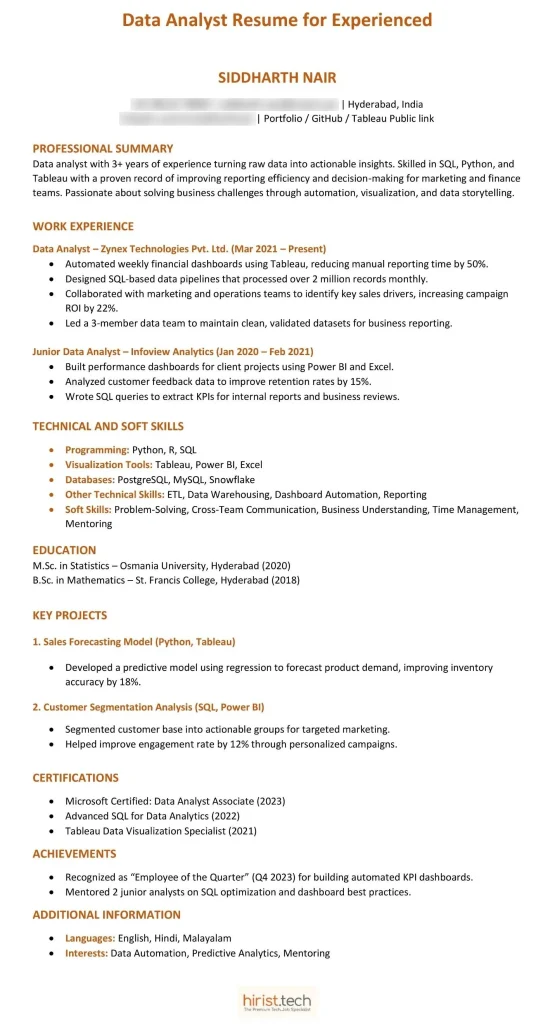
Example 3: Data Analyst Resume for Experienced
This data analyst 3 years experience resume example shows how professionals can highlight measurable results properly.
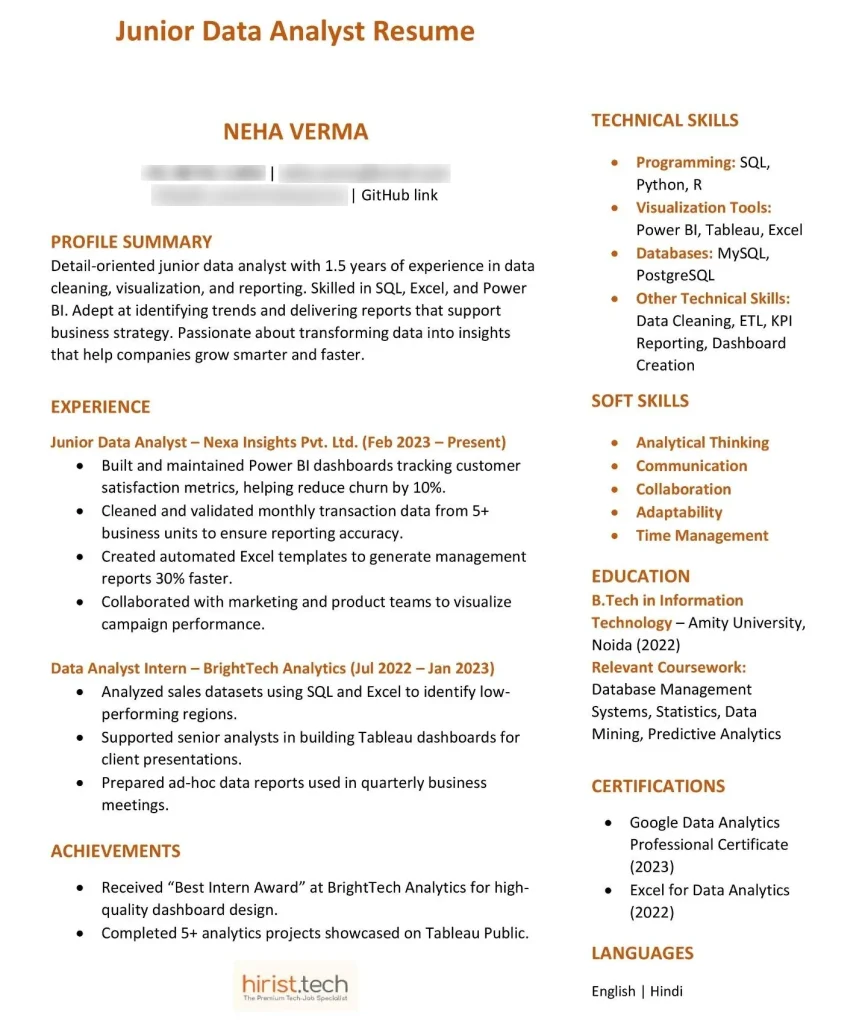
Example 4: Junior Data Analyst Resume
Here is another example of data analyst CV for freshers. You can use this data analytics resume for freshers to focus on internships and hands-on projects.
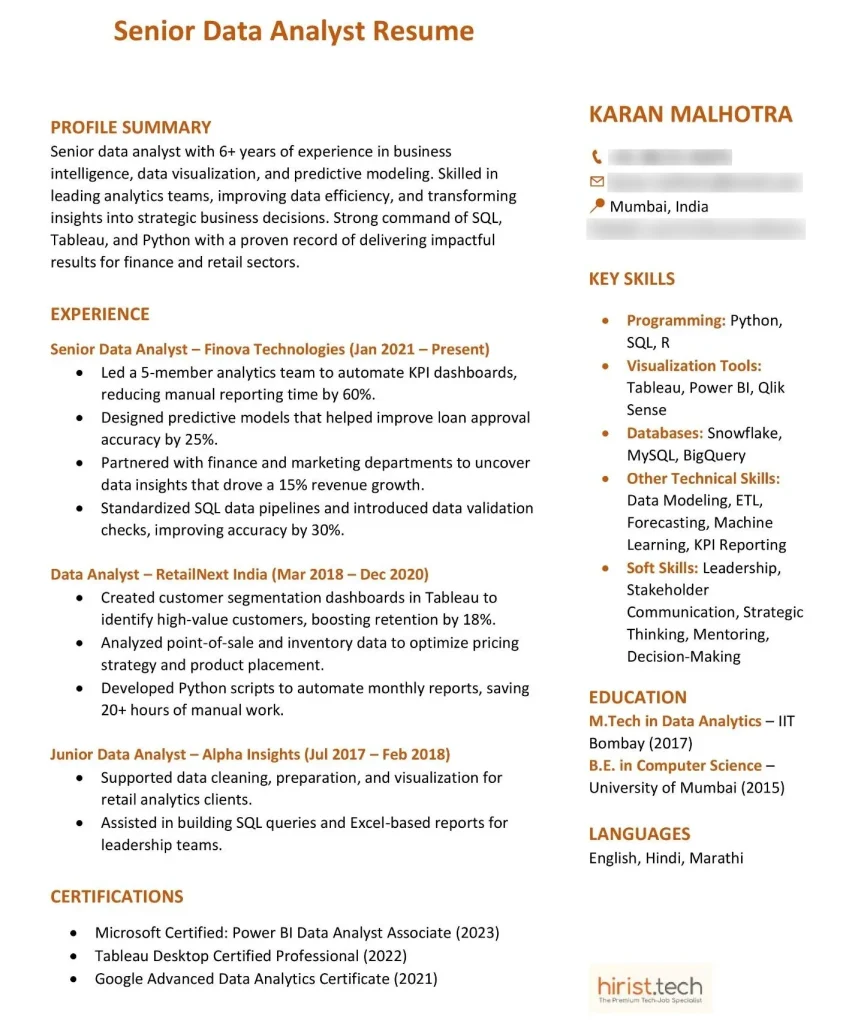
Example 5: Senior Data Analyst Resume
This sample resume for data analyst is perfect for senior and managerial level positions.
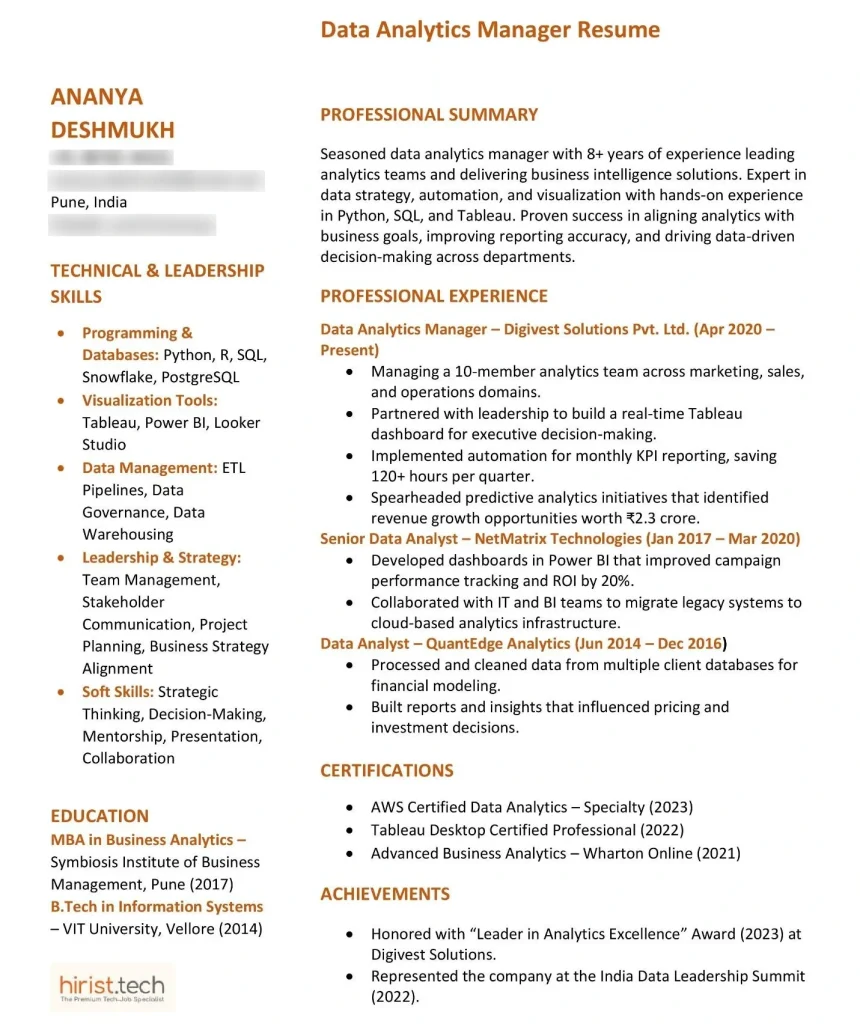
Example 6: Data Analytics Manager Resume
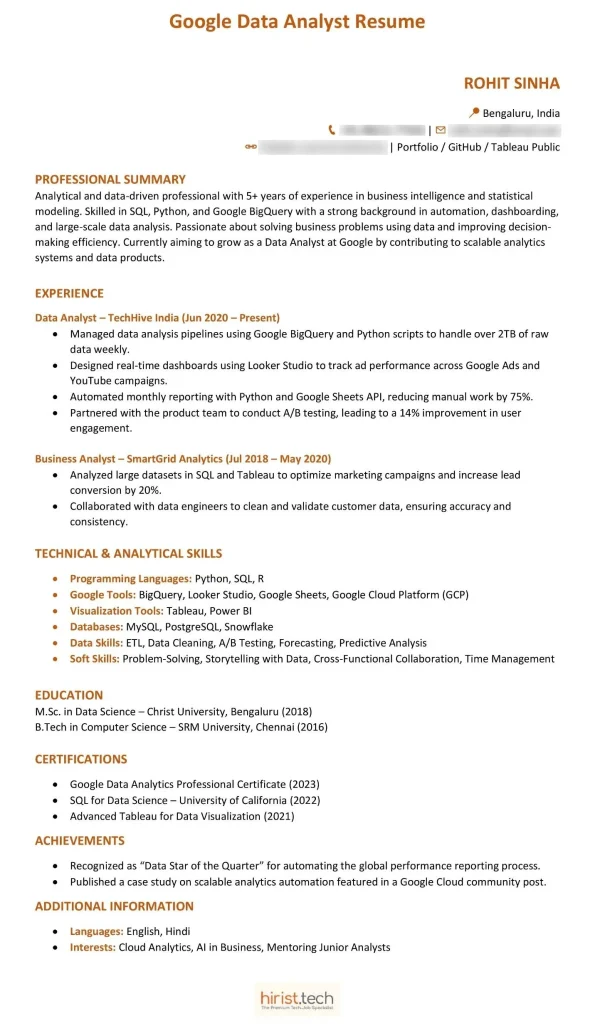
Example 7: Google Data Analyst Resume
Free Data Analytics Resume Templates
If you want an outline or structure to create your data analytics CV, use our free data analyst CV template to build a professional and ATS-friendly resume.
Template 1: Data Analyst Resume for Freshers
Here is a resume for data analyst fresher that highlights education and beginner projects. This is best for creating a strong data analyst entry-level resume.
FULL NAME
Phone | Email | Location
LinkedIn | Portfolio
CAREER OBJECTIVE
Motivated and detail-oriented data analyst fresher with hands-on experience in Excel, SQL, and Python. Looking to apply analytical and visualization skills to help businesses make smarter data-driven decisions.
EDUCATION
Degree Name – University / College Name, City (Year of Graduation)
Relevant Coursework: List key subjects like Statistics, SQL, Data Visualization, Machine Learning, etc.
TECHNICAL SKILLS
- Programming: Python, R, SQL
- Tools: Excel, Tableau, Power BI
- Databases: MySQL, PostgreSQL
- Other Skills: Data Cleaning, Reporting
PROJECTS
Project Title 1 – Describe what you did, tools used, and key result.
Project Title 2 – Describe another project briefly, focus on outcomes and learning.
CERTIFICATIONS
- Certification Name – Platform/Institute, Year
- Certification Name – Platform/Institute, Year
INTERNSHIP / TRAINING (OPTIONAL)
Role
Organization Name – Duration
- Responsibility or task 1
- Responsibility or task 2
ACHIEVEMENTS (OPTIONAL)
- Achievement or recognition related to analytics or academics
- Hackathon, competition, or club participation
ADDITIONAL INFORMATION (OPTIONAL)
- Languages, interests, or portfolio links if relevant
Template 2: Data Analyst Resume for Experienced
This sample resume for data analyst is best for mid to senior-level professionals.
NAME
Phone | Email | Location | LinkedIn | Portfolio
PROFESSIONAL SUMMARY
Results-driven data analyst with [X+] years of experience in transforming data into business insights. Skilled in SQL, Python, Tableau, and Power BI. Adept at handling large datasets, building dashboards, and driving data-backed strategies that boost efficiency and revenue.
EDUCATION
Degree Name – University / College Name, City (Year of Graduation)
Relevant Coursework: Advanced Statistics, Data Mining, Machine Learning, Predictive Modeling, Business Analytics
TECHNICAL SKILLS
- Programming: Python, R, SQL
- Tools: Tableau, Power BI, Excel, Looker
- Databases: MySQL, PostgreSQL, MongoDB
- Other Skills: Data Visualization, Reporting, ETL, Forecasting, Predictive Analytics
SOFT SKILLS
- Communication
- Problem-Solving
- Critical Thinking
- Time Management
- Attention to Detail
PROFESSIONAL EXPERIENCE
Role / Designation
Organization Name – Duration
- Responsibility or achievement 1 with measurable result
- Responsibility or achievement 2 with tools used
- Responsibility or achievement 3 that highlights collaboration or business impact
PROJECTS
Project Title 1 – Briefly describe project scope, tools used, and impact achieved.
Project Title 2 – Highlight a practical business problem solved with measurable results.
CERTIFICATIONS
- Certification Name – Platform/Institute, Year
- Certification Name – Platform/Institute, Year
ACHIEVEMENTS (OPTIONAL)
- Recognition or award related to analytics or performance improvement
- Published a dashboard or analysis used in decision-making
- Mentored junior analysts or contributed to internal analytics training
ADDITIONAL INFORMATION (OPTIONAL)
- Languages
- Interests: Data storytelling, business intelligence, automation
- Portfolio: Add GitHub, Tableau Public, or project links
Also Read - Data Analyst Internship: Apply, Eligibility, Skills & Stipend
How to Make Your Data Analytics Resume ATS-Friendly?
Your data analytics resume should be easy for both hiring managers and Applicant Tracking Systems (ATS) to read. Here is how to make it ATS-friendly:
- Keep the design simple: Use a simple layout with clear headings and no graphics or columns.
- Save in correct file format: Save your CV data analyst as a PDF to keep formatting consistent.
- Use the right keywords: Add relevant keywords from the job post throughout your data analyst resumes naturally.
- Stick to standard headings: Use standard section titles like “Education,” “Skills,” and “Experience” – ATS tools scan these easily.
- Don’t use fancy things: Avoid tables or icons that can confuse scanning software.
- Add tools and certifications: Include tools and certifications in your data analyst curriculum vitae for better match rates.
Also Read - Top 35+ Data Analyst Interview Questions and Answers
Tips to Make Your Data Analytics Resume Better
Your data analytics resume should be clean and personalized for each job. Follow these practical tips to make it more effective:
- Choose a professional font: Stick to simple fonts like Calibri, Arial, or Helvetica. Avoid fancy ones – they make your resume harder to read.
- Maintain proper font size and spacing: Use 10–12 pt for body text and 14–16 pt for section titles. Keep spacing consistent for a neat, readable layout.
- Keep margins balanced: Set 1-inch margins on all sides. It gives your resume breathing space and makes it look polished.
- Write a unique data analyst summary: Make sure you do not use copy-paste summary for your resume. It should be unique and clearly show your value.
- Customize your resume for each role: Tailor every application to the job. Add keywords from the job description and match your achievements with what the company needs.
- Use white space wisely: Avoid long paragraphs. Leave enough blank space between sections so your resume feels easy on the eyes.
- Add measurable impact: Use numbers wherever possible. Recruiters love seeing results – it makes your data analysis on resume more convincing and result-oriented.
- Stick to one page (for freshers): Keep your data analytics resume to one page if you have less than 5 years of experience. For senior roles, two pages are fine.
- Use bullet points, not paragraphs: Recruiters skim quickly. Short, crisp bullet points make your achievements easier to read and remember.
- Add links to projects or portfolios: Include your GitHub, Kaggle, or LinkedIn profile to showcase real projects and analytics work samples.
- Save your file properly: Name it clearly. Example, Ananya_Sharma_Data_Analyst_Resume.pdf. It looks professional and helps recruiters locate it easily.
Also Read - Data Science vs Data Analytics: Key Differences
Mistake to Avoid When Creating Your Data Analytics Resume
Creating a data analytics resume is not just about adding skills, it is also about avoiding small errors that can cost big opportunities. Here are the common mistakes to avoid:
- Using the same resume for every job: Each company looks for different skills. Always tailor your data analyst curriculum vitae to the specific role.
- Overloading with technical jargon: Recruiters may not understand every tool. Focus on results and how your work made a difference.
- Skipping proofreading: Typos or grammar errors create a poor impression. Always check your final document twice before sending it out.
- Listing outdated tools: Don’t include software or tools that are no longer used in the industry. Keep your skill list current.
- Adding irrelevant experience: Keep your resume focused. Irrelevant jobs make it harder for recruiters to find key data-related experience.
- Not showing soft skills: Analytical skills matter, but companies also value teamwork, problem-solving, and communication. Mention where you used them.
- Using unclear job titles: If your past role wasn’t “Data Analyst,” use a similar functional title to help recruiters understand your background.
- Submitting in Word format: Always send your resume as a PDF to preserve layout and formatting.
- Not updating regularly: Keep your data analyst curriculum vitae fresh by adding new projects, tools, and skills every few months.
Final Data Analytics Resume Checklist
Before sending out your data analytics resume, use this quick checklist to make sure it is accurate and ready to impress recruiters.
- Keep it to one or two pages max.
- Use a clean and simple layout with proper spacing.
- Add only relevant and updated skills.
- Make sure every role includes measurable results.
- Check all contact details and links.
- Use consistent fonts, bullet styles, and alignment.
- Proofread for grammar, spelling, and formatting errors.
- Save using professional file name.
Wrapping Up
So, this is how you write a professional data analyst resume. By following the steps we have listed, you can easily create any type of data analytics resume in just a few minutes. You can also use our free resume templates and samples to make the process even easier.
And once your resume is ready, you can visit Hirist to find some of the best data analyst job opportunities waiting for you.
FAQs
Your data analyst resumes should include a summary, skills, experience, education, certifications, and measurable achievements that show your real impact on business results.
A good data analyst summary is short and clear – two to three lines that highlight your top tools, achievements, and how you solve business problems using data.
A data analytics CV should follow a reverse-chronological structure with sections like summary, skills, experience, and education. Avoid complex designs or multiple columns.
Show data analysis on resume using specific examples. Write how you used tools like SQL or Python to find insights, improve processes, or increase revenue.
A data analyst curriculum vitae is usually longer and more detailed, used for research or academic roles. A resume is shorter and focuses on recent, relevant work.
If you are creating a data analyst resume for freshers, focus on projects, internships, and coursework. Show how you’ve applied analytical tools, even in academic projects.
Important skills for data analyst resume include SQL, Python, Excel, Tableau, Power BI, problem-solving, and data visualization. Combine technical and communication skills for balance.
In your data analyst responsibilities resume section, describe your work impact with action verbs and results. Example: “Analyzed customer data, improving retention by 18%.”
A data analytics resume objective should mention your career goals and how you aim to help the company with your analytical skills and curiosity for data.
In projects for data analyst resume, describe what you did, which tools you used, and what results you achieved. Example: “Used Python to clean 5M+ rows of sales data.”