“Are you willing to relocate for the job?” This is one of the most repeated HR interview questions for freshers and experienced candidates. Interviewers ask it to check if you can move when the role demands it. Companies plan teams and projects early and location can affect those plans later. You cannot answer it with a simple “yes” or “no”. Your reply should show your flexibility and how serious you are about the role.
This guide shares the 20 best sample answers to relocation questions asked in interviews. You will find examples for every situation along with templates and tips to help you frame a professional answer.
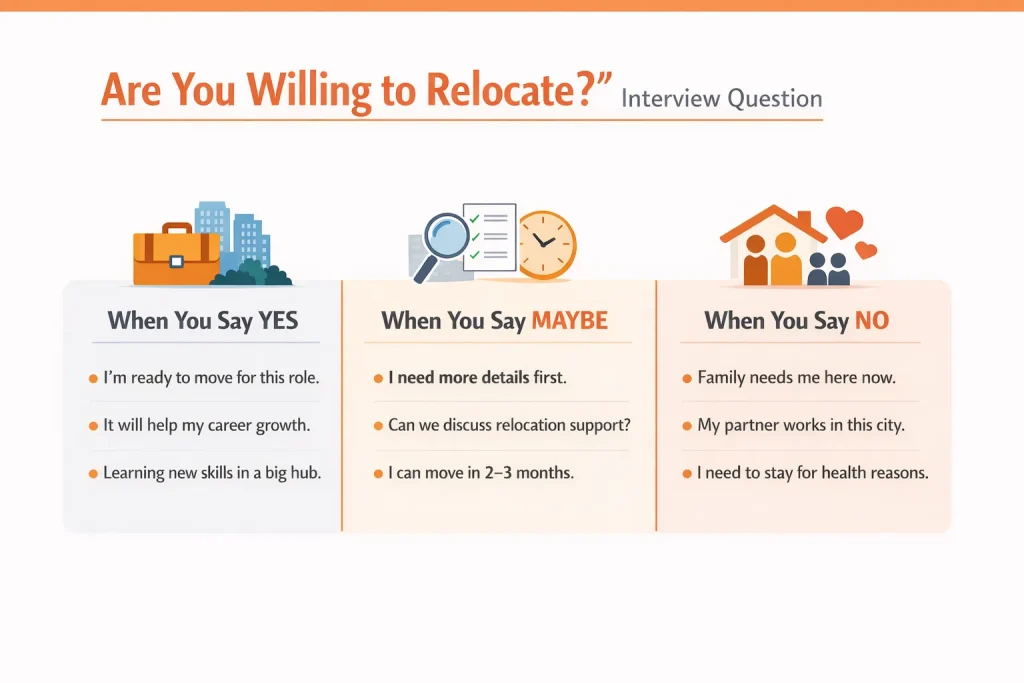
Best sample answers to “Are you willing to relocate?” interview question
Here are the best example answers for the interview question “Are you willing to relocate?” based on different situations. We grouped them into 3 main categories – “yes”, “no”, and “maybe”.
A. If your answer is “Yes”
First let’s look at “Are you willing to relocate?” sample answers for candidates saying YES. We also added examples for “Why do you want to relocate?” based on real situations.
Sample answer 1: Fresher with no location limits
You can use this “Are you willing to relocate?” answer for freshers if you are ready to move for work.
“Yes, I am willing to relocate to any city for this role. Right now the focus is on learning and working on real projects. Being part of larger teams across different offices will help me grow faster. I can move after the offer is finalized.”
Sample answer 2: Career growth opportunity
“I am open to relocation. The role has strong career upside and offers a chance to work in cities with high project volume. The move supports long-term progress without affecting job focus.”
Sample answer 3: Relocating to learn new skills
“Yes, relocation is fine for learning and skill expansion. The role involves new systems, tools, and real-time training. Moving to a city with bigger delivery centers or product teams adds more experience early in the career.”
Sample answer 4: Have family in the new city
“I am open to moving to a city that supports the job role and personal stability. Family presence in the destination city helps plan the transition without stress. The role remains the priority and the move fits practical planning.”
Sample answer 5: Good relocation policy and benefits
“Yes, relocation is possible. The company’s internal relocation policy offers support for the move, and that makes planning easier.”
Sample answer 6: Role matches your long-term plan
“I am ready to move because the role aligns with my long-term goals. The position matches my skills, industry focus, and future growth plans. Moving to the company’s project hubs or core office branches supports the job outcome.”
Sample answer 7: Open to national or global roles
“I am open to relocating as per the role’s future requirements. Large IT companies often move teams after onboarding, training, or project allocation. I can relocate when the company shares the next steps clearly.”
B. If your answer is “Maybe”
Here are “Are you willing to relocate?” sample answers if you are unsure about relocation and need more clarity and time to decide.
Sample answer 8: Need more time to decide
“I am interested in the role and open to relocation, but I need a few days to review the timeline and location details. A decision shared after understanding the requirements works better for planning.”
Sample answer 9: Want details on relocation support
Use this example if you want more details on relocation expenses and support the company is providing.
“The role sounds like a strong fit and relocation can work. Before I confirm, I would like to know what support is provided for travel, temporary stay, and moving reimbursement after onboarding.”
Sample answer 10: Family needs discussion first
“Relocation is not ruled out, but my family routines and timing need alignment. The role remains the priority, and a move planned after internal approvals and a shared timeline is possible.”
Sample answer 11: Okay to move with conditions
You can use this example if you have some constraints but are willing to move if certain conditions are met.
“I can relocate for this job if the move timeline and office city match my planning window. I am open to moving once the company shares the exact requirements for the next stage.”
Sample answer 12: Can move after 2–3 months
“Relocation can work, but a shift after 8 to 10 weeks is more practical for planning housing and travel basics. I can move once onboarding dates and city are confirmed.”
Sample answer 13: Willing if salary fits living cost
“I am open to relocating for this role, but I need to check if the salary range fits the cost of rent, travel, and monthly spending in the job city before I confirm the move.”
C. If your answer is “No”
These are “Are you willing to relocate?” sample answers for when you cannot move right now and need to say NO without hurting your chances.
Sample answer 14: Family health responsibilities
“Relocation is not possible right now due to family health responsibilities. This role is still the main priority and we can discuss a work mode that does not need a permanent city shift.”
Sample answer 15: Partner’s job in current city
“My partner’s job ties us to the current city, so a permanent move cannot happen right now. This role remains important and I can review travel for projects or relocation for future internal transfers when needed.”
Sample answer 16: Kids’ school or exams
“Relocation is not an option at the moment because it affects my kids’ school or exam schedule. This role is still a strong fit and we can discuss options that keep academic routines stable right now.”
Sample answer 17: Taking care of parents
“I support my parents here, so staying in the same city is necessary right now. This role is still a top choice and we can review work options that do not need a full home shift.”
Sample answer 18: Medical treatment ongoing
“A city shift is not possible right now due to ongoing medical treatment. This role matches my skills, and I can review relocation again for future opportunities when the timelines work.”
Sample answer 19: Can’t move but open to remote
“Relocation is not possible right now, but I can start in a remote work mode or take project-based travel if the role allows it.”
Sample answer 20: Preparing for a big personal milestone (marriage)
“An upcoming personal milestone stops a permanent move right now. This role remains a strong match, and I can review relocation again after this phase ends.”
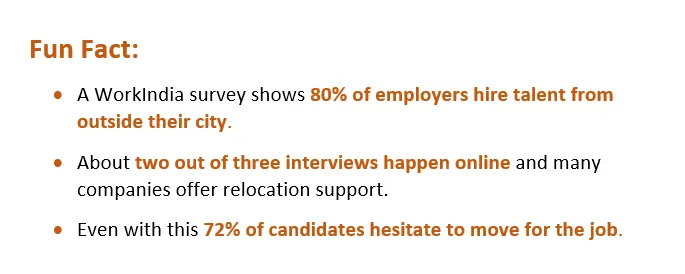
What is “Are you willing to relocate?” meaning?
Now that you have seen the examples, let’s understand the meaning of “willing to relocate”.
When someone says they are willing to relocate, it means they are open to moving to a new city or country if work requires it. The interview question “Are you willing to relocate?” means recruiters are checking two main points:
- Can you move to another city or country for the job if needed?
- Will the location become a problem after you accept the offer or join the team?
Why do interviewers ask “Are you willing to relocate?”
“Are you ready to relocate?” is a valid interview question recruiters ask before hiring. They ask this to understand if you can move later without creating problems. Here are the main reasons:
- To see your flexibility for future office or project transfers
- To check if you are a good geographical match
- To support company expansion into new cities or markets
- To know if they need to arrange logistics and moving costs
- To understand if relocation will affect your long-term commitment
- To confirm you can meet legal or visa requirements for international roles
- To see if you can adjust to a new work location or office branch
- To avoid future hiring issues after onboarding
Also Read - Top 10+ Answers for Reason for Job Change
How to answer “Are you willing to relocate?” interview question
Here are the steps you can follow to answer the “Are you willing to relocate?” interview question professionally:
- Check job post before interview
Read the job post before the interview. It often tells you the location needs. If it says relocation or travel, you already know the company expects a clear “Are you willing to relocate?” answer.
- Research company locations
Look up office cities or company branches in India or abroad. This helps you make a smart decision and prepare answers based on real facts instead of guessing in the interview.
- Consider important factors to make a decision
Relocation can affect rent, family plans, career goals, and personal commitments. So, consider the important factors before making a final decision about relocation.
- Answer in one clear line
When interviewers ask “Are you ready to relocate?” give a direct answer in one line. Here are some examples.
- If the answer is “Yes”: “Yes, I am open to relocating to Pune or Hyderabad for this role.”
- If the answer is “Maybe” with conditions: “I am open to relocating. Can you share the possible project cities and the expected move timeline?”
- If the answer is “No”: “Currently relocation is not possible due to family or financial planning. But remote or travel roles can work well.”
- Add one strong reason
Support your answer with a valid reason. Avoid dramatic or emotional excuses. Here are some examples to show your willingness to relocate:
- “Yes, I can relocate to Hyderabad. The city has more tech projects in my field.”
- “Yes, I can move to Pune. My family support system is there.”
- Ask smart questions for clarity
If you need details, ask one question back politely. This shows interest and maturity. Example: “Can you share which cities this role may require moving to in the future?”
- Ask for time if needed
You can also request a few days to decide, but do it professionally. Example: “I like the role. Can I share my relocation decision in 3 business days after checking the support and timeline?”
- Keep future options open
Never shut the door completely in early interview rounds. Here is an example of how you can tackle this question. Example: “Currently moving permanently may not work, but short project travel or relocation after 6 months can work well.”
How to answer and show your willingness to relocate
If you are willing to relocate for work, here’s how you should answer the question to create a good impression:
- Say yes in the first line without hesitation
- Link your yes to a strong reason like career growth or project scope
- Show confidence and enthusiasm in your tone
- Show planning mindset by sharing a relocation plan
- Ask for details only to understand the move better not to negotiate
- Keep your answer short when spoken – under 15 seconds
How to say you are unsure about relocation
It is acceptable to be unsure about relocation, as long as the answer is respectful. Here’s how you can do it professionally without sabotaging your chances:
- Say you are open to consider relocation
- Mention you have a few questions before deciding
- Ask about timeline and location
- Ask about relocation rules, benefits, and policy
- Check if travel can work instead of shifting home
- Request 2 to 5 days if you need time to think
- Show interest in the job while being honest
- Close with a line that keeps future options open
Also Read - Why Do You Need This Job? – 10 Sample Answers
How to say “no” to the relocation interview question
It is okay to say no to relocation if you have a strong reason. Here’s how to say no without sounding negative.
- Say no in a clear tone
- Add one real practical reason
- Do not blame the company or location
- Avoid long personal explanations
- Show interest in the job first
- Mention openness to remote or travel if possible
- End by keeping future options open
Also Read - Why Do You Want To Join Our Company? 10 Best Sample Answers
What to consider before answering “are you willing to relocate?”
Here are the factors every candidate should think about before answering the interview questions: “Are you willing to relocate?”
- Job location: Confirm the job location and whether the role requires one fixed city or allows movement later.
- Relocation policy for employees: This explains who qualifies for moving support and when relocation is approved.
- Relocation benefits: Check what benefits the company is offering to support your relocation. It can be travel, accommodation, or bonus.
- Relocation reimbursement: Reimbursement means refunding real bills. Most companies pay this only after onboarding or after a move is officially approved.
- Relocation bonus or moving bonus: A relocation bonus is not a refund. It is a one-time payment added to your CTC and is usually taxed like salary.
- Relocation expenses: Make a list of expected costs: packing, movers, travel, shipping deposits and paperwork. This helps you ask the right questions later.
- Relocation duration: Check if the move is short-term or long-term. Temporary relocation needs a different approach than permanent transfers.
- International relocation policy: If the job is global, check if visa travel permits or documentation support is required and whether the company pays for it.
- Moving timeline: Some companies ask for a move after training or after 30 to 90 days. Others expect immediate relocation only for niche senior hires.
- Tax impact: Add tax to your relocation budget if you receive a bonus. If reimbursements are bill-based, the tax rules may differ.
Also Read - Weakness in Interview: Best Examples, Tips & Answers
“Are you willing to relocate?” answer templates
Here are some ready-to-use templates for answering the question “Are you willing to relocate?”
Template 1: You are open to relocation
Use this template to show your willingness to relocate.
Yes, I am open to relocating for this role. Moving to {City/Office Location} supports my career plans because {professional reason}. I can relocate once the timeline {duration or date} is confirmed.
Template 2: You are not open to relocation
No, I cannot relocate permanently right now. I am fully interested in the role in {Current City/Work Mode} and can make it work through {remote work or travel option}. I can reconsider relocation in the future after {planning time or condition}.
Template 3: You have some questions but are willing
I am open to relocation for the right project or office. Before confirming, I would like clarity on {policy/timeline/city options}. The role aligns with my goals and I can share a final decision within {number of days}.
Also Read - How to Answer “What is Your Current CTC and Expected CTC?” in Interviews
Counter questions to ask for more clarity on relocation
Here are the counter questions you can ask recruiters to gain clarity when answering “Are you willing to relocate?”
- Which cities or office branches are hiring for this role?
- Will relocation happen after training or project assignment?
- Do you share the relocation policy for employees before joining?
- What relocation benefits are included for approved moves?
- Who approves relocation for employee transfers later?
- Is the city choice given to candidates or decided by projects?
- What documents or bills are needed for relocation approvals?
- Is the willingness to relocate part of future project planning?
- Are relocation support amounts the same for moving alone or with family?
- What expenses are reimbursed after onboarding?
Also Read - “What Are Your Hobbies” Interview Question with Sample Answers
Wrapping up
Relocation questions are not meant to confuse you. Recruiters ask this to check if you have already thought about the move before accepting the role. A good answer to “Are you willing to relocate?” should be honest and practical. Keep the focus on the job and ask for details when needed. This helps you make the right decision without losing the opportunity.
If you want strong IT roles in top Indian cities, visit Hirist, where you can find the best IT jobs in India.
Also Read - Self Introduction for Experienced Candidates: Examples & Samples
FAQs
Recruiters ask this question in different ways. The most common relocation questions are:
It means the candidate is open to moving to a new city or country for the job. It tells recruiters that location is not a limit and the person can shift if the role needs it.
dd a short line like “Willing to relocate internationally” or “Open to relocation” in the resume headline or summary. Keep it brief so it sounds professional and natural.
These are the main reasons why candidates say no to relocation: Family health responsibilities Taking care of parents Partner’s job in the same city Kids’ school or exam schedule No support system in the new city Preparing for exams Planning to get married
relocation bonus is extra money a company gives you to help with moving costs. It can cover packing, travel, hotel stay, shipping your items or settling in a new city.
The support can be different for each role, but these are the most common benefits of relocation: Moving bonus (one-time payment) Packing cost coverage Flight or travel ticket reimbursement Hotel stay for 3 to 15 days Temporary housing support Office transfer assistance Visa and paperwork support for global moves 7. When do recruiters ask “Are you ready to relocate?” Recruiters ask this during interviews when the role involves frequent travel or possible office transfer later. They want to know if you are open to moving in the future if the company or project needs it. 8. What are the best answers for “Why are you willing to relocate internationally?” Here are some good reasons to show your willingness to relocate internationally: Career growth in a global market Better pay and savings potential Chance to work with top teams abroad Learning new skills and work culture More job stability in the new country Better future for long-term career plans New industry exposure and bigger roles
relocation policy for employees is a company’s official plan that explains who can be moved, when they can be moved, how the process works, and what support or payments the company will provide
Yes, many companies reimburse relocation costs when the role needs you to move or travel for work. They usually refund one-time expenses like travel, packing, hotel stay, shipping, and sometimes rental deposit support. It is mostly offered after you join or when an official transfer is approved.
The best answer for freshers is clear and honest. Say you are open to relocation if you are. Add one short reason like career growth learning or flexibility.
Relocation expenses are taxed based on the country and company policy. In many cases reimbursements for actual bills like travel shipping and hotel are not taxed if they are paid directly by the company or claimed with proof.
Yes, relocation bonus is taxable in most countries because it is extra money added to your income and not linked to a specific bill. The tax is deducted the same way salary tax is deducted.
Here is the usual length of a “willing to relocate” arrangement in companies: 3 to 6 months: Short project or training-based move 6 to 12 months: Mid-size project or client site assignment 1 to 3 years: Big project, new branch setup, leadership needs Permanent: The job needs one fixed office or city
n international relocation policy explains company rules for moving employees to another country. It includes:
When to move
Visa support Housing Timeline Job location terms
ccenture’s relocation support changes with the role and the type of move. If the company asks you to move, they usually pay for flights, packing, movers, and a short hotel or temporary stay. Many offer letters mention 10 to 14 days of hotel support, daily allowance for food and travel, and one-time relocation pay for settling in. If you request the transfer yourself, support may be limited. The exact benefits depend on your grade, distance, and project need.
mazon’s relocation support depends on the job level. The global relocation budget is often reported between ₹16.8 lakh to ₹33.7 lakh based on role and experience. In India, Amazon usually offers two choices: a one-time lump sum or a full support package. The lump sum gives freedom to plan the move your way. The full package can include movers travel cost, temporary housing and a relocation specialist. For India hires, the common support is a third-party relocation service or a lump sum of around ₹1,50,000. This amount is taxable.
Cognizant India does not publicly share official relocation policy details, but employees report that relocation may be required for client projects. Support typically depends on project needs and HR terms. This can include travel costs and a short hotel stay or temporary housing while you settle in.
Yes, TCS offers relocation support for employees when the move is approved by the company. The help depends on the role and the distance. In most cases TCS can cover moving costs, packing services, travel tickets and a short temporary stay while you settle in. If you choose to move on your own request the support is usually decided by your manager and project needs.
t Walmart in India, relocation benefits are provided to permanent employees, with eligibility typically required within a specific period (move within 3 months of offer), but exact amounts aren’t publicly shared.
Intel India provides a relocation allowance based on your situation. For example, typical amounts reported are around ₹60,000 for single, ₹100,000 + family, ₹140,000 + two dependents. It is meant to help cover travel and moving costs.
Google India does not have a fixed public relocation package. Reports from employees suggest figures around ₹1.7 lakh for some analyst levels and up to ₹5 lakh for higher roles. For global moves, typical packages range from $15,000 to $50,000, depending on position, distance, and support offered.