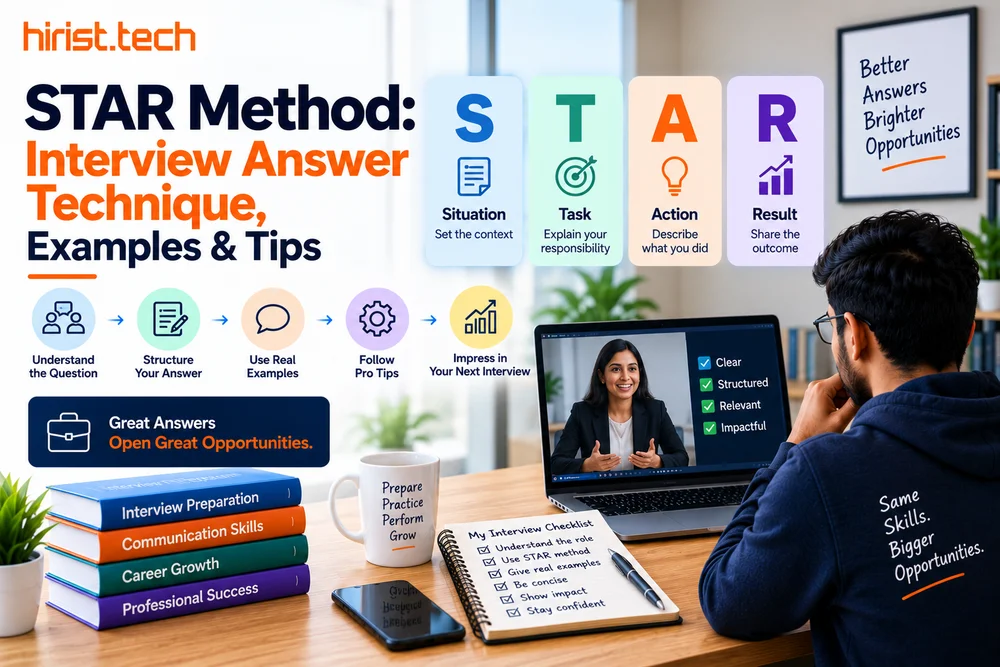
The STAR method is a clear way to answer behavioural interview questions that ask you to share real examples from your work or life.
These questions often start with,
- “Tell me about…”
- “Describe a time…”
- “How did you…”
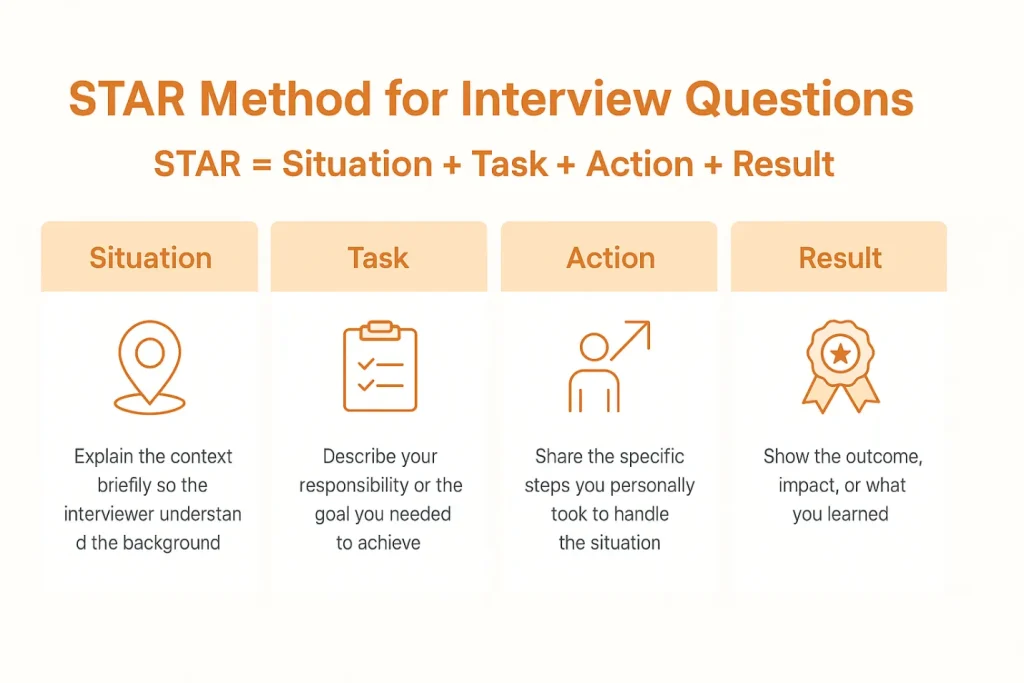
The full form of STAR is Situation, Task, Action, Results. This technique helps you divide your answer into a simple structure that is easy for you to speak and easy for the interviewer to follow.
You start with the situation, explain the task, walk through the action and end with the result. This keeps your answer focused and helps you highlight your skills without rambling.
In this guide we will show you how to use the STAR method to create strong responses for common behavioural interview questions. You will also find STAR interview question examples with sample answers for inspiration.
STAR method example answer
Before we get into the full guide, let’s look at a quick example. This will help you see how an interview answer sounds when you use the STAR method.
Question: “Tell me about a time you handled a difficult situation at work.”
Sample answer using STAR method:
- Situation: “Last year, our team had to finish a client project in 7 days because the deadline was moved forward. Two teammates were on leave, so our workload increased by 40%.”
- Task: “My responsibility was to manage the content part of the project and complete 5 key deliverables without delaying the overall timeline.”
- Action: “I created a simple action plan and broke the tasks into daily steps. I shared short progress updates with the client each evening. I also took 2 extra tasks from a teammate to keep the project running smoothly.”
- Result: “We delivered the project 1 day early. The client praised the communication and gave us an additional 3-month retainer project. The workflow we created later reduced our average delivery time by 20%.”
What is the STAR method?
The STAR method is a structured way to answer behavioural interview questions using a short story from your past. You share the Situation, explain the Task, walk through the Action, and finish with the Result. This structure helps you speak clearly without losing track of your point.
Many candidates know what they want to say but struggle to organise their thoughts at the moment. The STAR interview method gives you a clean path to follow. It keeps your answer short and focused on what you actually did. You can think of the STAR approach as a small storytelling tool for interviews.
Note: The STAR process is sometimes described using shorter terms like “situation action result” or “situation task action”, but the complete STAR technique situation task action result format gives a clearer structure for interviews.
How does the STAR method work?
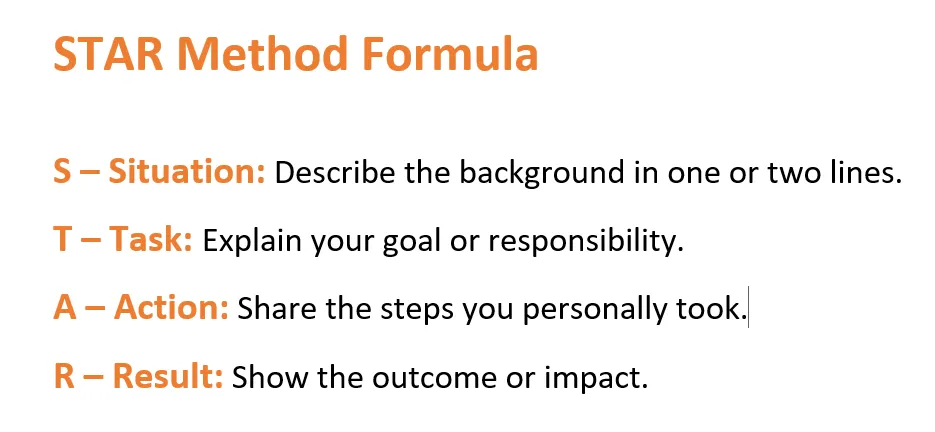
The STAR technique works by guiding you to explain one real example step by step. Each part focuses on a different piece of your story. Here is a simple breakdown of the star method:
S – Situation
This is the background. You set the scene in one or two lines so the interviewer understands what was happening. Say where you were, who was involved and what the main problem or context was. Do not go into your full job history here.
Example:
“Last quarter, our team had to submit a client report in five days, but two team members fell sick and we were already behind schedule.”
T – Task
This is your goal or responsibility in that situation. Make it clear what you had to do. Focus on your role only.
Example:
“My task was to organise the report work, divide the tasks and make sure we still submitted a complete report on time.”
A – Action
This is the most important part. Here you explain what you did to handle the situation. Talk about the steps you took. Mention tools, ideas, decisions and extra effort. Use “I”, not “we”, so the interviewer sees your part clearly.
Example:
“I listed all pending sections of the report and created a simple checklist for each day. I took over two sections from my sick teammates, stayed one extra hour each evening and set up a short check-in call with the client to manage their expectations.”
R – Result
This is what happened because of your actions. It is the outcome, ideally with numbers or clear impact. Share what you achieved.
Example:
“As a result, we submitted the report one day early. The client appreciated the clear updates and gave us another three-month project. My manager also used our checklist as a template for future reports.”
STAR interview question examples
Here are some common star-based interview questions that are commonly asked by recruiters:
- Tell me about a time you faced a challenge at work.
- Describe a situation where you had to solve a problem quickly.
- Give an example of a time you worked in a team.
- Tell me about a time you handled conflict with a coworker.
- Share an example of when you showed leadership.
- Describe a time you made a mistake and how you fixed it.
- Tell me about a goal you set and achieved.
- Give an example of a time you worked under pressure.
- Tell me about a time you had to deal with an upset customer.
- Describe a situation where you had to prioritise many tasks.
Also Read - Behavioural Interview Questions: Examples, Answers & STAR Tips
How to use the STAR method to answer interview questions
When you follow the STAR interview method step by step, your answer feels structured without sounding memorised. Below is a simple process you can use for any STAR methodology interview questions, no matter your role or industry.
1. Start by choosing the right example
Pick a real situation that fits the question. A strong STAR example comes from work, internships, projects, volunteering or college activities. Choose a moment where you solved a problem or created impact. Make sure the example matches the skill the employer wants – teamwork, leadership, problem-solving, adaptability or communication.
2. Break your story into the STAR format
The STAR technique helps you speak in four short parts:
- Situation: Set the scene in one or two lines.
- Task: Show your responsibility or goal at that moment.
- Action: Explain the specific steps you took.
- Result: Share the outcome and what improved because of your action.
This simple STAR process keeps your answer clear even under pressure.
3. Focus most of your answer on the Action
Interviewers want to know what you did. So, use “I” while describing your actions. Explain the approach you took, the tools you used, the decisions you made and the challenges you handled. This is where you show your problem-solving and thought process using the STAR framework for interview.
4. Quantify your result when possible
The strongest STAR answers end with numbers or clear impact.
You can mention:
- Time saved
- Revenue earned
- Customer satisfaction
- Efficiency improved
- Deadlines met
- Feedback from managers or clients
If you cannot give numbers, share the positive outcome or lesson learned when using STAR method for interviews.
5. Keep each part short and natural
Many candidates speak too long during interviews. The STAR approach avoids this problem. Each part should be brief, especially the Situation and Task. You do not need a long backstory.
- Aim for 1 to 2 lines for S and T
- Then 4 to 6 lines for A
- And 2 to 3 lines for R
6. Practise 3 to 5 STAR stories before the interview
You do not need 20 examples. Most STAR method interview questions can be answered using a small set of strong stories by simply adjusting your angle. Prepare stories for:
- Solving a problem
- Working with a team
- Handling conflict
- Leading a task
- Managing a deadline or pressure
These examples can fit dozens of questions.
7. Match your STAR story to the job description
The STAR framework works best when your example connects to the role. If the job needs leadership, choose a story where you coordinated a team. If the job needs customer focus, choose a story where you supported someone or fixed an issue. This shows relevance and helps the interviewer picture you in the job.
8. Speak in a calm, conversational tone
The STAR method helps your mind stay organised, but the delivery should still feel natural. Speak as if you are telling a short story to a colleague. Avoid memorising a script. Focus on the key points and let the conversation flow.
9. End with the result and what you learned
Interviewers value self-awareness. So, after sharing the result, add a short reflection:
- What did you learn?
- How did it change your approach?
- How does it help you in future roles?
This small step makes your answer deeper and more memorable.
Also Read - How to Start a Group Discussion: GD Tips & Examples
How to structure your answer using the STAR format
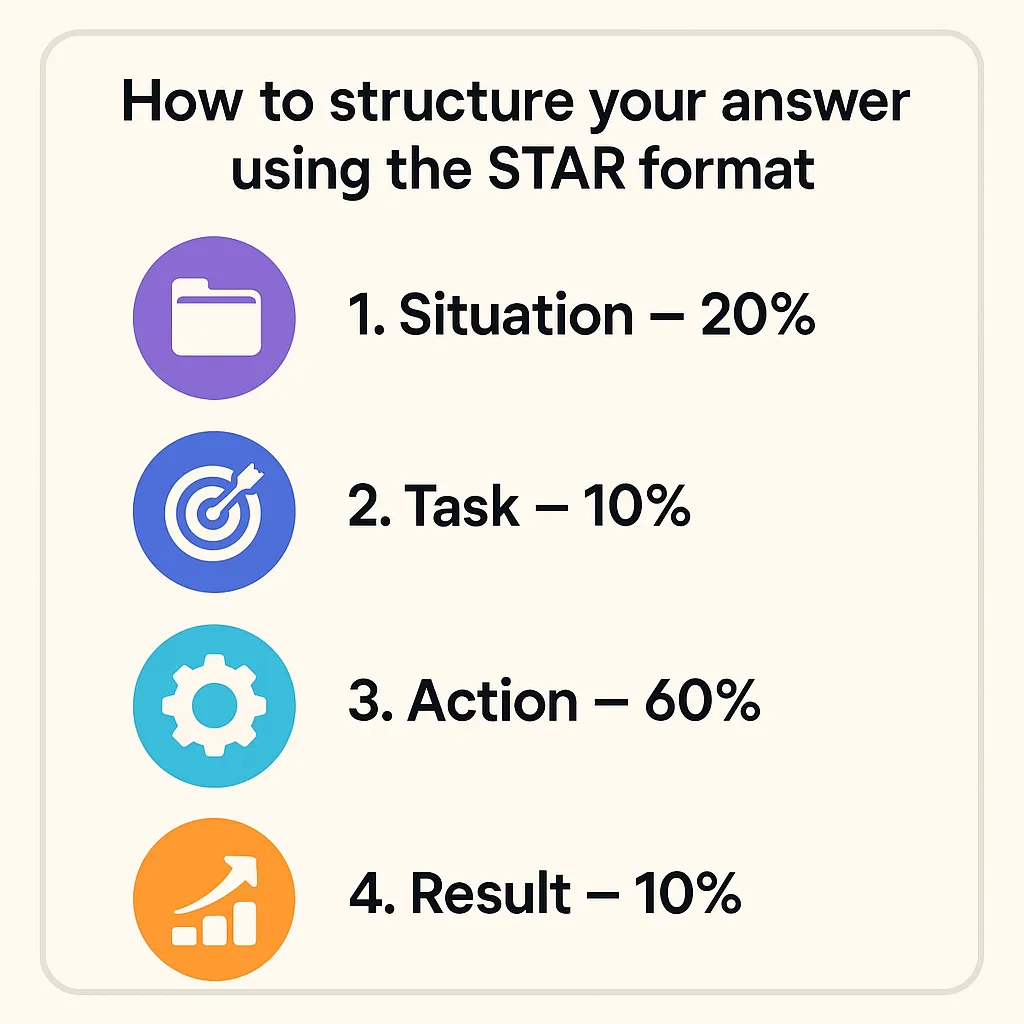
The STAR format gives you a clear way to divide your answer so it stays focused and easy to follow. Each part has a rough percentage of how much time you should spend on it.
1. Situation – 20%
Example:
“Our team had a major client delivery due in five days. Two key members fell sick, and the project was already running slightly behind.”
2. Task – 10%
Example:
“I had to reorganise the workload and make sure we submitted a complete, accurate delivery on time.”
3. Action – 60%
Example:
“I listed all pending tasks and grouped them by priority. I took over two high-impact sections myself, assigned the remaining parts to teammates based on strengths, and created a daily progress tracker. I also set up short morning check-ins to fix issues early and updated the client to manage expectations.”
4. Result – 10%
Example:
“We finished the project a day early and the client rated our work highly. My manager later adopted the tracker I created as a standard template.”
STAR method examples for common interview questions
These STAR questions and examples give you a clear idea of how to structure your answers.
1. Tell me about a time you worked in a team.
- Situation: In my previous role, our team had to create a new onboarding guide for clients. Everyone had different ideas, and the process became slow and confusing.
- Task: I was responsible for coordinating the content section and making sure everyone’s work fit together in a clear, consistent structure.
- Action: I organised a short brainstorming session to understand everyone’s inputs. Then I created a simple layout for the guide and assigned sections based on each person’s strengths. To avoid confusion, I set up a shared folder, added version control and created a weekly review checklist. I also helped two teammates rewrite complex sections to keep the tone consistent.
- Result: We completed the guide two weeks before launch. New clients said the guide made onboarding much smoother, and our support tickets dropped by 30% in the first month. My manager later asked me to lead documentation tasks for future projects.
2. Describe a situation where you had to adapt to a sudden change.
- Situation: During a product demo week, our main tool unexpectedly stopped working due to a system update. We had three demos scheduled that same afternoon.
- Task: I needed to find a quick alternative so the demos could continue without cancelling or disappointing potential clients.
- Action: I created a temporary demo using recorded workflows and live walkthrough slides. I informed the sales team about the change and practised the flow with them for consistency. While they ran the demos, I worked with the tech team to fix the issue and prepared a short update email to send to prospects after each session.
- Result: All three demos ran smoothly despite the tool outage. Two prospects appreciated our quick adjustment and booked deeper follow-up sessions. The temporary demo kit I created later became our official backup for future presentations.
3. Describe a situation where you had to resolve a conflict within your team.
- Situation: Two senior team members strongly disagreed about the direction of a feature we were building. Their arguments slowed progress, and the rest of the team felt stuck and unsure how to continue.
- Task: I needed to resolve the conflict quickly, create alignment and help the team choose a clear direction without hurting working relationships.
- Action: I arranged a short meeting where both team members could explain their viewpoints without interruption. I summarised the key points from each side and compared them with the client’s actual goals to bring clarity. Once the discussion became more focused, I suggested combining the strongest elements from both approaches. I assigned clear responsibilities, created a small prototype to test both ideas and set a quick review deadline to avoid further delays.
- Result: The team agreed on the combined approach, and the prototype helped us finalise the feature within two days. The client appreciated the balanced solution, and both team members later said the process improved how they worked together on future tasks.
4. Give an example of a time you showed leadership at work.
- Situation: A new joiner in our team was struggling to understand our internal tools and processes. This led to repeated errors and low confidence, and the rest of the team was unsure how to support them.
- Task: I decided to take the lead in helping the new teammate get comfortable with our workflow so they could contribute independently.
- Action: I scheduled short one-on-one sessions to walk them through our tools, explained common mistakes and shared simple checklists I personally use. I paired them with me for two tasks so they could see the full process step by step. I also encouraged the rest of the team to share tips in a shared document, which slowly turned into a small internal knowledge base.
- Result: The new teammate became fully independent within a month and their error rate dropped significantly. They later said the support helped them settle into the team faster. The knowledge base we created grew into a standard onboarding resource for all future hires.
5. How did you handle a situation where a colleague was not meeting expectations?
- Situation: In my last role as a support specialist, one teammate often delayed responses to customer tickets, which increased our backlog and affected our response-time metric.
- Task: My responsibility was to maintain team workflow and make sure we met our daily response targets.
- Action: I invited him for a short one-to-one chat to understand the issue. He said the new ticketing tool felt confusing. I offered to walk him through the features, created a simple step guide and checked in with him for the next few days. I also redistributed two high-priority tickets temporarily to reduce pressure.
- Result: His response time improved within a week. Our backlog dropped by 25 percent, and the team met the monthly service-level target again. He later said the guidance helped him feel more confident with the tool.
Why behavioural questions feel hard (and how STAR makes them easier)
Behavioural interview questions focus on how you handled real situations in the past. Instead of asking what you would do, they ask what you actually did. This helps employers understand your decision-making style and your approach to challenges.
Many candidates find behavioural questions difficult because:
- You must remember a clear example on the spot.
- You may start rambling when the story feels long.
- Pressure makes you forget key facts or steps.
- You know what happened, but explaining it simply is tough.
- You worry about sounding too basic or too rehearsed.
How the STAR method makes answering easier
The STAR model interview gives you a simple structure to follow:
- You tell the story in four clean steps: Situation, Task, Action, Result.
- It stops you from jumping around or sharing unrelated details.
- It helps you highlight your impact.
- It keeps your answer short.
- It shows the interviewer how you think and solve problems.
When should you use the STAR technique in interviews?
You should use the STAR interview technique whenever a question asks for a real example from your past. Use the STAR process when questions start with:
- “Tell me about a time…”
- “Give an example of…”
- “Describe a situation when…”
- “How did you handle…?”
- “What did you do when…?”
You can also use the STAR process when the interviewer wants to check:
- Your decision-making
- Your teamwork skills
- How you deal with pressure
- How you solve problems
- How you handle conflict or mistakes
Common mistakes candidates make with the STAR method
Many candidates know the STAR approach for interview but still struggle to use it well. Small mistakes can make a strong example sound unclear or incomplete. Here are the most common ones:
- Giving too much background in the Situation
- Not explaining their Task clearly
- Using “we” instead of “I” during the Action
- Listing actions without showing decision-making
- Forgetting to mention the Result
- Sharing results with no numbers or clear impact
- Choosing examples that do not match the job
- Using stories that are too old or irrelevant
- Sounding scripted instead of natural
- Telling one long story without breaking it into STAR steps
Simple tips to practice and improve your STAR responses
Practising the STAR method helps you speak with more confidence during interviews. These easy steps will help you sharpen your examples and make your answers stronger:
- Write 3 to 5 short STAR stories you can adapt for different questions
- Record yourself answering one question at a time
- Time your responses to stay within 1 to 2 minutes
- Practise turning long stories into short points
- Ask a friend to check if your answer felt structured
- Swap examples if your story does not match the job
- Rehearse until your answers feel natural
Wrapping up
The STAR method gives you a simple way to talk about your experience without getting stuck or speaking in circles. With a few clear STAR examples, you can walk into interviews feeling more prepared. And when you are ready to apply your skills, you can find top tech roles on Hirist, a trusted IT job portal in India that connects talent with the right opportunities.
FAQs
The STAR method is a structured approach to answering behavioral questions using four steps: Situation, Task, Action, and Result. It helps candidates share real-life examples clearly and concisely.
A strong STAR answer typically takes between one and two minutes. You should keep the Situation and Task brief, focus primarily on the Action you took, and conclude with a clear Result.
No, the STAR method is specifically for behavioral questions that ask for past examples. For questions about opinions, preferences, or personality, such as “What are your strengths?”, you should answer directly without using the STAR structure.
Beyond interviews, the STAR format is useful for writing CV bullet points, crafting cover letters, completing detailed application forms, and describing contributions during performance reviews to provide proof of your achievements.