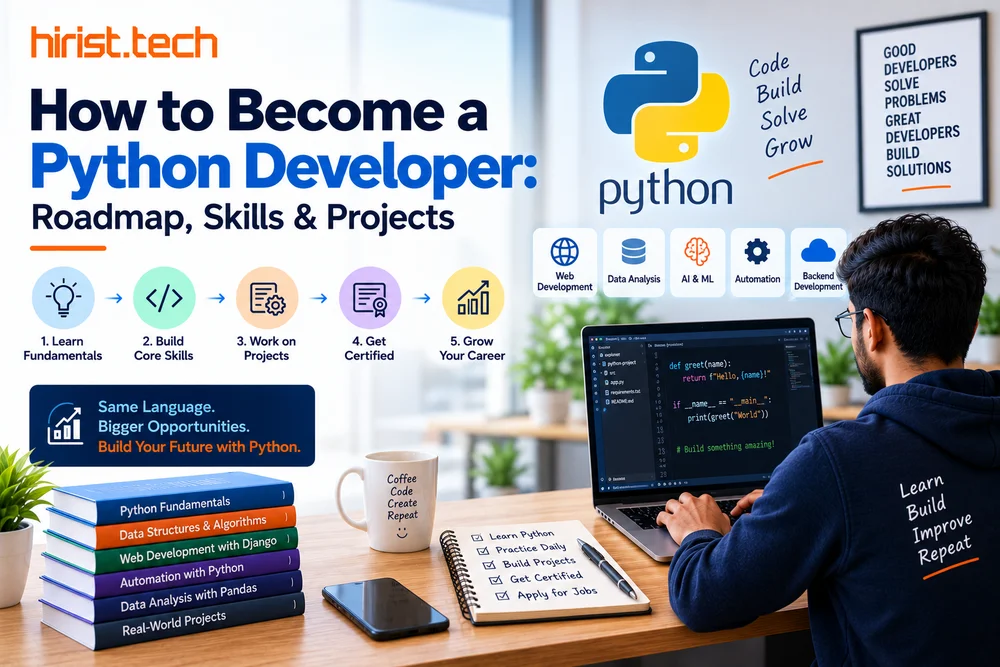
There are many different paths to becoming a successful Python developer, but in this guide we will share a simple roadmap that even people without a degree or any IT experience can follow.
Python is growing fast and now ranks among the most used programming languages in the world. The TIOBE Index shows Python holding 23 percent of global popularity. This tells us something important. Companies want people who can work with Python to build web apps, create data tools, handle automation and support research work.
So in this guide, we will walk through how to become a Python developer and look at the key skills and certifications that help you grow in this field.
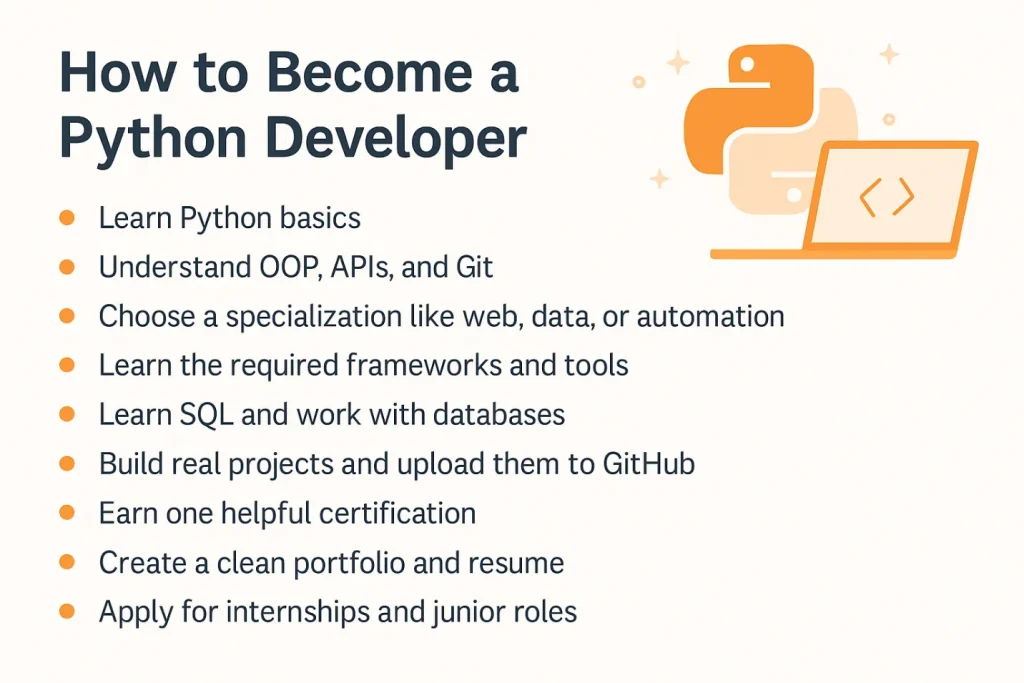
What is a Python developer?
A Python developer is a tech professional who works with the Python programming language to build different types of software and tools. They use Python to solve problems, create digital systems, and support teams that work with data or automation. Anyone can become a Python developer with the right learning path, even without a degree or technical background.
What is Python used for?
Python works on many systems and supports a wide range of projects across industries. Here are the common uses of Python:
- Web development
- Data analysis and dashboards
- Machine learning and AI projects
- Automation and scripting tasks
- Backend APIs and system tools
- Scientific and research computing
- Cybersecurity and ethical hacking
- Game development and simulations
Also Read - Top 15+ Python Automation Interview Questions and Answers
Roles and responsibilities of a Python developer
A Python developer works on different parts of a software project and uses Python to build and maintain applications or data systems. Here are the common roles and responsibilities of a Python developer:
- Writing clean and readable Python code
- Building backend systems and server-side logic
- Working with databases and creating efficient queries
- Creating APIs for apps and web services
- Testing code and fixing bugs
- Automating tasks to save time and reduce errors
- Working with data, files and external tools
- Using GitHub for version control and teamwork
- Integrating Python code with front-end features
- Improving the speed and performance of applications
Also Read - Top 20+ Python Interview Questions for Data Analyst
What is the salary of a Python developer?
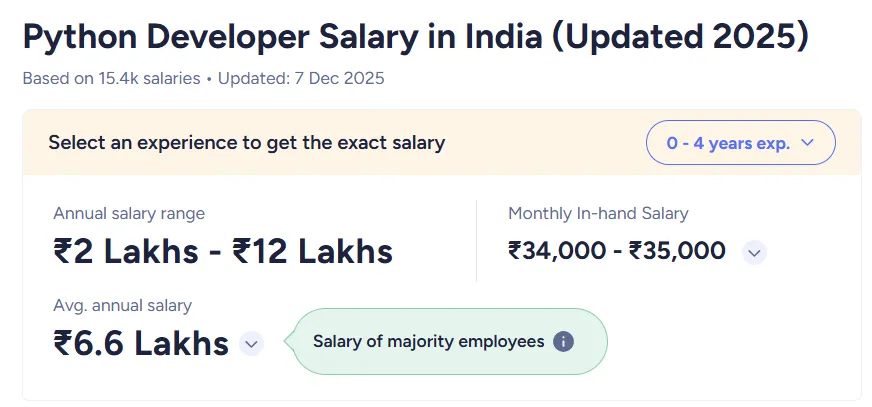
Python developers earn solid pay in India, and current AmbitionBox data gives a clear picture of what beginners can expect in the first few years.
- Annual range (0 to 4 years of experience): ₹2 lakhs to ₹12 lakhs
- Average annual salary: ₹6.6 lakhs
- Monthly in-hand salary: ₹34,000 to ₹35,000
Python developer salary based on experience:
| Experience | Average Annual Salary |
|---|---|
| Fresher | ₹3.2 Lakhs per year |
| 1 year | ₹3.7 Lakhs per year |
| 2 years | ₹5.1 Lakhs per year |
| 3 years | ₹6.7 Lakhs per year |
Python developer salary based on location:
| Location | Salary |
|---|---|
| Python Developer Salary in Gurgaon / Gurugram | ₹9.2 Lakhs per year |
| Python Developer Salary in Noida | ₹8.6 Lakhs per year |
| Python Developer Salary in New Delhi | ₹8.5 Lakhs per year |
| Python Developer Salary in Mumbai | ₹8.5 Lakhs per year |
| Python Developer Salary in Chennai | ₹8.1 Lakhs per year |
Python developer salary at top companies in India:
| Company | Salary |
|---|---|
| Foundever Python Developer Salary | ₹20.9 Lakhs per year |
| EY Global Delivery Services (EY GDS) Python Developer Salary | ₹13.4 Lakhs per year |
| Deloitte Python Developer Salary | ₹11.4 Lakhs per year |
| Ernst & Young Python Developer Salary | ₹11 Lakhs per year |
| CGI Group Python Developer Salary | ₹10.9 Lakhs per year |
Python developer salary across different industries:
| Industry | Salary |
|---|---|
| Python Developer Salary in Internet | ₹10.0 Lakhs per year |
| Python Developer Salary in Education & Training | ₹9.7 Lakhs per year |
| Python Developer Salary in Financial Services | ₹9.6 Lakhs per year |
| Python Developer Salary in BPO | ₹9.4 Lakhs per year |
| Python Developer Salary in Analytics & KPO | ₹7.7 Lakhs per year |
Also Read - Top 75+ Python Interview Questions and Answers
How to become a Python developer – Full roadmap with timeline
Many people start learning Python without knowing what to study first or how much time each stage takes. This roadmap gives you a structured path that covers everything. Here’s how to become a Python developer step-by-step
Step 1: Choose your learning path (Week 1)
Your learning path shapes how quickly you progress, so spend time picking the option that suits your style. You do not need a degree to become a Python developer. Many people in India start with online courses or self-learning and still get good jobs.
Your education options:
- Online courses – Best for beginners who want guided lessons
- Bootcamps – Faster learning with strict timelines
- College degrees – Useful but not required for Python jobs
- Self-learning – Flexible and easy to start
- IIT online courses – Respected in India and affordable
Step 2: Learn Python fundamentals (Weeks 1 to 4)
This phase builds the foundation for everything you will do later. Spend time learning how Python works instead of jumping into advanced topics too soon.
What to learn:
- Variables and data types
- Conditions and loops
- Functions
- Lists, tuples, dictionaries and sets
- File handling
- Basic error handling
- Writing small programs
Step 3: Learn core software concepts (Weeks 4 to 8)
Python developers must understand how real software works behind the scenes. And for this, you need more than just Python syntax. These concepts help you work like a real developer.
Here’s what to learn:
- Object-oriented programming
- How packages and modules work
- APIs and JSON
- Git and GitHub for version control
- Basic debugging
- Working with virtual environments
Step 4: Pick a specialization (Week 8)
Python opens doors to different career paths. Choosing one specialization helps you focus your learning and avoid confusion.
Popular specializations:
- Web development leads to backend roles and full-stack positions.
- Data science focuses on numbers, analysis and charts.
- Machine learning deals with predictions and algorithms.
- Automation focuses on scripts and tools that save time.
Pick the path that matches your interest. Once you select a direction, your study plan becomes much clearer and job preparation becomes easier.
Step 5: Learn the required frameworks (Weeks 8 to 12)
Frameworks make development faster and help you build real applications.
If you choose Web Development:
- Django or Flask
- Templates, routing, forms
- Authentication and sessions
If you choose Data Science:
- Pandas
- NumPy
- Matplotlib
- Jupyter Notebook
If you choose Automation:
- Selenium
- BeautifulSoup
- Requests
Spend this month creating projects with your chosen framework. The more you practice here, the easier your portfolio will come together later.
Step 6: Learn databases and SQL (Weeks 12 to 14)
Every developer works with data, so you must know how information is stored and managed. This helps you build real applications that interact with users and systems.
What to learn:
- SQL basics
- CRUD operations
- PostgreSQL or MySQL
- ORM tools like Django ORM or SQLAlchemy
Step 7: Build real projects (Weeks 14 to 20)
This is the most important part of your journey. Projects help you understand how Python works in real situations. They also make your portfolio stronger and show companies that you can solve problems with code. Build a mix of small and medium projects.
Also Read - Top 25+ Python OOPs Interview Question (2026)
Project ideas and tips for Python developers
1. Beginner-friendly project ideas
- Calculator app: Helps you learn functions, logic and user input.
- To-do list app: Teaches file handling and saving user data.
- Number guessing game: Good for beginners to learn loops and conditions.
2. Intermediate project ideas
- Weather app with API: Teaches you API calls, JSON and error handling.
- Blog website using Flask or Django: Helps you understand routing, templates and backend logic.
- Data dashboard: Use Pandas and Matplotlib to clean and visualise real data.
3. Advanced project ideas
- Machine learning model: Try prediction tasks with scikit-learn.
- Chatbot: Use NLP libraries to handle text and user messages.
- E-commerce backend: Create cart features, user logins and payment logic.
Tips to pick the right projects
- Start with simple ideas you can finish fast.
- Choose projects that solve a real problem in your daily life.
- Keep each project in a separate GitHub folder with a clear README.
- Add screenshots to show how the project works.
- Write clean and readable code so reviewers can understand your logic.
- Try one project on the web, one in data, and one in automation to experience different paths.
Step 8: Earn useful certifications (Anytime)
Certifications are not mandatory, but they help you prove your skills and gain credibility when applying for internships or junior roles. They also guide your learning with a structured path.
Also Read - Top 5 Python Developer Resume Examples, Samples & Guide
Best certifications for Python developers
Here are the important certifications to help you become a better Python developer:
| Certification | Issued By | Who It Helps |
|---|---|---|
| PCEP – Entry-Level Python Programmer | Python Institute | Freshers starting from zero |
| PCAP – Associate Python Programmer | Python Institute | Learners with some practice |
| PCPP1 – Professional Python Programmer 1 | Python Institute | Intermediate Python developers |
| PCPP2 – Professional Python Programmer 2 | Python Institute | Advanced learners in India’s tech roles |
| Google IT Automation with Python | Learners targeting automation jobs | |
| IBM Python for Data Science | IBM | Students entering data science fields |
| Microsoft Python Certification | Microsoft | Beginners wanting recognised credentials |
| AWS Python Developer Learning Path | Amazon Web Services | Developers moving toward cloud roles |
Step 9: Create a strong portfolio and resume (Week 20)
A good portfolio helps companies understand your skills at a glance. It also increases your chances of getting shortlisted.
Here’s what to include in your portfolio or resume:
- GitHub links
- Screenshots
- Project summaries
- A clean readme for each project
Step 10: Apply for roles and gain experience (Weeks 20 to 24)
Now you prepare for interviews and start applying. Practice coding questions and Python basics. Use platforms like Hirist to find roles in India.
How to prepare for jobs:
- Practice problem solving
- Learn basic interview questions
- Apply for internships and freelance work
- Contribute to open-source to gain visibility
- Connect with developers on LinkedIn
Python developer roadmap at a glance
| Timeline | What You Learn |
|---|---|
| Weeks 1 to 4 | Python basics and simple programs |
| Weeks 4 to 8 | OOP, APIs, modules, Git |
| Week 8 | Choose your specialization |
| Weeks 8 to 12 | Frameworks and core tools |
| Weeks 12 to 14 | Databases and SQL |
| Weeks 14 to 20 | Build real projects |
| Weeks 20 to 24 | Portfolio, resume and job applications |
Key skills for Python developers
Python developers need technical skills as well as soft skills along with practical tools experience to build a successful career. Here are the important skills that Python developers must have:
| Hard Skills | Tools | Soft Skills |
|---|---|---|
| Core Python syntax | Git and GitHub | Problem solving |
| Object-oriented programming | VS Code or PyCharm | Communication |
| Working with APIs | Postman | Teamwork |
| Databases (SQL, NoSQL) | Docker | Time management |
| Frameworks like Django, Flask | Jenkins or GitHub Actions | Adaptability |
| Data handling with Pandas, NumPy | Jupyter Notebook | Attention to detail |
| Debugging and testing | PyTest, Unittest | Continuous learning |
Wrapping up
So, this is a complete Python developer roadmap you can follow to choose the simplest path into this growing field. Stay focused on your skills and keep building projects because these are the things recruiters notice first.
Now that you know how to become a Python developer, start gaining real experience. Visit Hirist to find IT jobs, including Python developer job roles at top tech firms in India.
FAQs
Yes, it is entirely possible to become a Python developer without a formal degree. Employers typically prioritize practical skills, a robust GitHub portfolio, and knowledge of frameworks like Django or Flask over academic credentials. Focusing on building projects and gaining experience through internships or freelance work can effectively substitute for a degree.
Most beginners need three to six months to learn the basics and build simple projects. However, to secure a stable job and refine your professional skills, the process usually takes between six and twelve months of consistent practice and project development.
To become a full-stack developer, you must learn core Python, front-end technologies (HTML, CSS, JavaScript), and a Python web framework like Django or Flask. Additionally, you need to understand database management (MySQL/PostgreSQL), API integration, and build complete projects to showcase on GitHub.
Yes, you can acquire beginner-level job skills in three months with focused daily practice. A recommended schedule involves learning Python basics in the first month, OOP and frameworks in the second, and building two to three real projects in the third month before applying for entry-level roles.