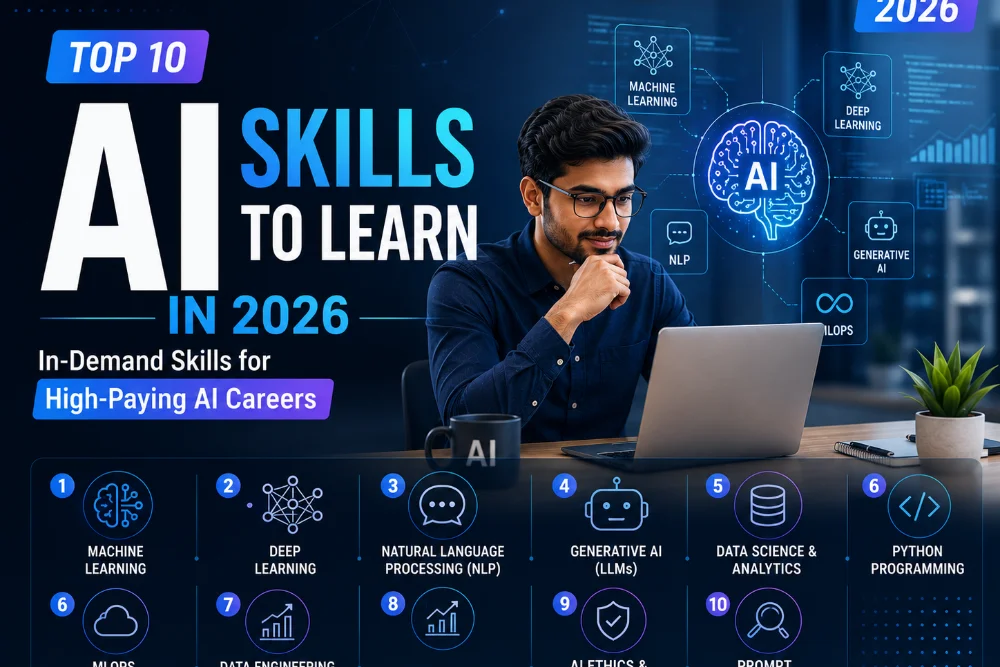
AI Skills to Learn – Learning AI skills has become essential for both freshers and experienced professionals, as more jobs now require at least a basic level of AI proficiency. According to NASSCOM’s AI Adoption Index 2.0, 87% of surveyed Indian companies are already using AI solutions beyond the trial stage.
This growing use of AI is also creating better career opportunities. PwC’s 2026 Global AI Jobs Barometer found that workers with AI skills earn an average wage premium of 62% compared with people in similar roles without these skills.
The opportunity is not limited to programmers or AI engineers. Professionals across marketing, finance, healthcare, operations, and other fields can also benefit from practical AI capabilities. Here are the 10 most in-demand technical and non-technical AI skills to learn in 2026 to build a high-paying career in AI.
AI skills in India – Key highlights
India is not lagging behind in the global AI race. It is building a strong AI ecosystem and competing with established AI economies such as the US and the UK.
- India ranks third globally in AI competitiveness, according to Stanford University’s 2025 Global AI Vibrancy Tool.
- India is the world’s second-largest contributor to AI projects on GitHub.
- India has deployed 38,000 GPUs under the IndiaAI Mission.
- AI could contribute $1.7 trillion to India’s economy by 2035.
These statistics are taken from the Government of India’s Transforming India with AI report, published in December 2025.
Why are AI skills in high demand?
AI skills are in demand because companies are moving beyond small experiments and using artificial intelligence in everyday work. PwC’s 2026 Global AI Jobs Barometer found that job postings requiring specific AI skills grew by 69%, compared with 9% growth across the overall job market.
Several changes are driving this demand:
- AI is becoming part of daily workflows: Companies use generative AI and AI agents to analyze data, create content, assist customers, write code, and automate repetitive tasks.
- Existing roles are changing: Professionals in marketing, finance, healthcare, operations, and other fields increasingly need AI proficiency to work faster and make better decisions.
- Startups are building with AI: According to the Government of India’s Transforming India with AI report, nearly 89% of new startups launched in 2024 used AI in their products or services.
- Businesses need people who can apply AI: Employers require technical professionals who can build and manage AI systems, as well as nontechnical professionals who can use AI tools effectively.
NASSCOM expects India’s AI talent base to grow from around 6-6.5 lakh professionals to more than 12.5 lakh by 2027. This rapid growth makes AI skills increasingly valuable for anyone preparing for future careers.
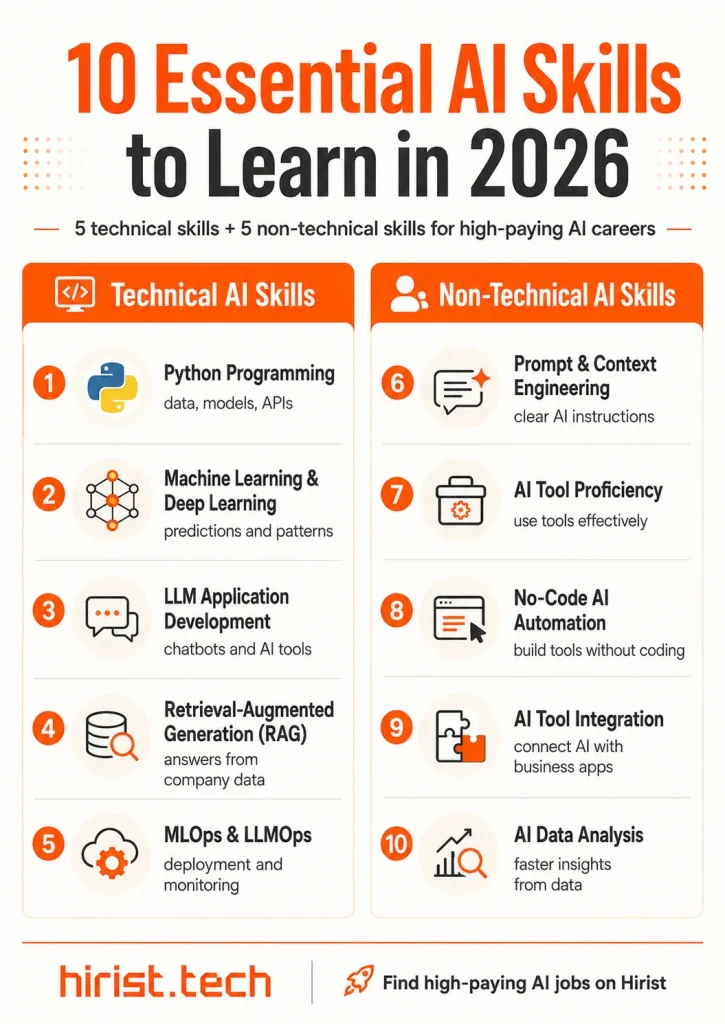
10 essential AI skills to learn in 2026
AI skills are the abilities that help people build AI systems or use AI tools effectively at work. AI skills for jobs can be divided into two main categories: Technical and non-technical AI skills.
We cover five of the most in-demand AI skills to learn from each category and explain how they are used in actual jobs.
Top technical AI skills to learn – For building AI systems
Technical AI skills help professionals create, train, test, deploy, and maintain AI models and applications. Here are five technical AI skills required for careers in AI engineering, machine learning, data science, and automation.
1. Python Programming
Python is one of the most in-demand AI skills to learn because it is used to prepare data, train machine learning models, build AI applications, and automate tasks. Its simple syntax also makes it easier to learn than many other programming languages. Libraries such as Pandas, NumPy, scikit-learn, TensorFlow, and PyTorch allow professionals to use Python for everything from basic data analysis to advanced AI development. It is one of the most important skills for AI engineer roles.
What you should learn:
- Python fundamentals
- Pandas and NumPy
- APIs and JSON
- scikit-learn
- Testing and Git
Other programming languages to learn: R for statistics and data analysis, Java for enterprise AI applications, C++ for high-performance systems, and Julia for scientific computing.
2. Machine Learning and Deep Learning
Machine learning and deep learning are essential AI skills for 2026 if you want to build systems that learn from data. Machine learning is used to make predictions, find patterns, recommend products, detect fraud, and forecast demand. You should learn machine learning first. Deep learning is useful later if you want to work with images, speech, video, or language-based AI applications.
What you should learn:
- Supervised and unsupervised learning
- Classification, regression, and clustering
- Neural networks
- Model training and evaluation
- scikit-learn, TensorFlow, and PyTorch
Relevant careers: Machine learning engineer, deep learning engineer, data scientist, computer vision engineer, and robotics engineer.
3. LLM Application Development
If you are good at programming and want to build practical AI tools, LLM application development is a valuable AI skill to learn. It involves using large language models to create chatbots, research tools, coding assistants, document summarization tools, and internal knowledge systems. This skill is in demand because companies need developers who can connect AI models with their data and everyday workflows. It can prepare you for high-paying roles in generative AI and AI application development.
What you should learn:
- Working with LLM APIs
- Prompt and context management
- Structured outputs
- Function and tool calling
- Token and cost management
- Testing and securing LLM applications
Relevant careers: LLM engineer, generative AI engineer, AI application developer, software engineer, and AI solutions architect.
4. Retrieval-Augmented Generation (RAG)
You should learn RAG if you want to build AI tools that answer questions using a company’s own documents and data. It allows an AI system to find relevant information first and then use it to create a more accurate and specific response. RAG is in demand because businesses need AI assistants that can work with internal policies, product information, legal documents, and customer records. It is commonly used in customer support bots, research tools, policy assistants, and internal knowledge systems.
What you should learn:
- Document preparation and chunking
- Embeddings
- Semantic search
- Vector databases
- Information retrieval
- Reranking and response evaluation
Relevant careers: RAG engineer, LLM engineer, generative AI developer, knowledge engineer, and AI solutions architect.
5. MLOps and LLMOps
Most people focus on building AI models, but companies also need professionals who can keep those models working after launch. MLOps and LLMOps cover deployment, monitoring, updates, security, reliability, and cost control. These skills are valuable because AI systems can become slower, more expensive, or less accurate when they are used with real-world data. Learning MLOps and LLMOps can prepare you for specialized and high-paying roles that manage AI systems throughout their lifecycle.
What you should learn:
- Model deployment and versioning
- Performance monitoring
- Cloud platforms
- Docker and containers
- Data and model drift
- Security and access control
- Cost and usage management
Relevant careers: MLOps engineer, LLMOps engineer, AI engineer, machine learning engineer, cloud AI engineer, and AI platform engineer.
Top non-technical AI skills to learn – For using AI at work
Non-technical AI skills help professionals use AI tools to save time, improve their work, solve problems, and make better decisions. Here are five non-technical AI skills to learn for building a good career in marketing, finance, healthcare, operations, and many other fields.
6. Prompt and Context Engineering
Getting useful results from AI depends on how clearly you explain the task and what information you provide. Prompt engineering helps you write effective instructions, while context engineering involves giving AI the documents, examples, audience details, and business rules it needs to respond accurately. This skill is in demand because companies need professionals who can use generative AI for actual workplace tasks, not just produce basic answers.
What you should learn:
- Writing clear instructions
- Providing relevant background information
- Setting the tone, length, and format
- Using examples to guide responses
- Testing and improving prompts
Relevant careers: Marketer, business analyst, recruiter, product manager, consultant, content strategist, and customer service professional.
7. AI Tool Proficiency
AI tool proficiency means knowing how to use different AI tools to complete workplace tasks. Many employers now look for professionals who can work confidently with different AI tools. These tools can help you research information, create content, analyze documents, design visuals, write code, and summarize meetings. Learning how to use them effectively can help you work faster and produce better results.
What you should learn:
- ChatGPT, Claude, Gemini, or Microsoft Copilot for everyday tasks
- Perplexity and NotebookLM for research
- Canva or Adobe Firefly for creating designs and images
- GitHub Copilot for coding support
- Otter.ai or Fireflies.ai for meeting notes and summaries
Relevant careers:
- Marketer
- Researcher
- Consultant
- Recruiter
- Project manager
- Customer service professional
- Operations professional
8. No-Code AI Automation
No-code AI automation is one of the best AI skills for professionals who do not have an IT or programming background. It allows you to build simple AI tools and automate workplace tasks using visual platforms instead of writing code. You can create AI-powered chatbots, lead management systems, reporting tools, document processors, and automated email workflows.
What this skill enables you to do:
- Build a basic AI tool without coding
- Turn repetitive tasks into automatic workflows
- Connect several workplace apps in one process
- Test an AI idea before hiring a developer
- Add human approval for important actions
Relevant careers:
- Operations manager
- Project coordinator
- HR professional
- Marketing operations specialist
- Business analyst
- Automation consultant
9. AI Tool Integration
AI tool integration means connecting AI with the software you already use, such as email, CRM, spreadsheets, analytics platforms, and inventory systems. This allows AI to access relevant information and complete more useful tasks. This AI skill is in demand because companies use several tools to manage their data and operations. They need professionals who can connect these systems with AI, reduce manual work, and help teams use information more effectively.
What you should learn:
- Choosing AI tools that work with existing software
- Using built-in connectors and integrations
- Deciding what information AI can access
- Connecting AI with CRM, email, spreadsheets, and databases
- Protecting customer and company data
Relevant careers: Product manager, business systems analyst, operations strategist, customer experience manager, automation consultant, and AI solutions consultant.
10. AI Data Analysis
AI is now widely used for data analysis because it can process large datasets, find patterns, and create reports much faster than manual methods. As businesses rely more on data to guide decisions, AI data analysis is becoming one of the most useful AI skills to learn. It is especially valuable for professionals in marketing, finance, sales, and operations who need to understand data without becoming full-time data scientists.
What you should learn:
- Analyzing spreadsheets with natural-language questions
- Using AI to clean and organize data
- Finding patterns, anomalies, and customer segments
- Creating forecasts and comparing scenarios
- Checking AI insights against the original data
Relevant careers: Business analyst, marketing analyst, financial analyst, operations manager, product manager, consultant, and sales analyst.
What are AI practitioners learning? Insights from Reddit
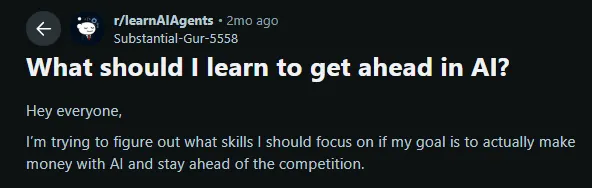
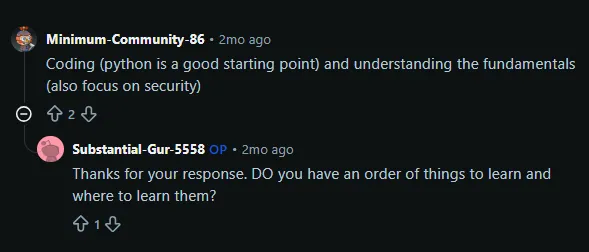
In a recent Reddit discussion about getting ahead in AI, several users recommended learning Python, APIs, databases, RAG, automation, and business workflows. The common advice was to build small, useful systems rather than trying to master every new AI model.
Which workplace skills help you succeed in an AI career?
Learning AI skills alone is not enough to build a successful career. You also need strong workplace skills to collaborate with different teams, handle pressure, solve problems, and manage difficult situations.
According to the World Economic Forum’s Future of Jobs Report 2025, 69% of employers consider analytical thinking an essential workplace skill.
Some of the key workplace skills to develop include:
- Analytical thinking
- Creative thinking
- Interpersonal skills
- Problem-solving
- Collaboration
- Leadership
- Flexibility and adaptability
- Curiosity
- Active listening
- Time management
- Decision-making
- Ethical judgement
How to improve your AI skills
Now that you know the top AI skills to learn, the next step is to build them through study and regular practice. You can start at any stage of your education or career. Focus on the skills that match the type of work you want to do.
AI training is already growing quickly in India. By August 2025, around 3.20 lakh candidates had enrolled in or completed training in AI and Big Data Analytics.
The government also offers several AI learning programmes:
- YUVAi: Helps students in Classes 8 to 12 learn AI ML skills through practical projects.
- CBSE AI courses: Offers AI as a skill module from Class VI and as a subject from Class IX.
- IndiaAI FutureSkills: Supports AI fellowships for 8,000 undergraduate students, 5,000 postgraduate students, and 500 PhD researchers.
- Data and AI Labs: Provide basic AI training in Tier 2 and Tier 3 cities.
- FutureSkills PRIME: Offers courses in AI and other emerging technologies.
You can also improve your AI skills by:
- Taking courses that match your career goal
- Earning relevant certifications
- Building projects such as AI assistants, dashboards, or prediction models
- Joining hackathons and open-source communities
- Following new tools and industry developments
Regular learning will help you build future AI skills and stay relevant.
Which industries need these AI skills?
AI is now used in almost every industry in India. Recruitment is one example. Hirist is an online job portal where professionals can find IT opportunities across India. At Hirist, we use AI-powered insights and machine learning to match job seeker profiles with the right employer requirements.
According to the Government of India’s Transforming India with AI report, industrial and automotive companies, consumer and retail businesses, banking and financial services, and healthcare together generate around 60% of AI’s total value in India.
This shows that AI skills for professionals are valuable across many industries, not only in technology companies.
Industry | Real Use Cases of AI
- Finance and banking | Axis Bank’s AHA is an AI-powered virtual assistant that answers banking queries and supports basic transactions
- Marketing and advertising | Zomato AI recommends dishes and restaurants based on customer requests and preferences
- Healthcare | The Nayanamritham programme uses AI to support diabetic eye-disease screening
- E-commerce and operations | Flipkart uses AI for product discovery and supply-chain planning
- Education | SATHEE uses AI-driven assessments to personalise exam preparation and identify learning gaps
- Agriculture | Kisan e-Mitra answers farmers’ questions about government schemes in 11 regional languages
- Defence | DRDO develops AI and machine learning solutions for intelligence analysis and cyber defence
- Recruitment | Naukri’s AI REX identifies suitable candidates and automates early-stage outreach and screening.
High-paying careers in AI in India
India has more than 1,800 Global Capability Centres, including over 500 focused on AI. This is creating opportunities in AI engineering, machine learning, data science, automation, and product development.
Here are the highest-paying AI jobs in the Indian market. The salary ranges are taken from the latest available AmbitionBox data.
| AI Role | Salary in India |
|---|---|
| AI Engineer | ₹15.5 lakh to ₹32 lakh per year |
| Machine Learning Engineer | ₹12.5 lakh to ₹29 lakh per year |
| Generative AI or LLM Engineer | ₹7 lakh to ₹35 lakh per year |
| Data Scientist | ₹15.1 lakh to ₹16.7 lakh per year |
| MLOps Engineer | Around ₹5.6 lakh to ₹23 lakh per year |
| Robotics Engineer | ₹5.2 lakh to ₹8.3 lakh per year |
| Computer Vision Engineer | ₹10.9 lakh to ₹22 lakh per year |
Find high-paying AI jobs on Hirist
The most valuable AI skills for 2026 will depend on the career you choose. You do not need to master everything at once. Start with the right AI skills to learn for your target role, build a strong technical foundation, and create practical projects that show employers what you can do.
Once you have the right AI skills and experience, visit Hirist to find high-paying AI jobs from leading startups, product companies, and technology employers across India.
FAQs
Python, machine learning, LLM development, RAG, MLOps, prompt engineering, AI automation, tool integration, and AI data analysis are among the most in-demand AI skills to learn.
Future AI skills may include AI agent development, multimodal AI, AI security, responsible AI governance, synthetic data, edge AI, and human-AI collaboration. These skills will become more important as AI systems grow more autonomous and widely used.
The main skills required for AI engineer include Python, machine learning, data handling, APIs, cloud platforms, model testing, and MLOps.
I Skills Yatra is a Microsoft initiative that helps learners build practical AI skills through simple lessons, hands-on activities, assessments, and recognized digital credentials. It covers areas such as generative AI, Microsoft Copilot, AI development, and cybersecurity.
Some technical roles require statistics, probability, linear algebra, and calculus. Most non-technical AI roles do not require advanced mathematics.