“Where do you see yourself in the next 5 years?” is a question we all expect in interviews, yet most of us still struggle to answer it well. This usually happens due to lack of preparation or choosing the wrong approach. Interviewers ask this to understand how you think about growth and whether your plans align with the role and the company. When you answer from their point of view, your response becomes more effective.
In this guide, you will learn five practical ways to answer the interview question “Where do you see yourself in the next 5 years?” along with sample answers for different career levels and ready-to-use templates.
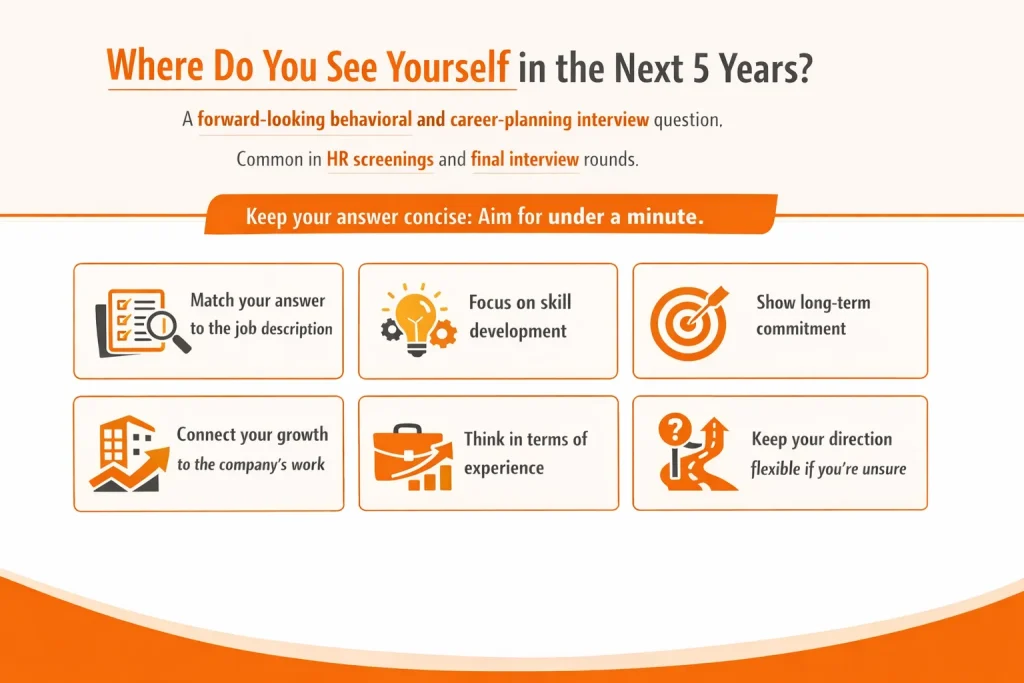
“Where do you see yourself in the next 5 years?” Best sample answer
Here is one strong sample answer to “Where do you see yourself in the next 5 years?” that works across roles and experience levels. It focuses on growth and long-term commitment without sounding rehearsed or robotic.
“Over the next five years, I want to become stronger at my work and more confident in handling responsibility. I plan to keep learning by picking up new tools relevant to my role and completing certifications that deepen my understanding. With experience, I would like to take on more meaningful work, support the team better, and gradually grow into a position where my skills and decisions add steady value.”
Why interviewers ask “Where do you see yourself in the next 5 years?”
Interviewers ask “Where do you see yourself in the next 5 years?” to understand your mindset and direction and assess whether you are the right fit for the role.
- Understand you career direction and clarity: Your response shows where you want to be in the next 5 years in terms of skills and professional growth. It helps interviewers judge whether your direction is realistic.
- Check your alignment with the role: Recruiters want to assess whether your goals match what the position and team can realistically offer.
- Know your long-term intent: This helps them understand if you plan to stay and take on more responsibility within the company.
- See your approach to skills improvement: Answers often reveal how you think about learning new skills and handling change over time.
- Check your level of maturity and planning: A structured response reflects self-awareness and practical career planning.
What interviewers are actually looking for in your answer?
When interviewers ask “Where do you want to be in the next 5 years?”, they look for a few key qualities in your response.
- Clear and logical thinking
- Realistic and honest ambition
- Openness to learning and change
- Commitment to the role
- Skill progression (not titles)
Make sure you frame your answer by keeping these points in mind. A well-structured response helps interviewers see you as someone who can grow with the role and the company.
How to answer “Where do you see yourself in the next 5 years?” (6 smart strategies)
Before answering this question, it helps to pause and think about where you want to see yourself in next 5 years in a realistic and practical way. The strategies below will help you structure your answer clearly.
- Match your answer to the job description
Start by linking your answer to the role you are applying for. Review the job description and identify the skills and responsibilities that matter most. When asked “Where do u see yourself in next 5 years?”, show how this role fits into your plans. This tells the interviewer that you understand the job and see it as a meaningful step in your career growth.
Sample answer:
“In the next few years, I want to grow stronger in the core responsibilities of this role. I see myself building deeper expertise in these areas and taking on more responsibility as I become more confident in the work.”
- Focus on skill development
Instead of talking about promotions or titles, focus on skills you want to improve. When explaining where do you see yourself in next five years, mention technical skills, problem-solving ability, or domain knowledge you want to build. This makes your answer practical and shows a learning mindset.
Sample answer:
“I want to spend the next five years improving my technical and problem-solving skills. My goal is to become someone the team can rely on for handling complex tasks and delivering consistent results.”
- Show long-term commitment
Interviewers want reassurance that you are not planning to leave quickly. While answering “Where do you see yourself in next 5 years?”, express interest in growing within the company and taking on more responsibility over time. Avoid sounding fixed or overly ambitious, and keep your tone steady and realistic.
Sample answer:
“I see myself growing within the organisation by taking on new challenges and contributing at a higher level over time. I’m interested in building a long-term career where I can add more value as I gain experience.”
A strong answer explains how your growth supports the organisation. When describing where you want to be in next 5 years, mention how you hope to contribute more to projects, teams, or outcomes that matter to the company. This shifts the focus from “me” to shared progress.
Sample answer:
“In the coming years, I want to contribute more meaningfully to the projects the company is working on. As I gain experience, I hope to support larger initiatives and help the team achieve stronger outcomes.”
Think about the kind of experience you want to gain rather than a specific role. When interviewers ask “Where do you see yourself in next five years?”, talk about handling bigger challenges or gaining exposure to new areas. This shows maturity and realistic planning.
Sample answer:
“Rather than a specific title, I focus on the kind of experience I want to gain. I see myself working on more difficult problems, collaborating across teams, and handling greater responsibility.”
It’s okay if you don’t have everything figured out. When asked “Where do you see yourself in the next few years?”, be honest but structured. Share a general direction, talk about learning and growth, and show openness to evolving with the role. This sounds genuine and thoughtful.
Sample answer:
“I have a general direction in mind, but I’m also open to learning and adapting. Over the next few years, I want to explore where I can contribute best while continuing to develop my skills.”
Also Read - Declaration in Resume: Meaning, Format & Examples
Sample Answers for Different Career Levels
Here are some of the best sample answers to the question “Where do you see yourself in the next 5 years?” for different career levels.
- Where do you see yourself in next 5 years – Student
Sample answer:
“As a student, I’m still understanding my strengths and interests. Over the next few years, I want to apply what I have learned in actual work settings, build practical skills, and gain clarity on the kind of role where I can contribute well. My goal is to become confident in my abilities and clear about the direction I want to take.”
- Where do you see yourself in next 5 years – Fresher
Sample answer:
“For me, the next five years are about building a strong foundation. I want to understand my role well, learn how teams function, and get better through day-to-day work. If I do that right, I see myself taking on more responsibility naturally and becoming someone the team can depend on.”
- Where do you see yourself in next 5 years – Experienced professional
Sample answer:
“In the next few years, I want to be known for the quality of my work. I’m aiming to take more ownership, handle situations independently, and contribute beyond my assigned tasks. I don’t have a fixed title in mind, but I do want my experience to genuinely matter to the team.”
- Where do you see yourself in 5 years – Manager
Sample answer:
“In five years, I want to be leading in a way that brings out the best in people. That means creating clarity, supporting team members when things get tough, and making decisions that balance people and results. If my team grows and performs better, I’ll know I’m doing my job right.”
- Where do you see yourself in 5 years – Project manager
Sample answer:
“In the coming years, I want to be someone who can run projects without constant firefighting. That means better planning, clearer communication, and fewer last-minute surprises. My focus is on delivering work that stakeholders trust and teams don’t feel burned out by.”
Also Read - Top 10+ Answers for Reason for Job Change
Variations of This Question
Interviewers may ask this question in different ways to understand where you want to see yourself in next 5 years and how you think about growth. Here are some common variations:
- Where do you see yourself in the next 3 years?
- Where do you see yourself in the next few years?
- Where do you see yourself going in this role?
- What are your career plans for the coming years?
Where do you see yourself heading professionally?
What does your career path look like over the next few years?
What NOT to say when answering “Where do you see yourself in next 5 years?”
When answering “Where you want to see yourself in next 5 years?”, certain responses can raise red flags. So, make sure you avoid saying these things:
- I don’t know: This can make you seem unprepared or uninterested, even if you are still figuring things out.
- I want your job: This often comes across as unrealistic or awkward, especially in early interviews.
- I’ll start my own company: Employers may hear this as a sign that you don’t plan to stay long.
- This is temporary: Saying or implying this suggests a lack of long-term interest in the role.
- I’m open to anything: This can sound vague and may suggest a lack of direction or interest in the role.
Also Read - Behavioural Interview Questions: Examples, Answers & STAR Tips
Quick answer templates you can customize in 30 seconds
Here are two simple templates you can use to shape your answer to the question “Where do you see yourself in the next 5 years?”
- Safe template: “Over the next [time period], I want to improve my skills in [key skill or area] and gain more experience through [type of work or responsibility]. My focus is on growing steadily and contributing more as I become stronger in this role.”
- Unsure-but-honest template: “I don’t have every step planned for the next [time period], but I do know I enjoy working on [area of interest] and want to keep getting better at it. I’m looking to grow through practical experience and gradually take on work where I can add more value.”
Also Read - Self Introduction for Experienced Candidates: Examples & Samples
Final interview tips to make your answer better
A good answer is important, but the way you respond shapes how it is received. These quick tips will help you stay calm and confident during the interview.
- Keep it under 60 seconds: A focused answer shows clarity and keeps the interviewer engaged.
- Speak calmly and naturally: Take a moment before answering and speak at a steady pace.
- Maintain eye contact and open body language: Look at the interviewer while speaking and keep your posture relaxed to show confidence.
- Don’t overexplain: Share enough to show direction and intent, then stop. More detail can weaken a good answer.
Also Read - Weakness in Interview: Best Examples, Tips & Answers
Wrapping up
That’s how you can answer the interview question “Where do you see yourself in the next 5 years?” It helps interviewers understand how clearly you think about your career and long-term growth. A simple and honest response often works best. Use the sample answers and templates shared above to shape your reply.
If you are actively looking for opportunities, visit Hirist, an online job portal for finding the best IT jobs in India, along with helpful interview advice.
Also Read - Answer to the Question “Why Should We Hire You for the Job?”
FAQs
Example answers usually focus on growth rather than job titles. Here are two examples: “In five years, I want to be confident in my role, trusted with important work, and contributing more through experience and consistent performance.” “Over the next five years, I see myself learning continuously, taking on greater responsibility, and adding more value to the team as I grow.”
Skills that combine technical ability with adaptability will matter most. These include problem-solving, communication, learning new tools quickly, working with data, and collaborating across teams. What is a strong answer to “Where do you see yourself in 5 years?” strong answer focuses on skill growth, learning, and contribution rather than a fixed job title. It should sound realistic, role-aligned, and honest.
Start by briefly talking about your current stage and what you want to improve or learn next. This helps your answer sound natural and well thought out. How do you answer “Where do you see yourself in 10 years?” Keep the response high-level. Talk about long-term growth, leadership, or impact without locking yourself into a specific position or outcome.
You can be honest about uncertainty while still showing direction. Focus on learning, gaining experience, and improving through the role you’re applying for.
Yes. Freshers should focus on learning and building skills, while experienced professionals can highlight ownership, impact, and deeper responsibility.
It can. A clear and thoughtful answer helps interviewers see you as someone who plans to grow with the role rather than leave quickly.
Keep it between 30 to 60 seconds. Short and clear answers leave a better impression than long explanations.
Yes. It is better to frame your growth in a way that connects with the role and the organisation, even if you are thinking long term.
The core idea can stay the same, but you should adjust it slightly based on the role, company, and experience level.