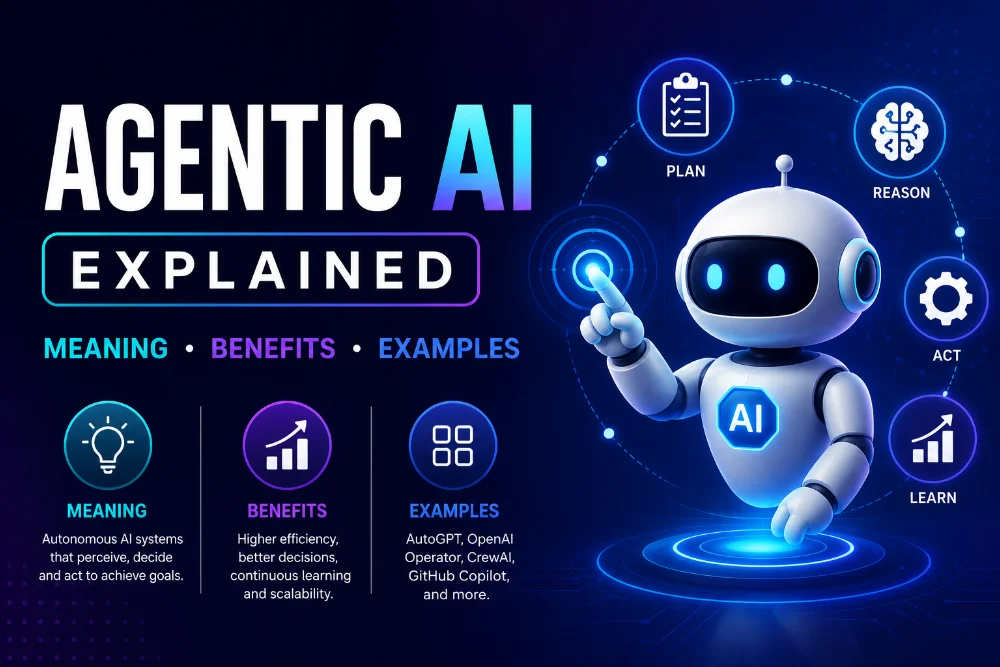
Artificial intelligence is evolving from systems that simply respond to prompts into systems that can independently plan, decide, and take action. This shift has given rise to agentic AI, a new approach that enables AI agents to complete complex tasks with minimal human intervention. Unlike traditional AI tools that generate content or answer questions, these intelligent agents can analyze information, interact with software, use external tools, and execute multi-step workflows to achieve specific goals. From customer support and software development to business operations and process automation, organizations are increasingly adopting agent-based systems to improve efficiency and decision-making. In this guide, we will explain what agentic AI is, how AI agents work, their benefits, examples, and what the future holds for this growing technology.
What Is Agentic AI?
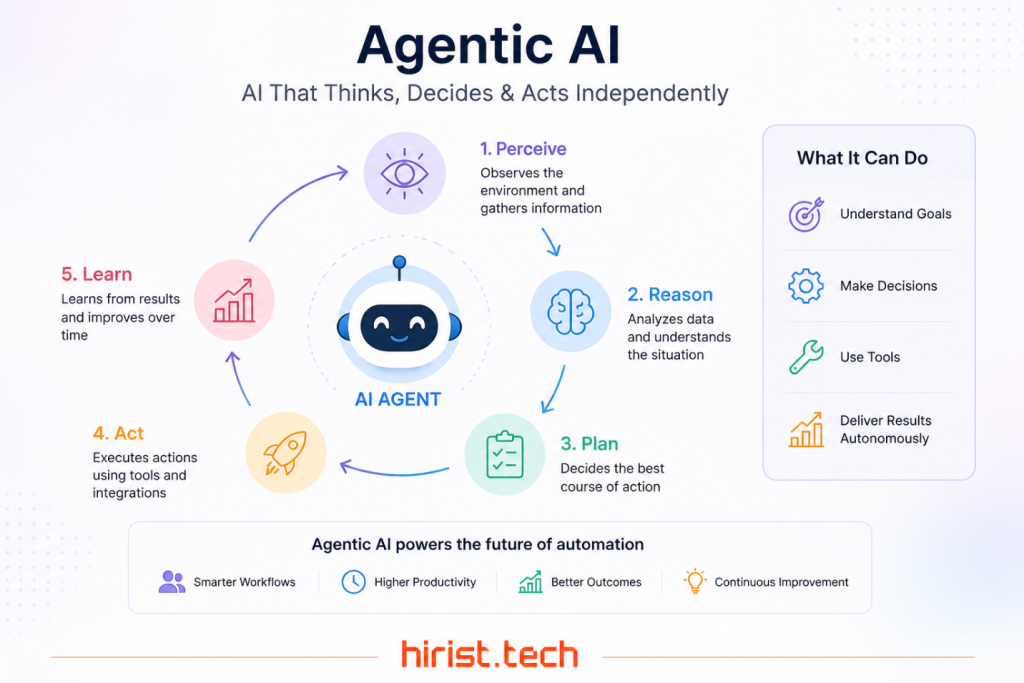
Agentic AI is a type of artificial intelligence that can independently pursue goals, make decisions, and take actions with limited human supervision. Instead of simply responding to prompts or generating content, agentic systems can analyze situations, create plans, use tools, execute tasks, and adapt their behavior based on outcomes. In simple terms, the agentic AI meaning refers to AI systems that possess a degree of autonomy and can actively work toward achieving a specific objective.
To understand what is agentic AI, it helps to compare it with earlier generations of artificial intelligence.
- Traditional AI follows predefined rules and performs specific tasks within a fixed environment. It can automate repetitive processes but struggles when conditions change or unexpected situations arise.
- Generative AI introduced a major leap by enabling machines to create text, images, code, and other content. However, these systems are largely reactive. They generate outputs when prompted but typically do not take independent action.
- Agent-based systems go a step further. Powered by autonomous AI agents, these systems can reason through problems, break complex goals into smaller tasks, interact with external tools, and continuously adjust their actions to reach a desired outcome.
Why Is It Called “Agentic”?
The term agentic comes from the word agency, which refers to the ability to make decisions and take actions independently to achieve a goal. In artificial intelligence, systems that possess this capability are known as intelligent agents.
An intelligent agent in AI is an entity that can observe its environment, process information, make decisions, and perform actions that help it achieve a specific objective. Humans use agency every day when making decisions, solving problems, and adapting to changing situations. Agentic systems aim to replicate a similar decision-making process through software.
This ability to act with purpose is what makes these systems “agentic.” Rather than waiting for continuous instructions, they can operate with a degree of autonomy, making decisions and executing tasks while staying focused on a defined outcome. As AI technology continues to evolve, agency is becoming one of the key characteristics that separates modern agentic AI from earlier generations of artificial intelligence.
What Are AI Agents?
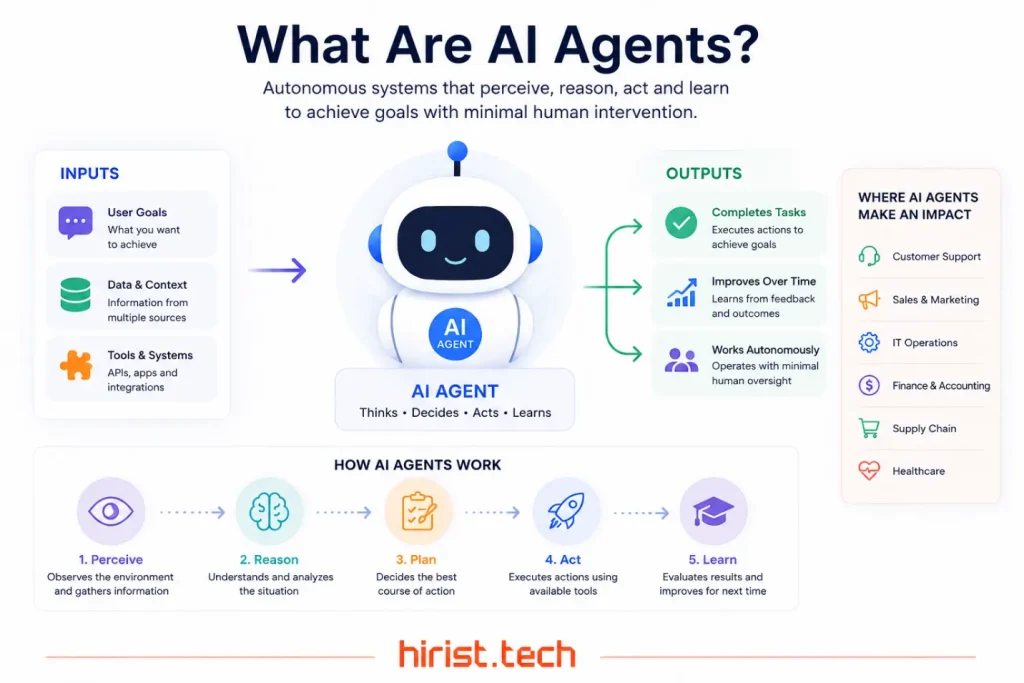
AI agents are software systems that can perceive information, make decisions, take actions, and learn from outcomes to achieve specific goals. Unlike traditional software that follows fixed instructions, agents in artificial intelligence can adapt to changing situations and determine the best course of action based on available data.
For example, an AI intelligent agent can monitor customer inquiries, analyze the context of each request, retrieve information from databases, generate responses, and take actions such as updating records or creating support tickets. This ability to move beyond simple responses and execute tasks makes AI agents a key building block of modern automation systems.
Every intelligent agent typically relies on four core capabilities:
| Component | Function |
|---|---|
| Perception | Understands and gathers information from its environment |
| Reasoning | Analyzes information and makes decisions |
| Action | Executes tasks and interacts with tools or systems |
| Learning | Improves performance through feedback and experience |
Types of Intelligent Agents in AI
Not all AI agents operate in the same way. Depending on their level of intelligence, decision-making capabilities, and ability to learn, researchers classify agents in artificial intelligence into several categories. Understanding these types helps explain how an intelligent agent in AI evolves from simple rule-following systems to advanced autonomous agents capable of complex reasoning.
1. Simple Reflex Agents
Simple reflex agents are the most basic type of intelligent agent. They respond directly to specific conditions using predefined rules without considering past experiences or future consequences.
Example: A thermostat that turns on the air conditioning when the temperature exceeds a set limit.
Best suited for: Simple, predictable environments where actions depend on immediate inputs.
2. Model-Based Agents
Model-based agents maintain an internal representation of their environment. This allows them to make decisions even when they do not have complete information about the current situation.
Example: A robotic vacuum that remembers room layouts and avoids previously detected obstacles.
Best suited for: Dynamic environments where conditions change over time.
3. Goal-Based Agents
Goal-based agents make decisions based on a desired outcome rather than following fixed rules. They evaluate different options and choose actions that move them closer to achieving a specific objective.
Example: A navigation app that calculates the fastest route to a destination based on real-time traffic conditions.
Best suited for: Complex tasks that require planning and decision-making.
4. Utility-Based Agents
Utility-based agents go beyond achieving goals by evaluating which outcome provides the greatest overall benefit. They compare multiple options and select the one with the highest expected value.
Example: An investment platform that recommends portfolios based on risk tolerance and expected returns.
Best suited for: Situations involving trade-offs, uncertainty, and optimization.
5. Learning Agents
Learning agents continuously improve their performance through experience and feedback. They analyze past actions, identify patterns, and adjust their behavior to achieve better results over time.
Example: Recommendation engines used by streaming platforms that become more accurate as they learn user preferences.
Best suited for: Environments that require adaptation and continuous improvement.
As artificial intelligence continues to advance, modern AI agents increasingly combine elements from multiple agent types. Today’s most sophisticated systems can learn from experience, pursue goals, evaluate outcomes, and adapt their behavior – making them far more capable than traditional rule-based software.
Agentic AI vs Generative AI
Although the terms are often used interchangeably, agentic AI and generative AI solve different problems.
Generative AI models are designed to generate text, images, code, audio, and other content based on user prompts. They excel at answering questions, summarizing information, and creating new content. However, they generally stop after producing an output.
Agentic AI builds on these capabilities by adding planning, reasoning, memory, and action. Instead of simply generating a response, AI agents can take the next step and execute tasks to achieve a specific goal. They can interact with external tools, access databases, communicate with software applications, and adapt their actions based on changing conditions.
| Generative AI | Agentic AI |
|---|---|
| Creates content | Completes tasks |
| Responds to prompts | Takes action toward goals |
| Typically handles single interactions | Manages multi-step workflows |
| Human-driven | Goal-driven |
| Produces outputs | Produces outcomes |
| Limited tool usage | Can use tools, APIs, and software systems |
A simple example highlights the difference. A generative AI tool such as ChatGPT can write a professional sales email when given a prompt. Once the email is generated, the process stops and a human must decide what to do next.
An agentic AI can handle the entire workflow. It can write the email, identify the right recipient, send the message, track responses, update the CRM, schedule follow-up meetings, and notify the sales team when action is required. Rather than assisting with a single task, it works toward completing the overall objective.
How Agentic AI Works
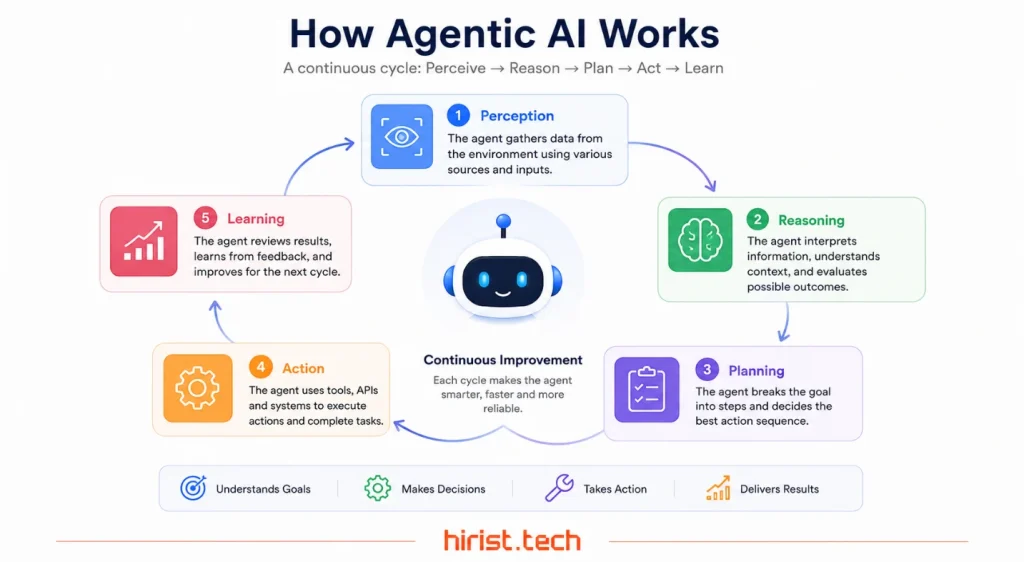
To understand how agentic AI works, it helps to look at the process as a continuous cycle. Unlike a standard chatbot that responds once and stops, autonomous AI agents move through several stages to understand a goal, decide what to do, take action, and improve based on results.
Step 1 – Perception
Perception is the first stage. The agentic AI gathers information from its environment, such as user prompts, documents, databases, websites, APIs, applications, images, or real-time system data. This allows the system to understand the current situation before making a decision.
For example, a customer service agent may read a support ticket, review the customer’s purchase history, check refund policies, and analyze previous conversations before deciding what action to take.
Step 2 – Reasoning
Once the agent collects information, it needs to interpret it. Reasoning helps the system understand context, identify patterns, evaluate possible outcomes, and decide what the information means.
This is where large language models and machine learning techniques play an important role. They help agentic AI understand instructions, compare options, detect problems, and choose a practical path forward.
Step 3 – Planning
Planning is the stage where the agent breaks a larger goal into smaller steps. Instead of completing only one isolated task, it creates a sequence of actions needed to reach the final objective.
For example, if the goal is to schedule a sales meeting, the agentic AI may need to identify the prospect, check availability, draft an email, send the message, monitor replies, and book the meeting once the prospect confirms.
Step 4 – Action
Action is what separates AI agents from simple generative AI tools. After planning the workflow, the agent uses connected tools, APIs, or software systems to execute tasks.
AI automation agents can update CRMs, send emails, generate reports, create tickets, approve routine requests, or trigger workflows across business applications. This ability to act inside software systems is what makes them useful for real-world automation.
Step 5 – Learning
The final stage is learning. After completing an action, the system reviews the outcome and uses feedback to improve future performance. It may learn which response worked best, which workflow caused delays, or which decision led to the desired result.
This feedback loop helps autonomous agentic AI become more accurate, efficient, and reliable over time. In practice, how AI agents work depends on the tools, data, memory, and guardrails connected to them, but the core cycle remains the same: perceive, reason, plan, act, and learn.
AI Agent Architecture
The effectiveness of an AI agent depends on its underlying architecture. A well-designed AI agent architecture enables the system to understand goals, process information, make decisions, interact with external tools, and improve over time. While implementations vary, most modern AI agents are built using a common set of components that work together to transform instructions into actions.
Core Components of an AI Agent Architecture
1. Large Language Model (LLM)
The LLM serves as the agent’s reasoning engine. It interprets instructions, understands context, generates responses, and helps evaluate potential actions. Models such as GPT, Claude, Gemini, and other advanced language models provide the intelligence that powers decision-making.
2. Memory
Memory allows the agent to retain information and context. Short-term memory helps track ongoing tasks and conversations, while long-term memory stores historical interactions, preferences, and knowledge that can be used in future decisions.
3. Tools
Tools extend the capabilities of AI agents beyond text generation. These may include APIs, databases, CRMs, search engines, email platforms, calendars, and business applications. Through tool integration, agents can retrieve information and perform real-world actions.
4. Planning Engine
The planning engine breaks large objectives into smaller, manageable tasks. Instead of attempting to solve a problem in a single step, it creates a structured workflow that guides the agent toward achieving the desired outcome.
5. Feedback Loop
The feedback loop allows the system to evaluate results and improve performance over time. By analyzing outcomes and learning from successes or failures, the agent becomes more accurate and efficient with continued use.
How These Components Work Together
A typical AI agent architecture follows a continuous workflow:
Input → Reasoning → Planning → Tools → Action → Memory
- Input: The agent receives a goal, instruction, or data.
- Reasoning: The LLM interprets the request and understands the context.
- Planning: The system determines the steps required to achieve the goal.
- Tools: The agent accesses external systems and information sources.
- Action: Tasks are executed based on the plan.
- Memory: Outcomes and context are stored for future use.
This architecture enables modern AI agents to move beyond simple conversations and perform complex, multi-step tasks autonomously. As agent-based systems continue to evolve, advancements in memory, planning, and tool integration will make them even more capable of handling sophisticated business workflows and decision-making processes.
Single-Agent vs Multi-Agent Systems
AI agents can operate individually or as part of a collaborative system. The choice depends on the complexity of the task and the level of automation required.
A single-agent system uses one AI model to manage an entire workflow. It handles reasoning, planning, and execution on its own, making it suitable for straightforward tasks and smaller workflows.
A multi-agent system uses multiple specialized agents that work together to achieve a common goal. Each agent focuses on a specific responsibility, such as research, analysis, planning, or execution, allowing the system to handle more complex processes efficiently.
| Single Agent | Multi-Agent |
|---|---|
| Simpler | More scalable |
| One model | Multiple specialists |
| Easier to manage | Better for complex workflows |
| Suitable for simple tasks | Handles large, multi-step processes |
For example, a single AI agent might generate a report from a prompt. In contrast, a team of autonomous AI agents could gather data, analyze findings, create visuals, review accuracy, and produce the final report collaboratively.
What Are Agentic Workflows?
Traditional automation focuses on completing individual tasks. In contrast, agentic workflows focus on achieving outcomes. Instead of automating one step in a process, agentic AI can manage an entire workflow from start to finish with minimal human involvement.
For example, in lead generation, an agent can perform multiple tasks automatically:
Research → Qualification → Outreach → Follow-Up
Rather than requiring separate tools or manual handoffs, the system continuously works toward the final goal of generating and nurturing qualified leads. This makes AI workflow automation more intelligent, flexible, and scalable than traditional rule-based automation.
What Is AI Orchestration?
As organizations deploy multiple AI agents, coordination becomes essential. AI orchestration is the process of managing how different agents, tools, and systems work together to complete a workflow.
Think of it like an orchestra. Individual musicians may be highly skilled, but they need a conductor to ensure everyone performs in sync. Similarly, an AI orchestration platform coordinates multiple agents, assigns tasks, manages information flow, and ensures all actions contribute to the desired outcome.
Benefits of Agentic AI
The growing interest in agentic systems is driven by their ability to move beyond simple task automation and handle complex workflows independently. As a result, businesses are using agent-based systems to improve efficiency, reduce costs, and scale operations more effectively.
1. Greater Automation
Traditional automation works well for repetitive tasks with predictable outcomes, but it often struggles when unexpected situations arise. Agentic AI can understand context, make decisions, and adapt to changing conditions. This allows organizations to automate entire workflows rather than individual tasks, reducing the need for constant human supervision and increasing operational efficiency.
2. Faster Decision-Making
Modern businesses generate enormous amounts of data every day. Agentic AI can process information from multiple sources, identify patterns, and evaluate options within seconds. By providing recommendations or taking action automatically, they help organizations make faster and more informed decisions in areas such as sales, customer service, operations, and finance.
3. Reduced Operational Costs
One of the most significant benefits of agentic AI is its ability to reduce manual effort. By automating repetitive tasks, minimizing human errors, and streamlining workflows, businesses can lower operational costs while improving productivity. Teams can spend less time on routine work and focus more on strategic initiatives that drive growth.
4. 24/7 Execution
Unlike human employees, agentic AI does not require breaks, shifts, or downtime. They can monitor systems, respond to customer requests, process transactions, and execute workflows around the clock. This continuous availability helps organizations maintain service quality, improve responsiveness, and support global operations across different time zones.
5. Scalable Workflows
As business demands increase, scaling manual processes often requires additional staff and resources. Agent-based systems can scale much more efficiently. Organizations can deploy multiple agents to handle larger workloads without significantly increasing costs, making AI process automation a practical solution for growing businesses.
6. Better Customer Experiences
Customers increasingly expect fast, personalized, and accurate interactions. AI agents can analyze customer data, understand intent, and provide tailored responses in real time. They can also proactively resolve issues, recommend products, and automate support processes, creating smoother and more satisfying customer experiences.
7. Continuous Learning and Improvement
Unlike traditional software that follows fixed instructions, agentic AI can improve over time through feedback and experience. By learning from past interactions and outcomes, they become more accurate, efficient, and effective. This ability to continuously optimize performance makes agentic systems a valuable long-term investment for organizations pursuing AI business automation initiatives.
AI Agents Examples Across Industries
The adoption of agentic AI is accelerating across industries as organizations look for smarter ways to automate workflows, improve decision-making, and increase efficiency. These real-world examples of AI agents demonstrate how autonomous systems can perform tasks that previously required significant human involvement.
Customer Support Agents
Customer support agents can answer queries, resolve common issues, process refunds, update customer records, and escalate complex cases when needed. By operating 24/7, they help businesses reduce response times while improving customer satisfaction.
Sales Prospecting Agents
Sales agents can identify potential leads, gather company information, qualify prospects, personalize outreach messages, schedule meetings, and track follow-ups. This allows sales teams to spend more time closing deals and less time on manual research.
Healthcare Agents
Healthcare agents assist with appointment scheduling, patient monitoring, medical documentation, and treatment recommendations. They help reduce administrative workloads and enable healthcare professionals to focus more on patient care.
Cybersecurity Agents
Cybersecurity agents continuously monitor networks, detect suspicious activity, identify vulnerabilities, and respond to threats in real time. Their ability to analyze large volumes of security data makes them valuable for protecting digital infrastructure.
Financial Trading Agents
Financial institutions use AI agents to analyze market conditions, evaluate risk, identify trading opportunities, and execute transactions automatically. These systems can process market data much faster than human analysts.
Supply Chain Agents
Supply chain agents monitor inventory levels, forecast demand, identify bottlenecks, and coordinate with suppliers to maintain optimal stock levels. This improves operational efficiency and reduces disruptions.
Autonomous Vehicle Agents
Among the most advanced examples of AI agents are self-driving vehicles. These autonomous AI agents process sensor data, interpret road conditions, make navigation decisions, and react to changing environments in real time to improve safety and efficiency.
Best AI Agent Tools and Platforms in 2026
As interest in agent-based systems continues to grow, a wide range of AI agent platforms and frameworks have emerged to help developers and businesses build, deploy, and manage intelligent agents. The right platform depends on your use case, technical requirements, and scalability needs.
| Platform | Best For |
|---|---|
| OpenAI Agents | General-purpose agents |
| LangGraph | Multi-agent systems |
| CrewAI | Agent collaboration |
| AutoGen | Multi-agent workflows |
| n8n | Workflow automation |
| Microsoft Copilot Studio | Enterprise automation |
- OpenAI Agents – Ideal for building general-purpose AI assistants and task automation workflows.
- LangGraph – Designed for creating complex, stateful, multi-agent systems.
- CrewAI – Enables specialized agents to collaborate on shared objectives.
- AutoGen – Supports communication and coordination between multiple AI agents.
- n8n – Combines AI capabilities with no-code workflow automation.
- Microsoft Copilot Studio – Enterprise-focused platform for building AI-powered business solutions.
These platforms provide the foundation for developing everything from simple AI assistants to sophisticated multi-agent systems.
How to Build AI Agents
Building an AI agent involves combining intelligence, memory, tools, and automation into a system that can achieve a specific goal. While the implementation varies by use case, most projects follow a similar process.
- Define the Objective: Start by identifying the problem the agent will solve. Clear goals help determine the agent’s responsibilities, required data, and success metrics.
- Choose a Model: Select a suitable language model based on your requirements for reasoning, performance, cost, and scalability.
- Add Memory: Memory enables the agent to retain context, recall previous interactions, and make better decisions over time.
- Connect Tools: Integrate APIs, databases, CRMs, search engines, or business applications so the agent can access information and perform actions.
- Create the Workflow: Design how the agent will reason, plan, make decisions, and execute tasks. This is where an AI agent framework such as LangGraph, CrewAI, or AutoGen can help simplify development.
- Deploy and Monitor: Deploy the agent in a real environment, track performance, monitor outcomes, and continuously optimize workflows based on feedback.
Challenges of Agentic Systems
While agentic AI offers significant benefits, it also introduces new risks that organizations must address before deploying AI agents at scale.
- Hallucinations: AI agents can sometimes generate incorrect information or make decisions based on inaccurate assumptions. If these errors go undetected, they can affect business outcomes and customer experiences.
- Security: Because AI agents often access sensitive data and business systems, they can become targets for cyberattacks, unauthorized access, or data breaches if proper safeguards are not in place.
- Governance: Organizations need clear rules around how agents operate, what decisions they can make, and who is accountable for their actions. Strong governance frameworks help reduce operational risks.
- Compliance: AI systems must comply with industry regulations and data privacy requirements. Businesses need to ensure agents handle customer and organizational data responsibly.
- Runaway Actions: Autonomous agents may occasionally pursue goals in unintended ways, especially if objectives or guardrails are poorly defined. This can lead to inefficient or undesirable outcomes.
- Human Oversight: Despite their growing capabilities, AI agents should not operate entirely without supervision. Human oversight remains essential for reviewing critical decisions, managing exceptions, and ensuring alignment with business objectives.
Future of Agentic AI
The future of agentic AI extends far beyond individual assistants and task automation. As the technology matures, AI agents will become more collaborative, autonomous, and deeply integrated into everyday business operations.
Several emerging trends are shaping the next generation of intelligent systems:
- Multi-Agent Ecosystems: Specialized agents will work together to solve complex problems, with each agent handling a specific role or responsibility.
- AI Coworkers: AI agents will increasingly function as digital teammates, assisting employees with research, analysis, planning, and execution.
- Autonomous Enterprises: Organizations will automate entire business processes, enabling systems to operate with minimal human intervention.
- Agent-to-Agent Communication: Agents will exchange information, coordinate tasks, and make decisions collectively to improve efficiency and outcomes.
- AI Operating Systems: New platforms will emerge to manage, orchestrate, and govern large networks of AI agents across organizations.
- Digital Workforces: Businesses will deploy teams of AI agents that can work alongside human employees, scaling operations without proportional increases in headcount.
Also Read - Top 45+ Artificial Intelligence (AI) Interview Questions and Answers
Wrapping Up
Agentic AI represents a major shift from AI that simply generates content to AI that can plan, decide, and take action. As AI agents become more capable, they will transform how businesses automate workflows, improve productivity, and scale operations. For technology professionals looking to build careers in this fast-growing field, staying ahead of emerging AI trends is essential.
Looking for opportunities in AI, machine learning, data science, or software development? Explore Hirist, one of India’s leading online job portals, to discover the best IT jobs and connect with top technology employers across the country.
FAQs
No. Agentic AI and Artificial General Intelligence (AGI) are different concepts. Agentic AI can independently pursue goals and complete tasks within a defined scope, while AGI refers to a hypothetical form of AI that can perform any intellectual task at a human level across multiple domains.
Yes. Many agentic AI platforms now offer no-code and low-code solutions that make it easier for startups and small businesses to automate customer support, lead generation, scheduling, reporting, and other operational tasks without large development teams.
AI agents are being adopted across industries, including healthcare, finance, retail, cybersecurity, logistics, manufacturing, and software development. Any industry with repetitive processes, large datasets, or complex workflows can benefit from agent-based automation.
While modern agentic AI can operate autonomously, human oversight is still important. Organizations typically implement guardrails, approval workflows, and monitoring systems to ensure agents act responsibly and align with business objectives.
Agentic AI is more likely to automate repetitive and administrative tasks than replace entire roles. As adoption grows, many professionals will shift toward higher-value activities such as strategy, creativity, problem-solving, and managing AI-powered systems.