Commvault is a well-known data protection and information management software company founded in 1988 by Bell Labs researchers. It started as a small project and grew into a global leader trusted by many enterprises. The company is based in New Jersey and offers solutions for backup, recovery, cloud data, and disaster management. Over the years, Commvault has created many roles for IT professionals, from administrators and engineers to consultants and architects. If you are aiming for such jobs, preparing with the right Commvault interview questions can give you a strong advantage. In this blog, we cover the top 20+ Commvault interview questions and answers to help you get ready.
Fun Fact: Commvault serves more than 100,000 organizations worldwide.
Understanding the Commvault Interview Process
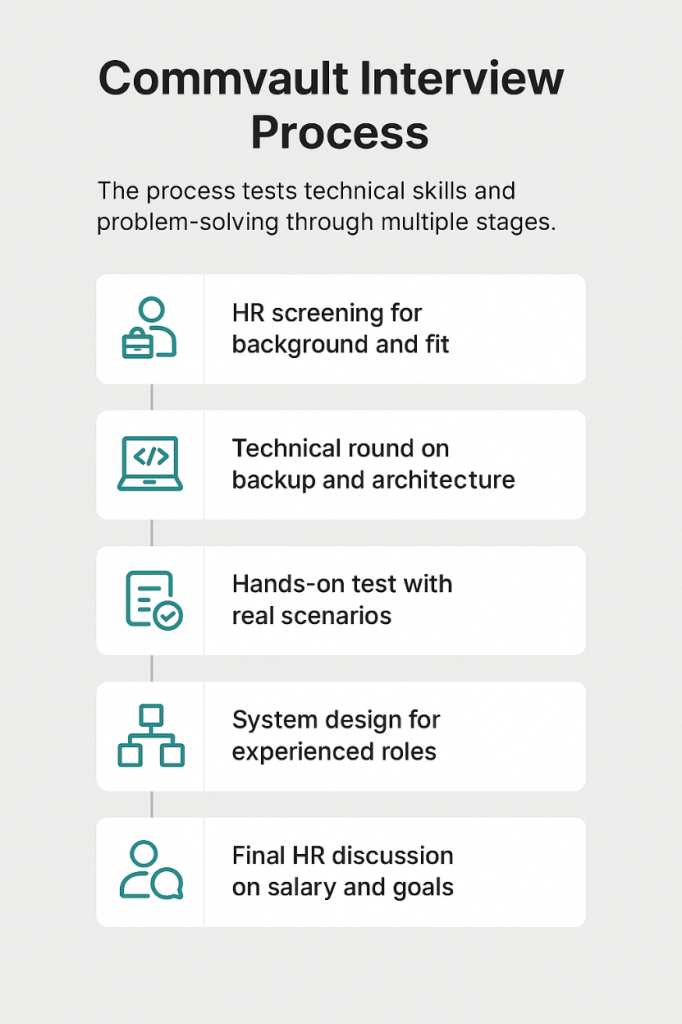
The Commvault interview process evaluates both technical expertise and problem-solving ability through structured rounds.
- Initial screening round with HR to check background and role fit
- Technical interview covering backup concepts, Commvault architecture, and troubleshooting
- Practical assessment or hands-on test on real backup and restore scenarios
- System design or advanced discussion for experienced roles
- Final HR round to discuss salary, career goals, and organizational fit
Commvault Interview Experience
Candidates often share that the interview is practical, detailed, and highly focused on real-world knowledge.
- Questions are usually scenario-based rather than just theory
- Interviewers expect clear explanations with step-by-step reasoning
- Hands-on tasks are common, especially for admin roles
- Experienced candidates face deep dives into architecture and disaster recovery
- Overall, candidates find the process fair and skill-focused with opportunities to explain practical experience
Commvault Interview Questions for Freshers
Here are Commvault interview questions and answers that will help freshers prepare effectively for their first job role.
- What is Commvault and how do CommServe, MediaAgent, Clients, and Console interact?
Commvault is a modern data protection and management platform that provides backup, recovery, archiving, replication, and cloud solutions for enterprises to secure and manage information.
- CommServe is the central server that controls operations.
- MediaAgent moves and stores data to disk, tape, or cloud.
- Clients are machines or applications where agents are installed.
- The Console or Command Center is the interface used to manage and monitor everything.
Together, they create a complete environment for backup and recovery.
- How does deduplication work in Commvault?
Deduplication removes duplicate data blocks. When data is written, a unique signature is created. The Deduplication Database (DDB) stores these signatures. If a block already exists, only a reference is saved, not the full data. Old blocks not needed by retention policies are pruned automatically.
- Which backup types does Commvault support?
It supports full, incremental, and differential backups. Synthetic full creates a new full backup from earlier backups without reading the client again. Block-level and application-aware backups are also supported for efficiency and consistency.
- What is a storage policy vs a copy in Commvault?
A storage policy defines how data is stored, protected, and retained. Within it, copies define where backups are written. Primary copies hold original backup data. Secondary copies like selective, synchronous, or IntelliSnap keep additional recoverable versions.
| Aspect | Storage Policy | Copy |
| Definition | A set of rules for storing, protecting, and retaining data. | Defines where backup data is written within a storage policy. |
| Purpose | Manages overall data lifecycle and retention policies. | Provides redundancy and recovery options beyond the primary backup. |
| Types | Only one storage policy per subclient. | Primary Copy (original data), Secondary Copies (Selective, Synchronous, IntelliSnap). |
| Scope | Governs all data handling for a subclient. | Focuses on backup placement and recovery availability. |
- How do VMware backups work using SAN, HotAdd, and NBD modes?
VMware backups use the VSA proxy. SAN mode reads directly from Fibre Channel or iSCSI storage. HotAdd attaches virtual disks to the proxy VM for backup. NBD and NBDSSL use the network to move data when SAN or HotAdd isn’t possible.
- How do you perform a basic restore using Commvault?
From Command Center, I pick the client and subclient. I choose the data or VM to restore. Then I select the destination path, recovery type, and start the job.
- What is Commvault Cloud / SaaS backup and when is it used?
Metallic is Commvault’s SaaS backup. It is used for Microsoft 365, Salesforce, endpoints, hybrid workloads, VMs, and databases (added in 2024–2025). Companies choose it when they want cloud-delivered protection without maintaining infrastructure.
Commvault Interview Questions for Experienced
Here are Commvault interview questions and answers for experienced professionals to help you tackle advanced concepts.
- How would you design a backup architecture with immutable storage and air-gapped copies?
I would start with a storage policy that includes immutable cloud or object storage with WORM or object lock. Then I would create secondary copies in an air-gapped library, often cloud or tape, isolated from the production network. This setup keeps a clean copy safe from tampering or ransomware.
- Walk me through how you investigate a failed backup job.
First, I check job details in the CommCell Console or Command Center. Then I review logs for errors, like connectivity or VSS failures. I confirm client services are running, storage paths are online, and space is available. If needed, I run a test backup or restart services to validate the fix.
- How would you rebuild a DDB (deduplication database) after corruption or when scaling out?
If a DDB is corrupted, I restore it from the DDB backup. For scaling, I create a new DDB partition and re-associate subclients to it. Seeding or auxiliary copy helps redistribute data safely. Regular DDB backups make recovery faster and less risky.
- When would you choose HyperScale vs scale-out appliances in a large deployment?
I use HyperScale X when I want integrated compute, storage, and Commvault software in one scale-out appliance. For enterprises with mixed vendor hardware, I might choose a reference architecture with separate scale-out storage. The decision depends on cost, growth, and management preference.
- How do you protect containerized workloads using Commvault?
Commvault provides a Kubernetes agent that integrates with CSI snapshots. It captures persistent volumes and application metadata. Protection is policy-driven and supports namespace, cluster, or app-level recovery. This is critical for stateful workloads in modern clusters.
- How do you build ransomware recovery plans using cleanroom recovery workflows?
I configure secondary immutable copies, then use Commvault Cleanroom Recovery to bring up workloads in an isolated environment. Here, data is scanned for malware before being restored into production. Orchestration helps automate steps like network isolation, VM spin-up, and validation. This way, recovery is clean and faster after an attack.
Bonus: Commvault L2 Interview Questions
If you are preparing for experienced roles, here are Commvault L2 interview questions to sharpen your knowledge and boost your chances.
- What are the steps to restore CommServe in disaster recovery mode on new hardware?
- How do you restore or rebuild content indexes without blocking restores?
- How do you migrate or expand a DDB safely without causing data loss or long downtime?
- What operations would you perform post-DR restore to validate system health?
- How do you monitor and tune deduplication performance?
Advanced Commvault Backup Interview Questions
Let’s go through Commvault backup interview questions and answers that cover advanced concepts to help you handle complex backup and recovery scenarios.
- How does IntelliSnap backup copy work under the hood?
IntelliSnap creates hardware snapshots of volumes and then manages them through Commvault policies. In inline mode, snapshot data is copied to backup storage during the original job itself, which means the copy completes alongside the snapshot. Offline mode defers the copy, so the snapshot is first taken and then transferred later. Inline is faster for immediate availability, while offline reduces job window pressure.
- How does encryption affect compression and media write performance?
Encryption randomizes data, which lowers the effectiveness of compression. This means media write speeds drop compared to non-encrypted data. In software encryption, CPU usage also increases, often causing a 40–50% performance impact on backup throughput. Deduplicated data is less affected, since only unique blocks are encrypted.
- What events occur internally during a DDB backup?
When a DDB backup runs, Commvault suspends activity on the active DDB briefly. All in-memory data is committed, and a snapshot is taken using VSS on Windows or LVM on Linux. Once the snapshot is created, normal operations resume. The snapshot copy is then backed up to protect the DDB.
- What is synthetic full backup and how does it differ from normal full backup?
A synthetic full combines existing full and incremental backups into a new full copy without re-reading client data. This saves client resources and network time. A normal full, by contrast, rereads all data directly from the client system.
Commvault Technical Interview Questions
These are some technical Commvault interview questions that are often asked for roles requiring deep system knowledge.
- Explain storage policy internals.
A storage policy defines how data is written and retained. Streaming moves data from the client to MediaAgent. Multiplexing allows multiple data streams to a target device, improving efficiency but sometimes slowing restores. Retention rules control data pruning. Block mapping supports deduplication and optimized restores.
- What is the difference between a snapshot and a clone in virtualization / storage terms?
Snapshot (Commvault IntelliSnap or VMware): A point-in-time image that captures changes from that moment onward. Lightweight, fast to create, and used for quick rollbacks or DR.
Clone: A full independent copy of the VM or volume. It consumes more space but is useful for testing, migration, or permanent recovery copies.
- How is a proxy server used in backup copy operations?
In proxy-based operations, the snapshot is mounted to a proxy server instead of the production system. The proxy reads data and writes it to the backup copy. This reduces the load on the production environment and speeds up secondary copies.
- What is a silo in Commvault and why is it used?
A silo is a collection of disk volume folders tied to the Deduplication Database (DDB). It stores deduplicated blocks and helps organize storage at scale, supporting performance and stability for large environments.
Also Read - Top 30+ VMware Interview Questions and Answers
Commvault MCQs
Here are some Commvault MCQs to test your knowledge and quick thinking during interview preparation.
- What is the default block size for deduplicated storage in Commvault?
a) 64 KB
b) 128 KB
c) 256 KB
d) 512 KB
Answer: b) 128 KB (default, though 64 KB is also supported in newer versions).
- Which of these is not a valid copy type in Commvault?
a) Selective Copy
b) Inline Copy
c) Synchronous Copy
d) Asynchronous Copy
Answer: d) Asynchronous Copy
- How much performance impact is typical with software encryption during backup?
a) 5–10%
b) 15–25%
c) 40–50%
d) 70–80%
Answer: c) 40–50%
- Where are passphrases stored in Commvault?
a) Storage Policy
b) CommServe Database
c) Job Manager
d) Passphrases are not stored
Answer: d) Passphrases are not stored
- Which transport mode is not valid for VMware backup?
a) SAN
b) HotAdd
c) NBD / NBDSSL
d) WAN
Answer: d) WAN
Tips to Prepare for Commvault Interview
Here are the tips you can follow when preparing for Commvault interview:
- Revise CommServe, MediaAgent, Clients, and CommCell basics
- Practice creating storage policies and copies
- Understand deduplication and DDB rebuild steps
- Prepare VMware, SQL, and cloud backup scenarios
- Review encryption impact on performance
- Learn recovery workflows including snapshots and synthetic backups
- Be ready to discuss ransomware recovery and immutable storage
- Practice explaining troubleshooting steps clearly
Wrapping Up
With these 20+ Commvault interview questions and answers, you now have a solid base to prepare with confidence. Focus on concepts, practice real scenarios, and stay updated on the latest features. This will help you stand out in interviews.
If you are looking for IT opportunities, visit Hirist where you can find Commvault jobs and other tech jobs.
FAQs
For SDE roles, Commvault often checks coding ability, algorithms, and handling of system-level problems.
Write code to check if a string has balanced brackets.
How would you design a concurrent file backup system?
Explain how you would optimize memory usage in a data-heavy process.
Write a program to find the longest common prefix in an array of strings.
How would you detect and recover from deadlocks in multithreaded applications?
How would you design a database schema for tracking backup jobs?
What are the trade-offs between SQL and NoSQL for Commvault workloads?
Explain how you would implement data deduplication in storage systems.
How do you handle consistency and availability in distributed backups?
Write code to schedule and retry failed jobs with exponential backoff.
You can find Commvault backup administrator interview questions and answers right here, where we have listed the most commonly asked ones with clear explanations. You can also explore more Commvault interview experiences and Q&As on AmbitionBox, where candidates share insights from their actual interviews.
As per AmbitionBox, the average annual salary for a Commvault Backup Administrator in India is ₹6.6 Lakhs. Professionals earn between ₹3.4 Lakhs to ₹12 Lakhs per year. The typical monthly in-hand salary falls around ₹45,000 – ₹46,000.
Commvault Backup Administrator Salary in India
| Detail | Information |
|---|---|
| Based on | 337 salaries |
| Updated | 20 Sep 2025 |
| Experience Range | 2 – 8 years |
| Annual Salary Range | ₹3.4 Lakhs – ₹12 Lakhs |
| Avg. Annual Salary | ₹6.6 Lakhs |
| Monthly In-hand Salary | ₹45,000 – ₹46,000 |
| Salary Indicator | Salary of majority employees |
Commvault Backup Administrator Salary by Experience
| Experience | Average Annual Salary |
|---|---|
| 2 years | ₹4.3 Lakhs per year |
| 3 years | ₹5.6 Lakhs per year |
| 4 years | ₹6.0 Lakhs per year |
| 5 years | ₹7.5 Lakhs per year |
Commvault Backup Administrator Salary by Location
| Location | Average Annual Salary |
|---|---|
| Commvault Backup Administrator Salary in Noida | ₹7.5 Lakhs per year |
| Commvault Backup Administrator Salary in Chennai | ₹7.2 Lakhs per year |
| Commvault Backup Administrator Salary in Pune | ₹6.9 Lakhs per year |
| Commvault Backup Administrator Salary in Hyderabad / Secunderabad | ₹6.8 Lakhs per year |
| Commvault Backup Administrator Salary in Bangalore / Bengaluru | ₹6.7 Lakhs per year |
Commvault Backup Administrator Salary by Company
| Company | Average Annual Salary |
|---|---|
| HCLTech Commvault Backup Administrator Salary | ₹6.9 Lakhs per year |
| Accenture Commvault Backup Administrator Salary | ₹6.1 Lakhs per year |
| Wipro Commvault Backup Administrator Salary | ₹5.6 Lakhs per year |
| TCS Commvault Backup Administrator Salary | ₹4.6 Lakhs per year |
Leading firms like Wipro, HCLTech, Accenture, Capgemini, TCS, and DXC Technology actively hire professionals skilled in Commvault.