Prompt engineering is the skill of writing clear instructions that help AI tools give useful answers. Its roots go back to early human-computer conversation research in the 1960s. It does not have one founder. The field grew with large language models as people started using AI for writing, coding, research, customer support, marketing and automation. This created roles like prompt engineer, AI content specialist, chatbot designer, and LLM tester. If you are applying for any of these roles, interviewers may test how well you understand prompts and their practical use. That is why we have created this article. It includes 33 commonly asked prompt engineering interview questions and answers for freshers and experienced candidates, along with helpful MCQs and practical preparation tips.
Fun Fact: ELIZA was one of the first chatbots created at MIT in the 1960s. It gave replies based on the words users typed. This simple idea connects with prompt engineering because the way we write instructions can affect an AI response.
How Prompt Engineering Is Tested in Interviews
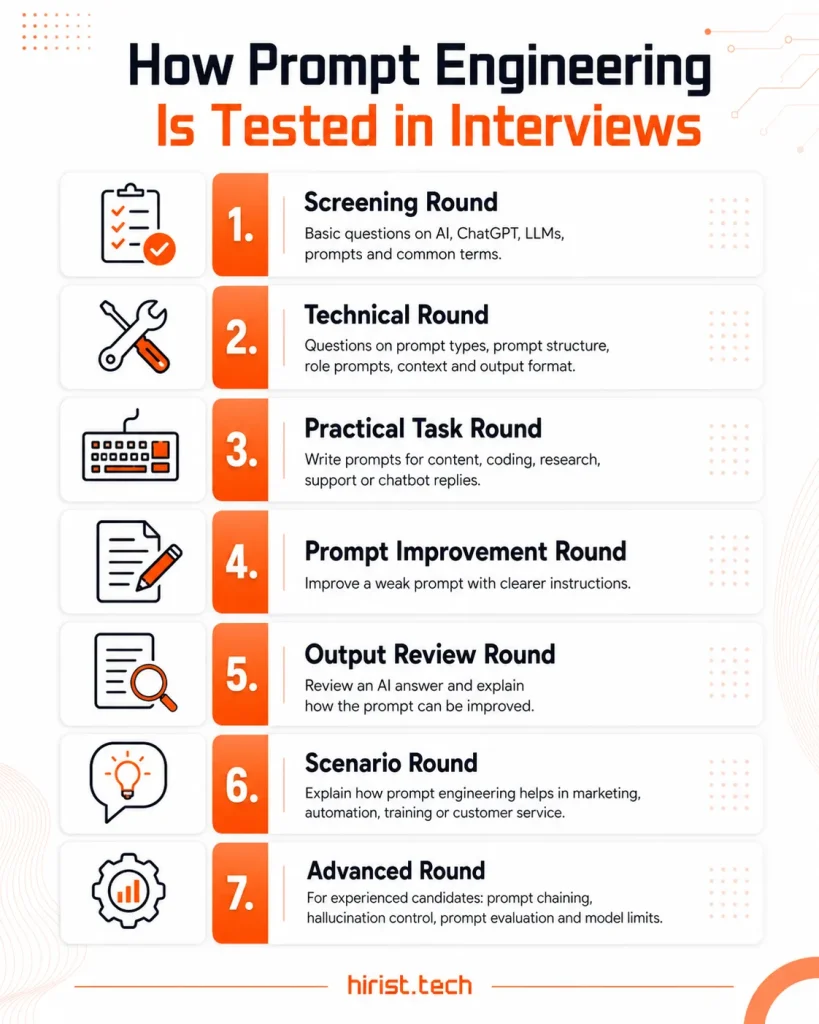
Prompt engineering is not always a separate interview round. It is often tested as part of interviews for AI, content, chatbot, automation, marketing and development roles. The interview usually checks how clearly you can guide AI tools with quality prompts.
Here is what you can expect:
- Screening Round: Basic questions on AI, ChatGPT, LLMs, prompts and common terms.
- Technical Round: Questions on prompt types, prompt structure, role prompts, context and output format.
- Practical Task Round: You may need to write prompts for content, coding, research, support or chatbot replies.
- Prompt Improvement Round: You may get a weak prompt and improve it with clearer instructions.
- Output Review Round: You may review an AI answer and explain how the prompt can be improved.
- Scenario Round: You may explain how prompt engineering can help in marketing, automation, training or customer service.
- Advanced Round: Experienced candidates may face questions on prompt chaining, hallucination control, prompt evaluation and model limits.
Basic Prompt Engineering Interview Questions
Here are the basic prompt engineering interview questions for freshers and beginners. These questions are usually asked in the screening round or at the start of the interview. They cover simple topics like prompts, LLMs, ChatGPT, AI responses, prompt structure and common terms.
- What is prompt engineering and why is it important when working with large language models?
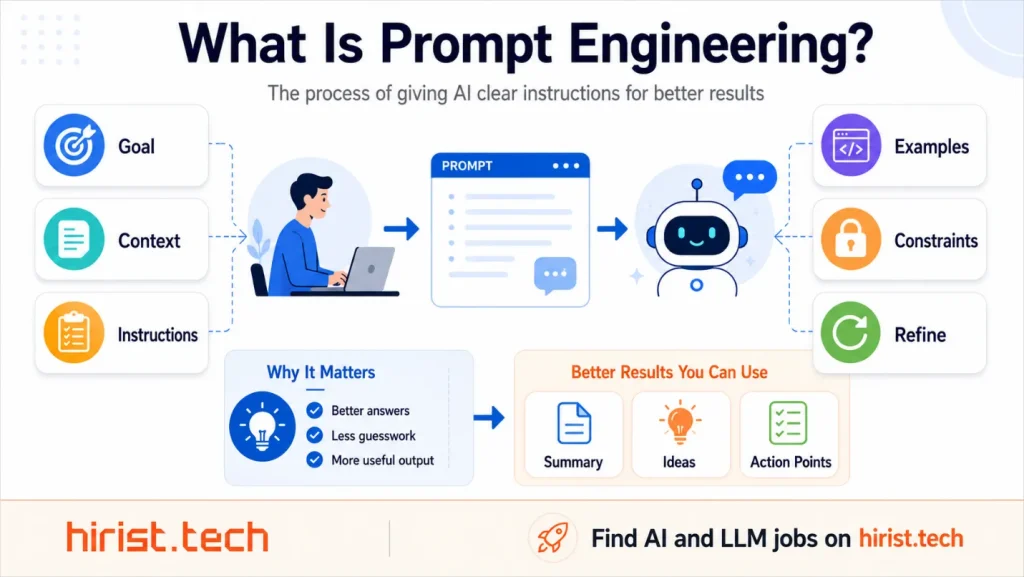
Prompt engineering is the process of writing and improving instructions for AI models. It helps large language models give answers that match the task, context and expected format. It is important because the prompt directly affects the output. A poor prompt can give vague answers. A clear prompt can guide the model toward a more useful response.
- What is a prompt in an AI model?
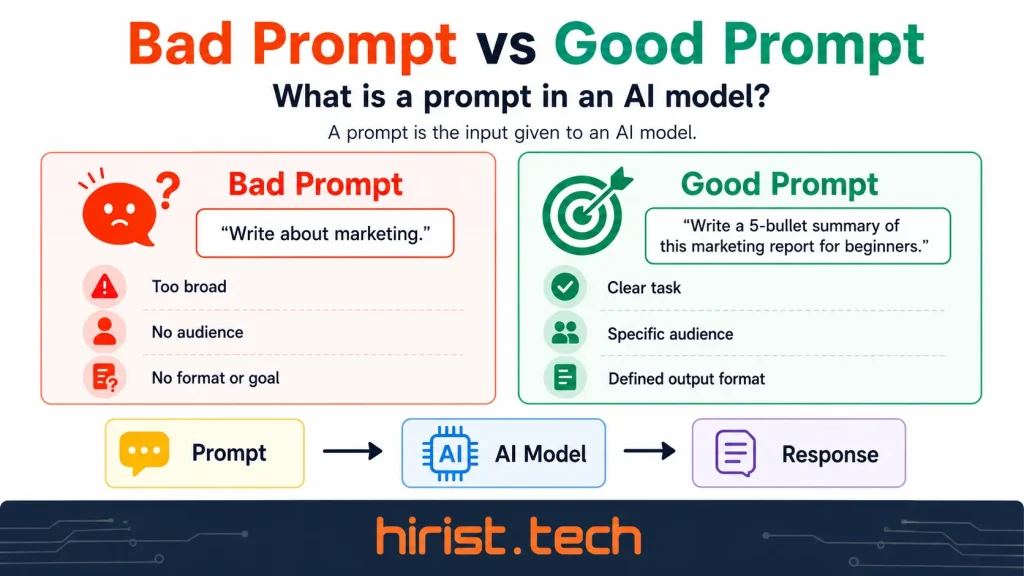
A prompt is the input given to an AI model. It can be a question, command, topic, document, example or task instruction. For example, “Summarize this report in five bullet points” is a prompt. The model reads the input and generates a response based on it.
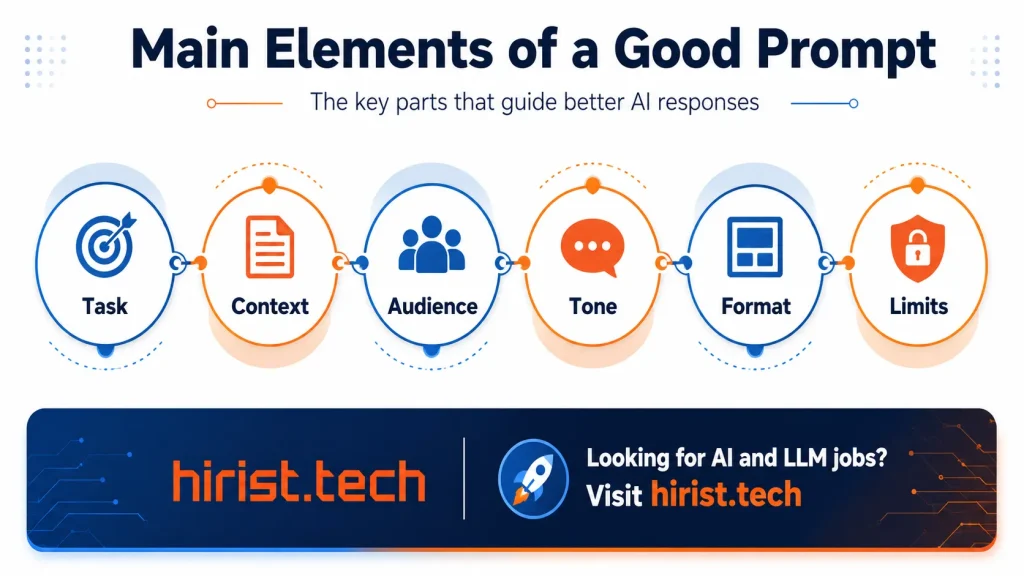
- What are the main elements of a good prompt?
A good prompt usually includes:
- Task: What the AI should do
- Context: Background details
- Audience: Who the answer is for
- Tone: Formal, simple, friendly or technical
- Format: Paragraphs, bullets, table or JSON
- Limits: Word count, length or output rules
These details reduce confusion and help the model produce a cleaner answer.
- How does prompt engineering guide the response of an AI model?
Large language models predict the next words based on the input they receive. They do not understand intent like humans. Prompt engineering gives the model stronger signals. It narrows the direction of the answer by adding task details, context, examples and output rules. This helps the model choose a better response pattern.
- What common mistakes do beginners make while writing prompts?
Beginners often make these mistakes when writing prompts:
- Writing broad prompts: “Write about marketing” does not give enough direction.
- Missing key details: They forget to add audience, tone, purpose or length.
- Mixing many tasks: One prompt may ask for too many things at once.
- Ignoring format: They do not mention whether they want bullets, paragraphs, tables or JSON.
- Not testing prompts: They use the first prompt only and do not improve it after seeing the output.
A better way is to write one clear task first. Then check the answer and improve the prompt step by step.
Prompting Techniques Interview Questions
Let’s go through prompt engineering interview questions and answers based on important prompting techniques. These questions are usually asked in technical rounds to check your understanding of zero-shot prompting, few-shot prompting, role prompting, context prompting, Chain of Thought and prompt chaining.
- Can you explain zero-shot prompting and share one example of where it can be used?
Zero-shot prompting means asking an AI model to do a task without giving any examples. The model uses its training and the instruction in the prompt to answer.
For example, you can write: “Classify this review as positive, negative or neutral: The product arrived late but works well.”
Zero-shot prompting is useful for simple tasks like classification, summarization, translation and basic content generation.
- What is few-shot prompting and when would you choose it over zero-shot prompting?
Few-shot prompting means giving the model a few examples before asking it to complete a similar task. These examples show the pattern, tone or format you want.
I would choose few-shot prompting when zero-shot prompting gives inconsistent results. It is useful for tasks that need a fixed style, structured output or specific labeling pattern. For example, email classification, sentiment analysis and JSON extraction often work better with examples.
- What is role prompting in prompt engineering?
Role prompting means asking the AI model to respond as a specific person, expert or function. It helps control tone, depth and style.
For example: “Act as a career coach and explain how a fresher can prepare for an AI interview.”
This tells the model what kind of response is expected. Role prompting is commonly used for content writing, tutoring, customer support, coding help and interview preparation.
- How does adding context to a prompt change the quality of the AI output?
Context gives the model background before it answers. Without context, the model may give a general response.
For example, “Write an email” is too broad. But “Write a polite follow-up email to a recruiter after an interview” gives clearer direction.
Context helps the model understand the situation, audience, purpose and tone. This usually leads to more accurate and useful answers.
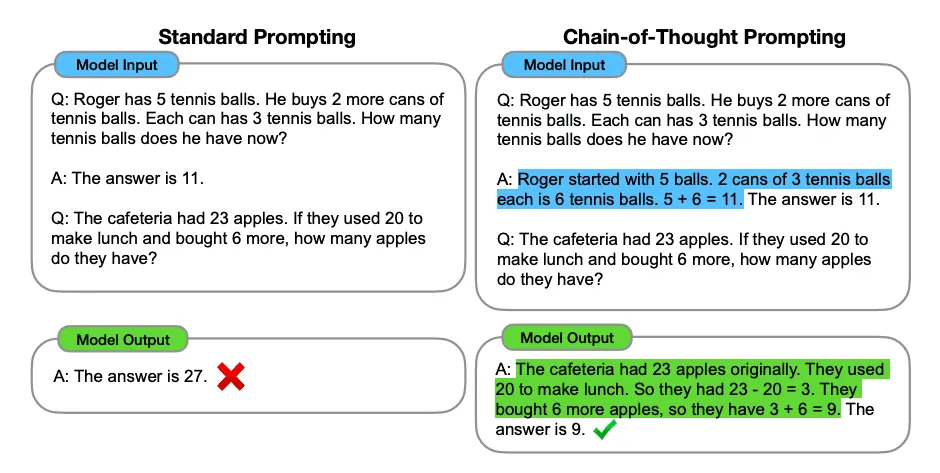
- What is Chain of Thought prompting and how does it help with reasoning-based tasks?
Chain of Thought prompting asks the model to solve a problem in steps instead of jumping to the final answer. It is useful for reasoning tasks like math, logic, planning and analysis.
For example, instead of asking only for the answer, you can ask the model to break the problem into steps and then give the result. This helps reduce mistakes in complex tasks.
Source: Wei et al. (2022)
Practical Prompt Engineering Interview Questions
Now let’s cover practical prompt engineering questions that are often asked in task-based rounds. These questions check how well you can write prompts for content writing, coding, chatbot replies, summarization, data extraction, customer support and research-based tasks.
- Write a prompt for creating a blog introduction for a specific target audience.
Include the topic, target reader, tone, word limit and what the intro should cover.
Sample Prompt: “Write a 100-word blog introduction on prompt engineering for freshers preparing for AI interviews. Use simple language. Start with what prompt engineering means. Then explain why it matters for AI jobs. End by saying that the blog includes interview questions, MCQs and preparation tips.”
- How would you design a prompt for a customer support chatbot that needs to answer user queries clearly?
Define the chatbot’s role, tone, answer style and limits. Also tell it when to ask for more details or suggest human support.
Sample Prompt: “You are a polite customer support assistant for an e-commerce brand. Answer the user’s query in simple language. Keep the reply short. If the query is unclear, ask one follow-up question. If the issue needs order details or payment access, tell the user to contact the support team.”
- What prompt would you use to summarize a long report into short and useful points?
Ask for a short summary, key findings and action points. Also mention the reader type.
Sample Prompt: “Summarize the following report for a busy manager. Give the main points in 5 bullets. Add 3 key findings and 3 action points. Avoid extra details. Use simple business language. Report: [Paste report here].”
- What approach would you follow to extract structured data from unstructured text using a prompt?
Give the fields clearly and ask for a fixed output format. JSON works well for this type of task.
Sample Prompt: “Extract the customer name, email, phone number, product name, order date and issue type from the text below. Return the answer in JSON format only. If any detail is missing, write null. Text: [Paste text here].”
Prompt Evaluation and Improvement Questions
15. How would you write a prompt to help an AI tool explain or debug a piece of code?
Share the code, error message and expected result. Then ask the AI to explain the issue before giving the fix.
Sample Prompt: “Review the code below and explain what it does in simple terms. Then find the error and suggest a corrected version. Explain the fix step by step. Code: [Paste code here]. Error message: [Paste error here]. Expected result: [Write expected output].”
Prompt Evaluation and Improvement Questions
Here are prompt engineering interview questions that test your ability to improve AI outputs. These questions are usually asked when interviewers want to see how you handle weak prompts, unclear answers, hallucinations, bias, response quality, testing and prompt versioning.
- How would you improve a prompt that gives vague or incomplete answers?
A vague prompt can be improved step by step:
- Check the output: Find what is missing or unclear in the answer.
- Clarify the task: Tell the model exactly what it needs to do.
- Add context: Give background details if the topic needs them.
- Mention the audience: Say who the answer is written for.
- Set the format: Ask for bullets, paragraphs, table or JSON.
- Add limits: Mention word count, length or number of points.
- Test again: Review the new output and improve the prompt if needed.
- How do you check whether a prompt is giving accurate, useful and consistent outputs?
A prompt can be checked through a simple testing process:
- Test with different inputs: Use different examples to see how the model responds.
- Check accuracy: See whether the answer is factually correct.
- Review usefulness: Check if the answer solves the actual task.
- Check format: See whether the output follows the required structure.
- Look for consistency: Run the prompt more than once and compare the results.
- Check for missing points: See if the answer skips important details.
- Use human review: For important tasks, a person should review the final output.
If the answers are clear, correct and stable across different inputs, the prompt is working well.
- What steps would you take if an AI response looks confident but contains unsupported information?
This type of issue is usually called a hallucination. It can be handled in these steps:
- Check the source: Compare the answer with trusted sources or the given reference text.
- Find unsupported claims: Mark any facts, numbers or statements that are not backed by the source.
- Rewrite the prompt: Add stricter instructions to stop the model from guessing.
- Limit the source: Use lines like “Use only the given text” or “Do not add outside information.”
- Add a fallback rule: Ask the model to write “Not available” if the answer is not found in the source.
- Test again: Run the revised prompt and check whether the answer stays factual.
For example, a better prompt would say: “Answer only from the given document. If the information is missing, write ‘Not available in the source.’”
- How would you identify and reduce bias in an AI-generated response?
Bias can be checked and reduced through a clear review process:
- Check assumptions: See if the response assumes gender, age, location, culture or background without reason.
- Look for unfair wording: Find words that favor or negatively describe one group.
- Test with variations: Use the same prompt with different names, locations or user types.
- Compare outputs: Check if the model gives different treatment without a valid reason.
- Use neutral language: Rewrite the prompt with balanced and respectful wording.
- Ask for balance: Add instructions like “Avoid assumptions and give a fair answer based only on the given context.”
- Review sensitive cases: For hiring, healthcare, finance or legal topics, human review is important.
A better prompt would say: “Give a neutral and balanced answer. Do not assume gender, background, income, location or personal details unless they are clearly mentioned.”
- How would you handle an AI response that is correct but not in the required format?
When the answer is correct but the format is wrong, the task does not need major changes. The format instruction should be made clearer.
For example, the prompt can say “Return the answer in a table with three columns” or “Give the output in JSON only.” A sample format can also be added if the output needs a fixed pattern.
Advanced Prompt Engineering Interview Questions
These are usually asked to experienced candidates or candidates applying for technical AI roles. The questions cover temperature, top-k, top-p, RAG, ReAct prompting, multimodal prompting, prompt leakage, model limits and advanced prompt control.
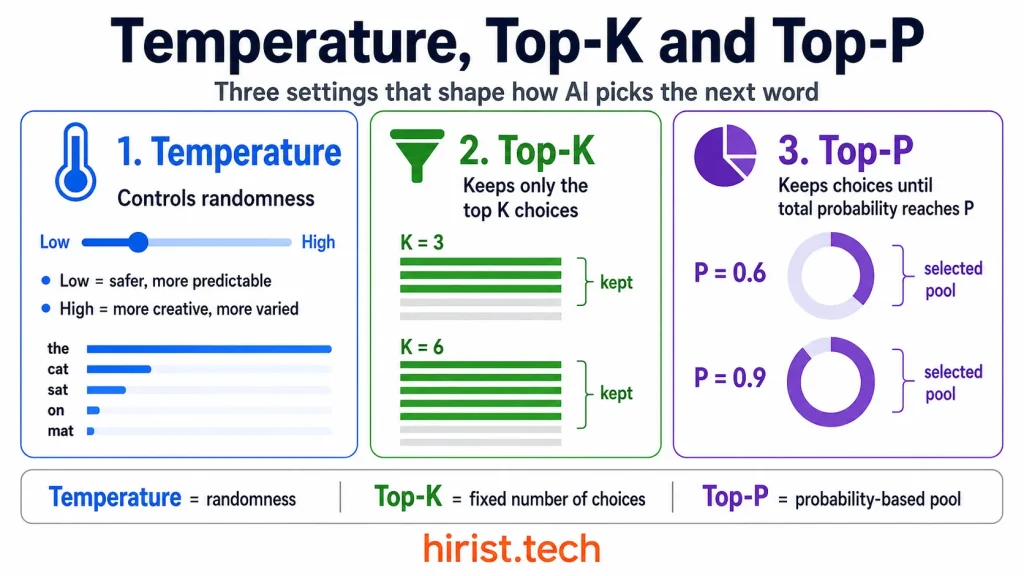
- How do temperature, top-k and top-p settings affect the creativity and accuracy of AI responses?
Temperature, top-k and top-p are model settings that control how predictable or creative an AI response can be. They control how the model chooses words while generating an answer.
| Setting | What It Means | Lower Value | Higher Value |
|---|---|---|---|
| Temperature | Controls randomness in the response | More predictable and factual | More creative and varied |
| Top-k | The model chooses from a limited number of likely words. | More controlled output | More variety in word choices |
| Top-p | The model chooses from a group of words based on probability. | More focused response | More diverse response |
For factual tasks, lower settings usually work better because they reduce random answers. For creative writing, slightly higher settings can help the model produce more varied ideas.
Prompt Engineering Questions
- What is RAG in prompt engineering and why is it useful?
RAG stands for Retrieval-Augmented Generation. It connects an AI model with external information before the answer is generated.
This is useful when the model needs fresh, private or source-based information. For example, a company chatbot can pull details from policy documents before answering employees. RAG helps reduce unsupported answers because the model responds using the retrieved content instead of only its training data.
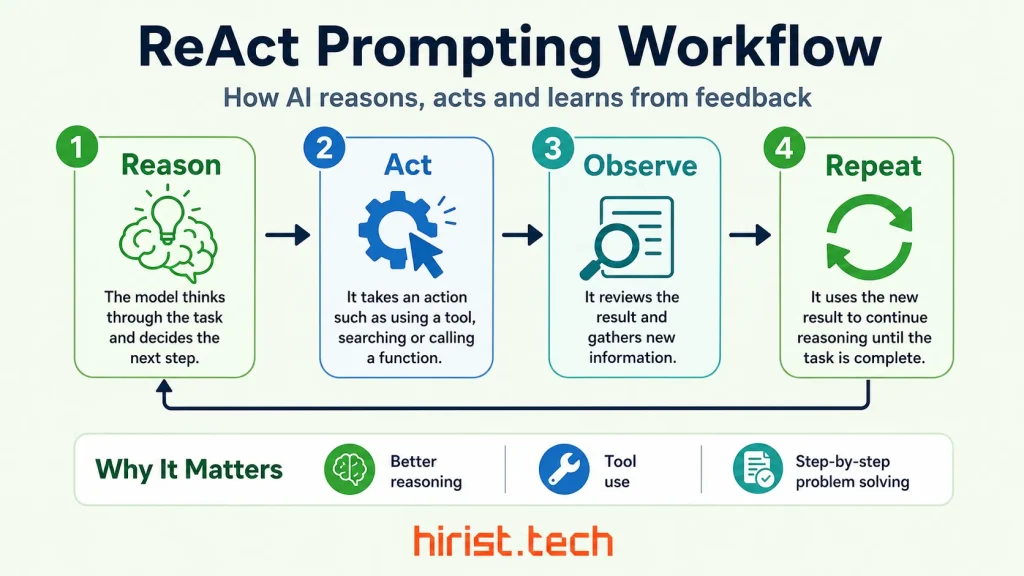
- What is ReAct prompting and how is it used in AI agents?
ReAct means Reasoning and Acting. It is a prompting method where the model thinks through a task and also takes actions using tools.
For example, an AI agent may read a user query, decide that it needs current data, search a source, read the result and then answer. ReAct is useful in agents because it allows the model to break tasks into steps, use tools and update its answer based on what it finds.
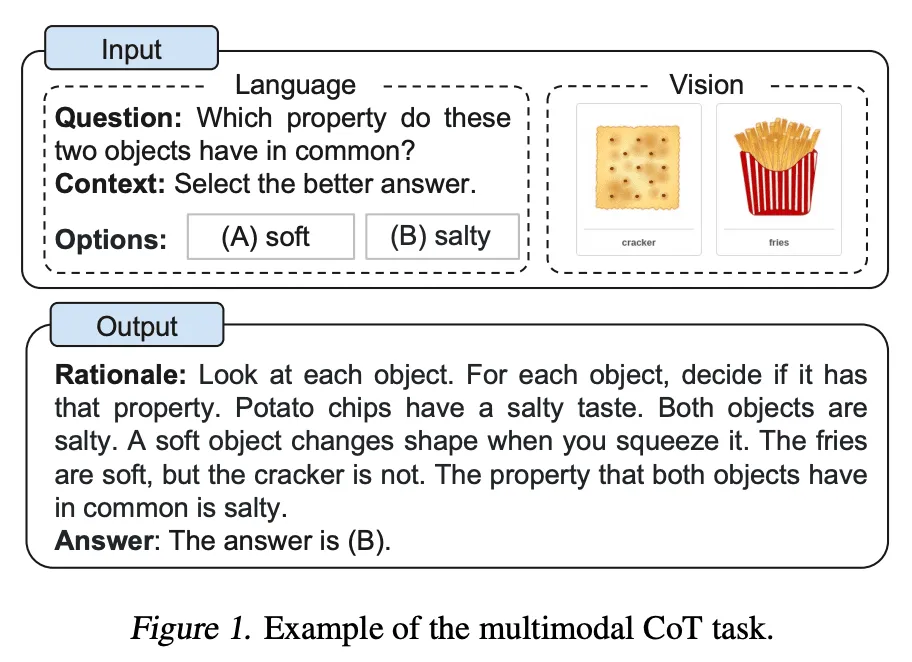
- How would you use multimodal prompting when the input includes text, images or documents?
Multimodal prompting is used when the model works with more than one input type, such as text, images, charts, screenshots or documents.
A good prompt should clearly mention what the model needs to check in each input. For example, it can say: “Read the document and review the chart. Summarize the key points and mention any mismatch between the text and image.” This helps the model connect visual and written information.
Source: Zhang et al. (2023)
- What is prompt leakage and how can it affect AI output?
Prompt leakage happens when hidden instructions, system prompts or private context appear in the model’s response.
This can affect privacy and safety. It may reveal internal rules, confidential data or instructions that should not be shown to users. To reduce this risk, prompts should separate private instructions from user-facing content. The model should also be told not to reveal hidden instructions, internal context or private data.
- How would you test and update prompts when an AI model changes its behavior after a new version release?
When a model changes, old prompts should be tested again before using them in important workflows.
A good testing process includes:
- Run old test cases: Check if past prompts still work.
- Compare outputs: Look for changes in tone, format, accuracy and length.
- Find broken prompts: Mark prompts that no longer follow instructions well.
- Update instructions: Add clearer context, format rules or examples.
- Test again: Check the revised prompts with different inputs.
- Track versions: Save the old and new prompt versions for future review.
This helps keep prompt performance stable after model updates.
Also Read - Top RAG Interview Questions and Answers
Prompt Engineering MCQs
Now let’s go through some prompt engineering MCQs for quick revision.
- Which prompt type asks the model to complete a task without giving examples?
Answer: b) Zero-shot prompting
- Which prompting method gives the model examples before asking it to perform a task?
Answer: b) Few-shot prompting
- Which setting controls how creative or predictable an AI response can be?
Answer: a) Temperature
- Which prompt is better for structured data extraction?
Answer: b) “Extract name, date and price. Return the answer in JSON format.”
- Which technique is used when an AI model is asked to reason through a problem step by step?
Answer: a) Chain of Thought prompting
- Which problem happens when an AI gives false or unsupported information?
Answer: b) Hallucination
How to Prepare for Your Prompt Engineering Interview?
Here are practical tips to help you prepare for a prompt engineering interview with more confidence:
- Read the job description and note the AI tools, skills and tasks mentioned.
- Practice commonly asked prompt engineering interview questions and answers before the interview.
- Learn basic terms like LLM, prompt, token, temperature, RAG and hallucination.
- Practice writing prompts for content, coding, research and chatbot replies.
- Take weak prompts and improve them with clearer context and format.
- Test prompts on tools like ChatGPT, Gemini or Claude.
- Prepare examples of prompts you have written or improved.
- Stay updated with new AI tools, model changes and prompt techniques.
Also Read - Top 25 LLM Interview Questions and Answers
Wrapping Up
So, that’s a wrap on the top prompt engineering interview questions and answers. These questions can help you revise basics, understand practical tasks and prepare for AI interview rounds with clarity. If you have good prompt engineering skills and are looking for AI and LLM jobs, visit Hirist, an online job portal for top IT jobs in India.
FAQs
Yes, some interviews may include coding questions, especially for AI engineer, GenAI developer, chatbot developer or LLM application roles. For non-coding roles, the questions are usually based on prompt writing and output improvement.
These questions usually check your basics, practical thinking and ability to improve AI outputs. Common prompt engineer interview questions include:
These questions are based on topics commonly seen in prompt engineering and GenAI-related interviews. The exact wording may change from company to company, but the concepts are widely tested. So, preparing these questions can help you answer similar interview questions with more confidence.
Freshers are usually asked basic and beginner-friendly questions. Common fresher questions include:
You need logical thinking, basic LLM knowledge and testing skills. It also helps to understand zero-shot prompting, few-shot prompting, role prompting, hallucinations, bias, RAG and output formatting. For technical roles, Python, APIs and basic GenAI workflows can be useful.