A casual leave is a short break you take when something personal needs attention and cannot wait. It may be a quick medical visit or a small family task that shows up without warning. Most employees know they get a fixed number of casual leave days. What many do not realise is that the rules change from one workplace to another. Government employees follow one set of guidelines and private sector staff follow another. This creates confusion about what is actually allowed. This guide makes things simple. You will understand the casual leave rules in India, the eligibility, the entitlements, the basic calculation and the right way to apply for it.
What is casual leave?
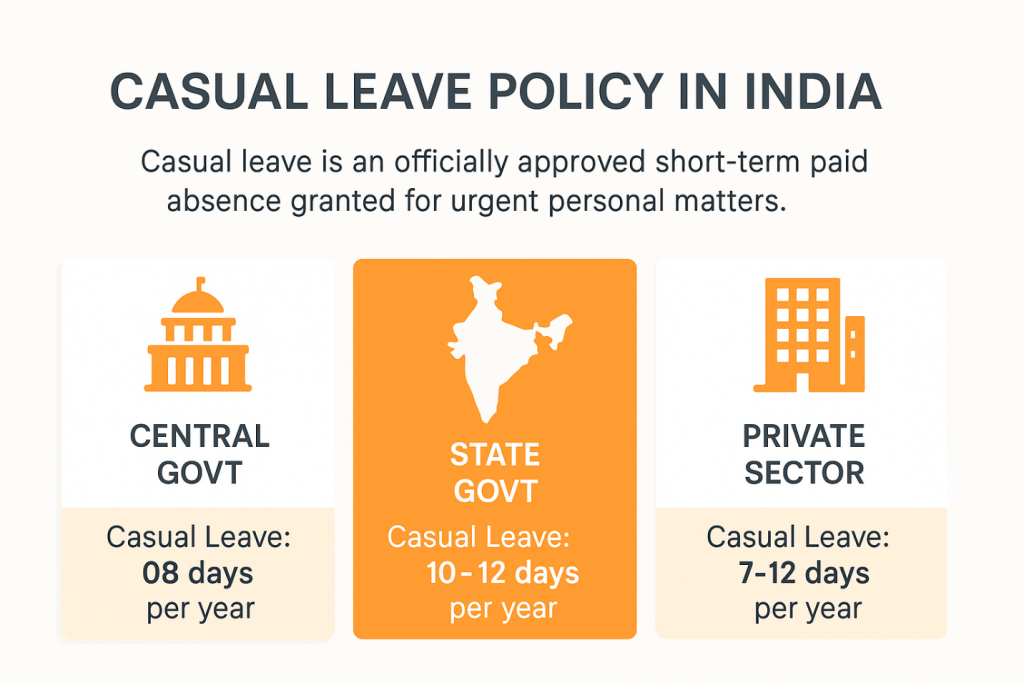
Casual leave is an officially approved short-term paid absence granted to employees for urgent personal matters that cannot be postponed. It gradually became part of Indian workplace policies through state labour regulations, especially the Shops and Establishments Acts, which formalised basic leave entitlements. Today it remains a core workplace benefit.
Key points on casual leave in India:
- Casual leave is usually pre-approved.
- CL is meant for short personal tasks and cannot be carried forward.
- It supports employee well-being and helps reduce stress.
- India has no single national casual leave rule. States set their own guidelines.
- Government and private sector employees get different CL limits.
- Unused CL cannot be encashed.
- Mass CL can be treated as a strike under new labour codes.
Fun Fact:
Casual leave was originally introduced to reduce unplanned absenteeism and improve workplace discipline.
Casual leave reasons for office
Employees use casual leave for small urgent tasks that need immediate attention. Here are common casual leave reasons for office:
- Quick medical appointments
- School meetings or parent duties
- Urgent banking or documentation work
- Sudden home repairs or maintenance
- Family functions or ceremonies
- Travel or commute issues
- Personal mental break day
- Attending exams or workshops
Also Read - How to Write Leave Application for Urgent Work: Format & Samples (2026)
Understanding the casual leave policy in India
Casual leave plays a bigger role in Indian workplaces than most employees realise. It is not only a short personal break. It is also a way for companies to support employee well-being and help people manage life’s unexpected moments without added stress. A good casual leave policy creates balance for both sides. Employees get space to handle personal matters. Employers get clarity and fewer workflow disruptions.
Is casual leave mandatory in India?
India does not have one national rule that fixes the exact number of casual leave days. Instead, two legal frameworks guide how companies create their policy:
- Industrial Employment (Standing Orders) Act, 1946: Organisations covered under this Act must define their leave structure clearly in their service rules.
- Shops and Establishments Act (state-wise): Each state sets its own leave requirements for private organisations within that state.
Because every state writes its own rules, the allowed number of casual leave days is not the same everywhere. For example, one state may require 7 days while another may require 10 or 12.
Also Read - Application for 10 Days Leave: Format, Samples & Guide
How companies decide their casual leave policy
Even though state laws set the minimum standards, employers still have flexibility. They consider factors like:
- Workload and nature of the industry
- Shift structure
- Number of working days in a week
- Employee wellness practices
- Internal HR policies
This is why a five-day IT company may offer different casual leave benefits than a six-day retail business.
Casual leave eligibility and entitlements
Casual leave eligibility and entitlement vary across companies. Understanding these rules helps employees use their leave correctly.
Who is eligible for casual leave?
Most full-time employees become eligible for casual leave soon after joining. Many companies activate CL after the probation period. Temporary staff and contract workers may get CL only if the company policy allows it.
How entitlement is decided?
Your casual leave entitlement comes from three sources:
- State labour laws under the Shops and Establishments Act
- Central Civil Services Rules for government staff
- Your company’s internal leave policy
These rules set the minimum number of days. Companies can offer more but not less.
Typical entitlement across India
- Private sector: Around 7 to 12 days each year
- State government: Often 10 to 12 days
- Central government: Up to 8 days per year
The exact number depends on where you work and which rules apply to your organisation.
| Employee Type | Typical Casual Leave Days (Per Year) | Who Decides the Rules |
| Private Sector | 7 to 12 days | Company policy + State Shops and Establishments Act |
| State Government | 10 to 12 days | State Government Leave Rules |
| Central Government | Up to 8 days | Central Civil Services (Leave) Rules |
Entitlement for part-time or probation employees
Some companies give fewer CL days or restrict usage until the probation period ends. This varies widely across workplaces.
Entitlement reset
Casual leave resets every calendar year. Unused days are not carried forward and are not encashed
Casual leave rules in India
Casual leave may look straightforward, but every workplace follows a defined set of rules for when and how it can be used. These rules help employees take short breaks without affecting work and also guide managers on approving leave fairly. Knowing these rules makes it easier to plan your leave and avoid last-minute issues.
- Purpose of casual leave
Casual leave is meant for short and urgent personal needs. You use it when something cannot wait. For example a sudden school meeting or a local bank visit. A small medical check or an urgent repair at home. It is not meant for long holidays or planned trips.
- Duration you can take at one time
Most companies allow:
- Half-day CL for very short tasks
- 1 to 2 days at a time in normal cases
- Up to 3 days in some organisations with manager approval
If you need a longer break your manager may ask you to use earned leave or another leave type.
- Approval and notice
In most workplaces, these rules apply:
- CL should be pre-approved as far as possible
- You send a request through the HR portal or email
- You mention dates and a simple reason
- In a real emergency you can inform your manager by phone and regularise it later
Managers can reject or reschedule CL if work will suffer. So it is always better to give some notice when you can.
- Paid status and impact on salary
Casual leave is fully paid leave. If it is approved and within your yearly limit, your salary does not change. If you take leave after using up your CL balance, the extra days are usually marked as leave without pay or adjusted against earned leave, based on policy.
- Carry forward and encashment
Two key rules apply almost everywhere:
- No carry forward – Unused casual leaves lapses at the end of the year
- No encashment – You do not get money for unused casual leaves during job or at exit
This is why CL is often called a use it within the year leave.
- Clubbing with weekends, holidays and other leave
Companies usually set their own rules here. Common patterns:
- Many allow CL to touch a weekend. For example taking Friday CL and using Saturday – Sunday to rest
- Some restrict CL before or after long national holidays
- A few companies allow CL to be clubbed with earned leave, but only with prior approval
- Many stop employees from stitching many leave types together to create a very long break
It is best to check your HR policy for this part.
Also Read - Leave Application for Festival in Office with Format & Samples (2026)
- Rules during probation and notice period
There is no single rule for all companies. But common practice is:
- During probation: CL may be limited or not allowed at all
- During notice period: CL is often tightly controlled. Some companies allow it for genuine reasons. Others allow only unpaid leave or ask for manager clearance and proof
Also Read - All About Serving Notice Period – Indian Laws, Negotiation & Leave Policy
- Pattern and misuse
HR teams also look at the pattern of CL:
- Repeated CLs on Mondays or Fridays
- Frequent one-day CLs around deadlines
- Sudden leave during every busy period
These can be treated as misuse. Managers may start asking for stronger reasons or may reject leave when it hurts team work.
- New rules under labour codes (from late 2025)
The new labour codes do not give one national CL count. The number of days still depends on state rules and company policy. However, there are two important points employees should know:
- Mass casual leave taken together as a protest can be treated as a strike
- Rules on annual paid leave eligibility and accrual have changed, which may affect how companies structure all leave types together
Note: The new rules under the labour codes are not fully implemented yet. Some parts may change when they come into force, and we will update this guide as soon as official instructions are released.
Also Read - Leave Encashment Rules: Tax Exemptions Limit, Calculation Formula & More
Casual leave rules for government employees
| Category | Central Government | State Government |
| Annual CL Days | Up to 8 days per year | Usually 10 to 12 days, varies by state |
| Who Sets Rules | Central Civil Services (Leave) Rules, 1972 | State Shops and Establishments / State Service Rules |
| Carry Forward | Not allowed | Not allowed |
| Encashment | Not allowed | Not allowed |
| Maximum CL at a Time | Usually 1 to 2 days, extendable to 3 with approval | Usually 2 to 3 days depending on department |
| Probation Usage | Allowed in some departments, restricted in others | Varies by state and job role |
| Clubbing with Other Leave | Allowed with approval | Varies by department |
| Application Process | Must apply through official portal or written request | State-specific formats or online portals |
Also Read - Leave Extension Letter: Sample Applications & Emails
Casual leave rules for private sector employees
| Category | Private Sector (General) |
| Annual CL Days | Typically 7 to 12 days, based on company + state rules |
| Who Sets Rules | Company HR policy + State Shops and Establishments Act |
| Carry Forward | Not allowed |
| Encashment | Not allowed |
| Maximum CL at a Time | Usually 1 to 3 days |
| Probation Usage | Often restricted until probation ends |
| Notice Requirement | Prior approval needed unless emergency |
| Clubbing with Weekends/Holidays | Allowed in some companies, restricted in others |
| Tracking System | HR portal, attendance software or manual register |
Casual leave calculation
Casual leave is not calculated the same way in every organisation. It depends on your company policy and the rules of the state you work in. Most companies use a monthly or pro-rata method to decide how many CL days an employee gets if they join mid-year or mid-month.
- Standard yearly entitlement
If a company offers 12 CL days a year, every employee gets the full 12 days, unless they joined late in the year.
- Pro-rata calculation for new employees
If you join during the year, companies usually calculate your CL like this:
Formula:
(Total CL for the year ÷ 12) × Number of months worked
Example:
Company gives 12 CL in a year.
You joined in July (6 months left).
Calculation:
12 ÷ 12 × 6 = 6 casual leave days
- CL calculation for a 5-day vs 6-day week
Some companies adjust CL based on working days:
- 5-day week companies often give 7 to 10 CL days
- 6-day week companies often give 10 to 12 CL days
This keeps the benefit balanced for all employees.
- Pay calculation for a CL day
If your CL is approved, your pay stays the same. If you run out of CL, companies sometimes calculate pay deduction using:
(Basic Salary ÷ 26 or 30) depending on company policy.
- Half-day CL calculation
Half-day leave simply deducts 0.5 from your total CL balance.
Also Read - Half Day Leave Application for Office: Format & Samples
How to apply for casual leave?
Applying for casual leave is simple, but doing it the right way helps avoid confusion and last-minute rejection. Here is a process most companies follow:
- Check your leave balance: Open your HR portal or ask HR to confirm how many CL days you still have. This avoids surprises later.
- Inform your manager early: If it is not an emergency, tell your manager as soon as you know you need the leave. Early communication makes approval easier.
- Submit your leave request: Apply through your company’s leave portal, email, or attendance app. Add the date and a short reason. You do not need long explanations.
- Wait for approval: Your manager or HR must approve the request before you take the leave. In emergencies, you may inform first and regularise later.
- Hand over pending work: Share quick updates with your team.o your absence does not affect the workflow. This shows responsibility and helps your approval chances in the future.
- Keep your phone reachable in rare urgent situations: Most companies expect employees to stay reachable only if something truly important comes up.
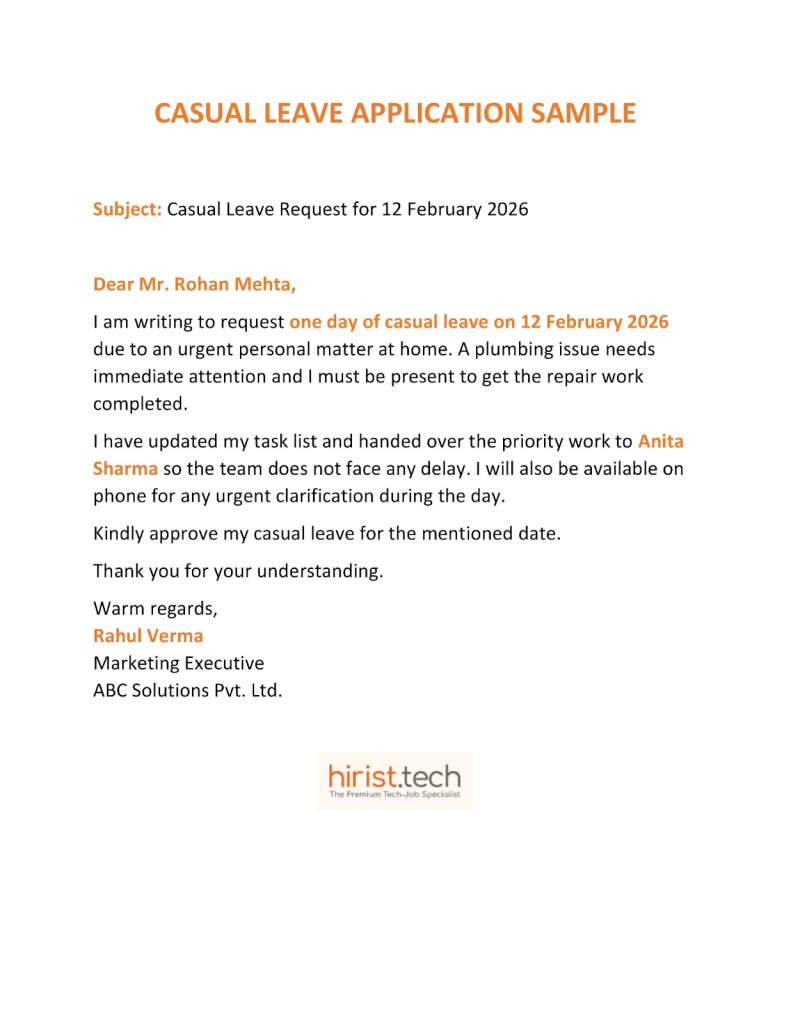
Casual leave application sample
Here is a simple casual leave application email you can use at work.
Also Read - Casual Leave Application for Office: Format & Samples
Difference between casual leave and earned leave
Casual leave and earned leave serve different purposes at work. Understanding the difference helps employees choose the right leave type when planning time off.
| Point | Casual Leave (CL) | Earned Leave (EL) |
| Purpose | Short and urgent personal needs | Planned long breaks or vacations |
| Typical Number of Days | 7 to 12 days per year (depends on state and company) | 12 to 30 days per year (varies by organisation) |
| Duration | 1 to 3 days at a time | Can be taken for longer stretches |
| Accrual | No monthly accrual | Earned monthly based on days worked |
| Carry Forward | Not allowed | Allowed as per company policy |
| Encashment | Not allowed | Often allowed during service or at exit |
| Approval | Quick approval for urgent needs | Needs advance planning and manager approval |
| Reset | Resets yearly | Accumulates until used or encashed |
Also Read - Earned Leave Application: Letter Format & Calculation
How a good casual leave policy benefits workplaces
A well-designed casual leave policy helps both employees and employers. Here are the benefits:
- Reduces burnout and improves morale
- Lowers unplanned absenteeism
- Encourages honest communication about leave needs
- Helps teams manage workflow smoothly
- Supports mental well-being and productivity
Also Read - Leave Application for Vacation in Office: Request Letter Examples
Smart tips to use casual leave effectively
Many employees lose casual leave every year because they do not plan it well. These simple tips help you use CL smartly without affecting work.
- Use for short tasks: Keep CL for quick needs. Save earned leave for long breaks.
- Do not wait till year-end: Unused CL expires. Using it early avoids last-minute rejection.
- Spread CL through the year: One or two days every few months helps reduce stress.
- Avoid patterns like Monday or Friday leave: Managers notice repeated long weekends.
- Tell your team before taking leave: A quick update avoids workflow issues.
- Check your balance often: Do a monthly check so you never run out unknowingly.
- Take half-day leave when possible: Use 0.5 CL for very small tasks instead of a full day.
- Skip CL during peak workload: Using CL smartly during non-busy weeks improves approval chances.
- Use work-from-home for minor tasks: If allowed, choose WFH instead of using a full CL day.
- Keep basic proof for emergencies: Helps in smooth approval when urgent leave is needed.
Also Read - Two Days Leave Application for Office: Format & Samples (2026)
Wrapping up
Casual leave is a small but important part of work life. When you know the rules and use your leave wisely, it becomes much easier to balance personal needs and office work. Every company follows different policies, so understanding your entitlement helps you plan better through the year.
If you are looking for IT jobs with good leave benefits, Visit Hirist, a trusted portal for top tech opportunities.
Also Read - One Day Leave Application for Office: Format & Samples
FAQs
Yes. Casual leave is designed for short breaks, so one day of CL is commonly allowed in almost every organisation.
TCS employees receive 7 casual leave days per year, credited quarterly at 1.75 days per quarter. These leaves must be used within the same financial year. They do not carry forward and automatically expire at the end of the year.
A half-day casual leave is when you take only half a working day off for a small personal task. It deducts 0.5 day from your CL balance.
Casual leave policy explains how many CL days you get, when you can use them, how to apply and what rules apply in your company.
There is no fixed monthly limit. Most companies allow CL anytime during the year as long as you stay within the yearly entitlement.
Yes. Managers can reject CL if workload is high, if many team members are already on leave, or if the reason does not match company policy.
Most private companies offer 7 to 12 days a year. Government employees generally get 8 to 12 days, depending on their state or department rules.
Most companies allow 1 to 3 days of CL at a time. Longer breaks may require switching to earned leave.
Yes. Casual leave is fully paid leave, as long as you have enough balance and the leave is approved.