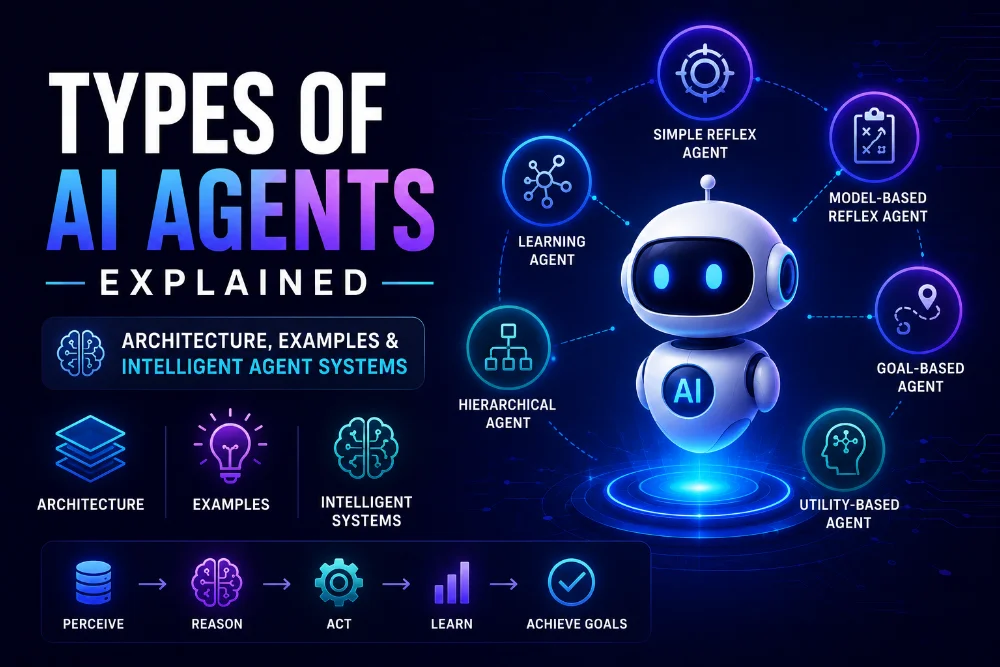
Artificial intelligence is rapidly moving beyond simple chatbots and automation tools. Today, AI agents can analyze information, make decisions, interact with software, and complete complex tasks with minimal human involvement. As organizations adopt agentic AI to improve productivity and automate workflows, understanding each type of AI agent becomes increasingly important.
Different AI agents are designed to solve different problems. Some follow predefined rules, while others learn from experience, plan actions, and optimize decisions based on changing conditions. From simple reflex systems to advanced learning agents and multi-agent environments, each approach offers unique strengths and limitations.
In this guide, we will cover the major types of agent in AI, how intelligent agent architectures work, and real-world examples of AI agents in action.
What Is an AI Agent?
An AI agent is a software agent that perceives its environment, processes information, and takes actions to achieve specific objectives. Unlike traditional software that only follows fixed instructions, AI agents can analyze inputs, make decisions, and respond to changing conditions with varying levels of autonomy.
At a basic level, every AI agent follows a continuous cycle of perception, reasoning, and action. First, the agent gathers information from its environment. It then processes that information to determine the most appropriate response before executing an action. This cycle allows agents to operate independently and solve problems without requiring constant human intervention.
What Makes an Intelligent Agent?
Not all AI agents are equally capable. The most advanced systems are known as intelligent agents because they can perceive their environment, make decisions, and take actions that help them achieve specific goals. Understanding the types of intelligent agents in artificial intelligence starts with understanding the qualities that make an agent intelligent.
Characteristics of Intelligent Agents
- Autonomy: Intelligent agents can operate independently without requiring constant human guidance.
- Reactivity: They monitor their environment and respond quickly to changes or new information.
- Proactiveness: Instead of only reacting, intelligent agents can take initiative and perform actions to achieve desired outcomes.
- Adaptability: Many intelligent agents learn from experience and adjust their behavior as conditions change.
- Goal Orientation: Their actions are directed toward achieving specific objectives rather than simply following instructions.
What Is a Rational Agent in AI?
A rational agent in AI is an agent that selects the action most likely to achieve the best outcome based on the information available at that moment. Rationality is not the same as intelligence. An intelligent system may have advanced capabilities, but a rational agent focuses on making the most effective decision using its knowledge, goals, and current situation.
Architecture of Intelligent Agents in AI
The architecture of intelligent agents in AI defines how an agent perceives information, processes it, and takes action. Regardless of complexity, most AI agents follow a common structure that enables them to interact with their environment and achieve specific goals.
The basic architecture of agent in artificial intelligence can be represented as:
Environment → Sensors → Agent Program → Actuators → Environment
In this cycle, the agent continuously gathers information, makes decisions, and performs actions based on its objectives.
Components of Intelligent Agent Architecture
Sensors
Sensors collect information from the environment. In software systems, sensors can include APIs, databases, user inputs, documents, and web applications. In robotics, they may include cameras, microphones, GPS systems, and motion sensors.
Agent Program
The agent program is the decision-making component. It analyzes incoming information, evaluates possible actions, and determines the most appropriate response based on predefined rules, goals, or learned knowledge.
Knowledge Base
The knowledge base stores information that helps the agent make better decisions. This may include historical data, business rules, user preferences, or previously learned experiences.
Learning Module
The learning module allows the agent to improve over time. By analyzing feedback and outcomes, it can refine its behavior and adapt to new situations without requiring manual updates.
Actuators
Actuators execute the agent’s decisions. For software agents, this may involve sending emails, updating databases, generating reports, or triggering workflows. For physical systems, actuators control motors, robotic arms, or other mechanical components.
Simple Intelligent Agent Architecture Diagram
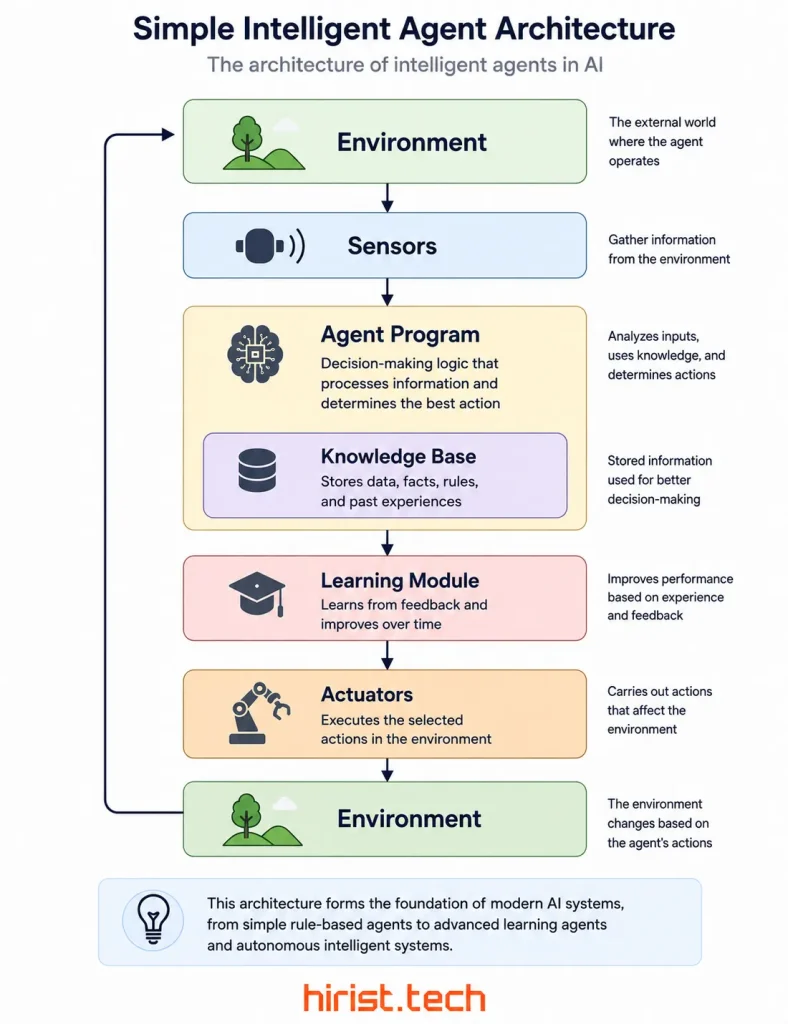
This architecture forms the foundation of modern AI systems, from simple rule-based agents to advanced learning agents and autonomous intelligent systems.
Types of AI Agents
AI agents can be classified based on how they perceive information, process data, make decisions, and interact with their environment. Some agents operate using predefined rules, while others can plan ahead, optimize outcomes, or learn from experience. Understanding the different types of agent in AI helps organizations choose the right approach for automation, decision-making, and problem-solving.
The most common AI agent types include simple reflex agents, model-based agents, goal-based agents, utility-based agents, and learning agents. Each type offers a different level of intelligence, flexibility, and autonomy.
1. Simple Reflex Agent
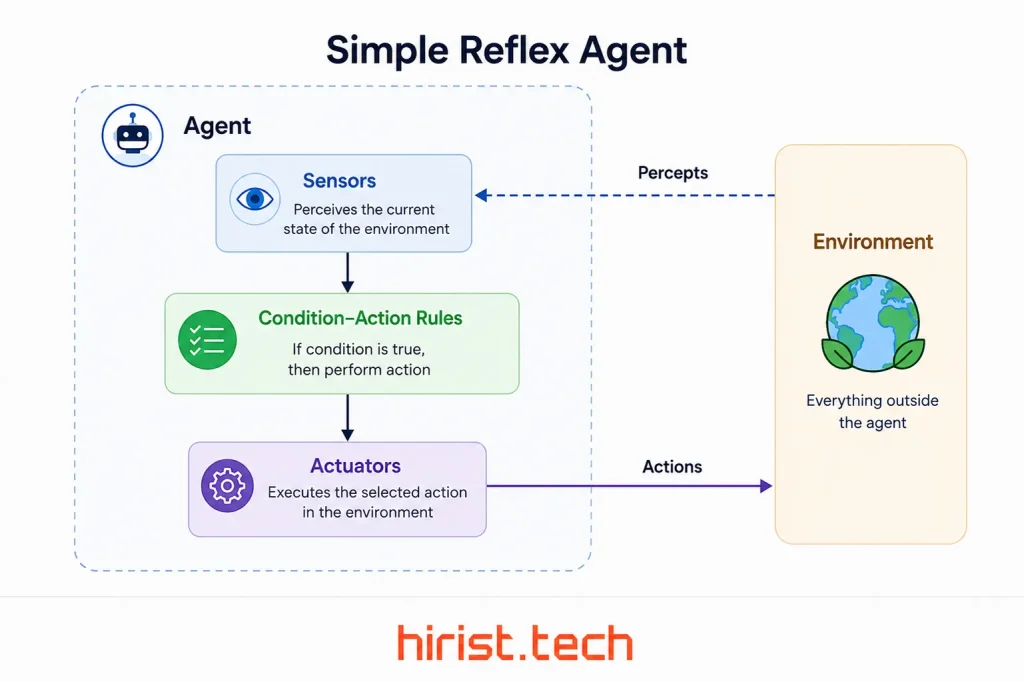
A simple reflex agent is the most basic type of AI agent. It makes decisions using predefined condition-action rules and responds only to the current situation without considering past events or future consequences.
How It Works
Simple reflex agents follow an if-then approach. When a specific condition is detected, the agent immediately performs the corresponding action. For example: If the room temperature falls below 20°C → Turn on the heater. Because these agents only react to current inputs, they do not maintain memory or store information about previous interactions.
Advantages
- Fast decision-making
- Easy to design and implement
- Low computational requirements
- Works well in predictable environments
Limitations
- Cannot learn from experience
- Cannot handle uncertainty or incomplete information
- Struggles in dynamic environments
- Limited decision-making capabilities
Example
Common examples of simple reflex agents include traffic light systems that change signals based on predefined rules and smart thermostats that activate heating or cooling when temperature thresholds are reached. These systems perform effectively because they operate in environments where the rules and expected responses are clearly defined.
2. Model-Based Agent
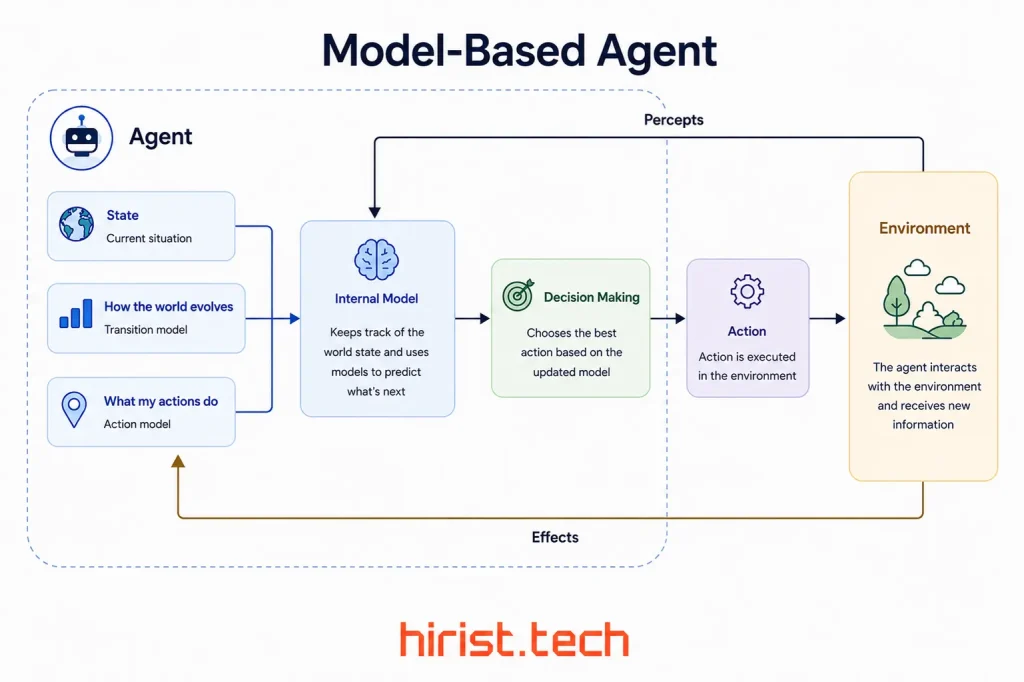
A model based agent in AI is an advanced version of a simple reflex agent. Unlike reflex agents that rely only on current inputs, model-based agents maintain an internal representation of their environment. This allows them to make decisions using both current observations and previously gathered information.
How It Works
A model-based agent continuously updates its internal state as new information becomes available. By tracking changes in the environment, it can understand situations that are not fully visible at any given moment. For example, if an obstacle temporarily moves out of view, the agent can still remember its location and adjust its actions accordingly. This ability makes model-based agents more effective in dynamic and partially observable environments.
Advantages
- Better context awareness and decision-making
- Maintains an internal state of the environment
- Can track environmental changes over time
- Handles partially observable situations more effectively than simple reflex agents
Example
Common examples of a model based agent in AI include robot vacuum cleaners that create maps of rooms, remember cleaned areas, and avoid obstacles, and warehouse robots that track inventory locations, monitor movement paths, and navigate efficiently through changing environments. By maintaining an internal model of the world, these agents can make more informed decisions and adapt to situations that simple rule-based systems cannot handle effectively.
3. Goal-Based Agent
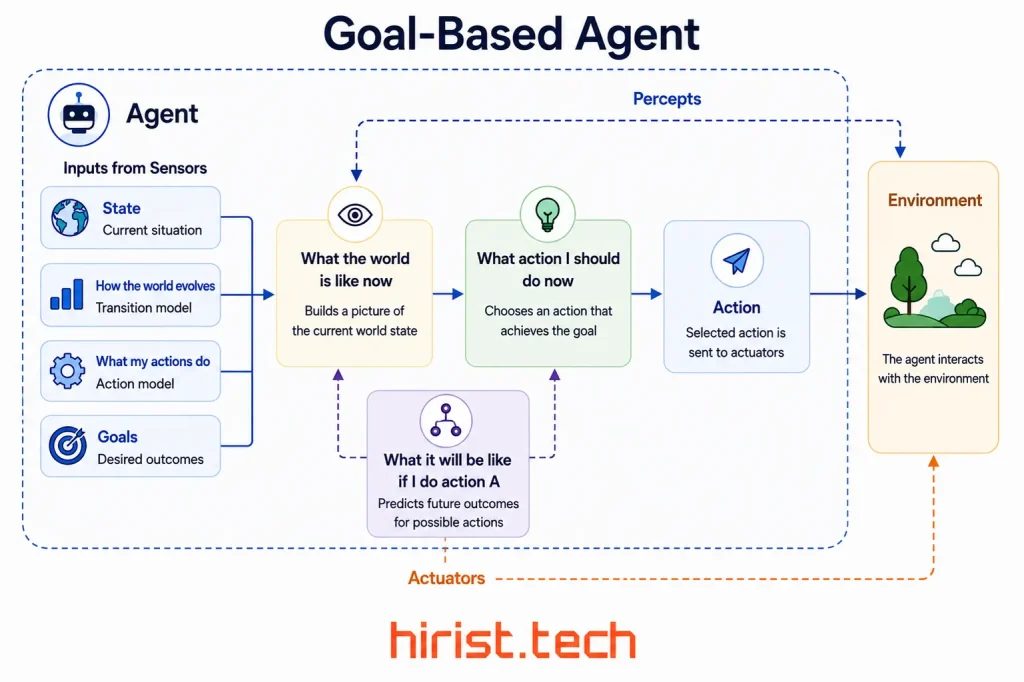
A goal based agent in AI makes decisions by evaluating whether an action helps achieve a specific objective. Instead of simply reacting to current conditions, these agents consider future outcomes and choose actions that move them closer to their goal.
How It Works
Goal-based agents start with a clearly defined objective and then evaluate different possible actions to determine the best path forward. They often use planning and search techniques to predict future states and identify the most effective sequence of actions. For example, if a navigation system’s goal is to reach a destination quickly, it will analyze multiple routes, traffic conditions, and road closures before selecting the best option.
Advantages
- More flexible than reflex-based agents
- Can evaluate multiple possible actions
- Future-oriented decision-making
- Adapts plans when conditions change
Example
Common examples of a goal based agent in AI include route planning systems that calculate the most efficient path to a destination and autonomous navigation systems used in robots and self-driving vehicles to reach specific locations while avoiding obstacles. Because goal-based agents focus on desired outcomes rather than fixed rules, they are well-suited for tasks that require planning, problem-solving, and dynamic decision-making.
4. Utility-Based Agent
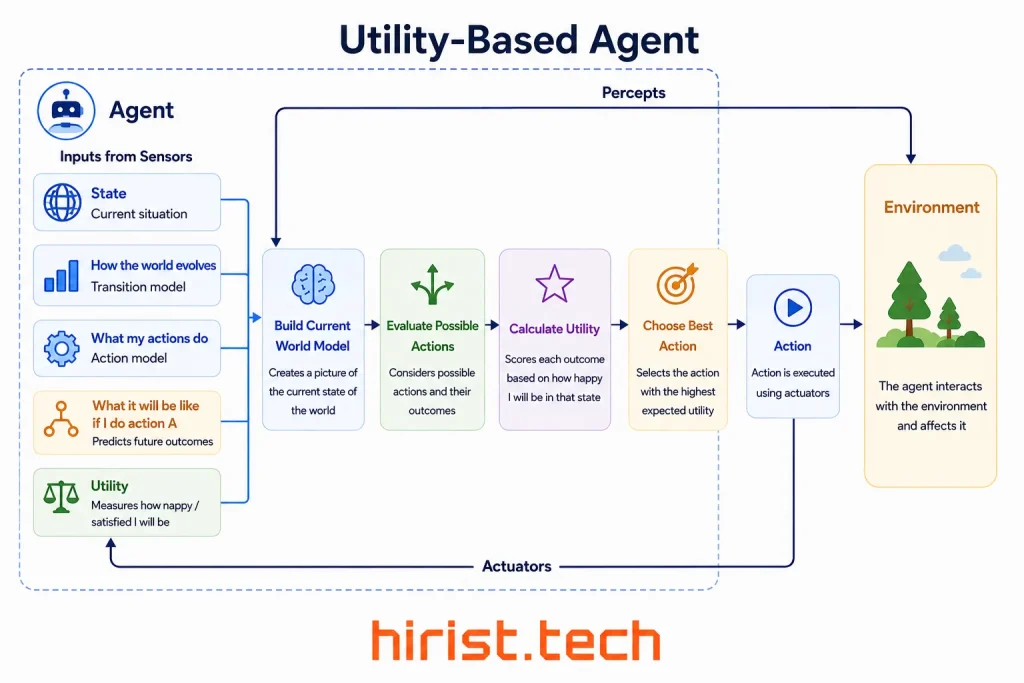
A utility based agent in AI takes decision-making a step further by evaluating multiple possible outcomes and selecting the one that delivers the highest overall value. While goal-based agents focus on achieving a specific objective, utility-based agents consider how desirable each outcome is and choose the option that maximizes benefits.
How It Works
Utility-based agents use a utility function, a scoring mechanism that assigns a value to different outcomes. The agent compares available options and selects the action with the highest utility score. This approach allows the agent to evaluate factors such as cost, risk, efficiency, time, and user preferences before making a decision. As a result, it can make more balanced and optimized choices, especially in complex environments.
Advantages
- Handles trade-offs between multiple objectives
- Optimizes decision-making based on overall value
- Performs well in uncertain environments
- Supports more intelligent and flexible behavior
Example
Common examples of a utility based agent in AI include investment recommendation systems that evaluate risk, return potential, and market conditions before suggesting investment options, and ride-sharing pricing systems that adjust fares by considering demand, driver availability, traffic conditions, and customer wait times. Because utility-based agents focus on maximizing the best possible outcome, they are widely used in applications where multiple factors must be balanced simultaneously.
5. Learning Agent
A learning agent in AI is the most advanced type of intelligent agent because it can improve its performance over time by learning from experience. Unlike other agents that rely on predefined rules, models, or utility functions, learning agents continuously adapt their behavior based on feedback, new data, and changing environments.
This ability to learn and evolve makes learning agents ideal for dynamic situations where conditions constantly change and fixed decision-making strategies are not enough. As they interact with their environment, they identify patterns, refine their actions, and become more effective at achieving their goals.
Components of a Learning Agent
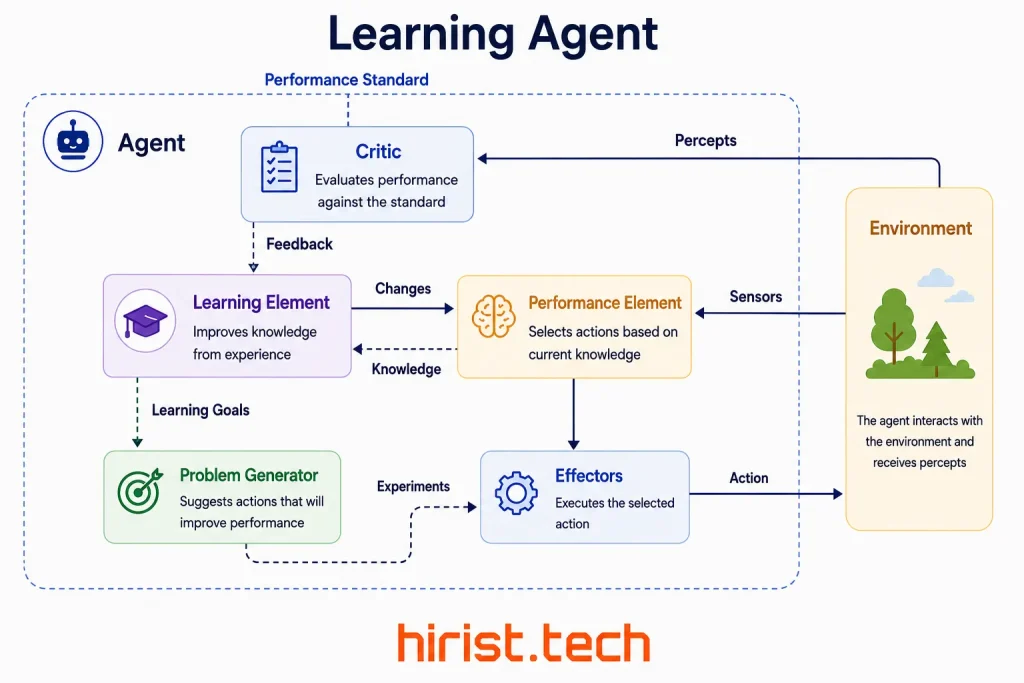
A learning agent typically consists of four key components that work together to improve performance:
- Learning Element: The learning element is responsible for acquiring new knowledge and improving the agent’s behavior. It analyzes experiences, feedback, and outcomes to identify better ways of performing tasks.
- Critic: The critic evaluates the agent’s actions and provides feedback on whether those actions produced desirable results. This feedback helps the agent understand what worked well and what needs improvement.
- Performance Element: The performance element is responsible for selecting and executing actions. It uses the agent’s current knowledge to interact with the environment and achieve specific objectives.
- Problem Generator: The problem generator encourages exploration by suggesting new actions or strategies. This helps the agent discover more effective solutions instead of relying only on previously successful behaviors.
How Learning Agents Improve Over Time
The power of a learning agent in AI comes from its ability to continuously adapt and optimize its decision-making process.
- Feedback Loops: Learning agents constantly receive feedback from their environment. Positive outcomes reinforce successful actions, while negative outcomes signal the need for adjustment. Over time, this feedback loop helps the agent make better decisions.
- Reinforcement Learning: Many learning agents use reinforcement learning, where the agent receives rewards for desirable actions and penalties for poor decisions. By maximizing rewards, the agent gradually learns the most effective strategies.
- Continuous Adaptation: Unlike traditional agents that follow fixed rules, learning agents can adapt to new information, changing user behavior, and evolving environments. This makes them highly effective in real-world applications where conditions are rarely static.
Advantages
- Continuously improves performance through experience
- Adapts to changing environments and user behavior
- Requires fewer manual rule updates
- Can identify patterns and insights from large datasets
- Handles complex and unpredictable situations effectively
Example
Some of the most common examples of a learning agent in AI include ChatGPT, which uses large language models and feedback mechanisms to generate increasingly relevant and helpful responses; recommendation engines used by Netflix, Amazon, and Spotify to personalize content based on user preferences and behavior; and fraud detection systems that analyze transaction patterns and continuously adapt to identify new types of fraudulent activity.
Comparison of Different Types of AI Agents
Understanding the differences between various AI agent types can help organizations select the right solution for their specific use case. While some agents focus on quick rule-based responses, others can plan ahead, optimize decisions, or continuously learn from experience.
| Agent Type | Memory | Planning | Learning | Complexity | Example |
|---|---|---|---|---|---|
| Simple Reflex Agent | No | No | No | Low | Traffic lights, smart thermostats |
| Model-Based Agent | Yes | Limited | No | Low-Medium | Robot vacuum cleaners, warehouse robots |
| Goal-Based Agent | Yes | Yes | No | Medium | Route planning systems, autonomous navigation |
| Utility-Based Agent | Yes | Yes | No | High | Investment recommendation systems, ride-sharing pricing systems |
| Learning Agent | Yes | Yes | Yes | Very High | ChatGPT, recommendation engines, fraud detection systems |
Among these different types of AI agents, simple reflex agents are best suited for predictable environments, while model-based agents perform better when some information is hidden or constantly changing. Goal-based and utility-based agents introduce planning and optimization capabilities, enabling them to make more strategic decisions. Learning agents represent the most advanced category because they can improve their performance over time through feedback, experience, and continuous adaptation.
Beyond Traditional Agent Types: Intelligent Agent Systems
The five core AI agent types provide the foundation for intelligent decision-making, but modern AI systems often combine multiple approaches to solve complex real-world problems. Rather than relying on a single agent architecture, organizations increasingly deploy intelligent agent systems that integrate planning, learning, optimization, and coordination capabilities.
These advanced systems represent some of the most practical types of intelligent agents in artificial intelligence because they can handle large-scale tasks, adapt to changing environments, and collaborate across multiple objectives.
1. Hierarchical Agents
Hierarchical agents organize decision-making into multiple layers, with each layer responsible for a different level of control. This structure allows complex tasks to be divided into smaller, manageable activities.
A typical hierarchical agent consists of three layers:
- Strategic Layer: The strategic layer focuses on long-term goals and overall planning. It determines what needs to be achieved and sets priorities for the system.
- Tactical Layer: The tactical layer translates high-level goals into actionable plans. It allocates resources, schedules tasks, and determines the best approach for achieving strategic objectives.
- Execution Layer: The execution layer performs the actual tasks. It interacts directly with the environment, monitors progress, and carries out instructions received from higher levels.
Example: Drone Delivery Systems
A drone delivery network is a common example of a hierarchical agent system. The strategic layer manages delivery objectives across an entire region, the tactical layer plans routes and schedules deliveries, and the execution layer controls individual drones during flight. This layered approach improves efficiency, scalability, and decision-making.
2. Multi-Agent Systems (MAS)
A Multi-Agent System (MAS) consists of multiple autonomous agents working together within a shared environment. Instead of relying on a single agent to solve a problem, responsibilities are distributed across several specialized agents.
Multiple Agents Working Together
Each agent in the system has its own role, knowledge, and decision-making capabilities. By dividing tasks among multiple agents, the system can solve problems more efficiently and handle greater complexity.
- Cooperation: Agents often cooperate to achieve shared objectives. They exchange information, coordinate actions, and support one another to complete tasks that would be difficult for a single agent to accomplish alone.
- Coordination: Effective coordination ensures that agents avoid conflicts, share resources efficiently, and work toward common goals. Communication mechanisms allow agents to synchronize activities and respond to changing conditions in real time.
Example: Multi-Agent Systems in Action
Multi-agent systems are widely used across modern industries, including smart factories where multiple agents manage production schedules, quality control, maintenance, and inventory, and supply chain networks where agents coordinate procurement, logistics, warehousing, and distribution activities.
AI Agent Types vs Agentic AI
As AI technology evolves, the conversation is shifting from traditional AI agents to agentic AI. While both can perform tasks and make decisions, agentic AI introduces greater autonomy, reasoning, and the ability to execute complex workflows with minimal human intervention.
Traditional AI Agents
Traditional AI agents are designed around specific architectures such as reflex, goal-based, utility-based, or learning agents. They typically operate within predefined boundaries and are optimized for particular tasks.
Key characteristics include:
- Fixed architecture and decision-making frameworks
- Limited autonomy beyond assigned tasks
- Focus on solving specific problems
- Restricted ability to use external tools independently
- Often designed for single-task execution
Examples include recommendation engines, navigation systems, robot vacuum cleaners, and fraud detection models.
Agentic AI
Agentic AI represents a new generation of intelligent systems capable of reasoning, planning, and taking actions across multiple steps to achieve a goal. Instead of simply responding to inputs, these systems can create plans, use tools, remember previous interactions, and adapt their approach based on results.
Key capabilities include:
- Planning: Agentic AI can break complex objectives into smaller tasks and determine the best sequence of actions to achieve them.
- Tool Usage: These systems can interact with external tools such as search engines, databases, APIs, calendars, CRM platforms, and business applications to gather information and complete tasks.
- Memory: Unlike many traditional agents, agentic AI can maintain memory across interactions, allowing it to retain context and make more informed decisions.
- Multi-Step Execution: Agentic systems can perform a series of connected actions without requiring constant human input. They evaluate progress, adjust strategies, and continue working toward the final objective.
Examples of Agentic AI
Modern agentic AI systems are already being deployed across a wide range of applications, including AI research agents that gather information, analyze sources, summarize findings, and generate reports; coding agents that write code, debug errors, test applications, and suggest improvements; and customer support agents that understand user requests, retrieve information from multiple systems, resolve issues, and escalate cases when necessary.
Examples of AI Agents
AI agents are no longer limited to research labs or experimental projects. Today, they power many of the technologies people use every day, from virtual assistants and recommendation engines to autonomous vehicles and industrial robots. Different types of AI agents are designed for different use cases depending on the level of intelligence, autonomy, and decision-making required.
Customer Support
Modern customer support platforms often rely on learning agents to improve interactions over time. These systems analyze customer conversations, identify common issues, and refine their responses based on feedback and previous interactions. For example, AI-powered chatbots can learn from thousands of customer queries and gradually provide faster and more accurate support while reducing the workload on human agents.
Self-Driving Cars
Autonomous vehicles combine goal-based agents and utility-based agents to make driving decisions. Goal-based capabilities help the vehicle reach a destination safely, while utility-based decision-making evaluates factors such as traffic conditions, passenger safety, fuel efficiency, and travel time. By balancing multiple objectives, self-driving cars can select the most appropriate action in real time.
Smart Homes
Smart home systems commonly use model-based agents to manage connected devices and automate daily tasks. These agents maintain an internal understanding of the home environment, tracking information such as occupancy, temperature, lighting conditions, and user preferences. This allows them to make context-aware decisions, such as adjusting thermostats, controlling lighting, or activating security systems.
E-Commerce
Online retailers use recommendation engines powered by learning agents to deliver personalized shopping experiences. By analyzing browsing history, purchase behavior, search patterns, and customer preferences, these systems recommend products that are most relevant to individual users. Popular platforms such as Amazon and Netflix rely heavily on AI-driven recommendation systems to improve engagement and conversions.
Robotics
Advanced robotic systems often operate as multi-agent systems, where multiple intelligent agents work together to complete complex tasks. In warehouses, manufacturing facilities, and logistics centers, fleets of robots coordinate their movements, share information, and divide responsibilities to improve efficiency. These collaborative systems can manage inventory, transport materials, and optimize workflows with minimal human intervention.
How to Choose the Right Type of AI Agent
Selecting the right AI agent depends on the complexity of the task, the level of decision-making required, and the environment in which the agent will operate. While some applications only require simple rule-based automation, others demand planning, optimization, or continuous learning.
The following framework can help you determine which agent type best fits your needs:
| Requirement | Recommended Agent |
|---|---|
| Simple automation | Simple Reflex Agent |
| Partial visibility | Model-Based Agent |
| Goal achievement | Goal-Based Agent |
| Optimization and trade-off analysis | Utility-Based Agent |
| Continuous improvement and adaptation | Learning Agent |
Choosing the Right Agent
- If your use case involves repetitive tasks with clear rules and predictable outcomes, a Simple Reflex Agent is often sufficient. These agents are fast, cost-effective, and easy to implement.
- When the environment changes over time or some information is not immediately available, a Model-Based Agent provides better context awareness by maintaining an internal representation of its surroundings.
- For applications that require planning and objective-driven decision-making, a Goal-Based Agent is the better choice. These agents evaluate possible actions and select those that move them closer to a desired outcome.
- If multiple factors such as cost, risk, speed, and efficiency must be balanced, a Utility-Based Agent can optimize decisions by selecting the option that delivers the highest overall value.
- Finally, when the environment is constantly evolving and performance needs to improve over time, a Learning Agent offers the greatest flexibility. These agents learn from experience, adapt to new situations, and continuously refine their behavior.
In practice, many modern AI systems combine multiple agent types to create more intelligent, adaptable, and autonomous solutions capable of handling complex real-world challenges.
Future of Intelligent Agents
The future of AI is moving toward more autonomous, collaborative, and intelligent systems. Advances in agentic AI are enabling agents to plan tasks, use tools, retain memory, and execute complex workflows with minimal human intervention.
Autonomous workflows will allow AI agents to handle entire business processes rather than individual tasks. At the same time, multi-agent collaboration will enable multiple specialized agents to work together to solve complex problems more efficiently.
Organizations are also adopting enterprise AI agents for customer support, sales, operations, software development, and business intelligence. Powered by large language models, these LLM-powered reasoning systems can analyze information, make decisions, and adapt to changing conditions.
Learning agents will become more adaptive, while rational agents in AI will make increasingly effective decisions under uncertainty. Together, these advances will drive the next generation of intelligent agent systems across industries.
Wrapping Up
AI agents are becoming a core part of modern technology, helping systems automate tasks, make decisions, and solve complex problems. From rule-based systems to advanced autonomous agents, each approach serves a different purpose. As businesses adopt more intelligent automation, choosing the right agent architecture will be key to improving efficiency, scalability, and real-world outcomes. To understand how these agents work within broader autonomous systems, read our guide on agentic AI explained.
Looking for opportunities in AI, software engineering, or data science? Hirist helps connect tech professionals with top IT companies and roles across India.
FAQs
An AI model generates predictions, recommendations, or outputs based on data. An AI agent goes a step further by using those outputs to make decisions and take actions autonomously within an environment.
Yes. Many modern AI systems combine multiple agent architectures. For example, a self-driving car may use goal-based decision-making, utility optimization, and learning capabilities simultaneously.
No. Chatbots are one application of AI agents. While basic chatbots follow predefined rules, advanced AI agents can reason, plan, use tools, retain memory, and perform tasks beyond conversation.
Developing AI agents typically requires knowledge of machine learning, programming languages such as Python, data processing, APIs, automation frameworks, and large language models (LLMs).
One of the biggest challenges is ensuring reliability in real-world environments. AI agents must handle incomplete information, changing conditions, and unexpected scenarios while maintaining accuracy and safety.
Learning agents are among the most widely used because they can adapt to new information and improve over time. They power recommendation systems, virtual assistants, fraud detection platforms, and many modern AI applications.