
A Database Management System (DBMS) is software that helps store, manage, and retrieve data easily. It was first introduced in the 1960s by Charles Bachman, who created the Integrated Data Store (IDS). Over time, DBMS became a core part of software systems across industries. Today, it is used in banking, healthcare, retail, and more. Roles like database administrator, data analyst, and backend developer often require DBMS knowledge. To help you get ready, here are 50+ DBMS interview questions with simple answers and expert tips.
Fun Fact: According to Grand View Research, the global DBMS market is expected to grow fast at 13.1% each year and reach $241.27 billion by 2030.
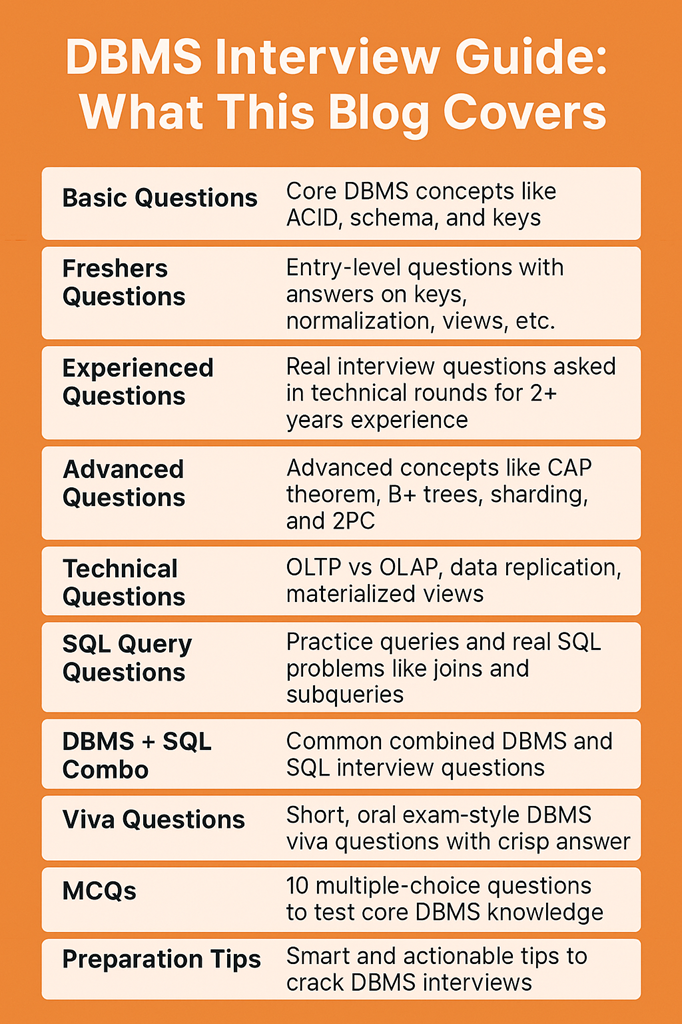
Note: We have divided the top 50 DBMS interview questions into different categories to make your preparation easier. You will find sections for basic questions, freshers, experienced professionals, advanced topics, technical questions, viva questions, and MCQs.
Basic DBMS Interview Questions
Here are some of the most common DBMS interview questions and answers to help you understand the basics clearly.
- What is a DBMS and how is it different from a file system?
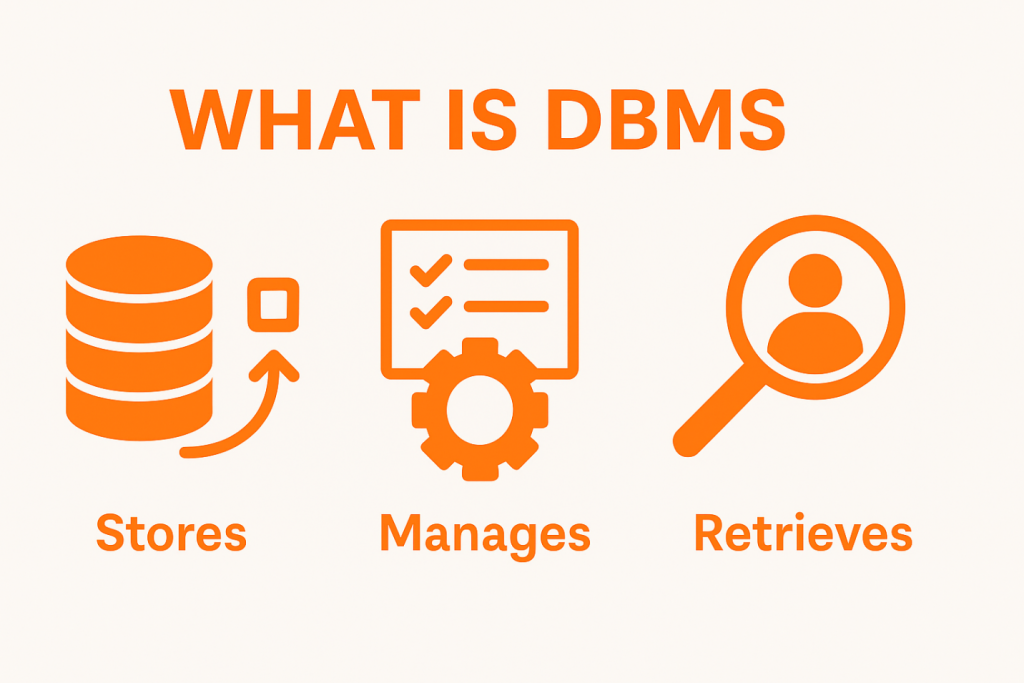
A Database Management System (DBMS) is software that helps store, organize, and manage data. It supports querying, updating, and controlling access to the data.
A file system, on the other hand, stores data as flat files without relationships. DBMS allows you to define how data relates to other data – which flat files can’t do.
- What are the different types of DBMS?
There are four main types:
- Hierarchical DBMS: Data is stored in a tree-like structure.
- Network DBMS: Uses graph-like connections with many-to-many relationships.
- Relational DBMS (RDBMS): Data is stored in tables (rows and columns).
- Object-Oriented DBMS: Data is stored as objects, like in OOP.
- What is data abstraction in DBMS?
Data abstraction hides unnecessary details from users. It works on three levels:
- Physical level: Describes how data is stored.
- Logical level: Shows what data is stored.
- View level: Displays only needed data to users.
- What are the key components of a DBMS?
Key components include:
- Storage Manager for managing data on disk
- Query Processor for handling user queries
- Transaction Manager to handle transactions and maintain data integrity
- Database Engine which reads/writes data
- Catalog or data dictionary
- What is a database schema?
A schema defines the structure of a database. It includes table names, columns, data types, and relationships. Think of it as a blueprint.
- What is a relation in a relational database?
A relation is a table with rows and columns. Each row is a record, and each column is an attribute.
- What is the role of a primary key in a table?
A primary key uniquely identifies each row. It cannot be null or duplicate.
- What are the ACID properties in DBMS?
- Atomicity: All steps succeed or none.
- Consistency: Database stays valid after the transaction.
- Isolation: Transactions don’t affect each other.
- Durability: Committed changes are permanent, even after a crash.
Note: These are some of the basic DBMS questions asked in interview rounds for freshers and entry-level roles. Understanding these will give you a strong foundation for more advanced topics.
Top DBMS Interview Questions for Freshers
These database management system questions and answers are perfect for freshers starting their interview preparation.
- What is normalization? Why is it needed?
Normalization is the process of organizing data to remove redundancy. It breaks large tables into smaller related ones. This keeps the data clean and reduces errors during updates. It also improves storage efficiency and makes the database easier to manage.
- What is the difference between a primary key and a foreign key?
A primary key uniquely identifies each row in a table. It can’t be null or duplicated. A foreign key connects one table to another by referring to the primary key in the other table. It helps maintain relationships between tables.
- What is a composite key?
A composite key is made of two or more columns used together to identify a record uniquely. Neither column alone is enough, but the combination makes it unique.
- What is a candidate key in DBMS?
A candidate key is any column or combination of columns that can uniquely identify a record. A table can have multiple candidate keys, but only one is picked as the primary key.
- What is a view in DBMS?
A view is a virtual table based on a query. It doesn’t store data itself. Instead, it shows data from one or more real tables. Views are useful when I want to give users limited access to specific data.
- What are the different types of relationships in a database?
There are three main types:
- One-to-One (1:1): One record matches one record.
- One-to-Many (1:M): One record links to many.
- Many-to-Many (M:N): Many records link to many in both directions.
- What are constraints in DBMS?
Constraints are rules that limit what data can be entered in a table. Common types are:
- NOT NULL: Field must have a value.
- UNIQUE: All values must be different.
- PRIMARY KEY: Uniquely identifies each row.
- FOREIGN KEY: Links to another table.
- CHECK: Limits values in a column.
- DEFAULT: Sets a default value if none is given.
Most Asked DBMS Interview Questions for Experienced Professionals
Let’s go through some important database management system interview questions that are often asked to experienced professionals during technical rounds.
- What is the difference between logical and physical database design?
Logical design defines tables, columns, data types, and relationships without worrying about how data is stored. Physical design focuses on how data is actually stored on disk – including indexing, partitioning, and file structures. Logical is about structure; physical is about performance.
- How does indexing improve query performance?
Indexing helps the database find rows faster. Instead of scanning every row, it jumps straight to matching entries. It speeds up SELECT operations, but slows down INSERTs and UPDATEs.
- What is a transaction log and how is it used in recovery?
A transaction log records every change made to the database. If the system crashes, the DBMS uses this log to recover. It can replay committed transactions or roll back incomplete ones to bring the database back to a stable state.
- What are deadlocks? How can they be avoided in DBMS?
Deadlocks happen when two transactions wait on each other forever. For example, I hold lock A and wait for lock B, while another transaction holds B and waits for A. To avoid deadlocks, systems use timeout, lock ordering, or deadlock detection and resolution techniques.
- How is concurrency control handled in DBMS?
Concurrency control makes sure multiple transactions can run safely at the same time. DBMS uses locking, timestamp ordering, or multiversion control to avoid problems like lost updates or dirty reads. These methods help keep data accurate even with many users.
- What are different transaction isolation levels and their impact?
There are four main levels:
- Read Uncommitted: Fastest but risks dirty reads.
- Read Committed: Prevents dirty reads. Still allows non-repeatable reads.
- Repeatable Read: Prevents dirty and non-repeatable reads.
- Serializable: Most strict, prevents all anomalies but can be slow.
Each level balances accuracy and speed differently.
Advanced DBMS Interview Questions
This section covers complex DBMS interview questions and answers that are commonly asked in senior-level and technical interviews.
- What is the CAP theorem and how does it apply to distributed databases?
The CAP theorem states that a distributed system can’t provide Consistency, Availability, and Partition Tolerance all at once. At most, you can have two out of three.
For example, during a network failure, a system must choose between being consistent or being available. Many NoSQL systems prioritize availability and partition tolerance.
- What is sharding and how does it work?
Sharding is the process of splitting a large database into smaller, faster parts called shards. Each shard holds a subset of the data.
For example, data can be split by region or customer ID. This allows horizontal scaling, meaning more machines can handle the load as data grows.
- What is the difference between B-tree and B+ tree indexing?
B-tree stores data in both internal and leaf nodes. In contrast, B+ tree stores data only in leaf nodes. Internal nodes in B+ trees only store keys. Also, B+ trees have linked leaf nodes, which makes range queries faster. That’s why most modern DBMS use B+ trees for indexing.
- How does the two-phase commit protocol work in distributed systems?
It is a method used to commit a transaction across multiple systems.
- Phase 1 (Prepare): The coordinator asks all nodes if they are ready to commit.
- Phase 2 (Commit/Rollback): If all say yes, it commits. If any say no, it rolls back everywhere. This helps maintain atomicity across systems.
- What is the role of a transaction manager in a distributed DBMS?
The transaction manager coordinates transactions across different nodes. It tracks states, handles commit or rollback, manages concurrency, and makes sure transactions follow ACID rules – even in a complex, distributed setup.
DBMS Technical Interview Questions
These are some DBMS imp questions that test your core technical knowledge and problem-solving skills in real-time scenarios.
- What is the difference between OLTP and OLAP systems?
OLTP (Online Transaction Processing) handles real-time operations like insert, update, and delete. It’s used in systems like banking and shopping carts.
OLAP (Online Analytical Processing) is used for data analysis and reporting. It processes large volumes of data but isn’t meant for frequent updates.
- How do you design a database for a real-world system like a library or an e-commerce store?
First, I identify the main entities – like Users, Products, Orders, or Books. Then I define relationships between them and create tables with appropriate keys. I focus on normalization to reduce redundancy, and I add indexes for faster search.
- What are materialized views and when should they be used?
A materialized view stores the result of a query physically. They need to be refreshed manually or on a schedule. Unlike regular views, it doesn’t fetch fresh data every time. It is useful when I need to run complex queries often and performance is important.
- What is data replication and why is it important?
Data replication means copying data from one server to another. It improves availability and reliability. If one server fails, others can still serve data. It also helps in load balancing for read-heavy applications.
- What is data partitioning and what are its types?
Data partitioning means dividing a large table into smaller, manageable parts. Types include:
- Horizontal partitioning: Splits rows
- Vertical partitioning: Splits columns
- Range/hash/list partitioning: Based on data values
DBMS Queries Interview Questions
Here are some important DBMS queries questions that will help you practice and improve your SQL query skills for interviews.
- Write a SQL query to get the second highest salary from an Employee table.
SELECT MAX(salary)
FROM employees
WHERE salary < (SELECT MAX(salary) FROM employees);
This works by finding the maximum salary that’s less than the highest one.
- How do you optimize a slow-running SQL query?
I check for missing indexes, avoid SELECT *, use WHERE clauses properly, and limit joins. I also review execution plans and avoid unnecessary subqueries or functions on indexed columns.
- What is the difference between INNER JOIN and OUTER JOIN?
An INNER JOIN returns only matching rows from both tables. An OUTER JOIN returns matching rows plus non-matching rows from one or both tables – LEFT, RIGHT, or FULL depending on the type.
- What is a correlated subquery and how does it work?
It is a subquery that depends on the outer query. It runs once for every row of the outer query. For example, finding employees who earn more than the average salary in their department.
- What is the purpose of the GROUP BY and HAVING clauses?
GROUP BY groups rows that share a value in a column. It is often used with aggregate functions like COUNT or SUM. HAVING is like WHERE, but it filters grouped results. I use HAVING when I need to filter based on group totals.
DBMS and SQL Interview Questions
Here are key questions that cover both DBMS concepts and SQL queries, often asked together in technical interviews.
- What is the difference between DDL, DML, DCL, and TCL in SQL?
- DDL (Data Definition Language): Deals with structure – CREATE, ALTER, DROP.
- DML (Data Manipulation Language): Works with data – SELECT, INSERT, UPDATE, DELETE.
- DCL (Data Control Language): Manages access – GRANT, REVOKE.
- TCL (Transaction Control Language): Controls transactions – COMMIT, ROLLBACK, SAVEPOINT.
- What is the use of the CHECK constraint in SQL?
The CHECK constraint limits values in a column based on a condition.
For example, to restrict age to 18 and above:
CHECK (age >= 18)
It helps maintain valid and clean data.
- What are aggregate functions in SQL? Give examples.
Aggregate functions perform operations on a group of values. Common ones include:
- COUNT() – counts rows
- SUM() – adds values
- AVG() – calculates average
- MAX()/MIN() – find highest or lowest value
- How does a stored procedure differ from a function?
A stored procedure performs tasks but doesn’t have to return a value. A function returns a value and is often used inside SQL statements. I usually use functions for calculations and procedures for logic flow.
- How can you prevent SQL injection attacks?
Use parameterized queries or prepared statements. Avoid string concatenation in SQL. Also, validate input on both client and server side.
DBMS Viva Questions
Let’s go through some common DBMS viva questions that are frequently asked in oral exams and academic interviews.
- Define DBMS in one line.
A DBMS is software that helps store, manage, and access data efficiently.
- What is a foreign key?
A foreign key is a column that creates a link between two tables. It refers to the primary key in another table. This helps maintain relationships and keeps data consistent across tables.
- What is an ER diagram and why is it used?
An ER (Entity-Relationship) diagram is a visual tool that shows entities, their attributes, and how they relate. It helps in designing databases by giving a clear layout before actual implementation. I usually draw one to plan the tables and relationships early on.
- Name three differences between DBMS and RDBMS.
- Data Storage: DBMS stores data as files; RDBMS stores it in tables.
- Relationships: DBMS doesn’t support relations between data; RDBMS does.
- Keys: RDBMS uses primary and foreign keys; DBMS may not.
- What is a trigger in SQL?
A trigger is a piece of code that runs automatically when a specific event happens in a table, like an insert or update. For example, I can use a trigger to log changes in a table whenever a row is updated.
Also Read - Top 20+ Interview Questions for RDBMS with Expert Answers
DBMS MCQs
Here are some multiple-choice DBMS interview questions to test your knowledge and help with quick preparation.
- Which SQL command is used to remove a table from a database?
A) DELETE
B) REMOVE
C) DROP
D) ERASE
Answer: C) DROP
- Which type of join returns all rows from both tables, including unmatched rows?
A) INNER JOIN
B) LEFT JOIN
C) RIGHT JOIN
D) FULL OUTER JOIN
Answer: D) FULL OUTER JOIN
- Which normal form removes transitive dependency?
A) 1NF
B) 2NF
C) 3NF
D) BCNF
Answer: C) 3NF
- What does the ROLLBACK command do in SQL?
A) Saves all changes made
B) Reverses changes made in the current transaction
C) Deletes the entire table
D) Commits the transaction
Answer: B) Reverses changes made in the current transaction
- Which of these is a DDL command?
A) CREATE
B) SELECT
C) UPDATE
D) INSERT
Answer: A) CREATE
- What is the default isolation level in most RDBMS?
A) Read Uncommitted
B) Read Committed
C) Repeatable Read
D) Serializable
Answer: B) Read Committed
- Which key allows null values – Primary, Unique, or Foreign?
A) Primary Key
B) Unique Key
C) Foreign Key
D) Both B and C
Answer: D) Both B and C
- What type of index is used to sort the data in a table?
A) Non-clustered index
B) Unique index
C) Composite index
D) Clustered index
Answer: D) Clustered index
- What does the term “atomicity” refer to in DBMS transactions?
A) Transactions that are fast
B) Transactions that are small in size
C) All operations in a transaction must succeed or none should
D) Transactions that can be rolled back partially
Answer: C) All operations in a transaction must succeed or none should
- Which SQL clause is used to group rows with the same values?
A) ORDER BY
B) HAVING
C) GROUP BY
D) PARTITION BY
Answer: C) GROUP BY
How to Prepare for a DBMS Interview?
Preparing for a DBMS interview means knowing theory and practicing queries. Here are some tips to help you.
- Revise all key DBMS concepts for interview like keys, normalization, indexing, and transactions.
- Practice SQL queries daily – focus on JOINs, subqueries, and GROUP BY.
- Review common DBMS viva questions if you are a student or fresher.
- Solve at least 2–3 real SQL problems on platforms.
- Read your project’s database design if applying as an experienced candidate.
- Stay calm and explain your answers clearly during the interview session.
Wrapping Up
With these 50+ DBMS interview questions and answers, you now have a strong base to prepare confidently. Focus on understanding the concepts and practicing queries – that’s what truly helps during interviews.
Looking for your next career opportunity? Visit Hirist to find high-paying IT jobs, including job roles in database management, development, and data engineering.
FAQs
A database is an organized collection of data that can be easily accessed, managed, and updated. It helps store information like customer details, orders, or records in a structured way.
It depends on the role. For freshers, DBMS interview questions are mostly conceptual. For experienced roles, expect scenario-based problems and advanced SQL. If you know your basics and practice queries well, DBMS interview questions are manageable.
The typical process includes:
An online or written technical test
One or two technical interviews (SQL + DBMS concepts)
An HR or managerial round
Sometimes, system design or real SQL problem-solving is also included.
In DBMS viva exams, questions are usually short and concept-based. You may be asked to define DBMS, explain keys, normalization, or ACID properties.
Infosys often asks questions that test both fundamentals and practical understanding. Here are 5 commonly asked DBMS interview questions.
What are the types of DBMS?
Explain normalization with an example.
What is a trigger in SQL?
How do primary and foreign keys work?
Write a query to fetch the second highest salary.
You can say: “DBMS stands for Database Management System. It is software that helps store, organize, and manage data so it can be accessed and updated easily. It supports multiple users, keeps data consistent, and helps in building applications that rely on structured data.”
Here is a salary comparison table for key DBMS-related roles in India, based on data from AmbitionBox.
| Role | Salary Range (₹ LPA) | Average Annual Salary (₹ LPA) | Monthly In-hand (₹) |
| Data Engineer | ₹4 – ₹22 LPA | ₹11.7 LPA | ₹60,000 – ₹61,000 |
| Database Developer | ₹2.2 – ₹13.5 LPA | ₹6.9 LPA | ₹39,000 – ₹40,000 |
| Database Manager | ₹3 – ₹37 LPA | ₹19.5 LPA | ₹1.02 L – ₹1.04 L |
| Database Administrator | ₹4 – ₹25 LPA | ₹10.8 LPA | ₹72,000 – ₹74,000 |
| Database Designer | ₹1.7 – ₹20 LPA | ₹5 LPA | ₹38,000 – ₹39,000 |
| Database Engineer | ₹2.8 – ₹20 LPA | ₹8.8 LPA | ₹47,000 – ₹48,000 |
Database Engineer Salary Overview (India, 2025)
| Metric | Value |
|---|---|
| Annual salary range | ₹2.8 Lakhs – ₹20 Lakhs |
| Avg. annual salary | ₹8.8 Lakhs |
| Monthly in-hand salary | ₹47,000 – ₹48,000 |
| Experience range in data | 1 – 8 years |
Database Developer Salary Overview (India, 2025)
| Metric | Value |
|---|---|
| Annual salary range | ₹2.2 Lakhs – ₹13.5 Lakhs |
| Avg. annual salary | ₹6.9 Lakhs |
| Monthly in-hand salary | ₹39,000 – ₹40,000 |
| Experience range in data | 1 – 7 years |
Database Manager Salary Overview (India, 2025)
| Metric | Value |
|---|---|
| Annual salary range | ₹3 Lakhs – ₹37 Lakhs |
| Avg. annual salary | ₹19.5 Lakhs |
| Monthly in-hand salary | ₹1.02 Lakh – ₹1.04 Lakh |
| Experience range in data | 1 – 15 years |
Comparative Summary of Database Roles
| Role | Avg. Annual Salary | Experience Range | Sample Size |
|---|---|---|---|
| Database Manager | ₹19.5 Lakhs | 1 – 15 years | 391 salaries |
| Database Engineer | ₹8.8 Lakhs | 1 – 8 years | 1.6k salaries |
| Database Developer | ₹6.9 Lakhs | 1 – 7 years | 4.5k salaries |
Some leading companies hiring for DBMS and database-related roles include:
TCS
Infosys
Accenture
Cognizant
IBM
Oracle
Wipro
Amazon and Google (for advanced DB roles)