
Mainframes are large and powerful computers designed to process massive data and run critical business tasks. They first emerged in the 1950s with IBM, guided by Thomas J. Watson, playing a key role in their development. Over time, mainframes became the backbone for industries such as banking, insurance, and government, and they are still widely used today. For anyone preparing to enter this field, understanding common questions is important. In this blog, we cover 30+ mainframe interview questions and answers from basics to advanced topics.
Fun Fact: 92 of the world’s top 100 banks still rely on IBM mainframes for their core operations.
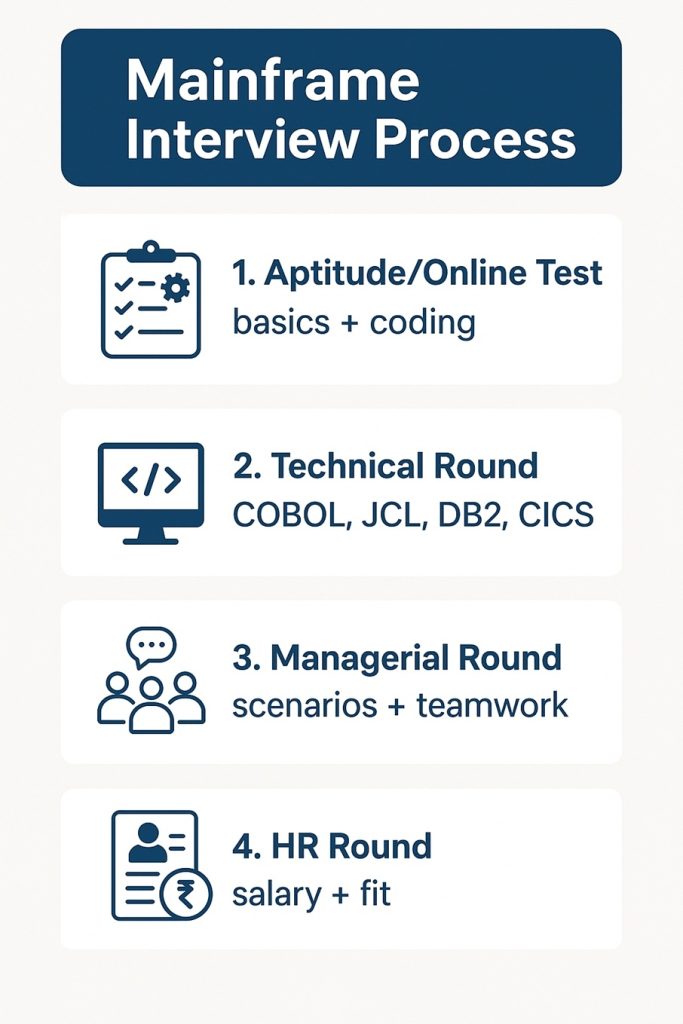
Mainframe Interview Process Explained
Mainframe Interview Questions for Freshers
Here are some of the most asked mainframe interview questions and answers to help you prepare for entry-level roles.
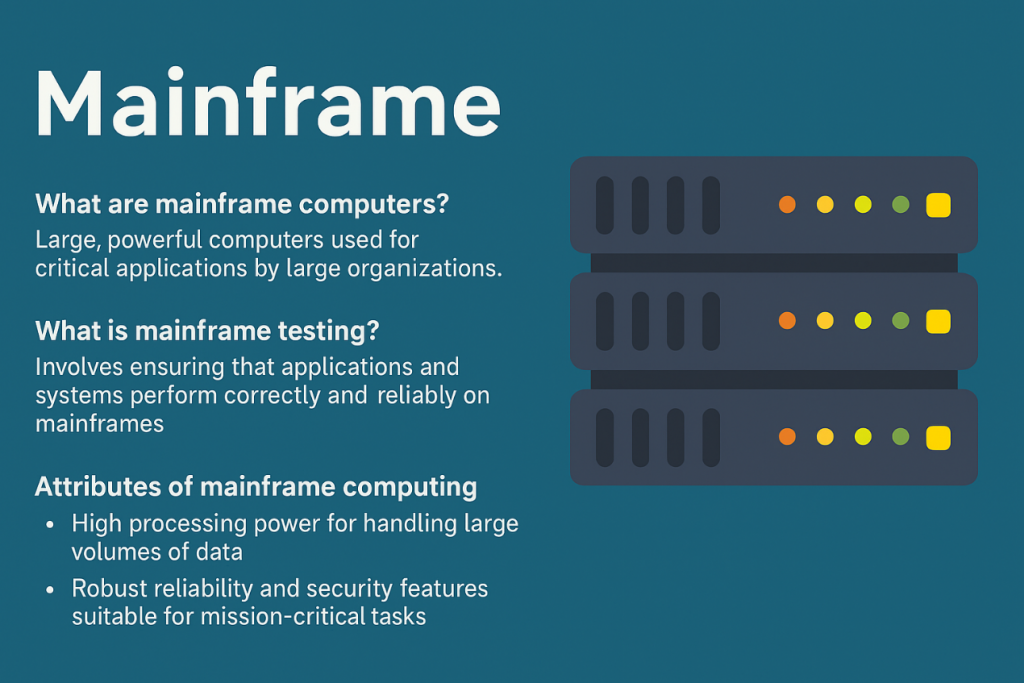
- What are mainframe computers?
Mainframes are large, high-performance computers built to process millions of transactions quickly. They support thousands of users simultaneously and are widely used in banks, airlines, and government.
- What are the key attributes of mainframe computing?
Mainframes are known for high speed, reliability, scalability, and strong security. They process petabytes of data with minimal downtime, making them critical for industries that cannot afford service interruptions.
- What is mainframe testing?
It means testing applications that run on mainframes. The focus is on batch jobs, online transactions, and database operations. The goal is to confirm that programs handle heavy loads, large data, and maintain accuracy.
- What does DRDA stand for and what role does it play in mainframe systems?
DRDA stands for Distributed Relational Database Architecture. It is a protocol that lets applications on one system talk to databases on another. IBM introduced it so remote clients could run SQL queries against DB2 databases without being on the same machine.
In practice, DRDA defines how requests are formatted, sent, and how results come back, which is crucial in enterprise setups where mainframes often interact with distributed servers.
- Name the types of JCL statements and what each is used for.
There are three types of Job Control Language (JCL) statements:
- JOB: Defines the start of the job and basic details like account info.
- EXEC: Specifies the program or procedure to run.
- DD (Data Definition): Describes input and output datasets used by that program.
- What are the three types of DB2 tablespaces?
DB2 supports simple, segmented, and partitioned tablespaces.
- Simple tablespaces can hold multiple tables but are less common now. IBM has deprecated them in favor of UTS (Universal Table Spaces.
- Segmented tablespaces group data by tables, improving performance for multi-table databases.
- Partitioned tablespaces divide a table across partitions, often used for very large datasets where access speed matters.
- Describe the difference between index and subscript in COBOL tables.
A subscript is just a number that represents the occurrence of an element. It requires conversion each time it is used. An index, on the other hand, stores the displacement value directly and is declared with the INDEXED BY phrase. That makes access faster than subscripts.
- How do you define a VSAM dataset?
VSAM datasets are defined using the IDCAMS utility. For example, you run DEFINE CLUSTER with options for dataset name, key length, and record size.
Mainframe Interview Questions for Experienced
These are some important mainframe experience interview questions and answers for senior roles.
- Walk me through diagnosing and fixing a slow CICS transaction impacting region-wide performance.
I would start by checking CICS performance monitors for transaction statistics. Next, I’d review CPU, I/O, and wait times to isolate bottlenecks. If it’s SQL-related, I’d examine DB2 access paths. In some cases, adjusting program logic or splitting workload reduces response delays.
- How do you optimize a DB2 query consuming high CPU in production?
The first step is to run an EXPLAIN to review access paths. Indexes may need to be added or restructured. I’d also check for unnecessary joins, functions on indexed columns, or large table scans. Partitioning can help if tables are very large.
- What action do you take when a critical batch job is running much longer than usual?
I’d check job logs for errors, then system utilization to see if other workloads are causing contention. Reviewing sort steps, I/O, and SQL execution often points to the cause. If needed, I’d restart the job with adjusted parameters or break it into smaller runs.
- What is a deadlock in DB2 and what typically causes it?
A deadlock happens when two programs are waiting on resources locked by each other. In DB2, this usually occurs when both try to update the same rows or tables at the same time. DB2 detects the conflict and cancels one transaction to break the loop.
- Why is a Type-2 index better and when do you use it?
A Type-2 index avoids page splits and improves concurrency. It is efficient for queries using multiple columns in predicates. I’d use it when large tables frequently need composite filtering and high throughput.
- How do you implement a high-availability solution for a batch job with a strict completion window?
I would configure job restarts with checkpoints so partial work isn’t lost. Parallel processing can be applied for independent steps. Scheduling tools like CA7 or Control-M help reassign resources dynamically if delays occur.
Note: We are also covering additional mainframe interview questions for experienced professionals, grouped according to different experience levels to help you prepare better.
Mainframe Interview Questions for 5 Years Experienced
- How do you keep up with the latest trends in mainframe technology?
- Tell me about a time you resolved a critical live issue in a mainframe environment.
- Describe a challenging situation with a mainframe system and how you handled it.
- Explain how you tune a DB2 query or COBOL job for better performance.
- What would you do if a batch job abends with S0C7?
Mainframe Interview Questions for 8 Years Experienced
- What role have you played in modernizing legacy mainframe applications or systems?
- Describe how you collaborate across teams during a production outage.
- Share a scenario where you had to debug a COBOL program that returned incorrect data.
- What approach do you take to handle DB2 lock contention or optimize access paths?
- How would you respond to a CICS slow-response issue affecting users?
Mainframe Interview Questions for 10 Years Experienced
- How have you implemented mainframe-hybrid integration or cloud bridging solutions?
- Tell me about leading a performance tuning initiative that markedly improved throughput.
- Give an example of solving a deep-rooted mainframe system issue using root cause analysis.
- Explain how you design complex job recovery mechanisms for long-running batch jobs.
- How would you lead recovery from a mainframe system crash with minimal downtime?
Tricky Mainframe Interview Questions
Let’s go through some tricky mainframe interview questions and answers that test deeper understanding and problem-solving skills.
- How does binary search work and why does it require sorted data?
Binary search repeatedly splits a dataset in half to find a value. The algorithm compares the target with the middle element, then discards half the data each step. It works in O(log n) time, which is efficient. Sorting is required because the algorithm assumes order when discarding half the data. Without sorted input, it won’t work correctly.
- What are the four FILE OPEN modes and how are they used?
- INPUT: Opens an existing file only for reading.
- OUTPUT: Creates a new file or rewrites an existing one.
- EXTEND: Opens a file to add new records at the end.
- I-O: Opens a file for both reading and updating.
Each mode is chosen depending on whether the file is read, written, or both.
- What is lock contention and how do you address it in DB2?
Lock contention happens when two or more programs try to access the same DB2 object at the same time. It slows processing and can cause deadlocks. To address it, I reduce the scope of locks by using row-level instead of table-level locks, commit more frequently, or redesign queries to avoid holding resources longer than needed.
- Explain paging. What it is and how it works at the hardware/software level.
Paging is a memory management method where data is moved between main memory and secondary storage in fixed-size blocks called pages.
The operating system uses a page table to map logical addresses to physical memory. Hardware support from the Memory Management Unit (MMU) handles translation, while software decides which pages to keep or swap.
Interview Questions for Mainframe Developer
This section covers mainframe interview questions with answers for developer roles.
- Describe how an IBM mainframe system is architected and how components interact.
An IBM mainframe uses a layered design. At the bottom is hardware with processors, memory, and channels. Above that is the z/OS operating system handling scheduling, I/O, and security.
Subsystems like DB2 and CICS sit on top to provide database and transaction services. Applications interact with these subsystems, while users connect through terminals or APIs. The components work together to process high-volume transactions with reliability.
- Walk through the flow of a CICS transaction from start to finish.
A user initiates a transaction by entering a code. CICS receives it, validates input, and routes it to the right program. That program may fetch or update data in DB2 or VSAM. After processing, CICS sends the result back to the user terminal.
- How do static and dynamic calls differ in COBOL programs?
In static calls, the called program is included during compile and link steps, making execution faster but less flexible. In dynamic calls, the subprogram is loaded at runtime, allowing changes without recompiling the main program.
- How do you use the PERFORM statement in COBOL for loops and subroutine execution?
The PERFORM statement repeats logic blocks or calls subroutines. It can be used for fixed iterations, conditional loops, or to call paragraph sections for modular code.
Interview Questions for Mainframe Testing
Here are some mainframe testing interview questions for experienced professionals and freshers.
- What does mainframe testing involve and why is it important?
Mainframe testing checks applications running on IBM mainframes. It covers batch jobs, online CICS transactions, database access, and system integration.
The goal is to confirm stability, accuracy, and performance when handling massive data volumes. It is important because industries like banking and insurance still depend heavily on mainframes for critical operations.
- How would you test a COBOL program that reads VSAM datasets?
I would start by preparing input VSAM files with valid and invalid records. Then, run the COBOL program in a controlled test environment and compare the output with expected results. I would also test edge cases like empty files or duplicate keys.
- What strategies do you use to test JCL, especially batch job error handling?
I test JCL by running jobs with both correct and incorrect parameters. To check error handling, I might intentionally provide missing datasets or invalid DISP values. Then, I verify whether the job abends with correct return codes and whether recovery steps are triggered properly.
Mainframe Architect Interview Questions
Here are the mainframe architect interview questions with answers that can help you prepare for senior-level discussions.
- How do you design a high-availability architecture for mainframe batch and online workloads?
I would design it with workload balancing, checkpoint restart for batch jobs, and parallel sysplex for online workloads. This setup minimizes downtime and supports continuous processing.
- What role does middleware play in modern mainframe integration?
Middleware such as MQ or APIs connects mainframes with distributed and cloud systems. It allows legacy COBOL or DB2 applications to interact with web services and modern platforms seamlessly.
- What security practices do you apply in mainframe architecture?
I implement RACF or equivalent for access control, encrypt sensitive data in transit and at rest, and apply auditing policies. I also regularly review system exits and monitor privileged IDs.
Interview Questions for Mainframe Production Support
These mainframe interview questions are designed to prepare you for production support scenarios and problem-solving tasks.
- How would you handle a region-wide CICS slowdown due to a specific transaction?
I would start by using CICS monitoring tools to identify the transaction causing delays. If the slowdown is from inefficient SQL, I’d review DB2 access paths. Sometimes code fixes or transaction limits are needed to restore response times.
- How do you manage a batch job running much longer than expected in production?
First, I check the job log and system usage. If CPU or I/O bottlenecks exist, I adjust scheduling or allocate more resources. I also look for unusual data growth or SQL inefficiencies. If possible, I’d restart the job from a checkpoint instead of re-running it entirely.
- What is your protocol when a CICS transaction times out or hangs?
I check the CICS log for transaction IDs and abend codes. If the issue is a loop or DB2 lock, I cancel the task and escalate with logs. For recurring cases, I review code and system settings to prevent repeats.
Other Important Mainframe Interview Questions
Here are some additional mainframe interview questions that cover mixed concepts from COBOL, JCL, DB2, VSAM, and CICS.
VSAM Interview Questions
Here are some important VSAM interview questions that cover data storage and performance concepts in mainframe systems.
- What are the different types of VSAM datasets?
- Which utility do you use to define or manage VSAM datasets?
- How do you optimize access to VSAM files in batch jobs?
- What are common errors seen with VSAM access and how do you troubleshoot them?
- How is data organized and retrieved in a KSDS cluster?
DB2 Questions for Mainframe Interview
Here are some commonly asked DB2 COBOL interview questions that will help you prepare for database-related mainframe roles.
- Explain what a deadlock is in DB2, how it happens, and how you resolve it.
- What are DB2 table spaces and what are their differences?
- How do you troubleshoot a DB2 query that is using an excessive amount of CPU?
- What is index cardinality and why is it important for query planning?
- What are the differences between static SQL and dynamic SQL in DB2?
CICS Mainframe Interview Questions
Here are some key CICS mainframe interview questions that focus on transaction processing.
- Explain how you investigate a CICS transaction that’s significantly slowing down.
- How do you monitor and debug CICS performance in real time?
- What commands or tools do you use to trace or gather CICS statistics?
- How do you handle deadlock involving CICS-issued locks or resources?
- What is the role of the PPT (Processing Program Table) in CICS?
Easytrieve Interview Questions
- What is Easytrieve and where is it commonly used?
- How do you define and use variables in Easytrieve?
- Explain the difference between FILE and REPORT statements in Easytrieve.
- How do you perform sorting and summarization in an Easytrieve program?
- What is the purpose of the JOB statement in Easytrieve?
Mainframe Interview Questions Asked by Top IT Companies
Now let’s look at some mainframe interview questions commonly asked by leading IT companies during their hiring process.
Infosys Mainframe Interview Questions
Here are the common Infosys mainframe interview questions for experienced professionals and freshers.
- Can you explain how to create a GDG in COBOL?
- How did you implement data integrity measures in mainframe systems?
- How can you pass parameters from JCL to COBOL?
- How do you respond to an unexpected system crash during production?
- How do you prevent future issues after resolving a system failure?
TCS Mainframe Interview Questions
- Tell us about a time you resolved a production incident quickly.
- What technical areas of mainframe do you specialize in?
- How do you approach debugging and fixing mainframe application issues?
- Describe your experience with mainframe databases like VSAM, DB2, or IMS.
- How do you use JCL in your daily tasks or projects?
Capgemini Mainframe Interview Questions
These are some important Capgemini mainframe interview questions for experienced professionals.
- What is the DBRM?
- What is a segment in IMS DB?
- Explain your experience working with CICS and BMS Macros in depth.
- What is your experience with maintaining legacy mainframe applications?
- How do you balance modernization and stability in mainframe systems?
Cognizant Mainframe Interview Questions
Here are some commonly asked CTS mainframe interview questions.
- Talk about a time you collaborated across teams during mainframe troubleshooting.
- How do you keep mainframe systems secure and compliant?
- Explain how you handle performance tuning on mainframes.
- Describe integrating mainframe services with modern systems.
- How do you plan for disaster recovery in mainframe environments?
IBM Mainframe Interview Questions
- How do you configure RACF for dataset security in z/OS?
- Explain the role of SMF (System Management Facility) in mainframe monitoring.
- What is the difference between LPAR and Sysplex in IBM mainframes?
- How do you analyze system dumps after an abend?
- Explain the process of IPL (Initial Program Load) in IBM systems.
Accenture Mainframe Interview Questions
- How do you migrate COBOL applications from mainframe to cloud platforms?
- Explain the use of GDGs in managing historical datasets.
- What steps do you follow for DB2 BIND in a deployment pipeline?
- How do you debug production abends in a multi-program batch job?
- What is the role of MQ in integrating mainframes with distributed apps?
Wipro Mainframe Interview Questions
- How do you handle performance tuning for DB2 batch queries?
- Explain the purpose and working of RESTART and RERUN in JCL.
- What are copybooks in COBOL and how do you maintain them across systems?
- How do you manage VSAM space issues in production?
- What tools do you use for mainframe job scheduling?
JP Morgan Mainframe Interview Questions
- How do you implement disaster recovery for a mainframe system?
- What is the difference between static and dynamic SQL in DB2?
- How do you monitor transaction load in CICS?
- Explain how encryption is applied for sensitive data in mainframe databases.
- Describe how you would handle a failed batch cycle before trading hours.
Barclays Mainframe Interview Questions
- What is IMS DB and how does it differ from DB2?
- How do you integrate mainframe systems with real-time APIs?
- Explain checkpoint/restart in COBOL batch programs.
- How do you test and validate performance in a banking workload?
- What’s the role of CA7 in mainframe job scheduling?
BNY Mellon Mainframe Interview Questions
- How do you set up security policies in RACF?
- What is the difference between REORG and RUNSTATS in DB2?
- How do you trace and resolve memory leaks in a COBOL application?
- Explain how you manage dataset versioning in a banking environment.
- What are common regulatory compliance requirements for mainframes in financial firms?
Broadridge Mainframe Interview Questions
- How do you design COBOL programs to handle high-volume transaction files?
- What steps do you take to automate VSAM dataset backups?
- How do you implement dual control for production dataset updates?
- Explain the process of creating test stubs for CICS transactions.
- How do you handle reconciliation of large data feeds on mainframes?
CGI Mainframe Interview Questions
- What is SMP/E and why is it important?
- How do you manage COBOL program version control in production?
- Explain how IMS DC differs from CICS.
- How do you configure JES2 for job prioritization?
- What tools do you use for mainframe change management?
DXC Technology Mainframe Interview Questions
Here are some commonly asked DXC mainframe interview questions.
- How do you migrate batch jobs from CA7 to Control-M?
- Explain the process of defining and managing GDGs for client data.
- How do you implement monitoring for SLA-bound jobs?
- What challenges do you face in cross-platform mainframe integration?
- How do you debug storage-related abends in COBOL programs?
Fiserv Mainframe Interview Questions
- How do you secure payment transaction data on mainframes?
- What are the steps in analyzing DB2 performance with EXPLAIN and PLAN_TABLE?
- How do you implement retry logic in JCL for failed jobs?
- What is the role of SMP/E in applying maintenance?
- How do you support 24×7 processing in mainframe environments?
HCL Mainframe Interview Questions
- How do you tune VSAM for high I/O workloads?
- What is the role of REXX in automating mainframe tasks?
- How do you manage COBOL copybook changes across multiple systems?
- Explain steps for resolving storage contention in DB2.
- What’s the difference between JES2 and JES3 job entry subsystems?
Mainframe MCQs
- Which utility is used to define VSAM datasets?
A) IEBGENER
B) IDCAMS
C) DFSORT
D) IEBCOPY
Answer: B) IDCAMS
- What does the S0C7 abend indicate?
A) Divide by zero
B) Invalid address
C) Data exception
D) End of file
Answer: C) Data exception
- What is the purpose of the PERFORM statement in COBOL?
A) To define variables
B) To call subroutines
C) To execute a loop or procedure
D) To read files
Answer: C) To execute a loop or procedure
- Which JCL statement executes a program?
A) EXEC
B) DD
C) JOB
D) DISP
Answer: A) EXEC
- In CICS, which command retrieves data from a terminal?
A) RECEIVE
B) SEND
C) WRITE
D) READ
Answer: A) RECEIVE
- What does TERMID specify in CICS?
A) Transaction ID
B) Terminal ID
C) File ID
D) User ID
Answer: B) Terminal ID
- Which DB2 component manages locks?
A) Data Manager
B) Lock Manager
C) Resource Manager
D) Transaction Manager
Answer: B) Lock Manager
How to Prepare for Mainframe Interview?
Preparing for mainframe interviews requires practice, focus, and strong command over both concepts and problem-solving. Here are some tips you can use.
- Revise mainframe interview questions regularly to stay confident and quick in responses.
- Practice COBOL, JCL, DB2, VSAM, and CICS coding examples with real datasets.
- Understand how to debug batch jobs and handle abends with practical scenarios.
- Read about performance tuning in DB2 queries and CICS transactions.
- Work on mock interviews to sharpen communication skills.
- Stay updated with latest mainframe tools used in production support.
Wrapping Up
So, these are the 30+ mainframe interview questions and answers that can help you prepare better. Mainframes are still widely used in industries like banking, insurance, and government, making skilled professionals always in demand.
If you are looking for IT jobs including mainframe job roles, explore exciting opportunities on Hirist today.
FAQs
It usually includes a technical round with coding or SQL tasks, followed by scenario-based problem-solving, and an HR round focusing on communication and team fit.
Top recruiters include IBM, TCS, Infosys, Capgemini, Cognizant, and major banks and insurance firms.
As per data from AmbitionBox, the average annual salary for a Mainframe Developer in India is ₹6.8 Lakhs. For professionals with 2–5 years of experience, the salary range is ₹4 Lakhs to ₹10 Lakhs per year. This translates to a monthly in-hand salary of around ₹43,000 – ₹44,000.
Mainframe Developer Salary Overview (India, 2025)
| Metric | Value |
|---|---|
| Annual salary range | ₹4 Lakhs – ₹10 Lakhs |
| Avg. annual salary | ₹6.8 Lakhs |
| Monthly in-hand salary | ₹43,000 – ₹44,000 |
| Experience range in data | 2 – 5 years |
Mainframe Developer salary based on experience:
| Experience | Average Annual Salary |
|---|---|
| 2 years | ₹4.7 Lakhs per year |
| 3 years | ₹5.9 Lakhs per year |
| 4 years | ₹7.2 Lakhs per year |
| 5 years | ₹8.5 Lakhs per year |
Mainframe Developer salary based on location:
| City | Average Annual Salary |
|---|---|
| New Delhi | ₹8.3 Lakhs per year |
| Noida | ₹8.2 Lakhs per year |
| Pune | ₹6.8 Lakhs per year |
| Chennai | ₹6.8 Lakhs per year |
| Hyderabad | ₹6.8 Lakhs per year |
Mainframe Developer salary at top companies:
| Company | Average Annual Salary |
|---|---|
| BNY | ₹10 Lakhs per year |
| Deloitte | ₹8.9 Lakhs per year |
| Amdocs | ₹8.8 Lakhs per year |
| Carelon Global Solutions | ₹8.3 Lakhs per year |
| UST | ₹7.5 Lakhs per year |
JCL stands for Job Control Language. It is used to define how batch jobs run, including input datasets, programs, and output.
Basics include COBOL programming, JCL job setup, DB2 for database management, VSAM datasets, and CICS for transaction processing.