
BigQuery is a cloud based data warehouse created by Google in 2010 under the Google Cloud Platform. It was built to handle massive datasets using fast SQL like queries and scalable infrastructure. The service was originally developed by the team led by engineers at Google who designed Dremel, the query engine that powers BigQuery. Today, it is widely used in analytics, business intelligence and data engineering. Roles such as data analyst, data engineer and cloud architect often require strong BigQuery skills. In this blog, we cover the top 25+ BigQuery interview questions and answers to help you prepare.
Fun Fact: BigQuery can scan 1 terabyte of data in just a few seconds using its Dremel engine.
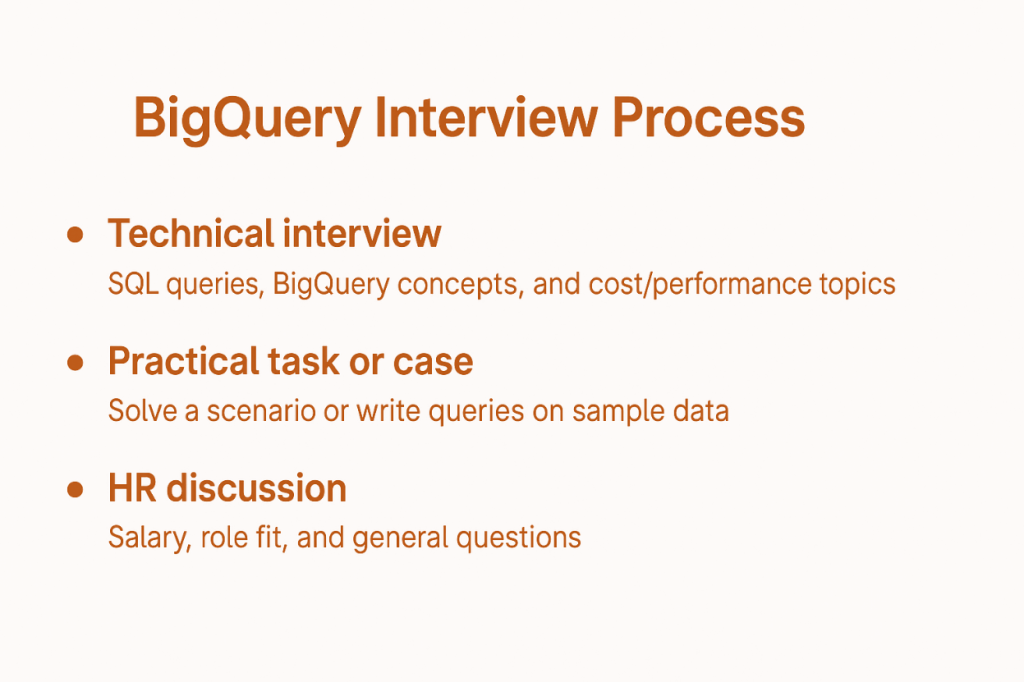
BigQuery Interview Process Explained
BigQuery Interview Questions for Freshers
Here are some important BigQuery interview questions and answers for freshers that will help you understand the basics and prepare for entry level roles.
- What is BigQuery, and how is it different from a traditional database or data warehouse?
BigQuery is Google Cloud’s serverless data warehouse built for analytics. Unlike on premise systems that need hardware and maintenance, BigQuery automatically scales storage and compute. Queries run on petabyte-scale data using SQL without manual tuning.
- What are datasets, tables, and views in BigQuery, and when would you use each?
A dataset is the top container that organizes data. Inside a dataset, you store tables that hold rows and columns of actual data. Views are virtual tables defined by SQL queries. I use views when I need a reusable query without storing duplicate data.
- What data types does BigQuery support and why do they matter?
BigQuery supports standard types like INT64, FLOAT64, STRING, BOOL, DATE, TIMESTAMP. It also supports complex types such as ARRAY, STRUCT, and JSON. These allow modeling nested data directly, which reduces the need for multiple joins and speeds up queries.
- What are common ways to load data into BigQuery, and when would you pick each?
Batch loads are used for historical or bulk data from Cloud Storage. Streaming inserts are for real-time pipelines like logs or transactions. Data Transfer Service is useful for scheduled imports from apps like Google Ads or SaaS tools.
- What is table partitioning in BigQuery, and how does it reduce scanned data?
Partitioning splits a large table into smaller segments by date, ingestion time, or integer ranges. When I query only one partition, BigQuery scans less data and lowers cost.
- What is clustering, and how does it work together with partitioning?
Clustering organizes data inside a table or partition based on column values. It makes filters and aggregations faster. Using both partitioning and clustering together is common in time-series and regional datasets.
Note: Freshers often come across basic GCP BigQuery interview questions that cover topics like architecture, SQL queries, data loading, and common use cases.
BigQuery Interview Questions for Experienced
These are some common BigQuery interview questions and answers for experienced professionals.
- How do you profile and cut query cost in BigQuery?
I start by checking query statistics to see bytes scanned. Dry runs give me an estimate before execution. I avoid SELECT * and choose only required columns. Partitioned and clustered tables help reduce scanned data. Caching is useful when queries repeat often.
- When do you use materialized views vs scheduled queries vs persisted tables for dashboards?
Materialized views are best for queries that refresh often and need low latency. Scheduled queries work well when I need to run transformations daily or hourly and write results back to a table. Persisted tables are a good fit for heavy dashboards where performance matters more than storage cost.
- How do slots (on-demand vs reservations) affect throughput, and when would you buy commitments?
On-demand slots scale automatically but costs vary with usage. Reserved slots provide dedicated capacity, which is more predictable. I would buy commitments when workloads are consistent and large, since flat-rate pricing often saves money compared to pay-per-query.
- What patterns do you use for secure access control in BigQuery?
IAM roles are the foundation for project and dataset permissions. For finer control, I use authorized views so users see only selected fields. Row-level security restricts data at the row level, while column-level security hides sensitive attributes like personal identifiers. These patterns are often combined for compliance.
- How do you design ingestion at scale and monitor reliability?
For batch jobs, Cloud Storage with load jobs works well. For real-time pipelines, Pub/Sub with Dataflow into BigQuery is the common design. Data Transfer Service covers recurring imports from SaaS tools. To monitor reliability, I use Cloud Monitoring metrics, error logs, and set up alerts for failures or latency.
Advanced BigQuery Interview Questions
Let’s go through some advanced Google BigQuery interview questions and answers that test deeper knowledge of architecture.
- How do you model nested and repeated data, and when do you UNNEST vs normalize into separate tables?
Nested and repeated fields allow storage of JSON-like structures directly inside a table. They are efficient for events, logs, and hierarchical data.
I use UNNEST when I need to flatten arrays for analysis. But if the nested structure grows too complex or joins are frequent, I normalize into separate tables for clarity and maintainability.
- When would you use federated queries instead of loading data, and what are the trade-offs?
Federated queries are helpful when I need quick access to data in Cloud Storage, Cloud SQL, or Google Drive without moving it into BigQuery. They save time and avoid extra storage costs. The trade-off is slower performance since the data is not stored natively, and large scans may be expensive.
- How do you tune joins on very large tables?
I start by filtering early with selective predicates to reduce rows before joining. I also check join order, putting smaller or filtered tables first. Partition filters reduce scanned data further. For large fact-to-fact joins, shuffle is common, but for small-to-large joins, a broadcast join often performs better.
- Where does BigQuery ML fit in production analytics, and what models or features are most used?
BigQuery ML lets teams train and run models directly with SQL. It is used for churn prediction, forecasting, recommendation, and text classification. Boosted trees, deep neural networks, and integrations with Vertex AI are widely adopted for real-time pipelines.
Also Read - Top 90+ Machine Learning Interview Questions and Answers
Technical BigQuery Interview Questions
Here are some important Google Cloud BigQuery interview questions that focus on technical concepts.
- How does BigQuery’s architecture separate storage and compute, and why does that matter for scale and cost?
BigQuery stores data in Colossus, Google’s distributed storage, while queries run on Dremel compute nodes. This separation allows storage to scale independently of compute.
It matters because you only pay for the data scanned during queries, not for idle infrastructure. It also improves flexibility since you can store petabytes cheaply and only consume compute when needed.
- What are Dremel, Colossus, and Jupiter, and how do they contribute to query speed?
Dremel is the query execution engine that reads columnar data and distributes work across thousands of slots. Colossus is the global storage layer that provides durability and quick access.
Jupiter is the high-speed network that moves data between compute and storage with very low latency. Together, they allow BigQuery to return results from terabytes in seconds.
- How do you choose partition type for a new table?
If data arrives continuously, ingestion-time partitioning is simplest. For analytics based on dates, timestamp or date partitioning works best. If values are numeric ranges, like user IDs or age groups, integer-range partitions are effective. I choose based on query filters used most often.
BigQuery SQL Interview Questions
We are also covering Google BigQuery interview questions related to SQL.
- Write a query that ranks the last 5 transactions per customer using window functions.
Use ROW_NUMBER() partitioned by customer and ordered by timestamp.
WITH r AS (
SELECT
customer_id,
txn_id,
txn_ts,
ROW_NUMBER() OVER (
PARTITION BY customer_id
ORDER BY txn_ts DESC
) AS rn
FROM `proj.ds.transactions`
)
SELECT customer_id, txn_id, txn_ts
FROM r
WHERE rn <= 5;
- Given an ARRAY or STRUCT column, query and aggregate using UNNEST while keeping row granularity correct.
Flatten nested fields and group by parent key.
SELECT
o.order_id,
SUM(i.qty * i.price) AS order_revenue
FROM `proj.ds.orders` AS o
LEFT JOIN UNNEST(o.items) AS i
GROUP BY o.order_id;
- Calculate percent contribution by product to total revenue without scanning unnecessary columns.
Select only required fields and use a window for totals.
SELECT
product_id,
SUM(net_revenue) AS revenue,
SAFE_DIVIDE(SUM(net_revenue),
SUM(SUM(net_revenue)) OVER ()) AS pct_total
FROM `proj.ds.sales`
GROUP BY product_id;
Note: Google BigQuery interview questions on SQL often include joins, window functions, subqueries, and performance optimization topics.
Also Read - Top 50+ SQL Interview Questions and Answers
BigQuery MCQs
Here are some BigQuery MCQs to test your knowledge and help you practice for interviews.
- BigQuery is best described as which type of system in Google Cloud?
a) Traditional relational database
b) Serverless, fully managed data warehouse
c) Virtual Machine-based SQL engine
d) Hadoop-based cluster
Answer: b) Serverless, fully managed data warehouse
- Which option reduces bytes scanned for time-series tables?
a) Partitioning
b) Denormalization only
c) Wider SELECT * queries
d) None of the above
Answer: a) Partitioning
- Which feature groups data within a table to speed up filters on specific columns?
a) Clustering
b) Sharding
c) Caching only
d) Replication
Answer: a) Clustering
- Which storage/compute components power BigQuery’s speed?
a) MapReduce + HDFS
b) Apache Spark + Cassandra
c) Dremel + Colossus + Jupiter
d) Hive + HDFS
Answer: c) Dremel + Colossus + Jupiter
- Which method supports near real-time ingestion?
a) Streaming inserts
b) Load jobs from Cloud Storage only
c) Transfers only
d) Batch ETL only
Answer: a) Streaming inserts
- Which resource governs compute throughput for queries?
a) Datasets
b) Slots
c) Connections
d) Storage buckets
Answer: b) Slots
- Which statement about nested and repeated fields is correct for BigQuery analytics?
a) They reduce joins via UNNEST
b) They block SQL joins
c) They are unsupported in BigQuery
d) They can only be used in JSON exports
Answer: a) They reduce joins via UNNEST
Tips to Prepare for BigQuery Interview
Preparing for BigQuery interviews needs focus on core concepts and practical problem solving skills. Here are some tips to help you:
- Revise fundamentals like datasets, tables, and views
- Practice writing queries with joins, window functions, and UNNEST
- Understand partitioning and clustering for performance
- Review cost control strategies and slot usage
- Go through common BigQuery interview questions and practice answers
- Work on sample projects and public datasets to gain confidence
Wrapping Up
With these 25+ BigQuery interview questions and answers, you now have a strong foundation to face your next interview with confidence. Keep practicing SQL, data modeling, and cost optimization to perform well as a skilled candidate.
Ready to put your skills to work? Find top IT opportunities, including BigQuery jobs, on Hirist today.
FAQs
GCP Big Query interview questions are usually asked for roles that work closely with data. These include Data Analysts, Data Engineers, Business Intelligence Developers, Cloud Engineers, and Machine Learning Engineers.
Accenture recruiters often ask practical and scenario-based BigQuery questions to test real project experience. Here are some questions you can expect:
How does BigQuery fit into the overall GCP ecosystem for enterprise analytics?
What is the difference between partitioning and clustering, and how do they impact cost and performance?
Can you explain a scenario where you used BigQuery with Pub/Sub or Dataflow in a real-time pipeline?
How do you manage access control and data security for sensitive client data in BigQuery?
How would you optimize a slow dashboard query running on billions of rows in BigQuery?
They can be challenging if you don’t have hands-on practice. Recruiters often ask practical scenarios on query optimization, cost control, and data modeling. With practice on real datasets, most questions are manageable.
Google Cloud Platform (GCP) is the full suite of cloud services. BigQuery is one service inside GCP, designed as a serverless data warehouse for analytics.
No, BigQuery is not an ETL tool. It is a data warehouse. However, you can run transformations inside BigQuery using SQL, or connect it with tools like Dataflow for ETL.
BigQuery uses standard SQL (ANSI SQL 2011 compliance). It also supports advanced extensions like ARRAY, STRUCT, and ML functions.
BigQuery is built on Dremel, Colossus, and Jupiter technologies. It stores data in columnar format and executes queries in parallel across thousands of slots, which makes it much faster than most traditional SQL databases.
As per AmbitionBox, GCP Data Engineers earn between ₹4 Lakhs to ₹19 Lakhs annually. The average salary stands at ₹9.2 Lakhs per year, while the monthly in-hand salary typically falls around ₹53,000 to ₹54,000.
GCP Data Engineer Salary Overview (India, 2026)
| Metric | Value |
|---|---|
| Annual salary range | ₹4 Lakhs – ₹19 Lakhs |
| Avg. annual salary | ₹9.2 Lakhs |
| Monthly in-hand salary | ₹53,000 – ₹54,000 |
| Experience range in data | 2 – 7 years |
GCP Data Engineer salary based on experience:
| Experience | Average Annual Salary |
|---|---|
| 2 years | ₹6.3 Lakhs per year |
| 3 years | ₹7.6 Lakhs per year |
| 4 years | ₹9.3 Lakhs per year |
| 5 years | ₹12.6 Lakhs per year |
GCP Data Engineer salary based on location:
| City | Average Annual Salary |
|---|---|
| Pune | ₹8.5 Lakhs per year |
| Hyderabad | ₹8.2 Lakhs per year |
| Bangalore | ₹8.2 Lakhs per year |
| Gurgaon | ₹8.1 Lakhs per year |
| Chennai | ₹8.0 Lakhs per year |
GCP Data Engineer salary at top companies:
| Company | Average Annual Salary |
|---|---|
| Deloitte | ₹14.9 Lakhs per year |
| Fractal Analytics | ₹14.7 Lakhs per year |
| IBM | ₹11.5 Lakhs per year |
| Capgemini | ₹9.2 Lakhs per year |
| DataMetica | ₹8.3 Lakhs per year |
BigQuery is in demand across consulting and tech firms. Top companies hiring include Google, Accenture, Deloitte, TCS, Wipro, Cognizant, Infosys, and global product companies that run large-scale analytics.