
Search Engine Optimization or SEO is the process of improving a website so it appears higher on search engines like Google. The idea of SEO began in the mid-1990s when early search engines first appeared. The term is often linked to pioneers like Bruce Clay who is considered one of the founders of SEO as an industry. Today SEO is used by businesses everywhere to attract traffic and build trust. It also created common job roles like SEO analyst and SEO manager. That is why SEO interview questions are now so important.
In this blog we cover the top 50+ SEO interview questions and answers to help you prepare.
Fun Fact: According to the 2025 Previsible State of SEO Jobs Report, 65% of SEO jobs are in-house and 35% are with agencies.
SEO Interview Process Explained
The process often includes these 4 steps:
- Screening
- Technical Round
- Scenario Round
- Final Round
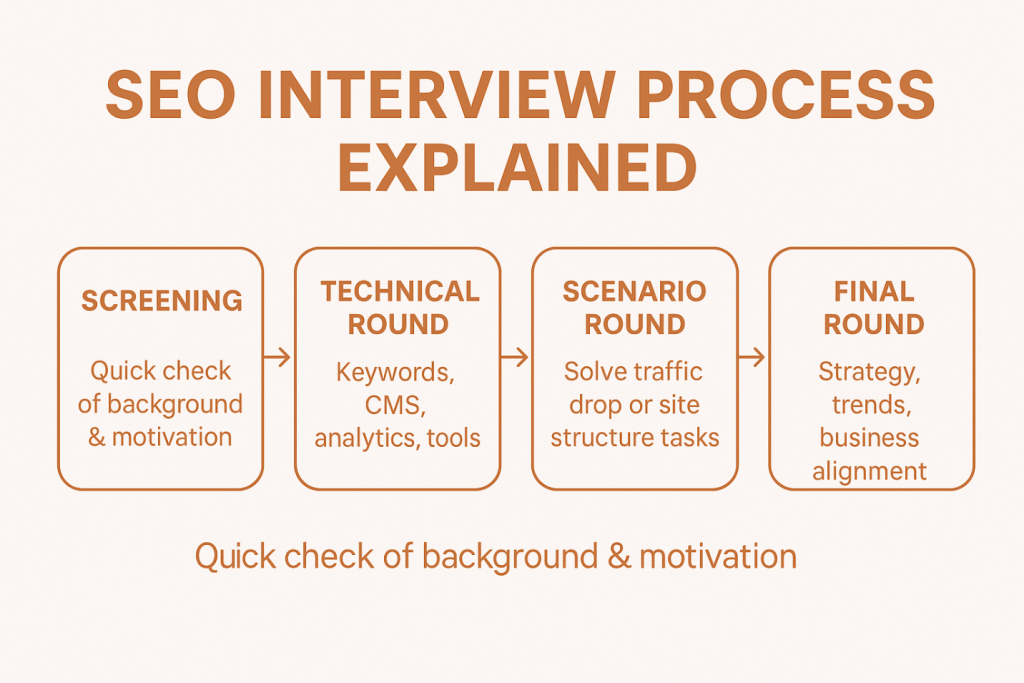
Note: This blog covers all important SEO interview questions across categories like basic, advanced, on-page, off-page, technical, local, ecommerce, and different job roles.
Basic SEO Interview Questions for Freshers
Here are some of the most common interview questions for SEO freshers that help beginners get ready for their first role in the industry.
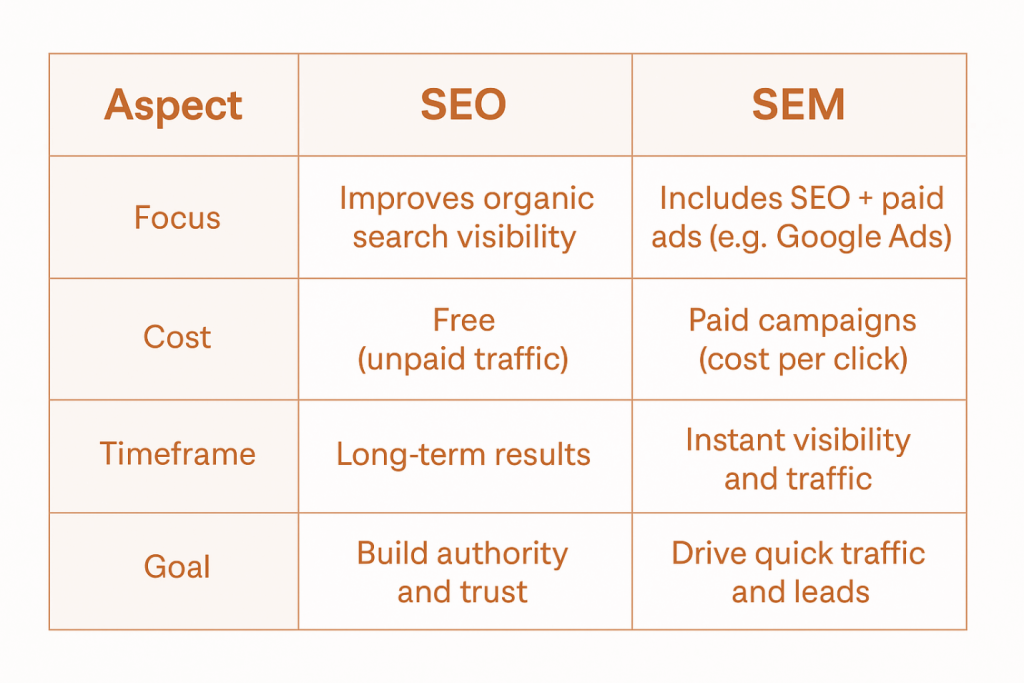
- What is SEO and how does it differ from SEM?
SEO is the process of improving a site’s visibility in organic search. It is unpaid and long-term. SEM combines SEO with paid ads like Google Ads. Paid campaigns bring instant results, while SEO builds authority over time.
Here is a table to give you a better idea:
- How do search engines crawl, index, and rank pages?
Crawlers scan links across the web. Indexed pages are stored in Google’s database. Ranking happens when algorithms decide which result best fits the query. Factors like content quality, speed, and backlinks matter.
- What signals tell you a page is eligible to appear in search?
A page is eligible to appear in search when:
- It does not have a noindex tag.
- It is not blocked in robots.txt.
- It returns a valid 200 status code (not 404/410).
- It is linked internally or externally so crawlers can discover it.
- It is included in the XML sitemap.
If a page has noindex, is blocked by robots.txt, returns an error code, or is not discoverable, it won’t appear in search results.
- What is E-E-A-T and how would you show it in content?
E-E-A-T stands for Experience, Expertise, Authoritativeness, and Trustworthiness. I show it by citing credible sources, using real data, and writing from personal experience when possible. Adding author bios and external references also builds trust.
- What are Core Web Vitals and why do they matter?
Core Web Vitals measure user experience. Google uses these as ranking signals.
- INP measures responsiveness to clicks and taps
- LCP measures loading of the main element
- CLS measures layout stability
- How do you choose target keywords based on intent?
I start by grouping searches into informational, navigational, or transactional. Then I pick keywords that match what users actually want. Tools like Search Console or Ahrefs help validate search volume and difficulty.
- What makes a good title tag and meta description today?
- Title: under 60 characters, keyword included, easy to read
- Meta description: under 160 characters, matches intent, motivates clicks
- Both should feel natural, not forced
- How do you measure SEO success for a new site in the first 90 days?
I track impressions, clicks, and rankings in Google Search Console. Organic traffic growth is another key signal. Early wins usually come from indexing improvements and long-tail keyword rankings.
Advanced SEO Interview Questions for Experienced
These are advanced SEO interview questions and answers that are often asked to experienced professionals.
- How has Google’s AI Overviews changed your approach to rankings and clicks?
AI Overviews often reduce clicks to organic results. I now focus on earning visibility inside summaries by answering questions clearly, using structured data, and covering intent in detail.
- Walk me through your process for diagnosing traffic drops after a core update.
- Check if the drop aligns with the update date
- Segment by pages, queries, and devices in Search Console
- Compare against competitor trends
- Audit content quality, intent match, and technical health
- Prioritize fixes based on where losses are highest
- How do you build topical authority with content clusters and internal links?
I start with a pillar page covering a broad topic. Then I create cluster pages that go deeper into subtopics. Internal links connect them, passing context and helping crawlers. Over time, this signals expertise and improves rankings.
- When would you use canonical tags vs. redirects vs. parameter handling?
- Canonical tags: for duplicate or near-duplicate pages you still want live
- Redirects: for permanent moves or consolidations
- Parameter handling: for dynamic URLs, like filters or tracking codes, that don’t need indexing
- How do you estimate and manage crawl budget on a large site?
I review log files to see how bots crawl. Priority is given to high-value pages like product or content hubs. I cut waste by blocking faceted URLs, reducing redirects, fixing broken links, and keeping sitemaps clean.
- Which structured data types drive the most impact for your use cases?
Product schema for ecommerce, FAQ and HowTo schema for informational pages, and Article schema for blogs. These boost visibility with rich snippets and help content stand out.
- How do you design and evaluate SEO experiments?
I set a clear hypothesis, like “changing titles will improve CTR.” Then I run split tests with control and variation groups. I monitor clicks, rankings, and conversions over weeks. Only if results are statistically sound do I roll out changes.
Interesting Fact: Mid-level SEO jobs make up 59% of listings, senior roles are 27%, and junior positions are 14%. (Previsible)
On Page SEO Interview Questions
Let’s go through important search engine optimization interview questions and answers that focus on on-page factors like content and keywords.
- How do you map search intent to page type (home, category, product, blog, help)?
- Home: brand and trust signals
- Category: discovery and comparisons
- Product: transactional queries with details and CTAs
- Blog: informational queries and awareness topics
- Help: support, troubleshooting, FAQs
- What is your checklist for high-quality on-page content in 2025?
Here is the checklist I follow:
- Clear title tag and meta description
- Main keyword used naturally in headings
- E-E-A-T signals like author info and sources
- Fast load times and mobile-friendly layout
- Helpful visuals with captions or explanations
- Schema markup where relevant
- How do you use headings, internal links, and anchor text to guide relevance?
I structure content with H1 for the main idea, H2s for supporting points, and H3s for details. Internal links connect related pages, while descriptive anchor text helps both readers and crawlers understand context.
- What is your approach to image SEO?
- Use descriptive filenames with keywords
- Write alt text that describes the image
- Compress with WebP or AVIF for faster load
- Serve images through a CDN for better delivery
- Add structured data when needed
- How do you keep content fresh without creating duplication?
I update older posts with new stats, examples, and FAQs. Instead of spinning off near-duplicate pages, I consolidate into one updated resource. This keeps authority strong and avoids dilution.
Off Page SEO Interview Questions
Here are the common SEO marketing interview questions that focus on off-page elements like link building and brand signals.
- How do you define off-page SEO?
Off-page SEO is about signals outside your site that influence trust, authority, and visibility. It includes backlinks, brand mentions, reviews, and community presence.
- What are the most effective link-building strategies now?
- Guest posting on high-quality sites
- Digital PR campaigns with newsworthy data
- Resource page and broken link outreach
- Building shareable assets like studies or tools
- Collaborations with niche creators and podcasts
- How do you evaluate backlink quality?
I look at:
- Domain authority and relevance to the topic
- Natural anchor text distribution
- Placement in editorial content vs. footer/sidebar
- Traffic from the referring domain
- Indexing and crawlability of the linking page
- How do you manage online reputation for SEO?
Reviews, mentions, and press all matter. I track brand mentions, respond to customer reviews, and publish positive stories on trusted sites. This helps search engines associate the brand with credibility.
- How do social signals influence off-page SEO?
Social shares don’t pass PageRank, but they amplify reach. Viral or widely shared content often attracts natural backlinks. Engagement also boosts visibility, which increases the chance of earning links.
Technical SEO Interview Questions
This section covers important interview questions for search engine optimization that test skills in crawling, indexing, site speed, and structured data.
- What is your process for a technical SEO audit?
- Crawl the site with Screaming Frog or Sitebulb
- Check indexation and crawl errors in GSC
- Review Core Web Vitals performance
- Test mobile usability and responsive design
- Inspect canonical tags, sitemaps, and robots.txt
- Fix duplicate content, broken links, and redirect chains
- How do you handle crawl budget for large sites?
I prioritize high-value pages, remove thin or duplicate URLs, and keep sitemaps updated. Clean internal linking and limiting parameter-based pages also save crawl budget.
- How do you improve Core Web Vitals in 2025?
- Optimize LCP by compressing hero images and speeding server response
- Improve INP with faster JavaScript execution
- Reduce CLS by reserving space for ads and media
- Use a CDN and caching to stabilize performance
- How do you use structured data today?
I add schema for products, FAQs, reviews, and articles. This improves rich result eligibility. Correct markup helps crawlers understand context and increases CTR in search.
- How do you approach site migrations or redesigns without losing rankings?
I map old URLs to new ones with 301 redirects, update internal links, submit updated sitemaps, and monitor GSC for indexing changes. Testing before launch reduces risks.
Local SEO Interview Questions
These SEO marketing interview questions focus on improving local search visibility and Google Business Profile.
- What is Local SEO and why is it important?
Local SEO focuses on ranking for searches tied to a location. It helps small and regional businesses reach nearby customers and show up in “near me” queries.
- How do you optimize a Google Business Profile (GBP)?
The goal is to make the profile complete, accurate, and engaging:
- Add consistent NAP (name, address, phone)
- Select the right categories and attributes
- Upload high-quality photos and videos
- Post updates, offers, and events
- Collect and respond to customer reviews
- What role do reviews play in local rankings?
Reviews build trust and impact rankings. Google looks at quantity, recency, and keywords in reviews. Responding to all reviews signals activity and credibility.
- How do you optimize for “near me” searches?
For “near me” visibility, I focus on:
- Adding local keywords in titles and content
- Creating locally relevant landing pages
- Building citations in trusted local directories
- Using schema to mark business details
- Encouraging customer reviews with location cues
- What are common Local SEO mistakes to avoid?
Businesses often lose visibility by:
- Having inconsistent NAP across directories
- Ignoring reviews or responding late
- Using duplicate or thin local content
- Failing to update Google Business Profile regularly
- Not tracking calls, directions, and local conversions
Ecommerce SEO Interview Questions
We are also covering SEO marketing interview questions that highlight tactics for product pages and boosting sales in online stores.
- What are the biggest SEO challenges for ecommerce sites?
Ecommerce sites face unique hurdles that affect rankings and sales:
- Thousands of product pages with duplicate content
- Managing faceted navigation and filters
- Slow load times due to images and scripts
- Keeping stock status updated for SEO value
- Balancing crawl budget across categories and products
- How do you optimize product pages for SEO?
A product page should inform, convert, and rank well:
- Use unique product descriptions with target keywords
- Add descriptive title tags and meta descriptions
- Include high-quality images with alt text
- Add FAQs, reviews, and structured data
- Internal link from categories and related products
- How do you manage duplicate content in ecommerce?
Duplicate issues often come from filters, sorting, and variants. I use canonical tags for preferred pages, noindex for low-value filters, and parameter handling in GSC.
- How to optimize site architecture for ecommerce SEO?
Strong architecture improves crawling and user flow:
- Use a clear hierarchy: Home → Category → Subcategory → Product
- Keep URLs short and keyword-rich
- Link related products and top categories
- Build XML sitemaps for products and categories
- How do you use structured data for ecommerce sites?
I apply schema for products, reviews, price, availability, and breadcrumbs. This improves visibility in SERPs with rich snippets like ratings, stock info, and pricing.
SEO Interview Questions Based on Job Role
Here are interview questions for search engine optimization based on different job roles, from SEO executives to managers and interns.
Interview Questions for SEO Manager
These interview questions for search engine optimization are often asked to candidates applying for manager-level roles.
- How do you set OKRs for SEO and tie them to revenue or pipeline?
I align OKRs with business outcomes, not just traffic. For example, I set goals around qualified leads or conversions influenced by organic search, then tie supporting metrics like rankings and CTR to those.
- Describe how you collaborate with product, dev, and content teams to ship changes.
I treat SEO as cross-functional. With product, I map SEO features into sprint cycles. With dev, I give clear requirements in JIRA or Asana, and for content I create briefs tied to keyword intent. Regular standups keep everyone aligned.
- How do you forecast SEO impact and communicate risk to leadership?
I use past performance data, keyword opportunity sizing, and scenario modeling. For example, “ranking top 3 for X term could drive Y clicks and Z revenue.” I also highlight risks like algorithm volatility or delayed payoff so expectations stay realistic.
- Tell me about a time you navigated a core update across multiple sites.
In 2023, two of our sites lost traffic after a core update. I led a review of content quality, pruning thin pages and improving topical coverage. Within three months, both sites recovered and one surpassed pre-update traffic.
Interview Questions for SEO Executive
These SEO interview question answers are suitable for professionals applying for executive roles.
- How do you pick keywords and map them to pages for a monthly plan?
I start with keyword research using tools like Ahrefs and GSC, looking at intent, volume, and difficulty. Then I map keywords to specific page types – transactional terms for product pages, informational ones for blogs – so every keyword has a clear home.
- What is your weekly reporting cadence and which metrics do you track?
I share a weekly snapshot that includes organic traffic, impressions, CTR, rankings for focus keywords, and conversions from organic. This helps the team spot quick wins and issues before they grow.
- How do you create briefs that writers can follow without keyword stuffing?
I provide a content brief with target keyword, secondary terms, search intent, headings, and competitor examples. Instead of asking for a keyword count, I explain how to naturally cover the topic so it reads well for users and ranks.
- Walk me through your outreach workflow for earning links to a new asset.
I identify relevant prospects first – blogs, industry sites, or resource pages. Then I build a pitch that explains the asset’s value, personalize the outreach, and follow up. I track responses and placements in a CRM or spreadsheet.
SEO Intern Interview Questions
Here are interview questions and answers for SEO that help interns prepare for entry-level roles in the field.
- What tools have you used and what did you learn from each?
I have used Google Search Console to check indexing and performance, Google Analytics for traffic insights, and Ahrefs for keyword and backlink research. Each taught me how data connects to SEO decisions.
- How would you check if a page can be indexed and ranked?
First, I’d search site:URL in Google to see if it’s indexed. Then, I’d check GSC coverage and look at the robots.txt, meta robots tag, and canonical tag to confirm it’s open for indexing.
- Draft a simple on-page checklist for a new blog post.
- Unique title tag with target keyword
- Meta description that drives clicks
- H1 with the main keyword
- Subheadings for structure
- Internal links to relevant pages
- Optimized images with alt text
- Clear CTA at the end
- Show how you would compare two competitors and suggest next steps.
I would compare domain authority, backlinks, and keyword coverage with tools like Ahrefs. Then I’d identify gaps – maybe one ranks for more long-tail topics. My next step would be to recommend new content or outreach to close that gap.
SEO MCQs
Here are multiple-choice SEO interview questions to quickly test your knowledge and practical understanding of key SEO concepts.
- Which Core Web Vital measures overall responsiveness to user interactions?
a) LCP
b) CLS
c) INP
d) FID
Answer: c) INP
- To stop a page from appearing in search results, which directive is used?
a) noindex
b) canonical
c) robots.txt allow
d) follow
Answer: a) noindex
- A permanent redirect that passes link equity is represented by status code.
a) 200
b) 301
c) 302
d) 404
Answer: b) 301
- Which schema type is most suitable for product price and availability?
a) Article
b) Breadcrumb
c) Product
d) FAQ
Answer: c) Product
- How can you check the queries your site ranks for in Google?
a) Google Ads Keyword Planner
b) Google Analytics
c) Google Search Console – Performance Report
d) Ahrefs
Answer: c) Google Search Console – Performance Report
- Which file communicates crawl rules to bots at the site root?
a) sitemap.xml
b) robots.txt
c) htaccess
d) meta description
Answer: b) robots.txt
- Which factor is most tied to map pack visibility for a single location business?
a) Number of blog posts
b) Domain age
c) Google Business Profile optimization
d) Backlinks only
Answer: c) Google Business Profile optimization
- Which setting helps target language and region versions of a page?
a) hreflang attribute
b) robots meta tag
c) sitemap priority
d) canonical tag
Answer: a) hreflang attribute
How to Prepare for SEO Interview?
Preparing for an SEO interview needs planning and practice if you want to feel confident. Here are the steps you can follow:
- Read through common SEO interview questions to know what to expect.
- Revise basics like crawling, indexing, ranking, and Core Web Vitals.
- Practice tools such as Google Search Console and Analytics with real examples.
- Learn about recent Google updates and AI-driven changes.
- Prepare short stories about solving SEO problems in past roles.
- Be ready to discuss numbers, growth impact, and reporting methods clearly.
Wrapping Up
With these 50+ SEO interview questions and answers, you now have a strong base to face interviews with confidence. Keep learning, stay updated with Google changes, and practice your skills regularly.
If you are ready to find new career opportunities, visit Hirist. Here, you can find IT jobs including SEO jobs.
FAQs
You can find interview questions for search engine optimization right here in this guide. It covers practical topics that mid-level professionals are often asked, along with clear answers to help you prepare with confidence.
Some common SEO interview questions for 3-year experienced candidates include:
How do you handle traffic drops after a Google update?
What is your process for keyword research and mapping?
How do you build topical authority with content clusters?
What are Core Web Vitals and how do you improve them?
How do you prioritize technical SEO fixes on a large site?
How do you measure ROI from SEO activities?
Google Search Console is a key tool for SEO, so interviewers often ask detailed questions about it. Common Google Search Console interview questions include:
How do you check if a page is indexed in Google Search Console?
What are impressions, clicks, and CTR in the Performance report?
How do you find and fix coverage errors?
What does the Core Web Vitals report show?
How do you submit a sitemap in Search Console?
How do you identify mobile usability issues?
Here are the tips you can follow:
Review the latest Google updates.
Practice common SEO interview questions.
Be ready with examples of past projects.
Know how to use tools like GSC, GA, Ahrefs.
Show problem-solving with real scenarios.
Here are the basic steps to do SEO for a new website:
Start with keyword research and competitor analysis.
Create a clean site structure with crawlable URLs.
Write high-quality, intent-focused content.
Optimize meta tags, headings, and internal links.
Add XML sitemap and submit to Search Console.
Improve Core Web Vitals and mobile speed.
Build initial backlinks through outreach and listings.
Here is a typical salary range for popular SEO roles in India according to AmbitionBox:
| Role | Annual Salary Range | Avg. Annual Salary | Monthly In-hand Salary |
| SEO Intern | ₹0.6 L – ₹4 L | ₹1.5 L | ₹10,000 – ₹11,000 |
| SEO Executive | ₹1.2 L – ₹4.2 L | ₹2.5 L | ₹16,000 – ₹18,000 |
| SEO Specialist | ₹2 L – ₹9 L | ₹5 L | ₹30,000 – ₹31,000 |
| SEO Manager | ₹3.1 L – ₹18 L | ₹9.3 L | ₹52,000 – ₹54,000 |
SEO Intern Salary Overview (India, 2025)
| Metric | Value |
|---|---|
| Annual salary range | ₹0.6 Lakh – ₹4 Lakhs |
| Avg. annual salary | ₹1.5 Lakh |
| Monthly in-hand salary | ₹10,000 – ₹11,000 |
| Experience range in data | 0 – 3 years |
SEO Specialist Salary Overview (India, 2025)
| Metric | Value |
|---|---|
| Annual salary range | ₹2 Lakhs – ₹9 Lakhs |
| Avg. annual salary | ₹5 Lakhs |
| Monthly in-hand salary | ₹30,000 – ₹31,000 |
| Experience range in data | 1 – 7 years |
SEO Executive Salary Overview (India, 2025)
| Metric | Value |
|---|---|
| Annual salary range | ₹1.2 Lakh – ₹4.2 Lakhs |
| Avg. annual salary | ₹2.5 Lakhs |
| Monthly in-hand salary | ₹16,000 – ₹18,000 |
| Experience range in data | 0 – 4 years |
SEO Manager Salary Overview (India, 2025)
| Metric | Value |
|---|---|
| Annual salary range | ₹3.1 Lakhs – ₹18 Lakhs |
| Avg. annual salary | ₹9.3 Lakhs |
| Monthly in-hand salary | ₹52,000 – ₹54,000 |
| Experience range in data | 3 – 12 years |
Comparative Summary of SEO Roles
| Role | Avg. Annual Salary | Experience Range | Sample Size |
|---|---|---|---|
| SEO Manager | ₹9.3 Lakhs | 3 – 12 years | 3.5k salaries |
| SEO Specialist | ₹5 Lakhs | 1 – 7 years | 3.2k salaries |
| SEO Executive | ₹2.5 Lakhs | 0 – 4 years | 16.7k salaries |
| SEO Intern | ₹1.5 Lakh | 0 – 3 years | 347 salaries |