
GitHub is one of the most popular platforms for developers to store code, track changes, and collaborate on projects. It was founded in 2008 by Tom Preston-Werner, Chris Wanstrath, and PJ Hyett, and later became part of Microsoft in 2018. Today, millions of developers and companies use GitHub for version control, project management, and open-source contributions. Because of its importance in software development, many roles like software engineers, DevOps specialists, and system administrators often face GitHub questions in interviews. Here are the top 50+ GitHub interview questions and answers to help you prepare.
Fun Fact: GitHub hosts over 150 million developers and more than 420 million repositories worldwide.
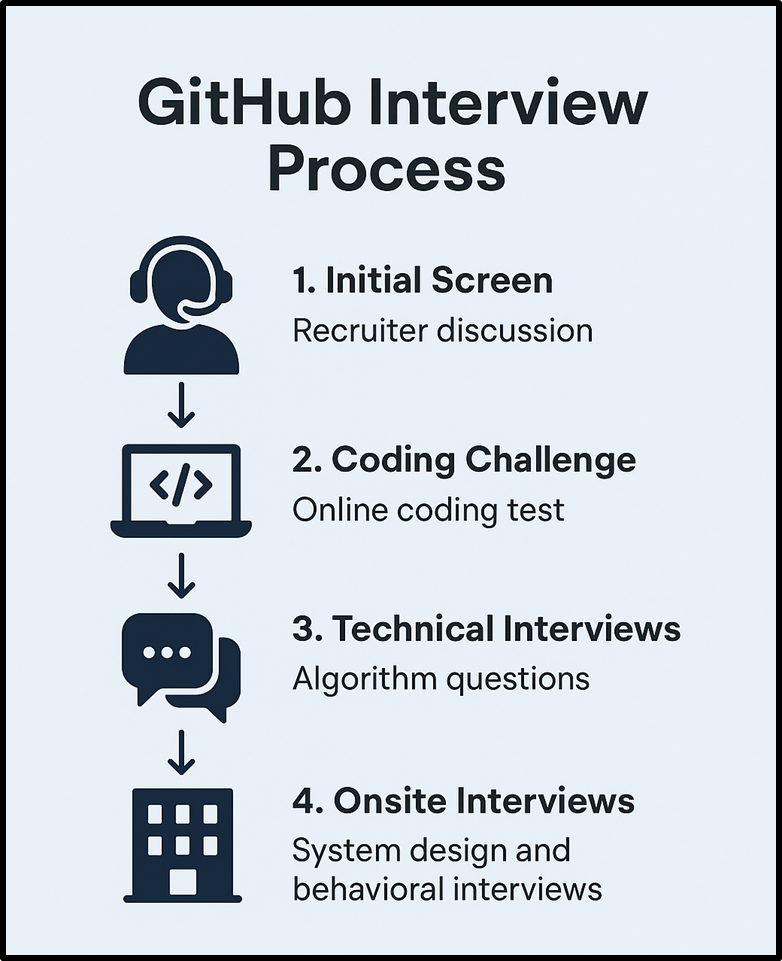
GitHub Interview Process Explained
Basic GitHub Interview Questions
Here are some commonly asked interview questions on GitHub that cover the fundamentals like repositories, commits, branches, and pull requests.
- What is a Git repository?
A Git repository is where all your project files and their history are stored. It tracks changes, versions, and who made them. Repositories can be local or hosted on platforms like GitHub.
- What is the purpose of a .gitignore file?
The .gitignore file tells Git which files or folders to ignore. For example, temporary logs, build outputs, or secret keys. This keeps your repository clean and avoids exposing sensitive data.
- What does git status show?
The git status command displays the current state of the working directory and staging area. It shows which files are modified, staged, or untracked, helping you decide the next step.
- What is the difference between git fetch and git pull?
git fetch downloads changes from the remote without merging them. It lets you inspect updates first. git pull does both – fetches and merges into your current branch directly.
- How can you safely revert a pushed commit?
Use git revert <commit_id>. It creates a new commit that undoes the changes. This keeps history intact and avoids breaking the shared branch. For already pushed commits, this is the safest way.
- What is branching, and why is it useful?
Branching lets you create an independent line of development. You can work on new features, fixes, or experiments without disturbing the main code. Once tested, changes are merged back.
Intermediate GitHub Interview Questions
These GitHub questions for interview focus on topics beyond the basics, such as branching strategies, merge conflicts, and collaboration workflows.
- When would you use git reset –soft, –mixed, or –hard?
–soft moves HEAD to a commit but keeps changes staged.
–mixed resets to a commit and unstages files but keeps modifications.
–hard resets everything, discarding staged and working directory changes.
I use –soft when I want to redo commits, –mixed when I only need to unstage, and –hard when I want a clean state.
- What is git stash, and when would you use it?
git stash temporarily saves uncommitted changes without committing them. I use it if I need to quickly switch branches or pull updates but want to come back to unfinished work later.
- How does git reflog help recover lost commits?
git reflog records every change made to HEAD. Even if a branch or commit is deleted, the reflog shows its reference. From there, I can check out the commit or create a new branch to recover lost work.
- How do you configure a local branch to track a remote branch?
I use:
git branch –set-upstream-to=origin/main
Or simply:
git push -u origin my-branch
This links the local branch to its remote counterpart, making git pull and git push easier.
- How do you manage different Git configurations across projects?
Git supports system, global, and local configs. I set my personal identity globally but override it locally for work repos.
Example:
git config user.name “Work Name”
git config user.email “work@example.com”
This keeps identities separated.
- How do you handle large files in Git (e.g., Git LFS)?
For large binaries like images or models, Git LFS (Large File Storage) stores file pointers instead of the actual file in the repo. The real file is stored separately, keeping the repository fast and lightweight.
- What are submodules, and how do you update them?
A submodule allows including another Git repo inside a parent repo. To update them, I run:
git submodule update –remote
This pulls the latest commits from the submodule’s tracked branch.
Advanced GitHub Interview Questions
Now, we will look at advanced interview questions on GitHub along with answers.
- Why use git push –force-with-lease instead of git push –force?
–force-with-lease is safer than –force. It updates a branch only if your local copy is in sync with the remote. This prevents overwriting commits pushed by teammates. In practice, I use it when I need to rewrite history but still want to avoid deleting others’ work.
- What is Git LFS, and how does it differ from standard Git?
Git LFS (Large File Storage) is built for big binary files like images, datasets, or videos. Instead of storing them inside the repository, it keeps lightweight pointers, while the real files live on a separate LFS server. This prevents the repo from becoming huge and keeps cloning fast.
- What are GitHub Actions, and how do workflows work?
GitHub Actions is GitHub’s built-in CI/CD service. Workflows are written in YAML and stored in .github/workflows. They automate tasks like testing, deployment, or linting. A workflow is triggered by events such as pushes, pull requests, or manual runs, and it runs jobs made of steps.
- What are reusable workflows in GitHub Actions?
Reusable workflows let you define automation once and use it across multiple repositories or jobs. This saves time and avoids repeating the same code. For example, a standard security scan can be written once and shared across all projects in an organization.
- How do you manage secrets within GitHub Actions workflows?
Secrets like API tokens are stored in repository or organization settings. In workflows, they’re accessed using the secrets context, for example:
${{ secrets.DB_PASSWORD }}
This keeps sensitive data hidden and safe from accidental exposure in logs or code.
- What is a matrix strategy in GitHub Actions?
A matrix strategy allows running jobs in parallel with different configurations, such as OS, runtime versions, or dependencies. It is commonly used to test projects across multiple environments quickly. This improves confidence before merging code since results come from varied setups.
Most Asked GIT and GitHub Interview Questions
Let’s go through some common interview questions on Git and GitHub that test your knowledge of version control and collaboration.
- What is the key difference between Git and GitHub?
| Feature | Git | GitHub |
| Type | Distributed version control system | Cloud-based hosting and collaboration platform |
| Purpose | Tracks changes and manages code history locally | Provides hosting, team collaboration, and project management |
| Usage | Works on a developer’s machine | Accessed via web to share and collaborate |
| Key Functions | Commits, branches, merges | Pull requests, issues, GitHub Actions, repository hosting |
| Relationship | Core tool for version control | Built on top of Git to extend features |
| Analogy | Engine that powers version control | Service that provides a full ecosystem for collaboration |
- How do commits, branches, and pull requests support collaboration?
Commits capture snapshots of code changes. Branches let developers work on features in isolation without touching the main branch. Pull requests allow team members to review, discuss, and approve changes before merging. Together, these three make collaboration smoother and safer in teams.
- How do you resolve merge conflicts?
Merge conflicts happen when two people change the same line of code. To fix it, I open the conflicted file, review both changes, and decide which version or combination to keep. Then I mark it as resolved and commit. Tools like VS Code or GitHub’s web editor also help.
- What are some effective branching and merging workflows?
Common strategies include Git Flow, GitHub Flow, and trunk-based development. For example, GitHub Flow uses feature branches and frequent merges into main. Trunk-based development encourages very short-lived branches with continuous integration. The choice depends on the team’s size and release schedule.
- How do you review history and roll back changes?
I use git log to explore commit history. If I need to undo a change, git revert <commit> creates a new commit that rolls it back safely. For local, unpublished work, I may use git reset. This way, history stays clear, and mistakes can be corrected.
Note: Git GitHub interview questions are often asked in technical interviews across different roles like software developers, DevOps engineers, and system administrators.
Also Read - Top 25+ Git Interview Questions and Answers
GitHub Interview Questions by Programming Language & Framework
This section covers popular GitHub interview questions that are often searched by developers preparing for roles in specific languages and frameworks.
React Interview Questions GitHub
Here are some commonly searched GitHub React interview questions that test both your React fundamentals and practical coding skills.
- What is JSX and how does it work?
JSX is a syntax extension for JavaScript that looks like HTML. React uses it to describe the UI. Under the hood, JSX is compiled into React.createElement calls, which build a virtual DOM tree that React updates efficiently.
- Why are keys important in lists, and what issues arise when using array indices as keys?
Keys help React identify which list items have changed, been added, or removed. Without proper keys, React may reuse elements incorrectly, causing bugs in rendering. Using array indices as keys can lead to issues when items are reordered or deleted, since indices are not stable.
- What are the rules of React hooks?
Hooks must be called at the top level of a component, not inside loops or conditions. They should only be called from React functions, never from regular JavaScript functions. Following these rules ensures hooks are executed in the right order every render.
Also Read - Top 25+ React JS Interview Questions and Answers
Angular Interview Questions GitHub
Here are some popular Angular interview questions on GitHub that help you prepare for frontend developer interviews.
- How does Angular’s change detection mechanism work?
Angular uses a change detection mechanism to check component data and update the DOM. It runs after events like user actions or HTTP responses. The framework compares the component’s current state with the previous one and updates only what has changed, making the UI responsive.
- What are Angular modules and how are they structured?
Modules in Angular organize code into functional blocks. The root module is AppModule, and it can import feature modules. Each module has declarations (components, directives, pipes), imports (other modules), providers (services), and bootstrap components. This structure keeps projects scalable.
- How do you handle dependency injection in Angular?
Angular has a built-in dependency injection system. Services or classes marked with @Injectable can be provided at module or component level. The injector supplies them when needed, reducing coupling and improving reusability.
Also Read - Top 25 AngularJS Interview Questions and Answers
React Native Interview Questions GitHub
Here are some commonly asked React Native interview questions on GitHub.
- What is the difference between React and React Native?
React is a JavaScript library for building web UIs, while React Native is a framework for building mobile apps using React. React renders to the browser DOM, whereas React Native renders to native components on iOS and Android.
- How do you handle styling in React Native compared to CSS?
React Native uses JavaScript objects for styling instead of traditional CSS files. The syntax is similar to CSS, but only a subset of properties are supported. Styles are applied using the StyleSheet API.
- How do you test apps in React Native?
Testing can be done with Jest for unit tests, React Native Testing Library for UI, and tools like Detox or Appium for end-to-end testing.
Also Read - Top 20 React Native Interview Questions With Expert Answers
Next.js Interview Questions GitHub
Let’s go through some important Next.js interview questions GitHub that focus on server-side rendering, routing, and performance.
- What is server-side rendering, and how does Next.js implement it?
Server-side rendering (SSR) means generating HTML on the server for each request. Next.js does this with functions like getServerSideProps. It improves SEO and reduces the time to first paint since the user sees content faster.
- What is static generation, and when would you use it?
Static generation builds pages at compile time and serves them as pre-rendered HTML. In Next.js, this is done with getStaticProps. It’s best for content that doesn’t change often, like blogs or documentation.
- How does routing work in Next.js?
Next.js uses a file-based routing system. Every file inside the pages directory automatically becomes a route. Nested folders create nested routes, making routing intuitive without extra configuration.
Redux Interview Questions GitHub
Take a look at the commonly searched Redux interview questions on GitHub.
- What is the role of actions and reducers in Redux?
Actions are plain JavaScript objects that describe what should change in the state. Reducers are pure functions that take the current state and an action, then return a new state. Together, they define how data flows in an app.
- What is middleware in Redux, and why is it used?
Middleware sits between dispatching an action and the moment it reaches the reducer. It is used for logging, handling asynchronous tasks, or modifying actions before they are processed. Popular middleware includes Redux Thunk and Redux Saga.
- Why might you use useSelector and useDispatch in a React+Redux app?
useSelector extracts data from the Redux store, while useDispatch sends actions to the store. They replace older connect patterns, making Redux easier with React hooks.
Also Read - Top 20+ Redux Interview Questions and Answers
Flutter Interview Questions GitHub
In this section, you will find key Flutter interview questions on GitHub that test cross-platform app development knowledge.
- What is a Widget in Flutter?
In Flutter, everything is a widget. Widgets define the structure, design, and behavior of the UI. They can be stateless, meaning they don’t change once built, or stateful, meaning they can change during runtime.
- What is the difference between StatelessWidget and StatefulWidget?
A StatelessWidget is immutable and built once. It’s used for UI elements that don’t change, like static text or icons. A StatefulWidget holds state that can update over time, like forms or animations.
- How do you manage state in Flutter?
State can be managed locally with setState, or globally with tools like Provider, Riverpod, or Bloc. The choice depends on the complexity of the app and how widely the state is shared.
Also Read - Top 30+ Flutter Interview Questions and Answers
Android Interview Questions GitHub
Here are some Android interview questions on GitHub that focus on core concepts like activities, fragments, and lifecycle.
- What are the key Android Activity lifecycle methods?
The main lifecycle methods are onCreate, onStart, onResume, onPause, onStop, and onDestroy. They manage how an Activity is created, displayed, paused, stopped, and destroyed as the user interacts with the app.
- What is the role of Fragment in Android?
Fragments are reusable components that represent part of the UI in an Activity. They help create flexible layouts and can be combined or reused across different screens. They also have their own lifecycle.
- How do you pass data between Activities?
Data is passed using Intent objects. You attach key-value pairs with putExtra in the sending Activity, and retrieve them with getIntent().getExtras() in the receiving Activity. For complex objects, Parcelable is commonly used.
Also Read - Top 50+ Android Interview Questions and Answers
SQL Interview Questions GitHub
These SQL interview questions on GitHub cover queries, joins, indexing, and database design basics.
- What is the difference between INNER JOIN and LEFT JOIN?
INNER JOIN returns only the rows that have matching values in both tables. LEFT JOIN returns all rows from the left table and the matched rows from the right table, filling unmatched rows with NULL.
- How do you optimize queries using indexes?
Indexes speed up data retrieval by creating a quick lookup structure. They are best applied to columns used in WHERE clauses, joins, or sorting. However, too many indexes can slow down inserts and updates.
- How do you write a query to fetch duplicate records?
You can group by columns and use HAVING:
SELECT column, COUNT(*)
FROM table
GROUP BY column
HAVING COUNT(*) > 1;
This finds values that occur more than once in the selected column.
Also Read - Top 50+ SQL Interview Questions and Answers
Python Interview Questions GitHub
Check out important Python interview questions on GitHub that evaluate coding logic, data structures, and libraries.
- What is a list comprehension, and why use it?
A list comprehension is a concise way to create lists in Python. Example:
squares = [x*x for x in range(5)]
It is shorter and often faster than using loops for building lists.
- How do you handle exceptions in Python?
Exceptions are handled with try, except, and optionally finally. Example:
try:
result = 10 / 0
except ZeroDivisionError:
print(“Cannot divide by zero”)
finally:
print(“Done”)
This prevents crashes and allows fallback behavior.
- What are Python decorators, and how are they applied?
A decorator is a function that modifies another function or method. They are applied using the @ symbol.
Example:
@staticmethod
def my_method():
pass
Decorators are widely used for logging, validation, and frameworks like Flask or Django.
Also Read - Top 75+ Python Interview Questions and Answers
CSS Interview Questions GitHub
These are some frequently asked CSS interview questions on GitHub.
- What is the difference between flex and grid layouts?
Flexbox is one-dimensional, best for aligning items in a row or column. Grid is two-dimensional, allowing control of both rows and columns. Flexbox is great for small layouts, while Grid suits complex page structures.
- How do media queries work in responsive design?
Media queries apply CSS rules based on device features like width, height, or orientation.
Example:
@media (max-width: 768px) {
body { font-size: 14px; }
}
This adjusts styles for smaller screens, making layouts responsive.
- What is the box model?
The box model represents how elements are sized in CSS. Each element has content, padding, border, and margin. Understanding it helps avoid layout issues when adding spacing or borders.
Also Read - Top 40+ CSS Interview Questions and Answers
HTML Interview Questions GitHub
These HTML interview questions on GitHub focus on structure, forms, semantic tags, and best practices.
- What are semantic HTML elements, and why use them?
Semantic elements clearly describe their meaning. Examples are <header>, <footer>, <article>, and <section>. They improve readability, SEO, and accessibility because browsers and screen readers understand them better than generic <div> tags.
- How do you create a form with validation?
HTML5 provides built-in attributes like required, pattern, and type.
Example:
<input type=”email” required>
This ensures the user enters a valid email before submission. Custom validation messages can also be added with JavaScript for more control.
- What is the difference between id and class?
id uniquely identifies a single element on a page, while class can be shared by multiple elements. Example: id=”main-header” vs class=”btn”. CSS and JavaScript often use both for styling and targeting elements.
Also Read - Top 50+ HTML Interview Questions and Answers
Golang Interview Questions GitHub
Prepare with Golang interview questions on GitHub that highlight concurrency, packages, and memory management.
- What is a goroutine, and how is it used?
A goroutine is a lightweight thread managed by the Go runtime. You create one by prefixing a function call with go.
Example:
go myFunction()
They allow concurrent execution without heavy system threads.
- How do you manage concurrency with channels?
Channels are used to communicate between goroutines. They ensure safe data exchange without explicit locking.
Example:
ch := make(chan int)
go func() { ch <- 5 }()
value := <-ch
This sends and receives data safely.
- What is a struct, and how is it different from a map?
A struct is a collection of typed fields, ideal for defining complex data models. A map is a key-value store. Structs are compile-time typed, while maps are more flexible but not as strict.
Also Read - Top 25+ Golang Interview Questions and Answers
OOPs Interview Questions GitHub
Here are the key OOPs interview questions on GitHub.
- What is polymorphism, and how is it implemented?
Polymorphism means one interface, many forms. In practice, it allows methods to behave differently based on the object. For example, a base class method can be overridden in child classes. This is common in languages like Java, C++, and Python.
- What is encapsulation, and why is it useful?
Encapsulation hides the internal state of an object and only exposes controlled access through methods. It protects data from unwanted changes and makes code easier to maintain. For instance, using private variables with getter and setter methods.
- What is inheritance, and provide an example?
Inheritance allows one class to reuse fields and methods from another. Example: a Car class inheriting from a Vehicle class. The Car automatically gains the common properties of Vehicle while adding its own.
Also Read - Top 50+ OOPs Interview Questions and Answers for 2025
Frontend Interview Questions GitHub
Find essential Frontend interview questions on GitHub related to UI design, performance, and modern frameworks.
- What is the critical rendering path, and why optimize it?
The critical rendering path is the sequence browsers follow to convert HTML, CSS, and JavaScript into pixels on screen. Optimizing it reduces load time and improves user experience. Techniques include minimizing CSS/JS blocking and using async loading.
- How do you improve page load performance?
I optimize assets by compressing images, minifying CSS and JS, and using caching. Lazy loading for images and splitting bundles also help. Content Delivery Networks (CDNs) reduce latency by serving content closer to users.
- What are service workers, and why use them?
Service workers are scripts that run in the background of a browser. They enable offline capabilities, caching strategies, and push notifications. They’re a core part of Progressive Web Apps (PWAs).
Also Read - Top 25+ Frontend Interview Questions and Answers
Role-Based and Skill-Specific GitHub Interview Questions
This section highlights GitHub interview questions tailored to specific job roles and core technical skills often tested in interviews.
Data Science Interview Questions GitHub
Here are some key Data Science interview questions on GitHub that focus on statistics, machine learning, and data handling.
- What is the difference between supervised and unsupervised learning?
Supervised learning uses labeled data, where the output is known. It’s used for tasks like classification or regression. Unsupervised learning works with unlabeled data, finding hidden patterns or groupings, like clustering.
- When would you use precision and recall instead of accuracy?
Accuracy can be misleading if the dataset is imbalanced. Precision and recall are better when false positives or false negatives carry more weight. For example, in fraud detection, recall is vital to catch as many fraud cases as possible.
- What is feature selection, and why is it important?
Feature selection is the process of picking the most relevant inputs for a model. It reduces overfitting, speeds up training, and often improves accuracy. Methods include correlation tests, recursive elimination, and tree-based importance scores.
Also Read - Top 50+ Data Science Interview Questions and Answers
Site Reliability Engineer Interview Questions GitHub
These Site Reliability Engineer interview questions on GitHub cover monitoring, scalability, automation, and reliability challenges.
- How do you monitor uptime and performance of services?
I use monitoring tools like Prometheus, Grafana, or Datadog to track metrics such as latency, error rates, and throughput. Alerts are set for threshold breaches to detect issues early. Logs and distributed tracing also help in root cause analysis.
- How would you design a scalable logging infrastructure?
A good design collects logs centrally and makes them searchable. Tools like the ELK stack (Elasticsearch, Logstash, Kibana) or cloud logging services are common. Logs should be structured, rotated, and stored efficiently to handle scale.
- What strategies would you use for incident response?
Clear playbooks, automated alerts, and regular drills are key. I focus on fast detection, immediate mitigation, and then root cause analysis. After resolution, postmortems are done to improve future response and prevent recurrence.
System Design Interview Questions GitHub
Here are some common System Design interview questions on GitHub.
- How would you design a system to handle millions of Git operations per day?
I would design it with distributed servers handling requests in parallel, backed by a load balancer. Caching frequently accessed data and using efficient storage like distributed file systems keeps response times fast. Scalability would come from adding more servers as demand grows.
- How can you optimize storage and performance in large-scale version control?
Compression of objects, deduplication of data, and using Git LFS for large binaries are effective. Sharding repositories across servers also prevents bottlenecks. Performance tuning includes minimizing lock contention and using SSD-backed storage.
- What architecture supports a globally distributed development team using Git?
A CDN-backed architecture with multiple mirrored servers across regions helps. Developers connect to the nearest mirror, while changes sync globally. This reduces latency and improves collaboration for teams spread worldwide.
Note:
Many candidates also practice with Grokking System Design GitHub repositories for deeper preparation.
Another useful resource is Grokking the System Design Interview GitHub, which provides structured system design practice.
Also Read - Top 30+ System Design Interview Questions and Answers
Company-Specific GitHub Interview Questions
This section includes GitHub interview questions often shared or discussed for specific companies, helping candidates target their preparation.
Google Interview Questions GitHub
These Google interview questions on GitHub cover coding, algorithms, and system design often asked in Google interviews.
- Explain a system design problem you solved using GitHub in your workflow.
- Describe a challenging merge or conflict situation you handled.
- How would you use GitHub to collaborate across different time zones?
- What is your strategy for organizing large monorepos in GitHub?
- How would you enforce code review and quality standards on GitHub?
Karat Interview Questions GitHub
Here are some Karat interview questions on GitHub that reflect real-time coding and problem-solving assessments used in technical screenings.
- Describe how you would use GitHub to submit a live coding session solution.
- How would you track and document your algorithm changes in GitHub?
- How do you respond to feedback on a pull request?
- How do you structure branches for feature-driven development?
- How would you revert a major refactor that introduced bugs?
Company Wise Coding Questions GitHub
Here are some popular company-wise coding questions on GitHub collections.
- How do you search for interview question collections on GitHub by company?
- How would you use GitHub to filter coding problems by difficulty level?
- How do you contribute to a company-specific coding repo on GitHub?
- How do you keep your fork in sync with updated answers?
- How do you manage multiple company-specific question repos locally?
GitHub MCQs
Test your knowledge with these commonly asked GitHub MCQs that often appear in interviews to check practical understanding.
- What command initializes a new Git repository?
(a) git init
(b) git start
(c) git create
(d) git new
Answer: (a) git init
- Which file lists untracked files to ignore?
(a) .gitignore
(b) ignore.txt
(c) .ignore
(d) gitignore.txt
Answer: (a) .gitignore
3. Which command stages changes for commit?
(a) git add
(b) git stage
(c) git commit
(d) git push
Answer: (a) git add
- Which action retrieves changes without merging?
(a) git fetch
(b) git pull
(c) git merge
(d) git sync
Answer: (a) git fetch
- Force push safely uses which flag?
(a) –force
(b) –force-with-lease
(c) -f
(d) –unsafe
Answer: (b) –force-with-lease
- What does LFS help manage?
(a) Large files
(b) Logs
(c) Short branches
(d) Actions
Answer: (a) Large files
Quick Tips to Prepare for GitHub Interviews
Here are some practical tips to help you prepare for GitHub interview questions:
- Practice real projects on GitHub to show skills
- Study popular repos like coding interview university GitHub for structured prep
- Get comfortable with branching, merging, and resolving conflicts
- Learn GitHub Actions basics and workflows
- Review common Git commands daily to build speed and confidence
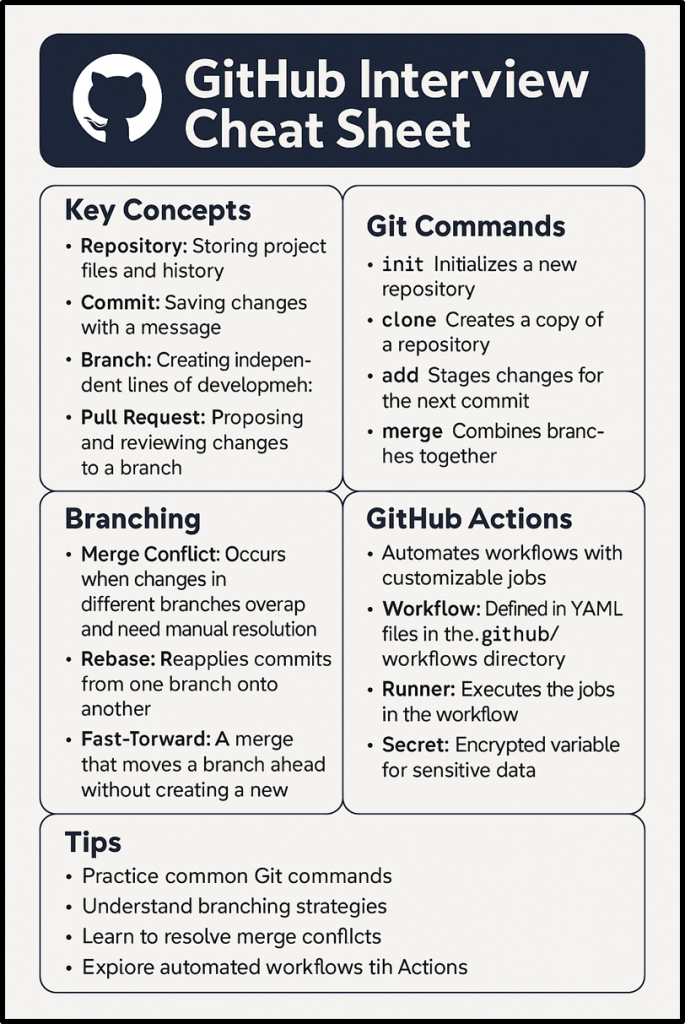
GitHub Interview Cheat Sheet
Wrapping Up
So, these are the 50+ GitHub interview questions and answers that can help you get ready for real interviews. Practice them, work on real projects, and you will feel more confident.
Looking for IT jobs, including roles requiring GitHub job skills? Find the best opportunities today on Hirist.
FAQs
Coding Interview University GitHub is a popular open-source repository created by John Washam. It provides a structured, self-study plan for becoming a software engineer. Many candidates use it as a roadmap to prepare for technical interviews.
Yes, many interview questions on GitHub are reliable because they come from real candidate experiences and company prep repositories. However, some may be outdated or too role-specific. Our guide covers the latest GitHub questions with accurate answers to help you prepare better.
Here are some common questions:
How does React update the DOM under the hood?
What is the difference between Presentational and Container components?
What distinguishes class components from functional components?
What is the difference between props and state?
What are React lifecycle methods, and name at least one deprecated method.
A GitHub interview can be challenging since it tests both coding and collaboration skills. Questions often cover Git basics, GitHub workflows, and role-specific technical concepts like React, Python, or system design.
Salaries vary by role and experience. Professional with GitHub expertise earn around ₹25.6lakhs annually.