React Native is an open-source framework for building mobile applications using JavaScript and React. It was created by Jordan Walke at Meta and released in 2015. The framework enables developers to build high-performance Android and iOS applications using a single codebase. Over the years, it has become one of the most widely adopted cross-platform technologies. Organizations across industries hire React Native developers as mobile app developers, frontend engineers, and cross-platform specialists. This blog covers the top 40+ frequently asked React Native interview questions and answers for freshers and experienced professionals to help you prepare for these common roles. You will also find expert interview preparation tips with MCQs to practice.
React Native Interview Guide (2026)
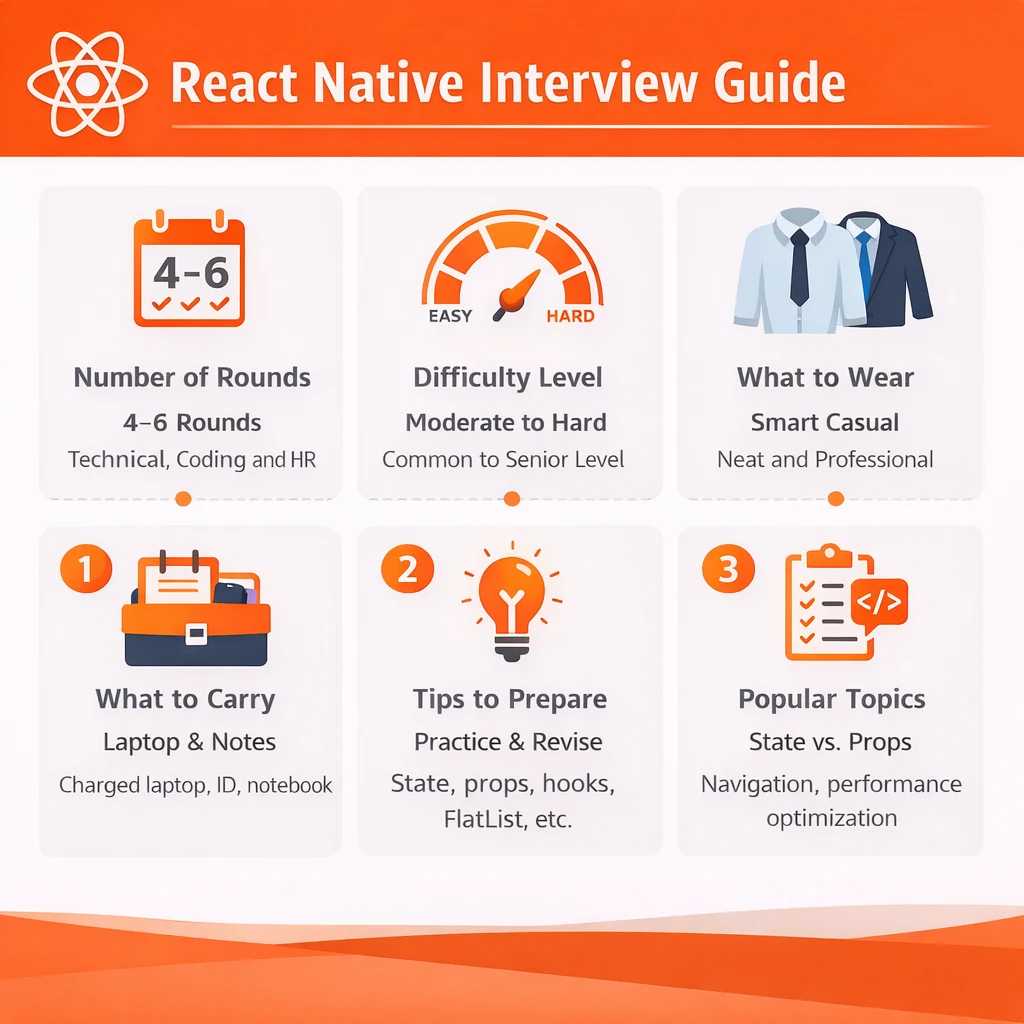
Fun Fact: More than 30,000 companies in the Information Technology and Services industry use React Native globally, and it powers popular apps like Facebook, Instagram, Amazon Alexa, Pinterest, and Discord.
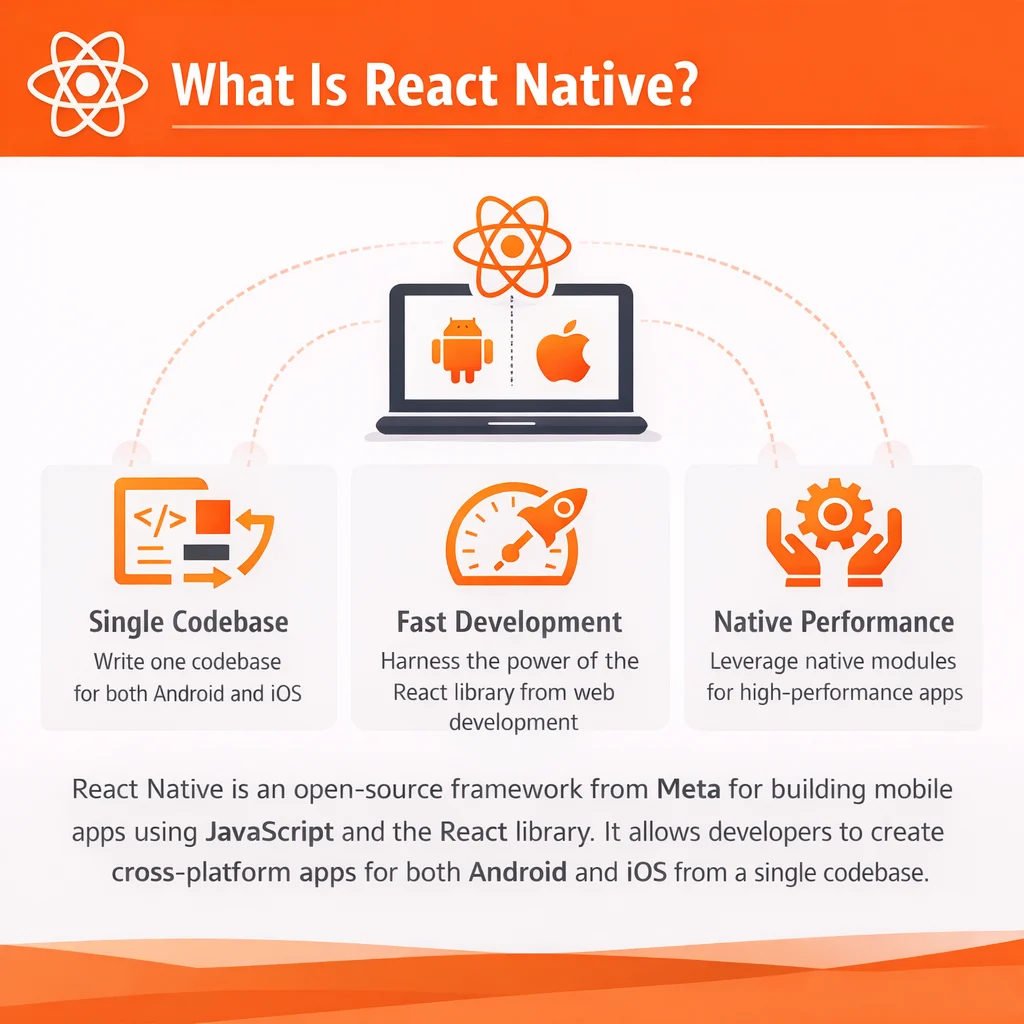
What Is React Native?
React Native is a JavaScript framework that enables developers to build mobile applications using native platform components. Unlike web-based hybrid frameworks, React Native renders real native UI elements and communicates with the native layer through a bridge. It allows most of the business logic to be shared across platforms while maintaining near-native performance. With the introduction of the new architecture, including Fabric and TurboModules, React Native continues to improve performance and developer efficiency.
Basic React Native Interview Questions
Here are some basic React Native interview questions and answers to help you prepare for entry-level roles.
1. What are the fundamental differences between React Native and ReactJS?
React Native is used to build mobile applications for Android and iOS, whereas ReactJS is used for building web applications. React Native renders native mobile UI components such as <View> and <Text>, while ReactJS uses HTML elements like <div> and <span>. React Native communicates with native modules to deliver near-native performance, while ReactJS runs inside the browser environment.
| Basis of Comparison | React Native | ReactJS |
|---|---|---|
| Platform | Mobile applications (Android & iOS) | Web applications |
| Rendering | Uses native UI components | Uses HTML DOM elements |
| Environment | Runs via native bridge/JSI | Runs inside browser |
| Styling | Uses JavaScript-based styling | Uses CSS |
| Performance | Near-native performance | Browser-dependent performance |
Also Read – Top 25+ React JS Interview Questions and Answers
2. What are the core components of React Native?
Core components are the building blocks of a React Native application. Some commonly used components include:
- View – Used for layout and container structure
- Text – Used to display text
- TextInput – Used to capture user input
- ScrollView – Provides scrolling functionality
- FlatList – Optimized component for rendering large lists
- Image – Displays images
- Button – Handles user interactions
- StyleSheet – Used to create optimized style objects
3. What is JSX in React Native?
JSX (JavaScript XML) is a syntax extension that allows developers to write UI components in a declarative way using JavaScript. It resembles HTML but compiles into JavaScript function calls. JSX makes UI structure easier to read and maintain in React Native applications.
4. What is the concept of state in React Native?
State is an object that stores dynamic data within a component. When the state changes, the component re-renders to reflect updated data. In functional components, state is managed using the useState hook. State is private to the component where it is defined.
5. What is the purpose of props in React Native?
Props (properties) are used to pass data from a parent component to a child component. They are read-only in the receiving component. Props help make components reusable and configurable.
6. What are Hooks in React Native?
Hooks are functions that allow developers to use state and lifecycle features in functional components. Common hooks include useState, useEffect, useContext, useMemo, and useCallback. Hooks simplify component logic and make code more readable compared to class-based components. They are widely used in modern React Native applications.
7. What is the difference between controlled and uncontrolled components in React Native?
A controlled component is one where the form data is managed using React state, typically with hooks like useState. The value of the input is controlled by state and updated through event handlers.
An uncontrolled component maintains its own internal state and is accessed using ref. In this case, React does not directly control the input value.
Controlled components are generally preferred because they provide better control over validation, form handling, and predictable data flow.
| Feature | Controlled Component | Uncontrolled Component |
|---|---|---|
| State Management | Managed by React state | Managed internally by the component |
| Data Access | Via state variables | Via refs |
| Form Validation | Easier to implement | Harder to control |
| Predictability | More predictable | Less predictable |
| Recommended Usage | Preferred in most cases | Used in simpler scenarios |
React Native Interview Questions for Freshers
Here are some React Native developer interview questions and answers for freshers:
8. What is a component in React Native?
A component is a reusable piece of UI logic. Components can be functional or class-based. They can manage state, accept props, and be combined to build complete application screens.
9. What are the threads used in React Native?
React Native operates using multiple threads:
- JavaScript Thread – Executes application logic.
- UI/Main Thread – Handles rendering and user interactions.
- Shadow Thread – Calculates layout using Yoga layout engine.
With the introduction of the New Architecture (Fabric and TurboModules), communication between JavaScript and native layers has become more efficient, reducing reliance on the traditional bridge.
10. Explain the difference between state and props.
State is used to manage data that changes within a component. It is private to the component and can be updated using state management functions such as useState.
Props are used to pass data from a parent component to a child component. They are read-only and cannot be modified by the receiving component.
| Basis of Comparison | State | Props |
|---|---|---|
| Definition | Manages internal component data | Passes data from parent to child |
| Mutability | Can be modified | Read-only |
| Scope | Local to the component | Received from parent |
| Purpose | Controls dynamic behavior | Configures component |
| Update Mechanism | Updated using setState / useState | Cannot be updated directly |
11. How can you optimise the performance of a React Native app, especially when dealing with large lists?
Performance optimization in React Native is essential to ensure smooth scrolling, faster rendering, and better user experience, particularly when handling large datasets or complex UI components. Poor list rendering can lead to lag, dropped frames, and increased memory usage. Developers can improve performance by following these best practices:
- Using FlatList instead of ScrollView for large datasets
- Configuring props like initialNumToRender and windowSize
- Using React.memo, useMemo, and useCallback to prevent unnecessary re-renders
- Avoiding anonymous functions inside render methods
- Enabling the Hermes engine for faster startup time
12. What tools and methods are available for debugging React Native applications?
Common debugging tools include:
- React Native Debugger
- Chrome DevTools
- Flipper
- LogBox for runtime warnings
- Performance Monitor
Developers also use console logging and profiling tools to detect bottlenecks.
13. What is the difference between ScrollView and FlatList?
ScrollView renders all its child components at once, which can impact performance when dealing with large datasets. FlatList, on the other hand, renders items lazily and only loads visible elements on the screen. Because of this optimization, FlatList is preferred when working with long lists or dynamic data in React Native applications.
14. What is the use of useEffect in React Native?
The useEffect hook is used to handle side effects in functional components. It allows developers to perform operations such as API calls, event subscriptions, timers, or data fetching after a component renders. The hook can also clean up resources when the component unmounts. It replaces lifecycle methods like componentDidMount, componentDidUpdate, and componentWillUnmount used in class components.
Also Read – Top 60+ JavaScript Interview Questions and Answers
React Native Interview Questions for Experienced Professionals
Here are some React Native experienced interview questions with answers to help you prepare for senior roles:
15. How does React Native handle styling?
React Native uses a JavaScript-based styling system similar to CSS but with camelCase properties. Styles are typically created using StyleSheet.create for performance optimization.
This is one of the most common React Native interview questions for 1 year experienced professional.
16. How do you handle navigation in a complex React Native app?
Navigation is typically handled using libraries such as React Navigation or React Native Navigation. React Navigation is JavaScript-based and widely used for flexibility. React Native Navigation offers deeper native integration and performance benefits in complex apps.
This is one of the most common React Native interview questions for 2-year experienced professionals.
17. When would you create a custom native module?
A custom native module is required when accessing platform-specific features such as biometric authentication, Bluetooth connectivity, or integrating a proprietary SDK not available in JavaScript libraries.
This is one of the most common React Native interview questions for 3-year experienced professionals.
18. How can you implement deep linking in React Native?
Deep linking can be implemented using the Linking API or React Navigation’s linking configuration. It allows users to open specific screens in the app through URLs, improving user engagement and marketing integration.
19. What is CodePush and when is it useful?
CodePush enables developers to deliver JavaScript bundle updates directly to user devices without requiring a full app store release. It is useful for quick bug fixes and minor feature updates. Developers must ensure compliance with Apple App Store and Google Play policies when using over-the-air updates.
Note: Interview expectations vary depending on your experience level. Below are additional React Native interview questions categorized for professionals with 1, 2, 3, and 5+ years of experience.
React Native Interview Questions for 1 Year Experienced Professionals
Here are some React Native interview questions for experienced individuals with 1 year of experience:
- How do you handle API integration using fetch or Axios?
- How do you prevent memory leaks?
- How do you optimize FlatList performance?
- What is the role of useEffect?
- How do you manage navigation state?
React Native Interview Questions for 2 Years Experienced Professionals
These are common interview questions for professionals with 2 years of experience in React Native:
- What is Fabric in React Native?
- What is the difference between the old bridge and JSI?
- How do you optimize startup time?
- What is InteractionManager?
- How do you structure reusable components?
React Native Interview Questions for 3 Years Experienced Professionals
Here are some common interview questions for professionals with 3 years of experience in React Native:
- How do you architect a scalable React Native app?
- How do you implement offline support?
- How do you manage state in large applications?
- How do you integrate native SDKs?
- How do you handle performance profiling?
React Native Interview Questions for 5 Years Experienced Professionals
Here are some React Native interview questions for experienced individuals with 5+ years of experience:
- How do you implement CI/CD for React Native?
- How do you manage environment configurations?
- How do you secure API keys and sensitive data?
- How do you optimize performance in production builds?
- How do you handle code splitting and bundle size reduction?
Also Read: Top 25 CI/CD Interview Questions and Answers
React Native Technical Interview Questions
Here are some React Native advanced interview questions with answers. The interviewer might ask these questions to gauge your technical skills.
20. What is the purpose of the Virtual DOM in React Native?
React Native uses a virtual representation of the UI tree to determine changes efficiently. However, unlike ReactJS, it does not interact with a browser DOM. Instead, it updates native UI components through the bridge or JSI-based architecture, ensuring optimized rendering.
21. What are Native Modules in React Native?
Native Modules allow JavaScript code to communicate with platform-specific code written in Java, Kotlin, Swift, or Objective-C. They are used when accessing device hardware features or integrating third-party native SDKs.
22. How can you resolve common React Native performance issues?
When faced with performance challenges, developers have several remedies at their disposal. To address some prevalent performance issues, consider these solutions:
- Enabling Hermes engine
- Reducing unnecessary re-renders
- Avoiding heavy computations on the JavaScript thread
- Using lazy loading
- Optimizing navigation transitions
- Auditing memory usage to prevent leaks
23. How can Redux be implemented in React Native?
Implementing Redux in your React Native project involves the following steps:
- Installing redux and react-redux
- Creating action creators
- Creating reducers
- Configuring a store
- Wrapping the root component with
<Provider>
In modern applications, lighter alternatives such as Context API, Zustand, or Recoil may also be used depending on project complexity.
Also Read: Top 20 Redux Interview Questions and Answers
24. What are the key differences between React Native and Flutter for mobile app development?
React Native and Flutter are both popular frameworks for building cross-platform mobile applications. While both support a single codebase for Android and iOS, they differ in programming language, rendering approach, and architecture.
| Basis of Comparison | React Native | Flutter |
|---|---|---|
| Programming Language | JavaScript (with React) | Dart |
| Developed By | Meta | |
| UI Rendering | Uses native platform components | Uses its own Skia rendering engine |
| Performance | Near-native performance | High performance with custom rendering |
| Community & Ecosystem | Large JavaScript ecosystem | Growing but smaller than JS ecosystem |
| Code Sharing | Single codebase for Android & iOS | Single codebase for Android & iOS |
Also Read – Top 25 Android Interview Questions and Answers | Top 30 Flutter Interview Questions and Answers
React Native Coding Interview Questions
Below are some common coding questions asked in the React Native interview to test your practical implementation skills.
25. Write a simple counter using useState in React Native.
import React, { useState } from 'react';
import { View, Text, Button } from 'react-native';

const Counter = () => {
  const [count, setCount] = useState(0);

  return (
    <View>
      <Text>{count}</Text>
      <Button title="Increase" onPress={() => setCount(count + 1)} />
    </View>
  );
};

export default Counter;
26. How would you fetch data from an API in React Native?
You can use the fetch API or Axios inside useEffect to load data when the component mounts.
useEffect(() => {
  fetch('https://api.example.com/data')
    .then(res => res.json())
    .then(data => console.log(data))
    .catch(error => console.error(error));
}, []);
27. How do you implement pull-to-refresh using FlatList?
You can use the refreshing and onRefresh props of FlatList.
<FlatList
  data={data}
  renderItem={renderItem}
  refreshing={refreshing}
  onRefresh={handleRefresh}
/>
28. How do you implement navigation between screens?
Using React Navigation:
navigation.navigate('HomeScreen');Navigation is configured using Stack, Tab, or Drawer navigators.
Scenario-Based React Native Interview Questions
Below are real-world scenario-based React Native interview questions that assess practical problem-solving and architectural thinking.
29. How would you improve the startup time of a React Native application?
Improving startup time requires reducing the amount of work done during the initial render phase. First, I would enable the Hermes engine to improve JavaScript execution speed. Then, I would remove unused dependencies and large libraries that increase bundle size. Optimizing image assets and using lazy loading for non-critical screens can further reduce load time. I would also avoid heavy computations inside the root component and defer non-essential logic until after the app has loaded.
30. How would you debug a performance issue in production?
To debug performance issues in production, I would first reproduce the issue in a production build rather than a debug build. Then, I would use tools like Flipper and performance monitoring tools to profile CPU and memory usage. I would check for unnecessary re-renders using React DevTools and verify that large lists are properly optimized using FlatList. Additionally, I would analyze bundle size and identify any memory leaks or blocking operations on the JavaScript thread.
31. How would you handle offline functionality in a React Native app?
To support offline functionality, I would implement local data storage using solutions such as AsyncStorage or secure storage libraries. API responses can be cached locally, allowing the app to display stored data when there is no network connection. I would use NetInfo to detect network status changes and implement retry mechanisms for failed API requests. Synchronization logic would ensure that data updates correctly when connectivity is restored.
32. How would you secure sensitive data in a React Native application?
Sensitive data such as API keys and authentication tokens should never be hardcoded in the application. I would use secure storage solutions to store tokens and ensure all API communication happens over HTTPS. Environment variables should be used to manage configuration across development and production environments. Additionally, I would implement proper authentication flows and validate all API responses to prevent security vulnerabilities.
React Native MCQs
Below are some commonly asked React Native multiple-choice questions (MCQs) to help you test your understanding of core concepts and technical fundamentals.
1. Which company developed React Native?
- A. Google
- B. Microsoft
- C. Meta
- D. Amazon
Answer: C. Meta
2. Which language is primarily used in React Native?
- A. Dart
- B. Java
- C. JavaScript
- D. Swift
Answer: C. JavaScript
3. Which component is best suited for rendering large lists efficiently?
- A. ScrollView
- B. FlatList
- C. View
- D. Section
Answer: B. FlatList
4. What hook is used to manage state in functional components?
- A. useEffect
- B. useReducer
- C. useState
- D. useMemo
Answer: C. useState
5. Which engine is commonly used to improve startup performance in React Native?
- A. V8
- B. Chakra
- C. Hermes
- D. Node
Answer: C. Hermes
6. What is the purpose of props in React Native?
- A. To store internal component data
- B. To pass data from parent to child components
- C. To handle navigation
- D. To manage styling
Answer: B. To pass data from parent to child components
7. Which API is used for deep linking in React Native?
- A. Linking
- B. Navigator
- C. Router
- D. Redirect
Answer: A. Linking
8. Which tool is commonly used for debugging React Native apps?
- A. Xcode only
- B. Flipper
- C. Eclipse
- D. Android Studio only
Answer: B. Flipper
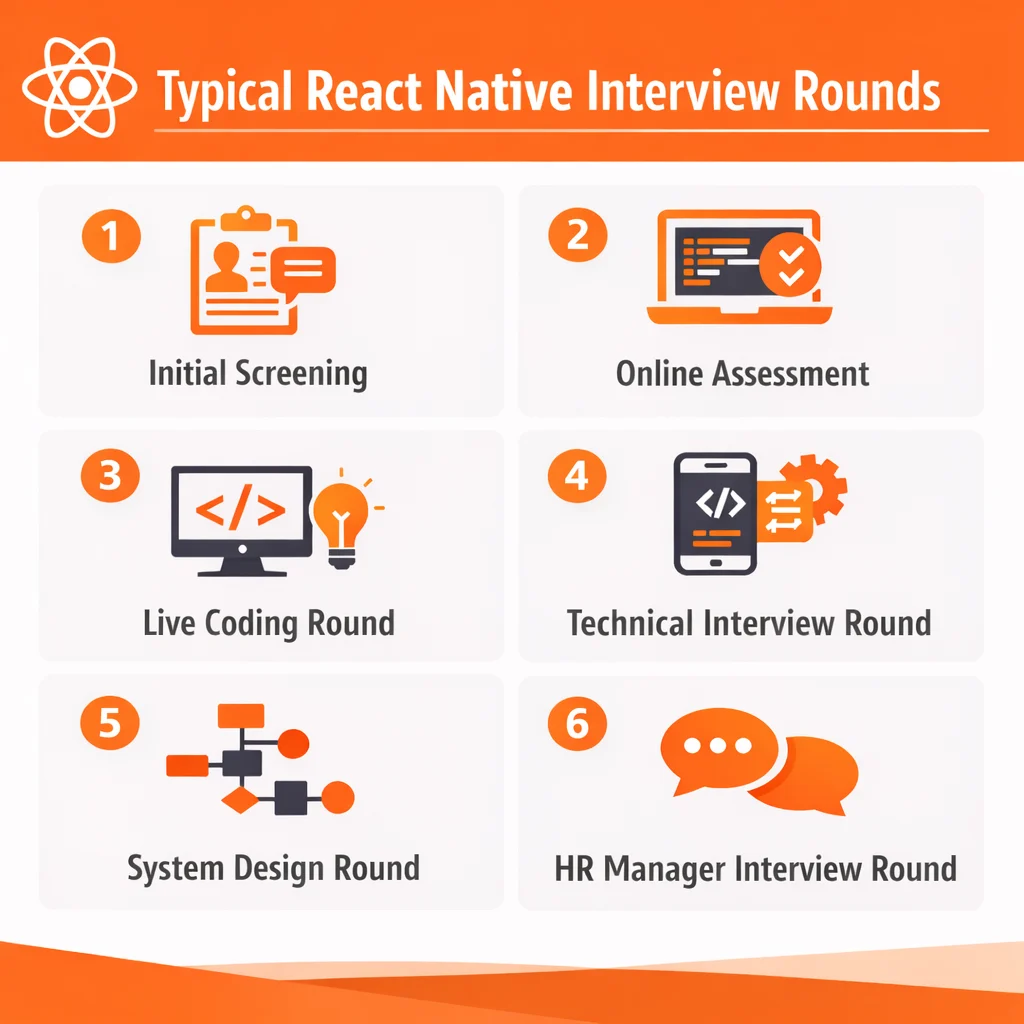
React Native Interview Process and Rounds
The React Native interview process usually includes a mix of technical screening, coding assessment, project discussion, and scenario-based questions to evaluate practical development skills.
- Initial Screening
- Online Assessment
- Live Coding Round
- Technical Interview Round
- System Design Round
- HR Manager Interview Round
Tips to Prepare for a React Native Interview
Preparing for a React Native interview requires focused and practical preparation. Here are some effective tips:
- Revise core concepts like state, props, hooks, lifecycle behavior, and component re-rendering.
- Be clear on performance topics such as FlatList optimization, avoiding unnecessary re-renders, and using Hermes.
- Prepare to explain real project challenges, including bugs you fixed and performance issues you solved.
- Practice writing small code snippets like API calls, navigation setup, and form handling without looking at documentation.
- Understand the basics of the new architecture, including Fabric and TurboModules.
- Review common scenario-based questions such as handling offline mode, debugging crashes, and securing sensitive data.
- Be ready to justify technical decisions, such as choosing Redux or another state management solution.
Related reads: Top 35 Mobile Application Testing Interview Questions | Top 25 iOS Interview Questions and Answers | Top 15 TypeScript Interview Questions and Answers | Top 35 Node.js Interview Questions and Answers
Wrapping Up
Preparing for a React Native interview becomes much easier when you know what kind of questions to expect. These top 40+ React Native interview questions and answers cover fundamentals, coding concepts, performance, architecture, and real scenarios to help you feel more confident.
If you are ready to move forward in your career, find the latest React Native job openings on Hirist and find a role that matches your skills and experience. Your next opportunity could be closer than you think.
FAQs
Yes. React Native continues to be widely used for cross-platform mobile app development. Companies prefer it because it allows faster development with a single codebase for Android and iOS. With consistent demand across startups and product-based companies, React Native remains a strong career option in 2026.
According to AmbitionBox, the average React Native developer salary in India is approximately ₹6.9 LPA for professionals with 0 to 6 years of experience.
Typical salary range: ₹6.6 LPA – ₹7.3 LPA
Top 10% earn: ₹10.7 LPA
Top 1% earn: ₹23.9 LPA
Salary varies based on experience, location, company type, and technical expertise. Developers with strong architecture and performance skills generally earn higher packages.
React Native Developer Salary Based on Experience
| Experience | Average Annual Salary |
|---|---|
| 0 – 1 yr | ₹3.1 Lakhs per year |
| 1 – 3 yrs | ₹4.6 Lakhs per year |
| 3 – 6 yrs | ₹8.3 Lakhs per year |
| 6 – 9 yrs | ₹13.9 Lakhs per year |
React Native Developer Salary Based on Location
| City | Average Annual Salary |
|---|---|
| Bengaluru | ₹11.1 Lakhs per year |
| Hyderabad | ₹10.6 Lakhs per year |
| Gurugram | ₹8 Lakhs per year |
| Mumbai | ₹7.9 Lakhs per year |
| Pune | ₹7.7 Lakhs per year |
React Native Developer Salary at Top Companies
| Company | Average Annual Salary |
|---|---|
| Uber | ₹14.6 Lakhs per year |
| Techahead Software | ₹9.7 Lakhs per year |
| N+A | ₹9.2 Lakhs per year |
| NeoSOFT | ₹8.6 Lakhs per year |
| Capgemini | ₹7.6 Lakhs per year |
Here are the list of skills you need to become a good React Native developer:
Strong knowledge of JavaScript and ES6 concepts
Understanding of React fundamentals and hooks
Experience with navigation libraries
API integration and state management
Performance optimization techniques
Basic understanding of native modules
Both frameworks are widely used. The choice depends on company requirements and team expertise. React Native is often preferred when JavaScript expertise is already available within the team, while Flutter may be chosen for its custom UI rendering capabilities.
Entry-level roles typically require strong fundamentals and at least one practical project. Mid-level roles require hands-on experience with real applications, debugging, performance optimization, and architecture decisions.
Interviewers typically focus on practical concepts that test both your fundamentals and real-world development experience. Common topics include:
State vs props
Hooks and lifecycle methods
FlatList optimization
Navigation
API integration
Performance debugging
React Native architecture
To prepare for React Native MCQs, check React Native documentation, work on practical projects, and practice coding. Additionally, use online resources and take sample MCQ tests to assess your knowledge and improve your understanding of key concepts.