
MuleSoft is a popular integration platform that connects applications, data, and devices through APIs. It was founded in 2006 by Ross Mason, a developer from London who wanted to simplify how systems communicate. The name came from the idea of “taking the donkey work out of integration.” Today, many companies in areas like finance, retail, and healthcare use MuleSoft to link their systems. This growth has opened up more jobs for people who know how to work with it. If you want to become a MuleSoft developer, architect, or consultant, this blog will help you. Here you will find the 30+ commonly asked MuleSoft interview questions and answers.
Fun Fact: MuleSoft makes up about 30% of the iPaaS (Integration Platform-as-a-Service) market.
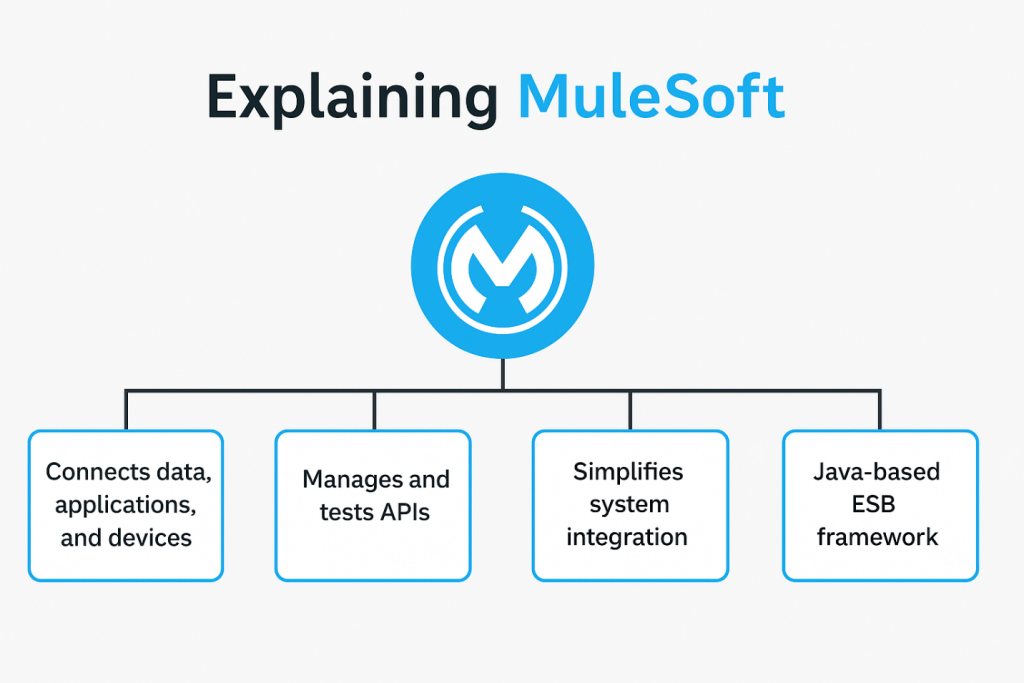
Note: In this blog on interview questions on MuleSoft, we have covered a complete range of questions for freshers, experienced professionals, scenario-based cases, developers, architects, and even questions asked by top IT companies to help you prepare thoroughly.
MuleSoft Interview Questions for Freshers
Here are some commonly asked MuleSoft interview questions and answers to help freshers prepare.
- What is MuleSoft and why is it used?
MuleSoft is an integration platform that connects applications, data, and devices. It helps businesses build APIs and automate workflows without writing complex code.
Companies use it to create connected systems across cloud and on premise environments. It saves time, reduces duplication, and makes data available in one place.
- Explain the types of variables in MuleSoft with examples.
MuleSoft has three main types of variables:
- Flow Variable: Stores data within a flow. Example: #[flowVars.userId].
- Session Variable: Holds data across the entire lifecycle of a message. Example: #[sessionVars.token].
- Record Variable: Used only in batch jobs to handle record-specific values. Example: #[recordVars.status].
- What are Batch Jobs in MuleSoft and where are they used?
Batch jobs process large volumes of data in steps. They split incoming messages into records and then process each record in parallel. At the end, results are summarized and sent to target systems. They are often used in data migration, synchronization between systems, or handling bulk API responses.
- What are the different types of messages in MuleSoft?
There are three message types:
- Echo and Log Messages: For logging and debugging.
- Bridge Messages: Passed directly from inbound to outbound routers.
- Build Messages: Created from static or dynamic values.
- What is Mule ESB and what are its main features?
Mule ESB (Enterprise Service Bus) is the runtime engine of MuleSoft. It supports both real-time and batch processing.
Key features include drag-and-drop design, message transformation, routing, security, and centralized monitoring. It provides universal connectivity, making it easier to integrate applications quickly.
- What are connectors in MuleSoft? Give examples.
Connectors are components that interact with external systems. They simplify sending and receiving data. Examples include the Database connector for MySQL or Oracle, Salesforce connector for CRM data, and HTTP connector for REST APIs.
- What are shared resources in MuleSoft?
Shared resources are reusable configurations used by multiple applications in the same domain. For example, an HTTP Listener configuration can be defined once and then referenced by different projects.
- What are the common endpoints available in MuleSoft?
Endpoints are entry or exit points for messages. Common endpoints include HTTP, FTP, JMS, SMTP/IMAP for email, Database (JDBC), and VM. These allow Mule applications to interact with systems in different ways.
MuleSoft Interview Questions for Experienced
Let’s go through important Mule interview questions for experienced professionals that can help you prepare better.
- What is the difference between Flow and Subflow in MuleSoft?
A Flow can start independently because it has an event source, like an HTTP Listener. It has its own error handling and can run asynchronously.
A Subflow does not have an event source. It runs only when called by a flow reference and inherits the parent flow’s error handling. Subflows are best for reusable logic.
- How do you handle error handling strategies in Mule 4?
Mule 4 introduced a new error handling framework. You can use On Error Continue to handle and move forward or On Error Propagate to stop execution and send the error upstream. There are also global error handlers for consistent behavior across applications.
- What is a Mule Transformer and what are its use cases?
A transformer converts message data from one format to another. Examples include XML-to-JSON or Object-to-CSV. Transformers help when systems communicate using different formats. Today, most transformations are done with DataWeave, but transformers are still useful in routing and message preparation.
- What are the different flow processing strategies in MuleSoft?
Common strategies include,
- Synchronous
- Asynchronous
- Queued
- Queued Asynchronous
- Non-Blocking
- Thread-per-Processor
- Custom
Each controls how Mule processes messages. For example, synchronous is simple but blocking, while asynchronous improves scalability.
- How do you improve the performance of a Mule application?
You can use streaming for large payloads, avoid storing payloads in flow variables, enable connection pooling, and reuse transformations. Adding cache scopes and designing lightweight flows also helps. Profiling with Anypoint Monitoring identifies slow components.
- What are the available resources for modularizing configurations in MuleSoft?
MuleSoft supports Independent, Inherited, Imported, and Heterogeneous configurations. These help split large projects into smaller, reusable parts.
For example, you can import a Spring configuration or reuse shared beans across multiple flows.
- What is the role of the Runtime Manager in MuleSoft?
Runtime Manager is a web console to deploy and monitor applications. It lets you scale workers, change configurations, track logs, and manage alerts. It supports both CloudHub and on-premise deployments, making operations easier.
MuleSoft Scenario Based Interview Questions
These are scenario-based MuleSoft interview questions that test how you handle real challenges.
- How would you design a flow to handle large volumes of data without message loss?
Use Batch Job with streaming to process records in chunks. Add a redelivery policy on the source. Write checkpoints to Object Store for restart. Use VM queues or persistent queues between stages.
Make writes transactional where supported (JMS/DB). Add an idempotent filter to avoid duplicates. Monitor with Anypoint Monitoring and alerts.
- You receive data in XML but need JSON output. How would you handle this in MuleSoft?
Read XML using an HTTP Listener or File. Transform with DataWeave 2.0: output application/json. Map fields, handle defaults, and cast types. Set response headers to application/json.
Keep the payload streaming if large. Add schema validation if needed using Validation module before the transform.
- How would you secure an API in MuleSoft before exposing it to external clients?
Terminate TLS on the HTTP Listener. Protect endpoints via Client ID Enforcement or OAuth 2.0 policy in API Manager. Add JWT validation when tokens are used.
Apply Rate Limiting and Spike Control. Restrict IPs with IP allowlist. Hide internals with CORS and headers. Store secrets in Secure Properties or a vault, not in code.
- If a REST API call fails in one system, how would you retry or handle it in MuleSoft?
Wrap the HTTP Request in a Try with On Error Continue/Propagate. Use Until Successful for bounded retries with backoff. Or configure reconnection and retry on the HTTP Request.
Persist failed requests to Object Store or a dead-letter queue for later replays. Add circuit breaker policy upstream if failures spike. Log with correlation IDs.
- How would you design a MuleSoft flow that consumes multiple APIs and aggregates the results?
Use Scatter-Gather to call services in parallel. Set per-route timeouts. Collect results, then DataWeave merges payloads by keys. Handle partial failures with defaults or a First Successful pattern.
Normalize formats first. If payloads are huge, keep streams and write paged merges. Return a clean, typed response model. Add metrics for each downstream call.
Also Read - Top 50+ REST API Interview Questions and Answers
MuleSoft Developer Interview Questions
This section covers key interview questions on MuleSoft that are often asked for developer roles.
- How do you use Anypoint Studio for building and testing Mule applications?
Anypoint Studio is the main IDE for MuleSoft. I drag components onto the canvas to design flows, configure connectors, and write transformations in DataWeave. For testing, I run apps locally and use the built-in debugger to check payloads and variables step by step.
- What is the purpose of DataWeave in MuleSoft?
DataWeave is MuleSoft’s language for transforming data. It converts formats like XML, JSON, and CSV. It also filters, maps, and joins data from multiple sources. In Mule 4, DataWeave replaced MEL for consistency and simplicity.
- How do you use Flow Reference in MuleSoft projects?
Flow Reference lets me call another flow within a project. It promotes reuse and keeps logic modular. The called flow executes synchronously and returns control back. I use it when multiple flows need the same logic, like logging or validation.
- What is the use of Choice Router and Scatter-Gather in MuleSoft flows?
Choice Router routes messages based on conditions, similar to an if-else block. Scatter-Gather sends the same message to multiple routes in parallel and collects responses. Choice is best for branching logic. Scatter-Gather is ideal for API aggregation.
- How do you implement caching in MuleSoft?
I use the Cache Scope in flows. It stores results of expensive operations like database calls. When the same request repeats, the cached response is returned. Object Store can also be used for custom caching.
MuleSoft Architect Interview Questions
Here are advanced Mule interview questions commonly asked in architect-level interviews.
- What is API-led connectivity and how does MuleSoft support it?
API-led connectivity is an approach where integration is built through reusable APIs at three layers: System APIs to unlock data, Process APIs to shape and combine it, and Experience APIs to deliver it to channels. MuleSoft supports this through the Anypoint Platform, which provides design, governance, and management tools.
- How do you design system, process, and experience APIs in MuleSoft?
System APIs connect directly with backend systems like SAP or databases. Process APIs combine logic from multiple systems and apply business rules. Experience APIs deliver data in the format needed by web, mobile, or partners. I usually design them separately so that changes in one layer do not affect the others.
- What are the best practices for securing MuleSoft applications at an enterprise scale?
Use TLS for transport security. Apply policies like OAuth 2.0, Client ID enforcement, and JWT validation in API Manager. Store secrets using Secure Properties or a vault. Add rate limiting and spike control. Monitor traffic with Anypoint Monitoring.
- How do you design MuleSoft architecture for high availability and scalability?
Deploy applications in multiple workers across regions. Use clustering for on-prem runtimes. Add load balancers in front of APIs. Scale horizontally by increasing worker numbers. Keep flows stateless so they can run in parallel.
- What is the role of Anypoint Exchange in enterprise projects?
Anypoint Exchange is a marketplace for reusable assets. Teams share connectors, templates, policies, and APIs there. It improves collaboration, speeds up development, and reduces duplication.
Additional MuleSoft Interview Questions
We are also sharing extra Mule interview questions to help you cover more topics in your preparation.
MuleSoft DataWeave Interview Questions
Here are some important DataWeave interview questions that focus on MuleSoft’s powerful data transformation language.
- What is DataWeave 2.0 and how is it different from Mule Expression Language (MEL)?
- How do you perform transformations in DataWeave? Give an example.
- How do you handle null values in DataWeave scripts?
- How do you filter and map data using DataWeave functions?
- How do you write reusable DataWeave scripts across multiple Mule flows?
RAML Interview Questions
- What is RAML and why is it used in MuleSoft?
- How do you define resources and methods in RAML?
- How do you apply security schemes in RAML?
- What is the difference between RAML and OpenAPI specifications?
- How do you handle versioning of APIs in RAML?
Mule 4 Interview Questions
- What are the major differences between Mule 3 and Mule 4?
- How does error handling work in Mule 4?
- What are Event and Variables in Mule 4?
- What is Auto-Paging in Mule 4 and when is it useful?
- How has DataWeave improved in Mule 4 compared to earlier versions?
MuleSoft Interview Questions Asked at Top IT Companies
These interview questions on MuleSoft are frequently asked by leading IT companies during their hiring process.
Deloitte MuleSoft Interview Questions
- How do you implement logging and monitoring in MuleSoft projects?
- What are the advantages of using API Manager in MuleSoft?
- How would you handle authentication and authorization in MuleSoft APIs?
- What are workers in MuleSoft CloudHub?
- Explain the use of Object Store in MuleSoft.
TCS MuleSoft Interview Questions
- How do you deploy Mule applications on CloudHub?
- What is the role of Anypoint Runtime Fabric?
- Explain the use of database connectors in MuleSoft.
- How would you implement asynchronous processing in Mule flows?
- What are the advantages of API-led connectivity in MuleSoft projects?
Accenture MuleSoft Interview Questions
- How do you use Anypoint Exchange for reusability?
- Explain the difference between Choice Router and First Successful Router.
- What are common performance tuning techniques in MuleSoft?
- How do you manage multiple environments in MuleSoft (Dev, Test, Prod)?
- What are different ways to consume RESTful services in MuleSoft?
IBM MuleSoft Interview Questions
- How do you integrate MuleSoft with legacy systems?
- What are the different types of scopes in MuleSoft?
- What is the role of Anypoint API Gateway?
- How do you secure communication between MuleSoft applications?
- What is API-led connectivity’s role in large-scale enterprise integration?
How to Prepare for MuleSoft Interview?
Preparing for a MuleSoft interview takes focus and practice with both concepts and hands-on tasks. Here are some tips to help you:
- Revise Mule basics like flows, connectors, and variables
- Practice solving real use cases in Anypoint Studio
- Go through common mule interview questions to understand patterns
- Learn DataWeave transformations and error handling in Mule 4
- Understand API-led connectivity and system, process, experience APIs
- Review security, deployment, and Runtime Manager features
- Be ready to explain past projects clearly and confidently
Wrapping Up
So, these are the 30+ MuleSoft interview questions and answers to help you prepare better. Focus on the basics, practice real scenarios, and stay updated with Mule 4 features to stand out. With the right preparation, cracking interviews becomes easier.
Looking for IT opportunities? Visit Hirist to find top tech jobs, including MuleSoft job roles.
FAQs
Here are some commonly asked questions for mid-level MuleSoft professionals:
How do you handle error handling in Mule 4?
What is the difference between Flow and Subflow?
How do you implement caching in Mule applications?
Explain API-led connectivity with an example.
How do you optimize Mule applications for performance?
According to AmbitionBox, MuleSoft developers in India earn an annual salary ranging from ₹4 Lakhs to ₹12 Lakhs, with an average of ₹7.7 Lakhs. The monthly in-hand pay is around ₹46,000 – ₹47,000 depending on location, tax, and benefits.
Mulesoft Developer Salary Overview (India, 2025)
| Metric | Value |
|---|---|
| Annual salary range | ₹4 Lakhs – ₹12 Lakhs |
| Avg. annual salary | ₹7.7 Lakhs |
| Monthly in-hand salary | ₹46,000 – ₹47,000 |
| Experience range in data | 2 – 5 years |
MuleSoft Developer salary based on experience level:
| Experience | Average Annual Salary |
|---|---|
| 2 years | ₹5.4 Lakhs per year |
| 3 years | ₹6.6 Lakhs per year |
| 4 years | ₹7.7 Lakhs per year |
| 5 years | ₹9.5 Lakhs per year |
MuleSoft Developer salary based on location:
| City | Average Annual Salary |
|---|---|
| Noida | ₹8.1 Lakhs per year |
| Mumbai | ₹8.0 Lakhs per year |
| Bangalore | ₹7.8 Lakhs per year |
| Pune | ₹7.8 Lakhs per year |
| Chennai | ₹7.7 Lakhs per year |
MuleSoft Developer salary at top companies:
| Company | Average Annual Salary |
|---|---|
| Deloitte | ₹10.4 Lakhs per year |
| NTT Data | ₹10.3 Lakhs per year |
| PwC | ₹9.7 Lakhs per year |
| Persistent Systems | ₹9.4 Lakhs per year |
| Genpact | ₹9.2 Lakhs per year |
Companies like Deloitte, Accenture, IBM, TCS, Capgemini, and Salesforce regularly hire MuleSoft developers and architects.
It usually involves a technical screening, hands-on coding or scenario tasks, and an HR discussion.
Yes, demand for MuleSoft professionals is growing as more enterprises adopt API-led connectivity.
Yes, basic programming knowledge helps. Most logic is built with DataWeave scripts for data transformation.
The most recognized ones are MuleSoft Certified Developer (Level 1) and MuleSoft Certified Integration Architect.