
SAP CPI stands for SAP Cloud Platform Integration. It is a cloud-based integration service by SAP SE, the German company founded in 1972 by former IBM engineers. The platform was created to connect SAP applications with third-party systems and simplify complex business workflows. Today, with over 92% of the Forbes Global 2000 companies using SAP, CPI has become a key tool for digital transformation. It is also a frequent topic in interviews for roles like SAP CPI developers, consultants, and integration specialists. In this blog, we share 25+ SAP CPI interview questions and answers to help you prepare easily.
Fun Fact: SAP has more than 280 million cloud users worldwide.
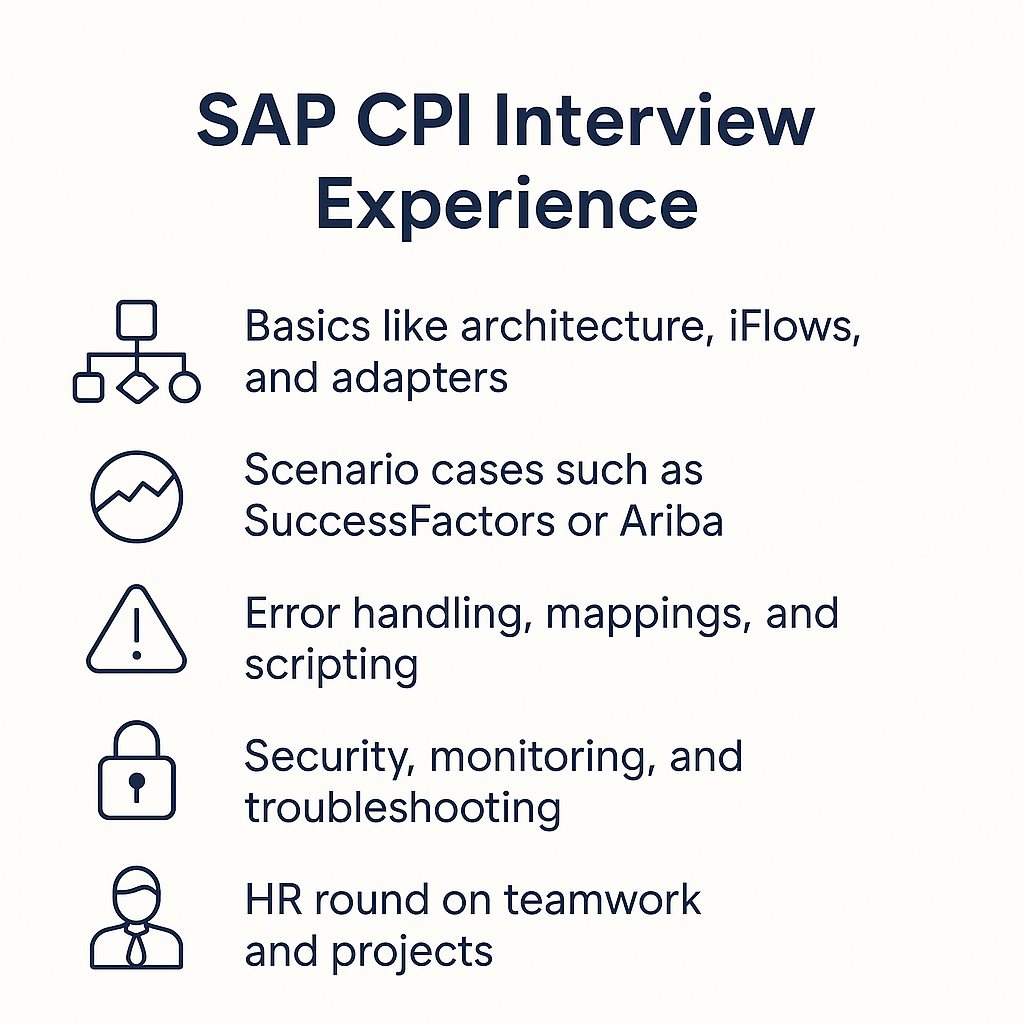
SAP CPI Interview Experience
Candidates often share that SAP CPI interviews focus on both fundamentals and real-world problem-solving. Common experiences include:
- Basic questions on CPI architecture, iFlows, and adapters.
- Scenario-based discussions like integrating SuccessFactors or Ariba.
- Hands-on tasks such as error handling or mapping transformations.
- Scripting questions on Groovy or JavaScript.
- Security-related queries about certificates, OAuth, and message encryption.
- Monitoring and troubleshooting exercises using the Operations view.
- Final HR round covering projects, teamwork, and career goals.
SAP CPI Interview Questions for Freshers
Here are some of the most asked SAP CPI interview questions and answers for freshers to help you get started.
- What is SAP CPI and why is it used?
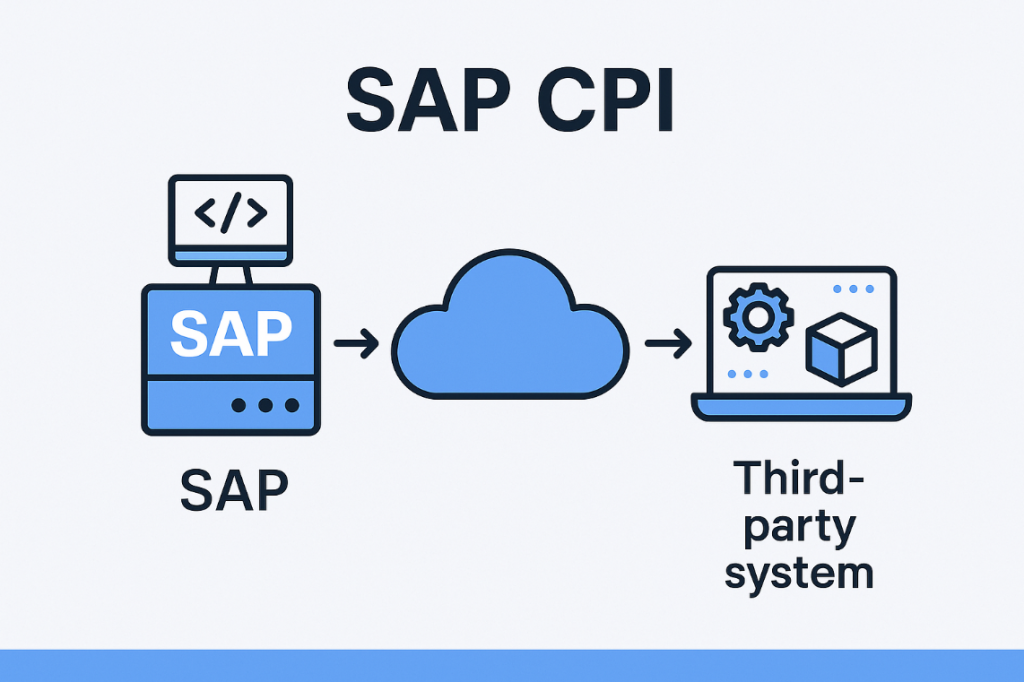
SAP CPI stands for SAP Cloud Platform Integration. It connects SAP and non-SAP systems across cloud and on-premise environments. It is widely used to streamline data flow, automate processes, and support hybrid business landscapes.
- Explain the architecture of SAP CPI.
SAP CPI runs on SAP Business Technology Platform with a microservices approach. It has two main parts: design time and runtime. Design time is where you create and configure iFlows, while runtime executes them. It also has monitoring tools and connectivity adapters to link different systems.
- What is an iFlow in CPI?
An iFlow, or integration flow, is a graphical model of how data moves between systems. It defines steps like mapping, transformation, and routing. I use iFlows to design end-to-end processes without heavy coding.
- Which adapters are commonly available in SAP CPI?
CPI provides many adapters to connect different protocols. Common ones are HTTP, SOAP, OData, SFTP, IDoc, JMS, and SuccessFactors adapters. These help integrate with cloud apps, databases, and third-party tools.
- How do you monitor a running integration flow in CPI?
Monitoring is done in the Web UI under the Operations view. I can track message status, check logs, and see payload details. Alerts and trace options help troubleshoot quickly.
- What is the Content Modifier step in CPI used for?
The Content Modifier changes message details during processing. It can add or update headers, properties, and payloads. For example, I may use it to pass dynamic values to the next step.
- What is the difference between synchronous and asynchronous integration in CPI?
Synchronous means the sender waits for an immediate response, like real-time APIs. Asynchronous means the sender does not wait and the system processes later, such as batch updates or queued messages.
SAP CPI Interview Questions for Experienced Professionals
Let’s go through important SAP CPI interview questions and answers for experienced professionals.
- How do you build error-handling logic within an iFlow?
Error-handling in CPI is implemented using exception subprocesses to capture failures during execution. Failed messages can be redirected to alternate flows, stored for reprocessing, or logged for audit purposes. Retry mechanisms handle temporary issues, while alerting features notify administrators immediately.
- What scripting options exist in CPI and when would you choose Groovy vs JavaScript?
CPI supports Groovy and JavaScript scripting. Groovy is typically used for advanced transformations, payload manipulation, and complex validations. JavaScript is chosen for lightweight tasks such as simple data checks or formatting. The choice depends on the complexity of the scenario and processing requirements.
- How is message versioning managed in CPI deployments?
Message versioning allows multiple versions of an integration flow to exist simultaneously. One version can remain active in production, while another is tested in parallel. Once validated, the new version can be deployed, with rollback available if issues occur. This minimizes disruption during updates.
- Describe how you would integrate a legacy on-premise system with SAP CPI using Cloud Connector.
Integration with legacy on-premise systems is achieved through SAP Cloud Connector, which establishes a secure reverse proxy connection without exposing internal networks. Appropriate adapters such as IDoc, SOAP, or FTP are configured in CPI. This setup allows seamless data transfer between cloud and on-premise systems.
- How do you secure communication between CPI and external systems?
Communication security in CPI involves the use of HTTPS, OAuth, or client certificates for authentication. Encryption is applied to data in transit, and field-level masking can be configured for sensitive information. Role-based access control at the tenant level further protects integration assets.
- How would you migrate or transport integration artifacts from development to production?
Integration artifacts can be migrated manually through export and import functions or automatically using SAP Transport Management Service or CTS+. Best practice is to validate flows in a quality system before deploying to production, ensuring stable and reliable integration.
Advanced SAP CPI Interview Questions
Here are advanced SAP CPI interview questions with answers to test deeper knowledge and problem-solving skills.
- Explain how you would implement content-based routing or dynamic routing in CPI.
Content-based routing uses conditions in the Router step to direct messages based on header values, payload content, or properties. Dynamic routing can be achieved by configuring routing expressions with variables or externalized parameters. This allows flexible handling of multiple target systems.
- How would you handle large payloads or streaming data in CPI?
Large payloads are managed using Splitters to divide data into smaller messages and Aggregators to combine results after processing. For streaming scenarios, adapters such as JMS or Kafka are often used with persistence options to maintain reliability and reduce memory usage.
- What is event mesh and how does CPI use it for event-driven scenarios?
Event mesh enables event-driven communication between applications and systems. CPI integrates with event mesh to publish and consume events asynchronously, reducing the need for direct peer-to-peer communication. Supported protocols like MQTT and AMQP allow scalable distribution of real-time messages.
- How can you design a scalable integration architecture in CPI across multiple cloud instances?
Scalable architectures are built using distributed processing, load balancing, and modular iFlows. Multiple tenants across regions can be used to reduce latency. External APIs and adapters provide flexibility to handle varying volumes while maintaining system performance.
- How do you maintain fault tolerance or resilience in message processing in CPI?
Fault tolerance is achieved through retries, exception subprocesses, and message persistence. Failed messages can be stored for later reprocessing, reducing the chance of data loss. Monitoring and alerting tools help identify issues quickly, while rollbacks allow recovery from failed deployments.
SAP CPI MCQs
Here are some SAP CPI MCQs to quickly test your knowledge and boost your interview preparation.
- Which adapter would you use to integrate via OData protocol in CPI?
a) SOAP Adapter
b) OData Adapter
c) SFTP Adapter
d) REST Adapter
Answer: b) OData Adapter
- What is the default process event to trigger an iFlow on a schedule?
a) Timer Start Event
b) Message Start Event
c) Router
d) Content Modifier
Answer: a) Timer Start Event
- Which of these is NOT a supported scripting option in CPI?
a) Groovy
b) Python
c) JavaScript
d) None of the above
Answer: b) Python
- What does a Content Modifier step let you adjust?
a) Headers
b) Properties
c) Payload
d) All of the above
Answer: d) All of the above
- Which protocol is used for secure file transfer in CPI?
a) FTP
b) HTTP
c) SFTP
d) SMTP
Answer: c) SFTP
- What is the purpose of a Data Store in CPI?
a) Temporary storage
b) Permanent storage
c) Versioning
d) Logging
Answer: a) Temporary storage
- Which step do you use for splitting a message into parts?
a) Splitter
b) Router
c) Enricher
d) Aggregator
Answer: a) Splitter
- What mechanism handles failed message retries in CPI?
a) Exception Subprocess
b) Timer
c) Parallel Multicast
d) Content Modifier
Answer: a) Exception Subprocess
- What is the term for storing message state to survive system restarts?
a) Persistence
b) Caching
c) Queueing
d) Encryption
Answer: a) Persistence
- Which authentication method is often used with API calls in CPI?
a) Basic Authentication
b) OAuth
c) Kerberos
d) Both a and b
Answer: d) Both a and b
Also Read - Top 20 OData Interview Questions and Answers
How to Prepare for SAP CPI Interview?
Here are some practical tips to help you prepare for SAP CPI interview:
- Revise the basics
Begin with fundamentals: what SAP CPI is, its architecture, and how iFlows work. Be clear on integration concepts like message routing, mappings, and monitoring.
- Focus on core components
Review frequently used elements such as:
- Content Modifier – adjust headers, properties, or payloads
- Data Store – store messages temporarily
- Router – route flows based on conditions
- Adapters – HTTP, OData, SFTP, IDoc, and more
- Practice hands-on scenarios
Work on a trial tenant or sandbox. Create simple iFlows, test transformations, and configure error handling. Practice monitoring messages and analyzing logs in the Operations view.
- Prepare for security questions
Be ready to explain HTTPS, OAuth, digital certificates, and masking of sensitive data. Security questions are common at all levels.
- Cover advanced topics
For experienced roles, focus on Groovy scripting, event mesh, hybrid integrations with Cloud Connector, and handling high-volume or streaming data.
- Think in real-world scenarios
Be prepared for scenario-based questions such as integrating SAP SuccessFactors with third-party apps. Explain the steps clearly and logically.
- Go through common interview questions
Reviewing frequently asked SAP CPI interview questions helps spot patterns. Practice short, precise responses that highlight practical knowledge.
Also Read - Top 25 SAP Interview Questions and Answers
Wrapping Up
And that’s a wrap on the top 25+ SAP CPI interview questions and answers. Preparing with these will help you understand core concepts, advanced scenarios, and real challenges better.
Looking for your next opportunity? Visit Hirist, where you can find IT jobs including SAP CPI job roles.
FAQs
Here are some commonly asked basic SAP CPI interview questions:
What is the role of Integration Packages in SAP CPI?
How does the Router step work in an iFlow?
What is the difference between Message Mapping and XSLT Mapping?
How do you configure Externalized Parameters in CPI?
What is the use of the Timer event in SAP CPI?
Capgemini often focuses on scenario-based and practical SAP CPI interview questions such as:
How do you handle exceptions and retries in CPI projects?
What are best practices when designing iFlows for performance?
How do you integrate SAP CPI with SAP Ariba or other procurement systems?
What monitoring tools are available in CPI for message tracking?
How would you handle GDPR compliance in SAP CPI integrations?
According to AmbitionBox, the average annual salary for an SAP Cloud Platform Integration Consultant in India is around ₹8.1 Lakhs. For professionals, the salary typically ranges between ₹3.8 Lakhs and ₹15 Lakhs annually, with an estimated monthly in-hand of ₹52,000 – ₹54,000.
SAP Cloud Platform Integration Consultant Salary
| Detail | Information |
|---|---|
| Based on | 1.2k salaries |
| Updated | 1 Oct 2025 |
| Experience Range | 2 – 6 years |
| Annual Salary Range | ₹3.8 Lakhs – ₹15 Lakhs |
| Avg. Annual Salary | ₹8.1 Lakhs |
| Monthly In-hand Salary | ₹52,000 – ₹54,000 |
| Salary Indicator | Salary of majority employees |
SAP CPI consultant salary based on experience:
| Experience | Average Annual Salary |
|---|---|
| 2 years | ₹5.8 Lakhs per year |
| 3 years | ₹7.0 Lakhs per year |
| 4 years | ₹8.4 Lakhs per year |
| 5 years | ₹10.7 Lakhs per year |
SAP Cloud Platform Integration Consultant Salary by Location
| Location | Average Annual Salary |
|---|---|
| SAP Cloud Platform Integration Consultant Salary in Visakhapatnam | ₹10.4 Lakhs per year |
| SAP Cloud Platform Integration Consultant Salary in Pune | ₹8.9 Lakhs per year |
| SAP Cloud Platform Integration Consultant Salary in Mumbai | ₹8.5 Lakhs per year |
| SAP Cloud Platform Integration Consultant Salary in Noida | ₹8.5 Lakhs per year |
| SAP Cloud Platform Integration Consultant Salary in Hyderabad / Secunderabad | ₹8.4 Lakhs per year |
SAP CPI consultant salary at top companies:
| Company | Average Annual Salary |
|---|---|
| IBM SAP Cloud Platform Integration Consultant Salary | ₹9.4 Lakhs per year |
| HCLTech SAP Cloud Platform Integration Consultant Salary | ₹9.1 Lakhs per year |
| Deloitte SAP Cloud Platform Integration Consultant Salary | ₹9 Lakhs per year |
| Capgemini SAP Cloud Platform Integration Consultant Salary | ₹8.3 Lakhs per year |
| Accenture SAP Cloud Platform Integration Consultant Salary | ₹7.6 Lakhs per year |
Top employers include Capgemini, Accenture, Deloitte, Infosys, TCS, IBM, and SAP itself. Many product-based companies and startups using SAP S/4HANA also hire for SAP CPI roles.
It depends on preparation. For freshers, interviews cover basics like iFlows, adapters, and content modifiers. For experienced professionals, scenario-based and advanced topics like Groovy scripting or event mesh are tested. With hands-on practice, the interview is manageable.
Most companies follow three rounds:
Technical round focusing on fundamentals and practical scenarios.
Advanced or case-study round for experienced candidates.
HR/Managerial round to check communication and fit.