
Adobe Experience Manager (AEM) is a powerful content management system developed by Day Software in Switzerland in 2000 and later acquired by Adobe in 2010. It helps businesses manage websites, mobile apps and digital assets in one place. Today, AEM is widely used by global companies for building smooth customer experiences. Because of this demand, roles like AEM developer, architect and administrator are highly popular. If you are preparing for such roles, these AEM interview questions and answers will guide you well.
Fun Fact: Around 126 out of the Fortune 500 companies (over 25%) use Adobe Experience Manager for their websites.
Note: In this blog on interview questions on AEM, we have included a complete set of questions for freshers, experienced professionals, scenario-based situations, AEM developers, and even a few bonus questions to help you prepare better.
AEM Interview Questions for Freshers
Here are some AEM interview questions and answers for freshers to help you understand the basics and get started.
- What is AEM and what role does it play in content management?
Adobe Experience Manager (AEM) is a content management system used to build websites, apps, and forms. It helps teams create, manage, and deliver digital experiences at scale. AEM also integrates with Adobe’s marketing tools, making it important for enterprises.
- What are the main components of AEM architecture?
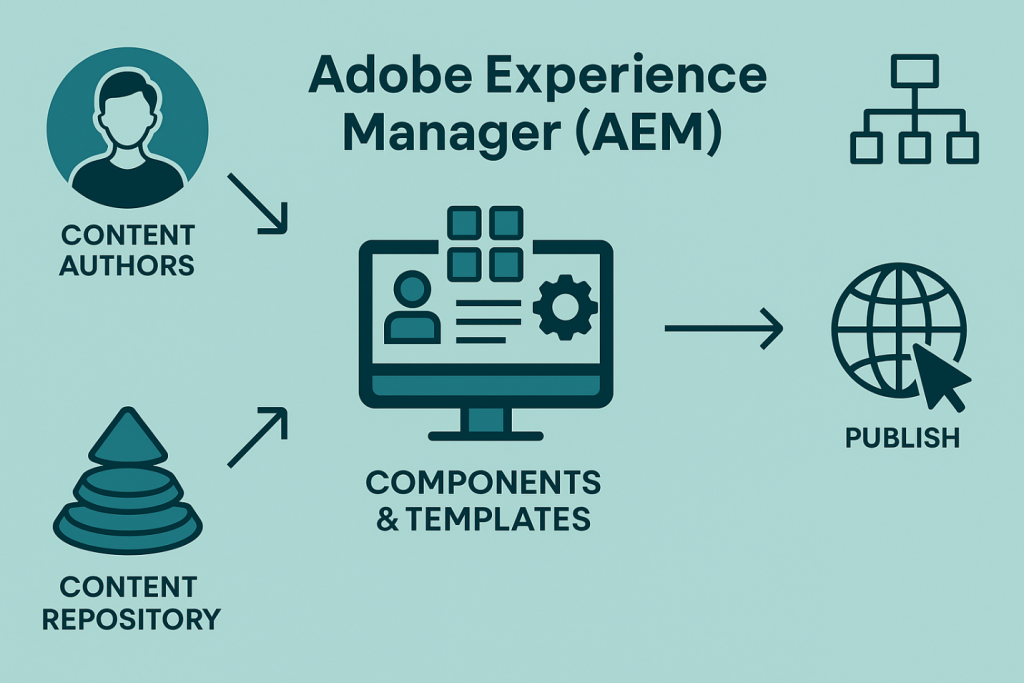
AEM has key components:
- Author instance for content creation
- Publish instance for live content
- Dispatcher for caching and load balancing
- OSGi framework for modular services
- JCR repository for storing content
- Sling framework for request handling
Together, they form the core architecture.
- What is the difference between Author and Publish instances in AEM?
Author is the internal environment where content authors create and edit content. Publish is the external, public-facing environment where approved content is available to users. Author is secure and behind a firewall, while Publish is optimized for performance and scale.
- What is a component in AEM?
A component is a reusable building block used to create content on a page. Examples include text, image, or navigation components. Developers can also create custom components for specific project needs.
- What is a template in AEM?
A template defines the structure of a page. It decides which components can be used, such as header, footer, or content area. AEM offers both static and editable templates.
- What are clientlibs and what is their purpose?
Clientlibs, or client libraries, are used to manage JavaScript and CSS. They allow organizing, minifying, and caching code for faster delivery.
- What is Sling in the context of AEM?
Sling is a web framework based on REST. It maps HTTP requests to JCR nodes and simplifies content rendering. It is central to how AEM delivers content.
AEM Interview Questions for Experienced
Let’s go through some AEM interview questions and answers for experienced candidates.
- How do you create custom components in AEM using HTL and backend logic?
First, I define the component in the JCR with dialogs for author inputs. Then I use HTL (HTML Template Language) to render the UI. For backend logic, I bind a Sling Model or Java class that connects data and exposes it to HTL. This keeps markup clean and business logic separate.
- What are Sling Models and when would you apply them?
Sling Models are Java classes annotated to map content resources or requests. They simplify connecting backend data with HTL templates. I apply them when I need to expose properties, add computed values, or integrate external data for a component.
- What roles do OSGi and Dispatcher play in AEM?
OSGi is the framework that allows modular services in AEM. It helps manage bundles like workflows, authentication, or search. Dispatcher is the caching and load balancing tool. It reduces load on Publish servers and improves site speed.
- How do you set up localization or multilingual support?
I create language copies of pages and use translation projects in AEM. The Multi Site Manager (MSM) helps keep global and local content in sync. For translations, I connect AEM with translation providers or use built-in workflows.
- How do you implement and run workflows in AEM?
I use the AEM Workflow console to design workflows with steps like review, approval, or publish. Workflows can have both human tasks and automated steps. Once activated, they run on content payloads like pages or assets.
- How do you debug a component that does not render properly?
I start by checking logs in error.log. Then I verify HTL syntax and Sling Model bindings. I test with “?debug=true” in the URL, confirm clientlibs are loading, and inspect browser console errors.
Note: Although we have already covered interview questions on AEM for experienced professionals, here are a few more based on different experience levels.
Also Read - Top 15+ Advanced Java Interview Questions
AEM Interview Questions for 3 Years Experienced
- How do you improve AEM performance?
- Describe a challenging AEM project you completed. .
- What part of developing with AEM do you enjoy the most?
- Tell me about a time you had to fix a production issue in AEM and how you approached it.
- How do you set up a responsive grid system or responsive components in AEM?
AEM Interview Questions for 4 Years Experienced
- What steps would you follow to migrate legacy CMS content to AEM?
- How do you manage and deploy AEM packages across different environments?
- What is one area of AEM development where you would like to improve?
- Describe a time when you had to collaborate with a non-technical team on AEM.
- How do you design a multi-site or multi-language setup in AEM?
AEM Interview Questions for 5 Years Experienced
- How would you plan and test a major AEM version upgrade?
- Describe how you would design an AEM solution for a global enterprise (multi-region).
- What motivates you to keep working with AEM after extensive experience?
- Give an example when your AEM solution reduced load time or improved performance.
- How would you integrate AEM headless-style with a frontend SPA?
AEM Interview Questions Scenario Based
These are some Adobe Experience Manager interview questions that are scenario based and will test how you apply AEM concepts in real projects.
- A content editor says pages are loading slowly. How would you find and correct the issue?
I would start by checking Dispatcher cache hit rates and logs. Then I’d review queries with the AEM Query Performance tool. If needed, I would optimize indexing, clientlibs, and workflows that may slow rendering.
- Marketing needs to A/B test different versions of a homepage – what is your approach in AEM?
I would use AEM’s built-in A/B testing with Adobe Target integration. Authors can create multiple page variations, and Target helps divide traffic, track results, and identify the winning version.
- You must build a dynamic multi-step form with validation. How would you implement that in AEM?
I would use Adaptive Forms for multi-step design. Client-side validation can be added with JavaScript, while server-side checks can be done with Sling Models or custom services. Conditional logic is configured to display fields based on input.
- You want to show search results with filters, how do you build faceted search in AEM?
I would use AEM’s Query Builder API with custom predicates for filters. Search results are displayed in components, and facets (like category or date) are generated from indexed properties. For large datasets, I would integrate Solr or Elasticsearch.
AEM Developer Interview Questions
Here are some AEM developer interview questions and answers for experienced professionals and freshers.
- How do you create a Sling Model to expose data to HTL templates?
Create a @Model class adaptable from Resource or SlingHttpServletRequest.
Inject values with @ValueMapValue, services with @OSGiService.
Add getters only.
Optionally export JSON with @Exporter.
Build and deploy the bundle.
In HTL, call it via data-sly-use and read getters.
- How do you implement template components with HTL and dialogs?
Create the component under /apps/…/components.
Add a cq:dialog using Granite UI fields for author input.
For editable templates, define policies under /conf to control allowed components and styles.
Render with HTL using data-sly-resource, conditions, and loops.
Bind data through a Sling Model.
- What is the process for writing a custom OSGi service in AEM?
Define a Java interface.
Implement it in a class annotated with @Component(service = YourApi.class).
Add @Designate and an @ObjectClassDefinition for runtime configs.
Use @Activate to read config.
Reference it from clients with @Reference.
Package, deploy, and test with AEM Mocks.
- How do you handle client-side performance (like JS/CSS) optimization in AEM?
Organize assets in clientlibs with categories and dependencies.
Enable minification and concatenation.
Serve via /etc.clientlibs using allowProxy.
Use long cache headers and file hashing.
Defer or async scripts.
Lazy load images.
Use responsive renditions from Core Image.
Compress over Gzip or Brotli at the web tier.
AEM Content Author Interview Questions
This section covers important AEM author interview questions and answers.
- How do you use templates to keep page layouts consistent for authors?
Templates define the structure of a page. Editable templates let admins control which components and styles are available. This keeps headers, footers, and layouts uniform, so authors focus only on content.
- What are components and how do they help authors create pages?
Components are reusable building blocks like text, image, or carousel. Authors drag and drop them into templates or pages. This makes creating new content flexible while maintaining consistency. Developers can also build custom components tailored to business needs.
- How do clientlibs affect what authors experience when adding content?
Clientlibs manage CSS and JavaScript in AEM. Well-structured clientlibs improve authoring by loading clean dialogs, responsive previews, and accurate styles. If clientlibs are broken, authors might see layout issues or unresponsive dialogs, so they are critical for a smooth experience.
- How can authors view or use previous versions or rollbacks of pages?
In AEM, each published or saved page creates a version. Authors can open the Timeline panel, select “Versions,” and restore a previous state. Rollback is useful when mistakes are published. I have personally used version restore after accidentally publishing incomplete content – it saved time and stress.
Other Important AEM Interview Questions
Now, let’s look at some additional AEM interview questions that are commonly asked across different roles and experience levels.
AEM Backend Developer Interview Questions
- What is the role of the JCR in AEM backend architecture?
- How do you set up replication from Author to Publish and handle failures?
- How do you develop a Servlet or REST endpoint in AEM backend?
- How would you write and register an OSGi service on the backend?
- How do you integrate AEM with external systems or APIs?
AEM Dispatcher Interview Questions
- What is a Dispatcher in AEM and what does it do?
- How do you configure Dispatcher caching rules for content updates?
- How would you set up load balancing with Dispatcher?
- What security settings can Dispatcher provide for the publish environment?
- How do you invalidate cache selectively for updated content?
AEM QA Interview Questions
- How do you test AEM content rendering across author and publish instances?
- What approach do you take to verify component behavior in different screen sizes?
- How can you automate testing of AEM workflows or component dialogs?
- What process do you follow to ensure dispatched pages are correctly cached?
- How would you test that translations or multilingual content render properly?
Also Read - Top 75+ Manual Testing Interview Questions and Answers
AEM Testing Interview Questions
- What is Bobcat in AEM testing?
- What is Hobbes.js, and why is it used in AEM testing?
- How do you write a basic UI test in AEM?
- How do you validate a custom workflow or form functionality via automated tests?
- How do you test for content regression after an AEM upgrade?
AEM Forms Interview Questions
- What are Adaptive Forms and how are they different from templates in AEM?
- What is an Adaptive Document?
- How do you add client-side validation in AEM forms?
- How would you integrate form submission with external services (e.g., email or backend API)?
- How do you manage form templates and reuse in AEM?
Also Read - Top 20+ Interview Questions On Java Servlets
Tips to Prepare for AEM Interview
Here are some practical tips to help you prepare for AEM interview:
- Revise AEM basics like components, templates, workflows, and Dispatcher
- Practice coding Sling Models and OSGi services
- Go through recent interview questions on AEM and attempt mock answers
- Be ready with real project examples you worked on
- Review performance tuning, caching, and multilingual setup topics
- Stay calm, think clearly, and explain your thought process
Wrapping Up
With these 25+ AEM interview questions and answers, you now have a solid foundation to prepare for different roles, from freshers to experienced developers. Keep practicing and stay updated with the latest AEM features.
Looking for AEM job opportunities? Visit Hirist to find the top IT jobs, including AEM developer job roles.
FAQs
AEM is both. Authors use its frontend interface to manage content, while developers work on backend code with OSGi, Sling, and JCR.
It is testing AEM applications without automation tools. Testers check page layouts, workflows, components, forms, and publishing manually to confirm they work as expected.
According to AmbitionBox, the average annual salary of an AEM developer in India is ₹11.9 Lakhs. The overall salary range is between ₹4 Lakhs and ₹30 Lakhs per year. On a monthly basis, the in-hand salary usually falls around ₹77,000 – ₹79,000.
Adobe AEM Developer Salary Overview (India, 2025)
| Metric | Value |
|---|---|
| Annual salary range | ₹4 Lakhs – ₹30 Lakhs |
| Avg. annual salary | ₹11.9 Lakhs |
| Monthly in-hand salary | ₹77,000 – ₹79,000 |
| Experience range in data | 1 – 7 years |
AEM developer salary based on experience:
| Experience | Average Annual Salary |
|---|---|
| 1 year | ₹9.6 Lakhs per year |
| 2 years | ₹9.2 Lakhs per year |
| 3 years | ₹10.0 Lakhs per year |
| 4 years | ₹14.8 Lakhs per year |
AEM developer salary based on location:
| City | Average Annual Salary |
|---|---|
| Mumbai | ₹16.7 Lakhs per year |
| Bangalore | ₹13.7 Lakhs per year |
| Gurgaon | ₹12.0 Lakhs per year |
| Hyderabad | ₹10.7 Lakhs per year |
| Pathankot | ₹10.0 Lakhs per year |
The process usually includes a technical round on AEM concepts, a coding or practical test, and a final HR or managerial discussion.
Top companies include Adobe, Accenture, TCS, Infosys, Cognizant, Capgemini, and several global product firms using AEM for digital experience platforms.