
SAP Basis stands for Business Application Software Integrated Solution. It is the technical foundation that keeps SAP applications running properly. The journey of SAP started in 1972 when five IBM engineers in Germany founded the company. Today it powers thousands of businesses worldwide. Basis professionals manage system performance, security and upgrades, making their role very important. That is why SAP Basis interview questions are often asked for jobs like consultant and administrator. In this blog we cover 20+ top questions with simple answers to help you prepare.
Fun Fact: According to Statista, SAP had over 109,000 employees worldwide in 2024. This shows how large and important the SAP ecosystem has become.
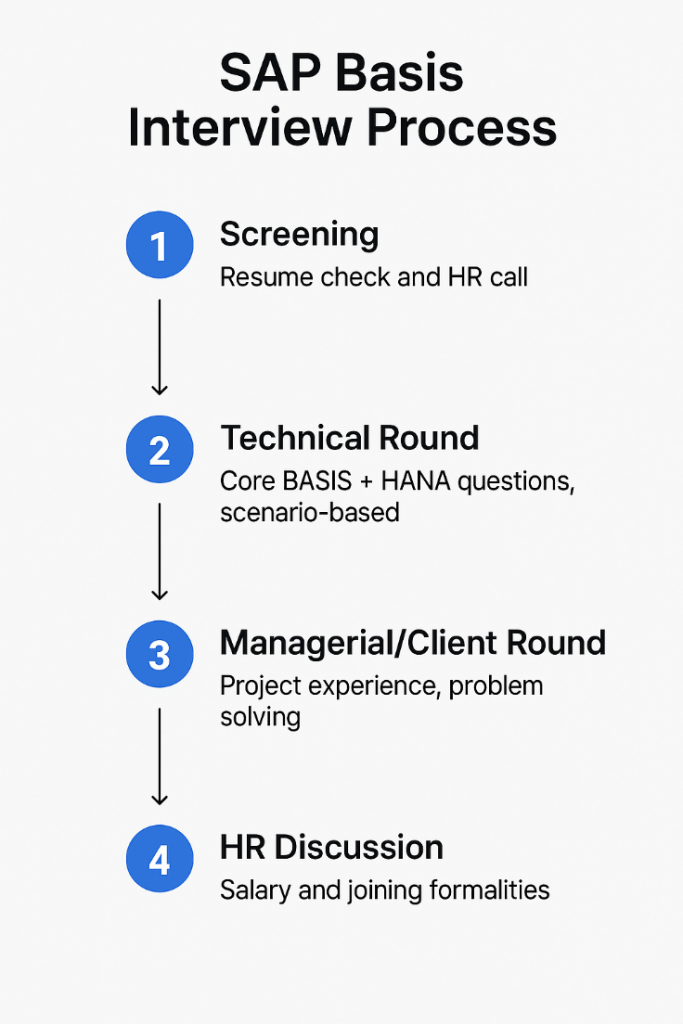
SAP Basis Interview Process
SAP Basis Interview Questions for Freshers
Here are interview questions and answers for SAP Basis that help beginners understand the basics and prepare confidently for their first job role.
- What is SAP Basis and why is it important?
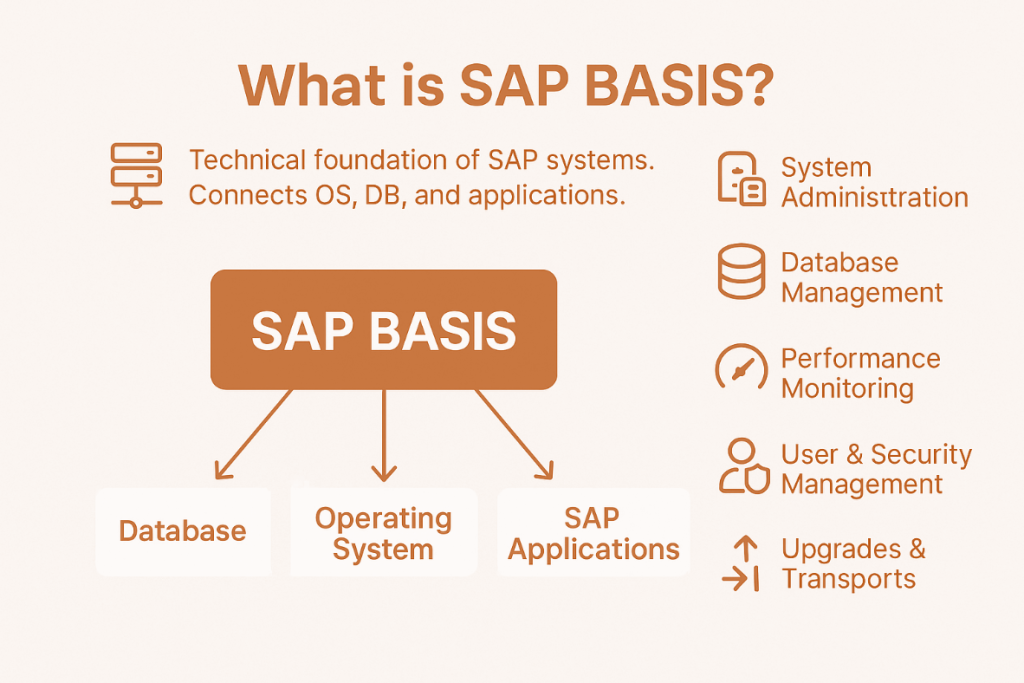
SAP Basis (Business Application Software Integrated Solution) is the technical layer of the SAP system. It handles system administration, database management, and application monitoring.
Without Basis, SAP applications would not run properly. It acts like the bridge between operating systems, databases, and SAP software, making it critical for smooth business operations.
- What are the different types of users in SAP?
SAP has several user types, such as:
- Dialog users are for interactive logins.
- System users are for background processes.
- Communication users are for RFC connections.
- Service users are for shared access.
- Reference users provide additional authorizations.
Each type serves a unique role in daily operations.
- What is the transaction code to check and delete locked objects?
The T-code is SM12. It displays locked objects in the system and allows administrators to delete locks if required. This is often used during troubleshooting when a process fails and leaves locks behind.
- What is SAP IDES?
IDES stands for Internet Demonstration and Evaluation System. It is a demo SAP system that contains sample business processes and data. Companies and students use it for training, testing, and practice. It gives a real feel of SAP scenarios without affecting live systems.
Note: IDES is still used for training but newer systems prefer S/4HANA trial landscapes.
- What is a client in SAP and how is it used?
A client is an independent environment in an SAP system. Each client has its own master data, user data, and settings. For example, one client can be used for training, another for testing, and another for production. This separation keeps activities organized.
- What are logon groups and how are they defined?
Logon groups are used to balance user load across servers. They are created in T-code SMLG. The message server then directs users to the right application server within the group, helping distribute workload effectively.
- What is the difference between a central instance and an application server?
The central instance is the first installed instance. It usually contains enqueue and message services.
Application servers handle dialog processing but don’t carry those central services. Together, they form a complete SAP system.
SAP Basis Interview Questions for Experienced
Let’s go through SAP Basis interview questions that focus on advanced concepts and problem-solving skills needed by experienced professionals.
- What are the different types of RFC in SAP?
RFC means Remote Function Call. It allows communication between SAP systems or with external systems. The main types are:
- Synchronous RFC, which waits for a response
- Asynchronous RFC, which continues without waiting
- Transactional RFC, which guarantees that COMMIT or ROLLBACK happens in both systems
- Queued RFC, which processes requests in order
- What is the difference between a support package, kernel, and SAP note?
A support package is a bundle of fixes and updates released by SAP.
The kernel is the low-level core of SAP that contains executables and manages memory and processes.
A SAP note is a single document that provides corrections, solutions, or configuration guidance for a specific issue.
Together, they keep systems stable and updated.
- How do you monitor and tune database performance in SAP?
I use ST04 to monitor database performance, and ST05 to analyze SQL statements. Regular checks on memory usage, long-running queries, and table indexes help identify issues.
I also update database statistics and reorganize tables when needed. Monitoring alerts and system logs also give early warnings about performance problems.
- How do you plan and execute an SAP system upgrade?
First, I plan by analyzing the impact on custom developments. Then I prepare development, quality, and production systems. Pre-upgrade tasks include system checks and backups. The upgrade is executed during a maintenance window. Afterward, I run tests, apply required transports, and confirm stability with end users before closing the upgrade project.
- What steps are involved in SAP disaster recovery planning?
The first step is identifying critical systems and setting recovery objectives. Then I design a DR architecture, often with a secondary site. Data replication and backups are configured. Failover and fallback steps are documented. Regular testing and updates are required so recovery actually works during emergencies.
SAP Basis Consultant Interview Questions
These SAP Basis interview questions are designed to test the knowledge and practical skills required to handle daily tasks as a consultant.
- What is STMS and how is it used for transport management?
STMS is the Transport Management System. It manages the movement of objects across SAP systems. Consultants use it to import, export, and track transport requests between development, testing, and production. It keeps system changes consistent.
- How do you perform a client copy and what are the key steps?
A client copy is done using SCCL. I log in to the target client, choose a profile like SAP_ALL or SAP_CUST, and enter the source client. The process can run immediately or be scheduled. Progress is tracked in SCC3. After completion, I check logs and adjust user roles.
- What is SAP EarlyWatch Alert and why is it used?
It is a monitoring service provided by SAP. It checks system health, collects performance data, and gives recommendations. Consultants use it to find potential issues early and improve stability.
- What is SAP Workload Analysis and how does it help in performance tuning?
Workload Analysis gives insight into CPU, memory, and response times. It helps identify bottlenecks in user activities or background jobs. Based on the data, consultants optimize parameters or adjust system resources.
SAP Basis Administrator Interview Questions
These are interview questions for SAP Basis administrator that check your expertise in system monitoring and overall administration tasks.
- How do you apply support packages or patches in SAP?
I use the SPAM/SAINT tool. First, I download the package from the SAP Marketplace. Then I upload it to the system, apply it step by step, and monitor logs. A backup is always taken before starting.
- How do you manage background jobs and what categories are available?
Background jobs are managed in SM36 and monitored in SM37. Jobs can be Immediate, Scheduled, or based on Calendar and Event triggers. Each type helps manage workload efficiently.
- What steps do you take to restrict multiple logins for a user?
I configure the parameter login/disable_multi_gui_login. This stops users from logging into multiple sessions. If needed, I also use security policies to allow exceptions only for admin users.
- How do you maintain roles and authorizations for users?
I create and adjust roles in PFCG. Then I assign them to users in SU01. I also run periodic checks to keep roles updated, follow segregation of duties, and remove unnecessary access.
SAP Basis HANA Interview Questions
Here are a few extra SAP Basis HANA interview questions often asked by recruiters.
- What is the role of SAP Basis in HANA administration?
Basis administrators manage HANA system installation, configuration, monitoring, and upgrades. They handle user roles, security, backups, and performance tuning. Basis ensures the HANA database integrates smoothly with SAP applications.
- What are the key steps in migrating from SAP ECC to HANA?
First, I assess system readiness with the SAP Readiness Check. Then I size hardware, plan downtime, and back up data. Using SUM with DMO (Database Migration Option), I migrate both the database and upgrade if needed. Post-migration, I test applications and validate data.
- How do you monitor performance in an SAP HANA system?
I use HANA Studio or SAP HANA Cockpit to monitor memory, CPU, and disk usage. I also check expensive statements, system alerts, and performance traces. Regular monitoring helps keep the database stable.
- What are the main differences between SAP S/4HANA On-Premise and S/4HANA Cloud?
On-Premise is installed in the company’s data center, with full control and customization. Cloud is hosted by SAP, updated quarterly, and faster to deploy but with limited customization. Both use the HANA database.
Also Read - Top 15+ SAP HANA Interview Questions and Answers
SAP Basis Interview Questions Asked in Top IT Companies
Here are SAP Basis interview questions frequently asked by leading IT companies.
Infosys SAP Basis Interview Questions
Here are SAP Basis interview questions Infosys commonly asks candidates to evaluate their technical expertise and ability to manage complex SAP systems.
- What is the purpose of transaction STMS_IMPORT?
- How do you configure logon load balancing in SAP?
- What are the steps involved in applying SAP notes?
- How do you check whether a system is Unicode or Non-Unicode?
- How do you analyze transport logs after import?
Accenture SAP Basis Interview Questions
- What are the default clients created in an SAP system and their use?
- How do you configure an OLAP connection in CMC?
- What are the key differences between synchronous and asynchronous RFC?
- How do you maintain high availability in an SAP environment?
- What authorization objects are always present in a user master record?
Note: You can also find more Accenture sap basis interview questions and answers on AmbitionBox.
TCS SAP Basis Interview Questions
- What is a logical system in SAP and why do we create it?
- What are transport routes and what is the difference between consolidation and delivery routes?
- What are common memory parameters you check in SAP performance tuning?
- How do you restrict the “Import All” option in STMS?
- What is LUW (Logical Unit of Work) in SAP?
SAP Basis MCQs
Here are some multiple-choice SAP Basis interview questions with options and their correct answers.
- Which transaction code is used to monitor spool requests?
a) SM50
b) SM51
c) SPAD
d) SP01
Answer: d) SP01
- In SCC4, which is the most commonly used option for customizing clients?
a) No changes permitted
b) Changes not automatically recorded
c) Changes automatically recorded
d) None of the above
Answer: c) Changes automatically recorded
- Which components are part of a transport request?
a) Datafile
b) Cofile
c) Both A & B
d) None
Answer: c) Both A & B
- What are the three startup modes for an Oracle database?
a) Mount, nomount, open
b) Online, offline, utility
c) Warm, cold, maintenance
d) Level 1, 2, 3
Answer: a) Mount, nomount, open
- Which clients are created by default during SAP installation?
a) 000
b) 001
c) 066
d) All of the above
Answer: d) All of the above
Tips to Prepare for SAP Basis Interview
Preparing for an SAP Basis interview needs both technical knowledge and smart preparation from the start. Follow these tips:
- Review SAP Basic interview questions and answers to cover core concepts
- Practice common T-codes like SM12, STMS, ST22, SM37, and ST06
- Focus on real scenarios from upgrades, transports, and performance tuning
- Stay updated with S/4HANA and cloud-based changes
- Be ready for HR questions about teamwork, problem solving, and future goals
Wrapping Up
So, these are the 20+ SAP Basis interview questions and answers that can help you get ready for your next interview. Go through them carefully, practice real scenarios, and build confidence before you face recruiters.
If you are looking for IT jobs including SAP Basis jobs, find the best opportunities now on Hirist.
Also Read - Top 25 SAP Interview Questions and Answers
FAQs
For a professional with 3 years of experience, interviewers often focus on project tasks and problem-solving. Here are the common questions:
How do you analyze and resolve system performance issues in SAP?
What are the steps to perform a client copy and post-copy activities?
How do you apply support packages or kernel upgrades safely?
Explain transport routes and their configuration in STMS.
How do you manage user roles and authorization conflicts?
SAP Basis non-HANA refers to the traditional Basis administration on older databases like Oracle, DB2, or MS SQL instead of SAP HANA. It covers tasks like installation, monitoring, transports, and upgrades on non-HANA systems.
SAP Basis jobs involve installing and maintaining SAP systems, monitoring performance, managing users, applying patches, and handling transports. Roles include Basis Administrator, Basis Consultant, and SAP HANA Basis Specialist.
According to AmbitionBox, the average annual salary for an SAP Basis Consultant in India is ₹7.5 lakhs. The salary typically ranges from ₹3.1 lakhs to ₹12 lakhs per year. The monthly in-hand pay is around ₹46,000 – ₹47,000 depending on deductions and benefits.
SAP Basis Consultant Salary Overview (India, 2026)
| Metric | Value |
|---|---|
| Annual salary range | ₹3.1 Lakhs – ₹12 Lakhs |
| Avg. annual salary | ₹7.5 Lakhs |
| Monthly in-hand salary | ₹46,000 – ₹47,000 |
| Experience range in data | 2 – 7 years |
SAP Basis Consultant salary based on experience:
| Experience | Average Annual Salary |
|---|---|
| 2 years | ₹4.7 Lakhs per year |
| 3 years | ₹5.9 Lakhs per year |
| 4 years | ₹7.2 Lakhs per year |
| 5 years | ₹8.7 Lakhs per year |
SAP Basis Consultant salary based on location:
| City | Average Annual Salary |
|---|---|
| Gurgaon | ₹9.1 Lakhs per year |
| Noida | ₹9.1 Lakhs per year |
| Kolkata | ₹8.9 Lakhs per year |
| New Delhi | ₹8.4 Lakhs per year |
| Mumbai | ₹8.2 Lakhs per year |
SAP Basis Consultant salary at top companies:
| Company | Average Annual Salary |
|---|---|
| SAP | ₹10.9 Lakhs per year |
| Deloitte | ₹9.2 Lakhs per year |
| PwC | ₹8.9 Lakhs per year |
| Bosch Global Software Technologies | ₹8.9 Lakhs per year |
| Ernst & Young | ₹8.8 Lakhs per year |
Infosys, Accenture, TCS, Wipro, Capgemini, and IBM are among the top recruiters for SAP Basis roles in 2026. Many global MNCs and product-based firms also hire skilled Basis professionals.