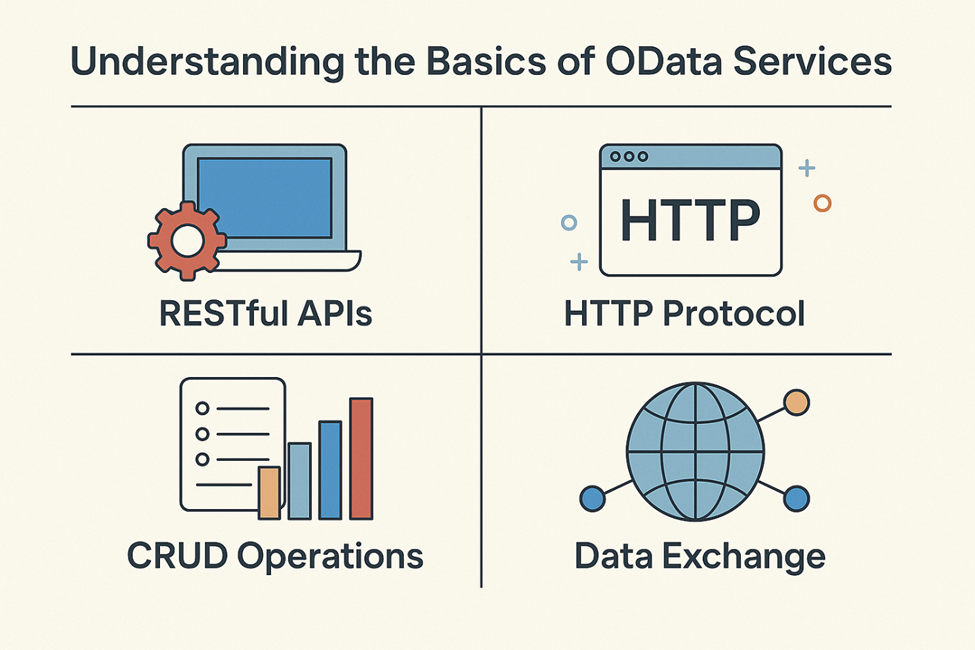
OData, short for Open Data Protocol, is a web protocol created by Microsoft in 2007 to simplify data sharing across applications. It was founded by Microsoft engineer Pablo Castro and later standardized by OASIS and ISO. OData is used for building RESTful APIs that allow smooth data exchange in industries like finance, healthcare, and e-commerce. As a result, roles like OData developer, API engineer and integration specialist are now in high demand. Here are the 20 most asked OData interview questions and answers to guide your preparation.
Fun Fact: OData is often called the “SQL for the web” because it lets developers query and manipulate data using a familiar style over RESTful APIs.
OData Interview Questions for Freshers
Here are some commonly asked SAP OData interview questions that are often asked to beginners.
- What is OData and how is it used in the SAP ecosystem?
OData (Open Data Protocol) is a standard for building RESTful APIs. In SAP, it is mainly used through SAP Gateway and Fiori apps to expose backend data in a consistent format. It allows developers to connect SAP systems with web, mobile, and third-party applications without building custom interfaces each time.
- Explain the architecture of SAP OData services.
The architecture has three layers.
- The Service Builder layer is where services are designed in transaction SEGW.
- The backend layer connects to SAP systems and retrieves business data.
- The frontend layer consumes the OData service in apps like SAP Fiori.
- What are Entity Types and Entity Sets in OData?
An Entity Type defines the structure of a business object, including its properties and keys. An Entity Set is a collection of entities of the same type, similar to a database table. Both are core concepts in OData.
- How do you perform CRUD operations in OData?
CRUD maps directly to HTTP. Create uses POST, Read uses GET, Update uses PUT or PATCH, and Delete uses DELETE. These methods let clients interact with SAP data in a simple, predictable way.
- What are common OData query options like $filter, $select, $orderby, $top, $skip?
$filter narrows results, $select limits fields, $orderby sorts data, $top controls how many rows return, and $skip moves past a set number of records. Together, these make queries efficient.
- What is the purpose of the Metadata Document in OData?
The Metadata Document defines the entire service model. It describes entities, properties, and relationships in XML. Clients use it to understand the service and build queries dynamically.
- What is the $expand option in OData?
$expand lets you fetch related entities with the main entity in one request. This avoids multiple round trips.
- How do you secure OData services in SAP?
Security involves HTTPS for transport, role-based authorization in SAP, and authentication methods like Basic or OAuth. These steps protect both data and access.
Also Read - Top 25 SAP Interview Questions and Answers
OData Interview Questions for Experienced
These are some frequently asked OData interview questions and answers for experienced professionals.
- What is Deep Entity in SAP OData and how is it used?
A Deep Entity allows creating or updating a main entity along with its related entities in one call. For example, I can create a sales order and its items together. It reduces the need for multiple round trips and keeps relationships intact.
- What are Function Imports in OData and why would you use them?
Function Imports are custom operations defined in the OData service. They allow execution of logic that doesn’t fit into standard CRUD. For instance, calculating tax or running a special approval process can be exposed through Function Imports.
- How is pagination implemented in OData using $top and $skip?
Pagination helps handle large datasets. $top limits how many records return, while $skip lets you move past a certain number of rows. Together they allow apps to load data in smaller, manageable chunks.
- Explain versioning strategies for SAP OData services.
Versioning is done to support new features without breaking existing clients. Common methods include creating new service endpoints like /v2/ or using HTTP headers to indicate the version. Both approaches keep older consumers working while supporting upgrades.
- What are best practices for designing SAP OData services?
Best practices include exposing only the required data, using clear names for entities and properties, and securing services with role-based access. Documentation through metadata and annotations is important. Services should also be kept modular and easy to maintain.
- How do you handle error scenarios in OData?
Errors are handled with HTTP codes and detailed messages. For example, 400 for bad requests, 401 for unauthorized, 404 for not found, and 500 for server errors. Custom error payloads can include more context to guide debugging.
- What is $batch request in OData and when is it used?
$batch groups multiple operations in a single HTTP request. It reduces network calls and improves performance, especially when many related operations need to be executed together.
Also Read - Top 15+ SAP HANA Interview Questions and Answers
Advanced Interview Questions on OData in SAP ABAP
Let’s go through some advanced OData in SAP ABAP interview questions and answers.
- How do you create an OData service using transaction SEGW?
In SEGW, I start by creating a new project. Then I define entity types and sets, map them to backend structures, and generate runtime objects. Finally, I register and activate the service in /IWFND/MAINT_SERVICE so it can be consumed.
- What HTTP methods does OData support in the context of SAP ABAP?
OData supports standard HTTP methods: GET for read, POST for create, PUT or PATCH for update, and DELETE for remove. These map directly to CRUD operations in SAP ABAP services.
- How does RAP (RESTful ABAP Programming Model) support OData service development in ABAP?
RAP simplifies exposing business objects as OData services. It uses CDS views, behavior definitions, and service bindings to generate services quickly. This approach is cleaner than the old SEGW method and is the preferred model in S/4HANA.
- How do annotations in CDS views help expose OData services via RAP?
Annotations in CDS views describe how data should behave in OData. For example, @OData.publish:true exposes the view as a service. UI annotations define field labels, search options, and navigation. This makes the service ready for use in Fiori apps.
- What tools or logs would you use to debug or monitor an OData service in SAP?
I often use the SAP Gateway Client (/IWFND/GW_CLIENT) to test requests. Error logs like /IWFND/ERROR_LOG and /IWBEP/ERROR_LOG provide details on failures. The ABAP Debugger is also useful for tracing runtime issues.
Also Read - Top 50+ SAP ABAP Interview Questions With Answers
Tips to Prepare for OData Interview
Getting ready for an OData interview requires strong basics and clear examples from real projects. Here are some tips to help you prepare:
- Revise core OData concepts and SAP use cases
- Practice answering common OData interview questions with short and clear responses
- Use tools like SAP Gateway Client or Postman for hands-on practice
- Prepare real scenarios from past work to explain your approach
- Stay updated with SAP Fiori and RAP model changes
Wrapping Up
So, these are the 20 OData interview questions and answers that can help you prepare better. Understanding the basics and advanced concepts will give you the confidence to face real interviews. Keep practicing and stay updated with the latest SAP developments.
Looking for IT job opportunities? Hirist is an online job portal for IT professional where you can find the best tech jobs including OData job roles.
FAQs
OData interview questions on LinkedIn often include basics like Entity Types, CRUD operations, metadata, $filter, $expand, and advanced topics like Deep Entity, Function Imports, and versioning. Candidates may also face scenario-based questions.
V2 is an older version of OData supported widely in SAP systems. V4 is the latest version with richer features such as improved JSON format, better annotations, and streamlined batch processing. Many companies now adopt V4 for modern apps.
MPC (Model Provider Class) defines the data model such as entities, sets, and properties. DPC (Data Provider Class) handles the runtime logic for CRUD operations and connects the model with real backend data.
According to AmbitionBox, SAP ABAP and OData consultants earn between ₹3 Lakhs to ₹15 Lakhs annually. The average salary is around ₹8.5 Lakhs per year. Monthly in-hand pay usually falls close to ₹62,000 – ₹64,000, depending on company policies, location, and benefits.
SAP ABAP and OData Consultant Salary Overview (India, 2026)
| Metric | Value |
|---|---|
| Annual salary range | ₹3 Lakhs – ₹15 Lakhs |
| Avg. annual salary | ₹8.5 Lakhs |
| Monthly in-hand salary | ₹62,000 – ₹64,000 |
| Experience range in data | 2 – 9 years |
OData Consultant salary based on experience:
| Experience | Average Annual Salary |
|---|---|
| 2 years | ₹5.0 Lakhs per year |
| 3 years | ₹6.0 Lakhs per year |
| 4 years | ₹8.7 Lakhs per year |
| 5 years | ₹10.5 Lakhs per year |
OData Consultant salary based on location:
| City | Average Annual Salary |
|---|---|
| Vuyyuru | ₹15.0 Lakhs per year |
| Navi Mumbai | ₹13.9 Lakhs per year |
| Gurgaon | ₹10.0 Lakhs per year |
| Hyderabad | ₹9.7 Lakhs per year |
| Mumbai | ₹8.5 Lakhs per year |
Companies like SAP, Accenture, TCS, Infosys, Capgemini, Deloitte, and Cognizant actively hire professionals skilled in OData, especially for SAP Fiori and S/4HANA projects.
The process usually starts with an online test or technical screening. It is followed by technical rounds covering OData services, ABAP, and SAP integration. The final round often includes HR and project-based discussions.
An OData consultant should have strong knowledge of SAP Gateway, ABAP, and CDS views. They also need experience with SAP Fiori integration, query options like $filter and $expand, debugging tools, and security methods such as OAuth. Understanding RAP in S/4HANA has become essential in 2026 for modern OData service development.