JCL stands for Job Control Language. It is the scripting language used on IBM mainframe systems. JCL was introduced in the 1960s along with OS/360 under the leadership of Gene Amdahl and Frederick Brooks at IBM. It is used to run batch jobs, handle input and output, and control system programs. Even today, JCL is common in banking, insurance, and other enterprises that rely on mainframes. In this blog, we cover 20 JCL interview questions with clear answers to help you prepare with confidence.
Fun Fact: Around 71% of Fortune 500 companies still rely on mainframes for their core business operations.
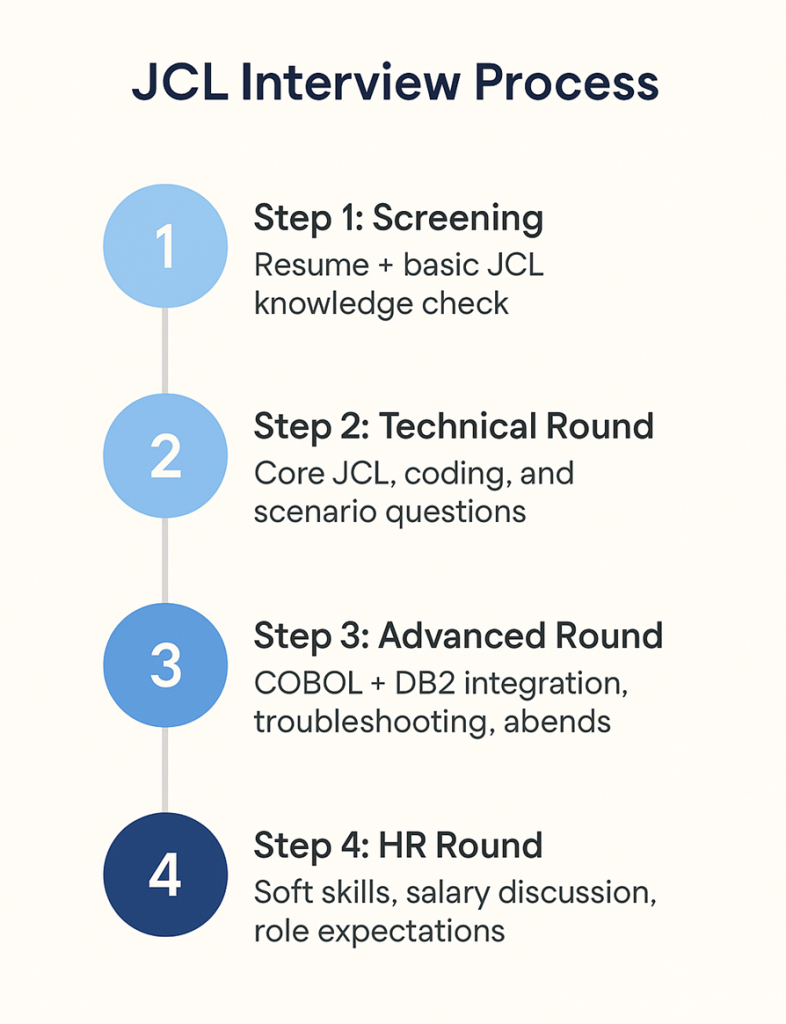
JCL Interview Process
JCL Interview Questions for Freshers
Here are some important JCL interview questions and answers to help beginners understand the basics and prepare for entry-level roles.
- What is JCL and what role does it play in mainframe batch processing?
JCL, or Job Control Language, is used to tell IBM mainframes how to run batch jobs. It defines which programs to run, what input and output datasets to use, and under what conditions. Without JCL, the system would not know how to schedule or execute tasks in batch mode.
- What are the main JCL statements and what do they do?
The JOB statement starts the job and identifies it to the system.
The EXEC statement specifies the program or procedure to be executed.
The DD (Data Definition) statement defines the datasets required for each job step, including input, output, and temporary files.
- What is a Generation Data Group (GDG) and how do you reference a prior generation?
A GDG is a collection of datasets related by name and version. Each generation is numbered, like G0001V00, G0002V00, and so on. To reference the latest generation, you use (0). A previous generation is (-1), and the next new one is (+1).
- How can you detect if a file is empty using JCL?
The common way is by using IDCAMS. When an empty file is used as input, IDCAMS returns code 4. That return code indicates the file has no records.
- What does the RESTART parameter do, and how can it be used to resume a job?
The RESTART parameter allows a failed job to start again from a specific step. On the JOB card, you specify RESTART=STEPname. The system skips earlier steps and begins from that point.
- What is the difference between DISP=SHR and DISP=OLD in DD statements?
DISP=SHR lets multiple jobs share a dataset in read mode. DISP=OLD gives exclusive control to one job and prevents others from using it at the same time.
Mainframe JCL Interview Questions for Experienced
Let’s go through some commonly asked mainframe JCL interview questions and answers for experienced professionals.
- How can you pass data from JCL to a COBOL program?
There are three main ways. You can pass data through the SYSIN DD statement, through PARM parameters coded in the EXEC statement, or by passing input files directly. In COBOL, these are read using the ACCEPT verb or Linkage Section.
- What is the purpose of a PROC, and how does an instream PROC differ from a cataloged one?
A PROC is a set of prewritten JCL statements reused across jobs. An instream PROC is coded directly within the JCL between PROC and PEND statements. A cataloged PROC is stored in a procedure library and can be called by name.
- What is the purpose of the MSGCLASS or MSGLEVEL parameter in a JOB statement and how is it used?
MSGCLASS defines where system messages go, usually to a printer or spool class. MSGLEVEL controls which JCL statements and messages appear in the output log. Together, they help in monitoring job details without unnecessary noise.
- What are common utilities in JCL and when would you use IDCAMS or IEBGENER?
IDCAMS is mainly used for managing VSAM datasets, like creating or deleting them. IEBGENER is used for copying datasets, printing them, or creating test files. Both utilities save time by handling standard dataset tasks quickly.
- What does the TIME parameter do when coded in the JOB or EXEC statement?
TIME sets a CPU limit for the job or step. If that time is exceeded, the system ends the process with a timeout abend.
- What is the function of the INCLUDE statement in JCL and when would you use it?
The INCLUDE statement pulls in a predefined set of JCL statements from a library. It is useful when the same code block is needed in many jobs.
Also Read - Top 30+ Mainframe Interview Questions and Answers
Scenario-Based JCL Mainframe Interview Questions
These are practical mainframe JCL interview questions and answers designed to test how you apply concepts in real project situations.
- How can you check JCL syntax without actually executing the job?
You can do this using the TYPRUN=SCAN parameter on the JOB statement. It scans the entire JCL for syntax errors but does not run the job. Another option is using utilities like JSCAN in some mainframe environments. Both methods help you find mistakes early without consuming system resources.
- How would you run multiple jobs one after the other in JCL?
Sequential execution can be handled by creating job dependencies. In many installations, job schedulers like Control-M or IBM JES2 are used. Within JCL, you can control flow using condition codes. If one job finishes with a return code of 0, the next job starts. This avoids overlap and keeps jobs in the right order.
- How would you control execution of a job step based on a return code from an earlier step?
The COND parameter is used for this. You can write COND=(0,EQ) to skip a step if the prior return code equals 0. It is flexible since you can test codes like NE, GT, or LT. This makes it possible to build conditional logic directly in JCL.
- How can you pass parameters from one job to another in a mainframe environment?
Parameters can be passed through datasets. The first job writes its output or control values to a temporary or permanent dataset. The next job then reads this dataset as input. In practice, shops often use PROCs with symbolic parameters combined with datasets to achieve smooth job chaining.
Mainframe Interview Questions COBOL JCL DB2
Here are some commonly asked COBOL JCL DB2 interview questions and answers that cover key concepts across all three mainframe technologies.
- What is the difference between static SQL and dynamic SQL in a COBOL-DB2 program?
Static SQL is embedded in the COBOL source code and precompiled using DB2’s precompiler. It is optimized at bind time, so execution is faster but changes in queries require recompilation. Dynamic SQL is constructed and executed at runtime using statements like EXECUTE IMMEDIATE. It is more flexible, allowing programs to build queries dynamically, but performance can be slower compared to static SQL.
- What role does JCL play when running COBOL programs in batch jobs?
JCL acts like a bridge between COBOL and the mainframe operating system. It tells the system which COBOL program to run, which datasets to open, and where to write the results. Without JCL, the COBOL executable cannot run in batch mode.
- What is DCLGEN in DB2 and why is it used?
DCLGEN (Declarations Generator) creates the host variable declarations and SQL skeletons for DB2 tables. It saves time and keeps field definitions consistent between the COBOL program and DB2 database.
- What are the main fields in SQLCA that your COBOL program uses when interacting with DB2?
The SQLCA (SQL Communication Area) contains fields that capture the status of SQL operations. The most used is SQLCODE, which shows success or error codes. SQLERRM provides error messages. SQLWARN flags highlight possible issues like truncation.
Note: COBOL JCL interview questions often include topics related to file handling, job scheduling, error handling, and integration with databases like DB2.
Also Read - Top 50+ SQL Interview Questions and Answers
Tips to Prepare for JCL Interview
Preparing for a JCL interview requires strong basics and clear practice with real mainframe scenarios. Here are some tips to help you:
- Revise commonly asked JCL questions and answers to build confidence
- Practice writing JOB, EXEC, and DD statements in sample jobs
- Understand GDG, PROC, COND, DISP and utilities like IDCAMS, IEBGENER
- Focus on error codes and restart methods
- Solve scenario-based tasks with return codes and datasets
- Review COBOL integration and DB2 related JCL usage
Wrapping Up
With these 20 JCL interview questions and answers, you can feel more prepared for real interviews. Focus on basics, practice scenarios, and review common utilities to build confidence. Mainframes are still vital in banking and enterprise systems, so JCL skills matter.
Looking for career opportunities? Hirist is an online job portal where you can easily find the best IT jobs, including JCL jobs.
FAQs
Mainframe JCL questions are not very difficult if you prepare well. Most focus on basic concepts like JOB, EXEC, DD statements, GDG, and common utilities. Reviewing JCL questions and answers regularly helps you understand patterns and gives you confidence to face interviews without stress.
Banks, insurance firms, and IT service giants like IBM, TCS, Infosys, Accenture, and Cognizant hire JCL professionals.
The process usually includes a technical round with JCL coding questions, a scenario-based problem-solving round, and an HR discussion.
Start with basics of JOB, EXEC, and DD statements. Practice GDG, COND, and DISP. Go through sample JCL coding tasks and mock interviews.
Along with JCL, it is useful to learn COBOL, DB2, CICS, and VSAM. Many mainframe jobs require knowledge of how these work together. Adding skills in performance tuning, utilities like IDCAMS, and job scheduling tools can also improve career opportunities.