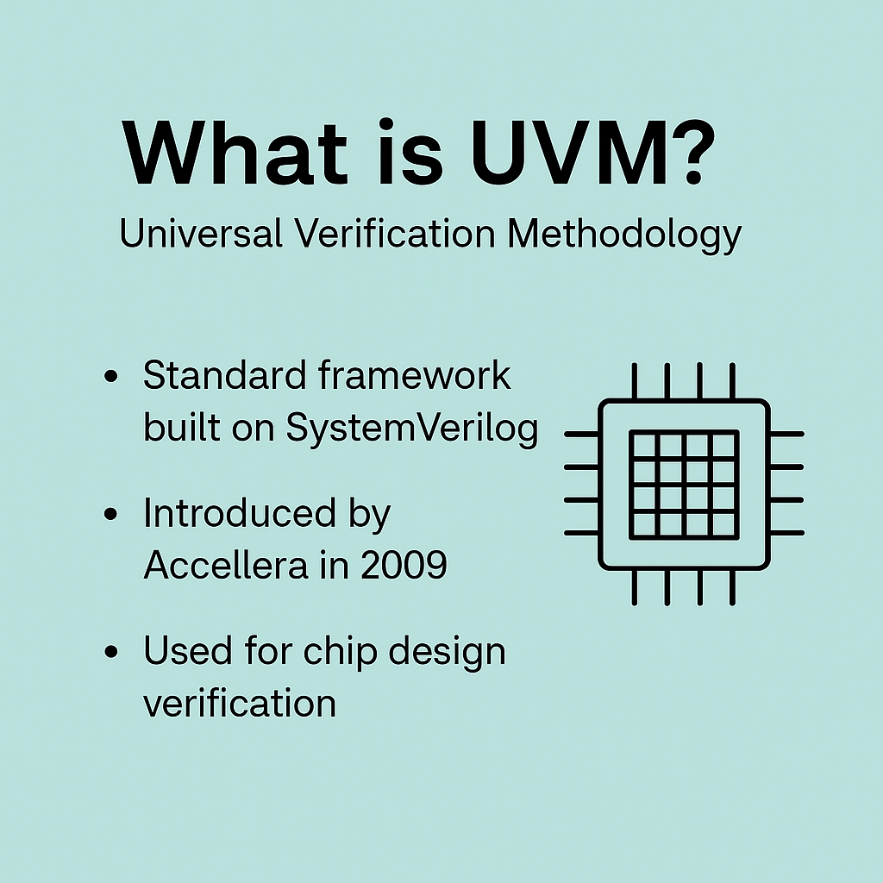
UVM stands for Universal Verification Methodology. It is a standardized framework used in chip design verification. UVM was introduced around 2009 by Accellera, a group formed by leading industry experts to bring consistency to verification practices. Built on SystemVerilog, UVM helps engineers create reusable and scalable testbenches for complex semiconductor designs. It is widely used by verification engineers, design engineers, and test automation roles in industries like electronics and semiconductors. In this blog, we cover 20 UVM interview questions and answers ranging from basics to advanced concepts.
Fun Fact: Over 82% of semiconductor companies worldwide use UVM as their primary verification methodology.
UVM Interview Questions for Freshers
Here are some of the most important UVM interview questions and answers to help beginners prepare for entry-level roles.
- What is UVM and why is it used in verification?
UVM (Universal Verification Methodology) is a standard framework built on SystemVerilog. It was created to bring consistency and reusability in testbench development. Companies use it because it saves time, reduces duplication, and allows teams to share verification components across projects.
- What are the main UVM components?
The key components of UVM are agent, sequencer, driver, monitor, and scoreboard.
- An agent groups verification components for an interface.
- A sequencer controls sequences.
- A driver drives stimulus into the DUT.
- A monitor observes DUT outputs and sends data to analysis components.
- A scoreboard checks expected vs actual results.
- How do UVM phases work at a high level?
Phases are ordered steps in simulation. The build phase creates components. The connect phase links ports and exports. The run phase runs stimulus and checking. Finally, cleanup and reporting happen in the final phase. This order keeps simulations structured.
- What is the difference between uvm_component and uvm_object?
uvm_component is for hierarchical elements like agents, drivers, and monitors. They have phases and reporting. uvm_object is for lightweight data items like transactions and sequences. Objects don’t have phases but support randomization, copy, and compare.
- How does a UVM sequence interact with a sequencer and a driver?
A sequence generates transactions. These go to the sequencer. The sequencer schedules them and passes one at a time to the driver. The driver then drives these into the DUT.
- What is the UVM config_db and when would you use it?
The config_db is a centralized database used to share configuration values. For example, I can pass a virtual interface or parameter from the top test to lower components without hard coding paths. It keeps the testbench flexible.
- What is an analysis port and where is it used?
An analysis port broadcasts data to multiple subscribers. A monitor uses it to send transactions to a scoreboard or coverage collector. It’s unidirectional and supports one-to-many communication, making it useful for checking and coverage.
UVM Interview Questions for Experienced
Let’s go through some advanced UVM interview questions with answers that are commonly asked for experienced verification roles.
- How would you design a reusable scoreboard and connect it via analysis exports?
A reusable scoreboard is built as a uvm_component with analysis exports. It receives transactions from monitors through analysis ports. Inside, I usually store expected results in queues or reference models. Then I compare them with actual outputs.
By keeping it protocol-independent and using parameterized transaction types, the same scoreboard can work across projects.
- When do you use factory type override vs instance override, and why?
Type override replaces every instance of a class with another class across the testbench. Instance override replaces only a specific instance.
For example, I use type override when I want every driver replaced with a new driver version. I use instance override when I want just one agent or one monitor customized without affecting the others.
- How do you debug a test that never ends due to objections?
First, I check which component is still holding an objection. Using print_objections() shows the list. Often, a sequence forgets to drop objections in body(). Sometimes drivers or monitors raise them but never release. Fixing these mismatches usually solves endless runs.
- How do you coordinate multiple agents and sequences across interfaces in a complex environment?
I use a virtual sequencer that holds handles to lower-level sequencers. The virtual sequence starts sub-sequences in parallel or in a specific order. This keeps cross-interface scenarios clean and easy to manage.
- How do you handle randomization failures and make constraints more robust?
I start by checking constraint conflicts with randomize() with {} debugging. If constraints are over-constrained, I relax them step by step. I also use soft constraints where possible. When randomness still fails, I add default values or post-randomize checks to make the transactions usable.
Tricky Interview Questions on UVM Methodology
These are some tricky interview questions on UVM methodology and their answers.
- Items are pushed into a TLM FIFO but never pop out; what would you check first?
I would first confirm that the consumer side is connected correctly in the connect_phase. If the consumer never calls get() or peek(), the FIFO will stay full. I also check blocking vs non-blocking calls, as a mismatch can stall data flow.
- Which UVM phases are functions and which are tasks, and why does that matter?
Build, connect, and end_of_elaboration are functions. Run phase is a task. This matters because tasks can wait or consume time, while functions execute immediately. Mixing them incorrectly leads to scheduling issues.
- How would you add a user-defined phase and integrate it with the phase graph?
I create a new class extended from uvm_phase. Then I register it with the phase graph using uvm_domain::add(). This allows me to insert custom phases between existing ones, for example, a pre-run setup phase before run_phase.
- What is the difference between analysis FIFOs and TLM FIFOs, and when would you pick one over the other?
An analysis FIFO connects an analysis port to a consumer that needs to pull transactions. It stores incoming transactions for later use. TLM FIFO is a more general point-to-point channel between two components, supporting put/get/peek operations.
I use analysis FIFO when connecting monitors to scoreboards. I use TLM FIFO when building communication channels where timing and order matter.
UVM Coding Interview Questions
This section covers practical coding-based UVM interview questions that check your hands-on skills in SystemVerilog and testbench development.
- Write a minimal UVM sequence that randomizes a transaction with constraints and starts on a sequencer.
class my_item extends uvm_sequence_item;
rand bit [7:0] addr; `uvm_object_utils(my_item)
function new(string n=”my_item”); super.new(n); endfunction
endclass
class my_seq extends uvm_sequence#(my_item);
`uvm_object_utils(my_seq)
task body(); my_item it = my_item::type_id::create(“it”);
if (it.randomize() with { addr inside {[8’h10:8’h1F]}; }) begin
start_item(it); finish_item(it);
end
endtask
endclass
A simple sequence creates, randomizes, and sends a transaction.
- Code a driver that gets items from a sequencer, drives a simple bus, and reports activity.
class my_driver extends uvm_driver#(my_item);
`uvm_component_utils(my_driver)
task run_phase(uvm_phase p); my_item it;
forever begin
seq_item_port.get_next_item(it);
// drive ‘it’ to DUT here (few cycles)
seq_item_port.item_done();
end
endtask
endclass
The driver fetches items from the sequencer and drives them to the DUT.
- Show how to connect a monitor analysis_port to a scoreboard analysis_export in connect_phase.
class my_monitor extends uvm_component;
uvm_analysis_port#(my_item) ap; `uvm_component_utils(my_monitor)
function new(string n, uvm_component p); super.new(n,p); ap=new(“ap”,this); endfunction
endclass
class my_scoreboard extends uvm_component;
uvm_analysis_export#(my_item) ax; `uvm_component_utils(my_scoreboard)
function new(string n, uvm_component p); super.new(n,p); ax=new(“ax”,this); endfunction
endclass
class my_env extends uvm_env;
my_monitor m; my_scoreboard s; `uvm_component_utils(my_env)
function void build_phase(uvm_phase p); m= my_monitor::type_id::create(“m”,this);
s= my_scoreboard::type_id::create(“s”,this); endfunction
function void connect_phase(uvm_phase p); m.ap.connect(s.ax); endfunction
endclass
In connect_phase, a monitor’s analysis_port is bound to the scoreboard’s analysis_export.
- Write a constraint to randomize a 32-bit value so exactly two bits change from the previous value.
class flip_item extends uvm_sequence_item;
rand bit [31:0] curr; bit [31:0] prev; rand bit [31:0] mask;
`uvm_object_utils(flip_item)
constraint c { $countones(mask)==2; curr == (prev ^ mask); }
endclass
This constraint forces curr to differ from prev in exactly two bit positions.
Tips to Prepare for UVM Interview
UVM interviews test both theory and practical skills in verification and SystemVerilog environments. Follow these tips to prepare:
- Revise basics of UVM components, phases, and configuration flow
- Practice small code snippets like sequences, drivers, and scoreboards
- Be ready to explain factory overrides and objections with examples
- Understand coverage, randomization, and debugging methods in detail
- Go through real projects you worked on and highlight challenges solved
- Stay updated with verification trends and tools used in industry
Also Read - Top 35+ System Verilog Interview Questions and Answers
Wrapping Up
With these 20 UVM interview questions and answers, you now have a solid base to prepare confidently. Focus on both concepts and coding practice to stand out in interviews. Keep learning from real projects and industry updates.
For IT jobs, including job roles in UVM verification, find opportunities on Hirist and take the next step in your career.
FAQs
UVM interviews can feel challenging because they mix theory with coding. Freshers often face questions on basics like components and phases, while experienced candidates get scenario-based coding and debugging tasks.
With consistent practice on SystemVerilog and UVM examples, plus revision of common interview questions, the difficulty becomes manageable.
Here are the commonly asked UVM Verification interview questions:
How do you plan functional coverage in a UVM environment and map it to verification goals?
How do you integrate SVA with UVM and handle assertion failures in the flow?
How do you build a register access test plan using UVM RAL with frontdoor and backdoor access?
How do you collect, aggregate, and report regression results for a UVM project?
How do you model or stub DUT interfaces to start verification before full RTL is ready?
Freshers should begin with SystemVerilog basics, then move to UVM concepts like components, sequences, and phases. Practicing small coding examples and reviewing common interview questions helps build confidence.
Here is a list of the commonly asked SV and UVM interview questions:
Which SystemVerilog OOP features are most useful in UVM and where do you apply them?
How do virtual interfaces work and how are they passed to components via config_db?
Mailboxes vs TLM FIFOs: what are the differences and typical use cases?
How do you use queues or dynamic arrays inside transactions, and what do pack/unpack help with?
What are the differences between blocking and non-blocking get/peek/try_get in TLM?
According to AmbitionBox, verification engineers in India earn between ₹3 Lakhs and ₹30 Lakhs annually depending on experience. The average salary is ₹13.2 Lakhs per year, with monthly in-hand pay around ₹65,000 – ₹66,000 for mid-level professionals.
Verification Engineer Salary Overview (India, 2025)
| Metric | Value |
|---|---|
| Annual salary range | ₹3 Lakhs – ₹30 Lakhs |
| Avg. annual salary | ₹13.2 Lakhs |
| Monthly in-hand salary | ₹65,000 – ₹66,000 |
| Experience range in data | 0 – 5 years |
Verification Engineer salary based on experience:
| Experience | Average Annual Salary |
|---|---|
| Fresher | ₹7.9 Lakhs per year |
| 1 year | ₹8.1 Lakhs per year |
| 2 years | ₹8.2 Lakhs per year |
| 3 years | ₹15.4 Lakhs per year |
Verification Engineer salary based on location:
| City | Average Annual Salary |
|---|---|
| Bangalore | ₹11.3 Lakhs per year |
| Noida | ₹11.1 Lakhs per year |
| Mumbai | ₹10.8 Lakhs per year |
| Hyderabad | ₹10.7 Lakhs per year |
| Bhubaneswar | ₹10.1 Lakhs per year |
Verification Engineer salary at top companies:
| Company | Average Annual Salary |
|---|---|
| Analog Devices | ₹53 Lakhs per year |
| Intel | ₹24 Lakhs per year |
| Nvidia | ₹22.2 Lakhs per year |
| Accenture | ₹18.3 Lakhs per year |
| Qualcomm | ₹17.7 Lakhs per year |
These are some common UVM RAL interview questions:
What is a UVM RAL model and why is it required?
How do you build a register model and connect it with a bus adapter?
What are frontdoor vs backdoor accesses, and when would you use each?
How does prediction work (implicit vs explicit), and how do mirrored and desired values interact?
Which standard register sequences do you write for reset, access, and bit-bash testing?