Gross salary and net salary are two important terms every working professional should understand. Gross salary is the total amount your company agrees to pay before any deductions. Net salary is the money that actually reaches your bank account. Both appear in your offer letter and salary slips, yet many people still mix them up.
In this blog, we explain what gross salary is, what it includes and excludes, how it differs from net salary, and how you can calculate it using simple examples.
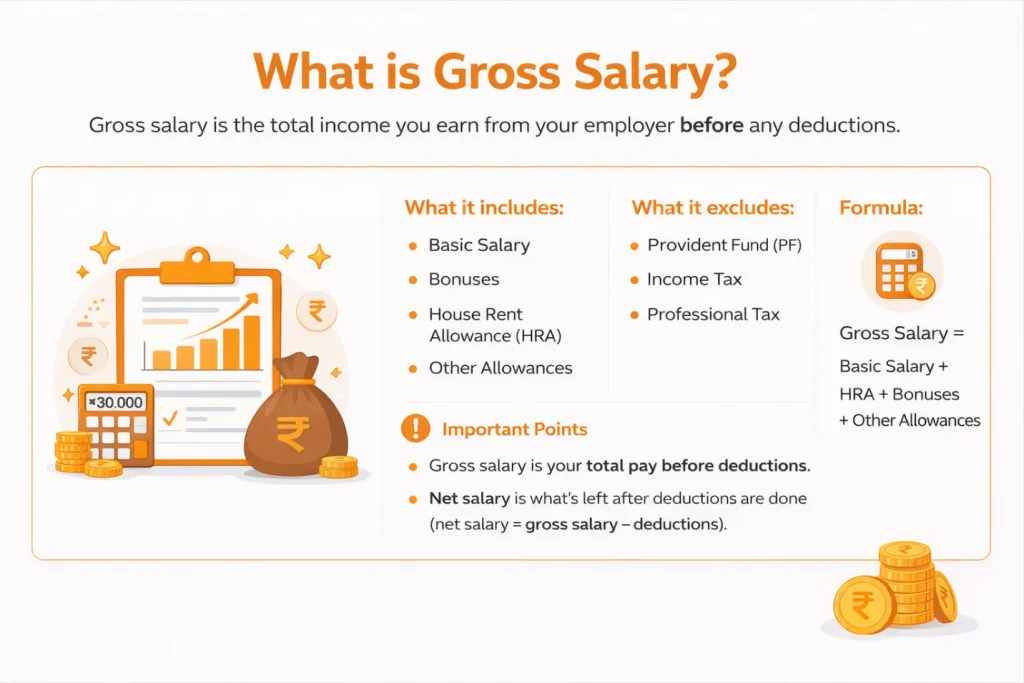
What is gross salary?
Gross salary is the total amount of money an individual earns before any deductions or taxes are taken out. This is the salary figure your company agrees to pay and usually mentions in the offer letter. It is not the money you receive in your bank account. Since no tax, provident fund, or other deductions are removed at this stage, gross salary always appears higher.
Gross salary consists of different parts. It includes your basic salary along with several allowances added to it. These may include dearness allowance, house rent allowance (HRA), car allowance, medical reimbursement, conveyance allowance, and other similar allowances. When you add all these components together, you get your gross salary.
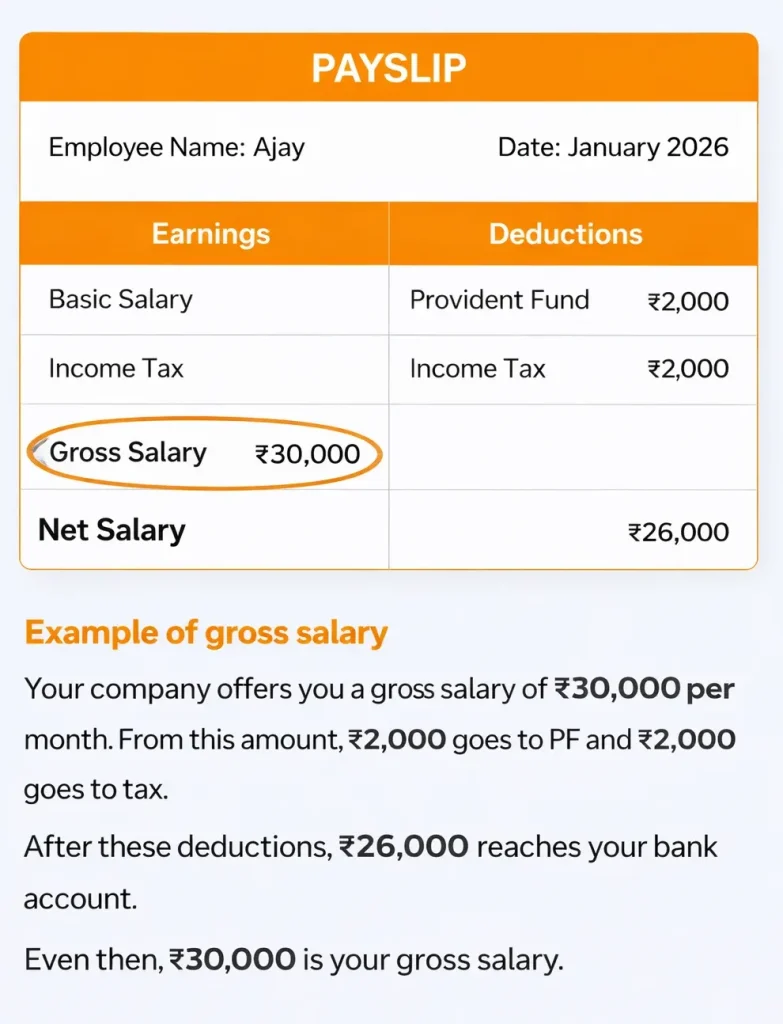
Example of gross salary
Your company offers you a gross salary of ₹30,000 per month.
From this amount, ₹2,000 goes to PF and ₹2,000 goes to tax.
After these deductions, ₹26,000 reaches your bank account.
Even then, ₹30,000 is your gross salary.
Components of a gross salary
Gross salary is not a single amount. It is made up of different parts that together decide how much you earn before any deductions are applied.
1. Basic salary
Basic salary is the fixed part of your pay. Your employer pays this amount regularly every month. Many other components like allowances and provident fund contributions depend on basic salary. It usually forms a large portion of your gross salary.
2. Allowances
Allowances are additional amounts paid over and above basic salary. Employers include them to cover specific expenses you may have while working or living. Here are some common allowances:
- House rent allowance (HRA): HRA helps you pay rent if you live in a rented house. If you meet certain conditions, part of this allowance can reduce your tax burden. This makes HRA an important salary component.
- Dearness allowance (DA): Dearness allowance protects your income from the effect of rising prices. It is more common in government and public sector jobs and increases when inflation rises.
- Travel or conveyance allowance: This allowance covers daily travel costs between your home and workplace. Some companies provide it as a fixed amount each month.
- Special allowance: Special allowance is a flexible salary component. Employers use it to balance the salary structure. It has no specific purpose but forms a part of gross salary.
- Shift allowance: Some companies pay shift allowance to employees working night or rotational shifts. This amount is added to the gross salary.
- Medical allowance: Medical allowance supports healthcare expenses. Some employers pay it as a fixed amount, while others reimburse expenses after you submit medical bills.
- Food allowance: Food allowance helps cover meal expenses during work hours. Employers may provide it as cash or through meal cards or coupons.
Some roles also include variable pay components that depend on work hours or performance.
3. Overtime pay
Overtime pay is given when you work beyond your regular working hours. Employers usually pay this at a higher rate than normal working hours.
4. Performance incentives
Performance incentives reward employees for meeting targets or goals. Unlike a fixed salary, this amount can change from month to month.
5. Commission
Commission is linked to performance. It is common in sales and target-based roles and depends on the results you achieve.
6. Bonus
A bonus is an extra payment given in addition to regular salary. Employers often link it to performance, company profits, or achievement of goals. It may be paid monthly or yearly.
Components excluded in gross salary
Some benefits and payments may come from your employer, but they are not treated as part of gross salary because they are either occasional or linked to specific conditions.
1. Expense reimbursements
When you spend money for official work and the company pays it back, this amount is not counted as salary. It only covers actual costs and does not increase your earnings.
2. Leave travel concession (LTC)
LTC covers travel expenses taken during approved leave. Since it is linked to travel and claimed separately, it does not form part of regular gross salary.
3. Gratuity
Gratuity is a payment made to employees after a certain period of service. It is usually a lump sum amount and is not included in the gross salary.
Gross Salary Components
Gratuity is paid only after completing a required period of service. It is not a monthly earning, so it stays outside gross salary.
- The amount your employer contributes to your provident fund is a benefit, not salary. It does not appear in gross salary, even though your own PF is deducted from it.
- Food or snacks provided at the workplace are facilities meant for convenience. Since no cash payment is involved, they are not added to gross salary.
- Payment received for unused leaves usually happens at resignation or retirement. Because it is not a regular payment, it is excluded from gross salary.
- When the company pays for your health insurance, it is considered a benefit. It supports your well-being but does not increase your gross salary.
How to Calculate Gross Salary
Gross salary is the total money you earn before any deductions like tax or provident fund are removed. The calculation depends on how you are paid. Some people receive a fixed salary, while others are paid based on hours worked. Here are the two ways to calculate gross salary:
Gross Salary Calculation for Salaried Employees
- Note your basic salary: Start with the basic salary mentioned in your offer letter or salary slip.
– Add all allowances: Include allowances such as House Rent Allowance (HRA), travel or conveyance allowance, medical allowance, food allowance, special allowance, or shift allowance.
- Add extra earnings: If you receive bonuses, overtime pay, or performance incentives for that month, add them as well.
– Total everything: The sum of all these amounts gives you your gross salary.
Gross salary formula:
Gross Salary = Basic Salary + Allowances + Variable Pay
Example:
– Employee: Rahul
– Basic salary: ₹15,000 per month
– House Rent Allowance (HRA): ₹6,000 per month
– Dearness Allowance (DA): ₹3,000 per month
– Travel Allowance (TA): ₹1,000 per month
Gross salary = 15,000 + 6,000 + 3,000 + 1,000 = ₹25,000 per month
So, Rahul’s gross monthly salary is ₹25,000.
Deductions like tax and PF will be applied later to calculate take-home pay.
Gross Salary Calculation for Hourly Employees (Variable Working Hours)
- Calculate weekly earnings: Multiply your hourly pay rate by the total hours you worked in a week.
– Calculate annual gross salary: Multiply your weekly earnings by 52 weeks.
– Calculate monthly gross salary: Divide the annual amount by 12 to get your monthly gross salary.
Gross salary formula:
Weekly Gross Salary = Hourly Pay Rate × Hours Worked per Week
Annual Gross Salary = Weekly Gross Salary × 52
Monthly Gross Salary = Annual Gross Salary ÷ 12
Monthly Gross Salary = (Hourly Pay Rate × Weekly Hours × 52) ÷ 12
Example:
– Employee: Aman
– Hourly pay rate: ₹500
– Hours worked per week: 40
Weekly gross pay: ₹500 × 40 = ₹20,000
Annual gross pay: ₹20,000 × 52 = ₹10,40,000
Monthly gross pay: ₹10,40,000 ÷ 12 ≈ ₹86,700
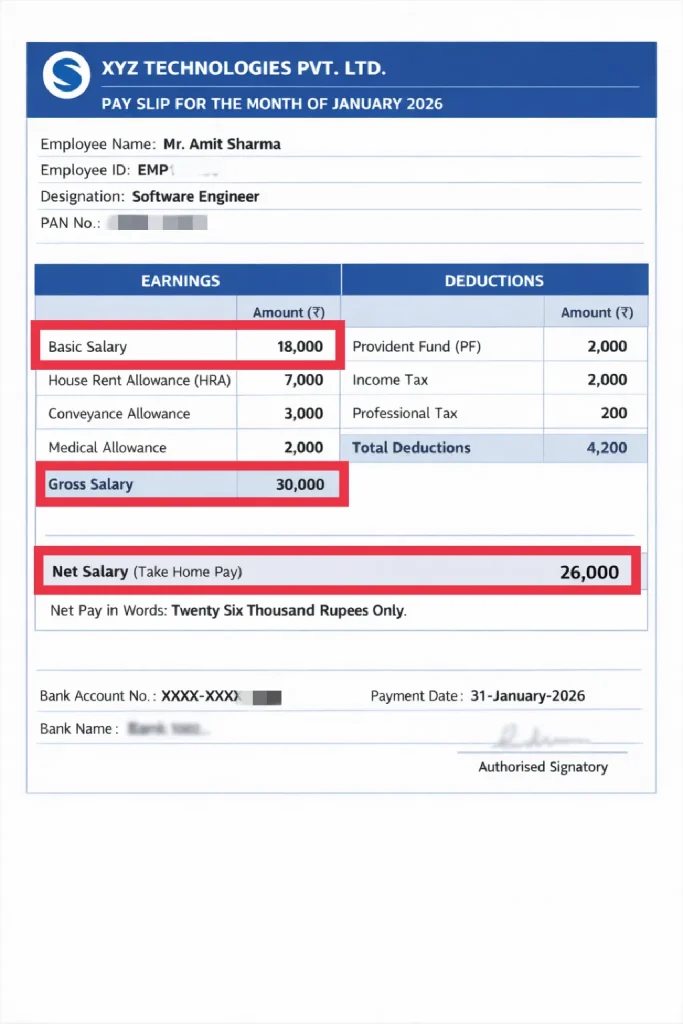
Difference between Gross Salary and Net Salary
Net salary is the final amount you receive in your bank account after all the deductions are made from the gross salary. Since these deductions reduce your pay, net salary is always lower than gross salary.
Let’s take a look at gross salary vs. net salary:
| Point of Difference | Gross Salary | Net Salary |
|---|---|---|
| What it means | Total salary before any deductions | Final salary you receive in your bank |
| Also called | Gross pay or total earnings | Take-home or in-hand salary |
| Includes | Basic salary, allowances, bonuses, incentives | Amount left after all deductions |
| Deductions applied | No deductions applied | All deductions already applied |
| Tax impact | Tax is calculated on this amount | Tax has already been deducted |
| PF impact | PF is deducted from this | PF deduction already done |
| Amount | Always higher | Always lower than gross salary |
| Use for planning | Helps understand full pay structure | Helps plan monthly expenses |
Difference between Gross Salary and Basic Salary
Gross salary represents your total earnings before deductions. Basic salary is only one part of this total. It is the fixed base pay decided by the employer and does not include allowances or bonuses.
Gross Salary vs. Basic Salary
Other salary components are added to basic salary to arrive at gross salary. In simple terms, basic salary forms the foundation, while gross salary is the complete amount built on top of it.
| Point of Difference | Gross Salary | Basic Salary |
|---|---|---|
| What it means | Total salary before any deductions | Fixed base pay decided by the company |
| What it shows | How much you earn in total | How much your core pay is |
| What it includes | Basic salary plus all allowances and earnings | Only the base amount |
| Amount | Always higher | Always lower than gross salary |
| Purpose | Used to calculate take-home pay | Used to calculate PF and some benefits |
| Changes | Can change with bonuses or incentives | Usually stays the same |
| Role in deductions | Deductions are applied to this amount | Deductions depend on this amount |
| Role in allowances | Already includes allowances | Allowances are added on top of it |
Difference between Gross Salary and CTC
CTC or Cost to Company shows how much a company spends on an employee in a year. It includes salary as well as employer-paid benefits like provident fund, insurance, and other facilities.
Gross salary is the amount you earn before any deductions are applied. It does not include employer expenses that do not reach you as cash. This is why CTC is always higher than gross salary, even though both appear in job offers.
| Point of Difference | Gross Salary | CTC (Cost to Company) |
|---|---|---|
| What it means | Salary you earn before deductions | Total cost the company spends on you |
| What it shows | Your actual earnings before tax | Employer’s overall expense |
| Includes | Basic salary, allowances, bonuses, incentives | Gross salary plus employer benefits |
| Employer PF contribution | Not included | Included |
| Insurance costs | Not included | Included if paid by employer |
| Gratuity | Not included in monthly gross | Included as a future liability |
| In-hand relevance | Closer to take-home pay | Not related to monthly take-home |
| Size | Lower than CTC | Always higher than gross salary |
| Changes monthly | Can change with incentives | Usually fixed annually |
Why you should understand gross salary
Understanding gross salary helps you make informed decisions about your career and financial planning.
- Job offers: Gross salary helps you judge job offers correctly. Two offers may show different salary figures, but the real difference becomes clear only when you understand the gross amount before deductions.
- Take-home pay: Gross salary explains why the amount credited to your bank account is lower. Taxes, provident fund, and other deductions are applied later, which reduces the final take-home pay.
- Tax planning: Income tax calculations start from gross salary. Knowing this number helps you plan deductions and exemptions in a better way.
- Salary comparison: Comparing salaries using gross figures gives a fair view of compensation, especially when bonuses and allowances differ.
- Salary slips: Once you understand gross salary, reading salary slips becomes easier and less confusing.
Also Read - How to Write a Letter for Increment in Salary? A Comprehensive Guide
What is the Employee Provident Fund (EPF)?
Employee Provident Fund (EPF) is a statutory social security scheme designed for salaried employees in India. It is prescribed by the Ministry of Labour and aims to provide long-term financial support. EPF helps employees save for retirement while also offering benefits related to housing, insurance, medical needs, and children’s education.
- Both the employee and employer contribute 12% of basic salary plus dearness allowance each month.
- The employee’s full contribution goes into the EPF account.
- From the employer’s share, 8.33% is diverted to the Employee Pension Scheme (EPS) and the remaining 3.67% goes to EPF.
- The EPF balance earns annual interest of around 8% to 8.25%, as declared by the government.
- EPF is mandatory for employees earning up to ₹15,000 per month, though higher earners can join voluntarily.
- Employee EPF contributions qualify for tax deduction under Section 80C, subject to applicable limits.
- EPF accounts are linked through a Universal Account Number (UAN), making them transferable when you change jobs.
- Employees can withdraw the full EPF balance at retirement, which currently begins at 55 years of age.
- EPFO also allows 90% withdrawal one year before retirement and 75% withdrawal after one month of unemployment, with the remaining balance transferable to a new employer.
Reporting gross salary on taxes
Reporting gross salary on taxes is a crucial aspect of financial planning. It is the amount you earn before any deductions are applied, and it is used to calculate income tax. Understanding how to report gross salary on taxes can help you avoid errors and ensure compliance with tax laws.
When you file your income tax return, gross salary is the starting point for calculating your taxable income. From this amount, you can reduce eligible exemptions and deductions such as HRA, home loan benefits, and investments under Sections 80C, 80D, and other applicable sections. The final tax payable depends on your income type and filing category.
The Reporting Process
The reporting process differs slightly for salaried and self-employed individuals.
For Salaried Individuals
If you earn income mainly from salary, you must report your gross salary exactly as shown in your Form 16 or salary slip.
- ITR-1 (Sahaj): Applicable if your total income is up to ₹50 lakh, you have income from salary, one house property, and other sources like interest. Agricultural income should not exceed ₹5,000.
- ITR-2: Used if you have income from salary along with capital gains or more than one house property.
- ITR-3: Applicable if you earn income from salary and a business or profession.
While filing, you must:
- Declare gross salary under “Income from Salary”
- Report exempt allowances like HRA separately
- Add income from other sources such as fixed deposit interest
For Self-Employed Individuals
If you are self-employed, gross income includes earnings from your business or profession.
- ITR-4 (presumptive income): Used if you opt for presumptive taxation under sections like 44AD or 44ADA.
- ITR-3: Used if you maintain detailed books and claim actual business expenses.
Self-employed individuals can deduct legitimate business expenses such as rent, utilities, travel, and professional costs, provided proper records are maintained.
You can reduce your taxable income by claiming eligible deductions allowed under income tax rules.
- Section 80C: EPF, PPF, ELSS, life insurance, tuition fees (up to ₹1.5 lakh)
- Section 80D: Health insurance premiums for self and family
- HRA: Rent paid if you live in a rented house
- Home loan interest: Interest on housing loan for self-occupied property
- Education loan interest: Interest paid on higher education loans
- NPS (80CCD): Extra tax benefit for pension savings
- Donations (80G): Contributions to approved charities
- Savings interest: Deduction on savings account interest
Understanding Gross Salary
Understanding gross salary helps you take better control of your career and finances. It is not just a number on paper. It influences many important decisions.
- How to judge offers better: Always compare job offers using gross salary, not just CTC. This gives a clearer picture of what you earn before deductions.
- How to plan savings: Knowing your gross salary helps you estimate taxes, PF, and take-home pay. This makes budgeting and long-term saving easier.
- When to negotiate: If the basic salary is too low or allowances look inflated, negotiate the salary structure, not just the final figure.
If you are looking for IT jobs in companies that offer better compensation in terms of gross salary and net salary, visit Hirist. It is an online job portal to find some of the best tech jobs in India.
Also Read - Probation Period Rules: Salary, Resignation and Notice during Probation
FAQs
Gross salary is your total pay before deductions. Net salary is the final amount you receive after tax, PF, and other deductions.
In India, gross salary includes basic salary, allowances, bonuses, and incentives before any deductions like income tax or PF.
nnual income is the total money you earn in one financial year from all sources, including salary and other income.
Gross pay is another name for gross salary. It means earnings before deductions.
Gross annual income is your total gross salary calculated for the entire year before deductions.
Monthly gross income is your gross salary for one month before any deductions.
Monthly net income is the salary credited to your bank account after all deductions.
Net salary depends on tax, PF, and other deductions. For ₹25,000 gross, net salary is usually lower and varies by individual.
nnual gross compensation is total yearly earnings before deductions. Fixed salary is the guaranteed part paid regularly.
It is the amount mentioned as “Gross Earnings” or “Gross Pay” on your salary slip.
Gross salary includes basic pay, DA, and allowances. Net salary is what remains after deductions like NPS and tax.
Subtract employer PF, gratuity, insurance, and other benefits from CTC to arrive at gross salary.
fair gross salary matches your role, experience, location, and industry standards.
It refers to salary income as defined under the Income Tax Act, including wages, allowances, and bonuses.
It means total monthly earnings before deductions equal ₹15,000.
Not always. It can change if bonuses, incentives, or overtime are included.
Not always. A higher gross with low basic pay may reduce long-term benefits.
No. In-hand salary is always lower because deductions apply.
Look for “Gross Earnings” or “Gross Salary” near the top of your payslip.
fter gross salary is calculated, certain mandatory deductions are applied to arrive at your take-home salary. This is why the money credited to your bank account is always lower than your gross salary.