
Database testing is a process used to check the accuracy, reliability, and security of data stored in a database. It goes back to the early 1970s when Dr. Edgar F. Codd at IBM introduced the relational database model. Since then, databases have become the backbone of modern applications, powering industries from banking to healthcare. Jobs like software tester, QA engineer, and database administrator often require knowledge of database testing. To help you prepare, we have compiled 25+ database testing interview questions with answers.
Fun Fact: Over 90% of organizations worldwide use relational databases to manage their critical data.
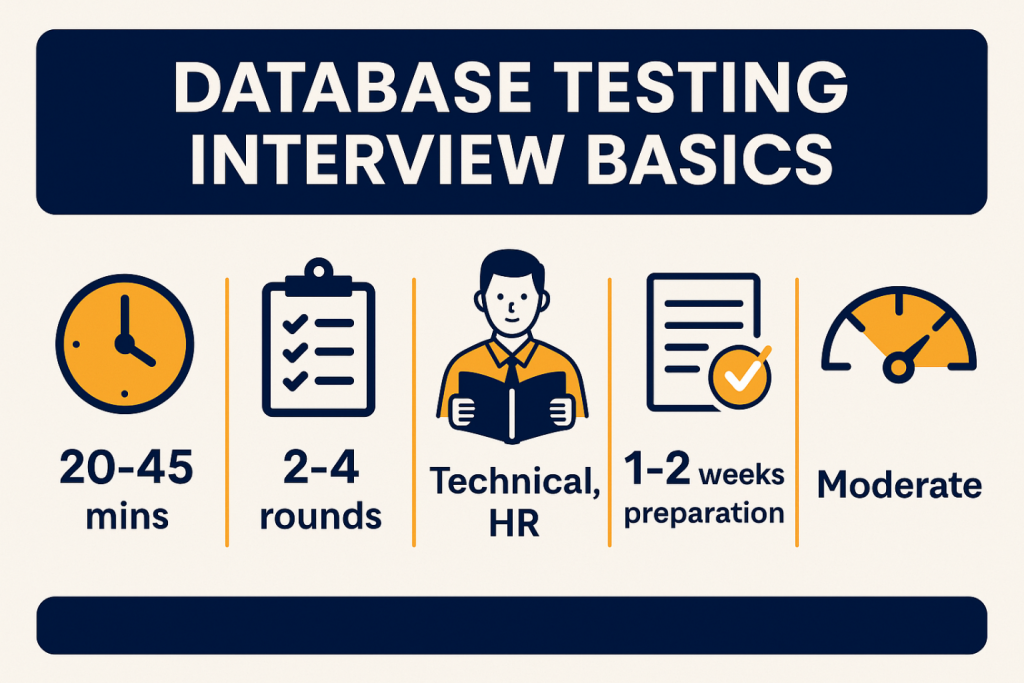
Database Testing Interview Basics
Database Testing Interview Questions for Freshers
Here are some of the most asked database testing interview questions and answers to help beginners get started easily.
- What is database testing and why does it matter in modern applications?
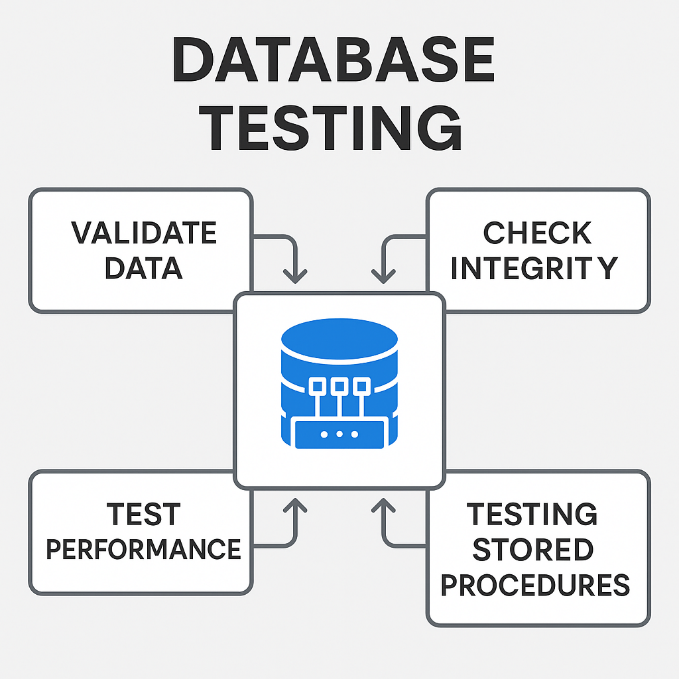
Database testing is the process of checking the correctness, integrity, and security of data stored in a database. It matters because applications today depend heavily on accurate and consistent data. If the backend fails, the entire system can produce errors, expose data, or slow down.
- What types of database testing are commonly performed?
The main types are structural, functional, and non-functional testing. Structural testing checks schema, tables, indexes, and constraints. Functional testing covers CRUD operations, stored procedures, and triggers. Non-functional testing includes performance, load, stress, and security testing.
- How would you test a trigger or stored procedure?
I start by reviewing the requirements and inputs. Then I run the trigger or procedure with valid and invalid data. I check if expected actions happen in the tables, like inserts or updates. I also test performance and see if it handles errors properly.
- What are ACID properties and how would you check them?
ACID stands for Atomicity, Consistency, Isolation, and Durability.
To test atomicity, I check if a transaction either fully succeeds or rolls back. For consistency, I see if data rules and constraints hold after execution. For isolation, I test multiple simultaneous transactions to confirm they don’t affect each other. Durability is tested by committing data, restarting the system, and checking if the data persists.
- What kinds of data integrity constraints exist and how do you test them?
Common constraints include primary key, foreign key, unique, not null, and check constraints. I test by inserting or updating records that break these rules. For example, I try inserting duplicate values where uniqueness is required, or nulls where not null is applied. The system should reject invalid data.
- How would you test the performance of a database?
I create scenarios with large datasets and high user activity. Tools like JMeter or LoadRunner help simulate heavy loads. I monitor response times, query execution, CPU, and memory. Then I adjust indexing or query design to improve performance.
- What is data-driven testing and how is it applied when testing databases?
Data-driven testing uses external data sources like CSV or Excel to run the same test with different inputs. Instead of writing multiple scripts, I keep inputs in files and connect scripts to them. This helps in checking how the database behaves with varied values.
Also Read - Top 20 JMeter Interview Questions and Answers
Database Testing Interview Questions for Experienced
These database testing interview questions are designed to help experienced professionals prepare for advanced concepts.
- Can you describe a complex database testing scenario you’ve handled and the outcome?
I worked on a banking project where fund transfer transactions were failing under high load. I tested triggers, procedures, and locks in the database. The issue was due to missing indexes on transaction tables. After adding the right indexes, query times dropped, and transaction failures stopped.
- How do you approach optimizing a query that is running slowly?
I first check the execution plan to see where time is spent. Then I look at indexes, joins, and filtering conditions. Often, replacing SELECT * with specific columns improves speed. Partitioning or rewriting queries into smaller parts also helps.
- What are the differences between clustered and non-clustered indexes?
A clustered index sorts and stores rows in the table based on the index key. Since the data is stored physically, only one clustered index is allowed per table. A non-clustered index stores a separate structure with pointers to the data rows. Multiple non-clustered indexes can exist.
- How would you debug a failed SQL query during testing?
I start by running the query in isolation. If it fails, I check syntax, table names, or column mismatches. I also verify permissions and data types. If the query runs but returns wrong results, I review joins, conditions, and constraints step by step.
- What steps do you take when validating data migration between databases?
I compare row counts between source and target tables. Then I validate sample data with queries on both systems. I also check data types, lengths, and constraints to confirm they match. Finally, I run functional checks to see if the application works with the new database.
- How do you test for proper handling of concurrent transactions or database locks?
I simulate multiple users performing inserts, updates, and reads at the same time. Then I check for deadlocks, lost updates, or dirty reads. Tools like SQL Profiler or built-in monitoring help me track lock behavior.
Also Read - Top 30+ LoadRunner Interview Questions and Answers
SQL Database Testing Interview Questions
Let’s go through important SQL testing interview questions that will help you understand queries, validations, and practical scenarios.
- Write a query to fetch the second-highest salary from a table.
The common way is:
SELECT MAX(salary)
FROM employees
WHERE salary < (SELECT MAX(salary) FROM employees);
Alternatively, I can use ROW_NUMBER() or DENSE_RANK() with window functions for better clarity.
- How would you find duplicate records in a table using SQL?
I usually group the data and count rows. Example:
SELECT name, COUNT(*)
FROM employees
GROUP BY name
HAVING COUNT(*) > 1;
This shows duplicate names. Adding more columns can refine the check.
- Explain how you would test a database join operation with multiple table relationships.
I first review schema relationships like primary and foreign keys. Then I create queries that join the tables. I check if all expected rows appear and if missing or extra rows show up. I also test with edge cases like unmatched keys.
- Given a timeout on a large query, how would you identify and fix the bottleneck?
I look at the execution plan to see scans or joins causing delays. Then I check indexing on join or filter columns. If needed, I rewrite the query into smaller parts or use partitioning for big tables.
- Describe how you’d handle scenario-based testing using window functions (e.g. ranking, moving averages).
I create test data with clear expected outcomes. For ranking, I check if ties are handled correctly using DENSE_RANK(). For moving averages, I compare results against manual calculations. This confirms the function logic matches requirements.
Note: SQL testing interview questions are often asked in database testing interviews to check both query skills and practical knowledge.
Oracle Testing Interview Questions
Here are key Oracle testing interview questions that help professionals prepare for testing Oracle databases.
- What is the difference between SQL and PL/SQL in Oracle?
SQL is declarative and set-based. It runs single DDL/DML queries to read or change data. PL/SQL is procedural. It supports variables, loops, exceptions, packages, triggers, and stored procedures. SQL defines what data to work with, while PL/SQL controls how and when that logic runs, including bulk operations (BULK COLLECT, FORALL) and exceptions.
- How would you test performance of an Oracle stored procedure?
I test with production-like data. I trace with SQL_TRACE/TKPROF and view plans via DBMS_XPLAN.DISPLAY_CURSOR. I measure elapsed time, CPU, logical reads, and waits (AWR/ASH). I check bind usage, stats freshness, and plan stability. Then I tune joins, indexes, and consider bulk operations to cut context switches.
- What are the Oracle tablespace, datafile, and database relationship?
A database is the full set of physical files plus control files and redo logs. A tablespace is a logical container for segments. One tablespace maps to one or more datafiles. Datafiles are the physical storage on disk that hold those segments.
- How do you validate Oracle-specific objects like function-based indexes or materialized views?
I confirm a function-based index is used with EXPLAIN PLAN/DBMS_XPLAN and queries that apply the same deterministic function. I test NLS and session settings that affect the function.
For materialized views, I check DBMS_MVIEW.EXPLAIN_MVIEW, refresh modes (FAST vs COMPLETE), and ON COMMIT vs ON DEMAND. I validate query rewrite by enabling it and confirming the plan hits the MV.
Database QA Interview Questions
Here are important Database QA interview questions that focus on validating data integrity, performance, and quality in databases.
- How do you validate referential integrity between tables in QA workflows?
I check if every foreign key has a matching primary key. I insert invalid rows to see if they are rejected. I also test cascade updates and deletes. Queries comparing parent and child counts help spot mismatches.
- What test cases would you write to check schema changes across environments?
I compare column names, data types, constraints, and indexes between environments. I write test cases for new constraints, default values, or dropped columns. I also check stored procedures and triggers that might break after changes. Schema diff tools make comparisons faster.
- How do you verify database backups and recovery mechanisms are working?
I restore the backup on a test server. Then I compare row counts and run integrity checks. I simulate partial failures and test point-in-time recovery. For Oracle, I use RMAN restore. For SQL Server, I run full and differential restores.
- What kind of SQL scripts or checks would you automate for regression testing in databases?
I automate scripts that check data consistency, key constraints, and CRUD operations. I add scripts to test common queries and views. I also automate counts for critical tables after batch jobs. These checks catch errors when code changes affect the database layer.
How to Prepare for Database Testing Interview?
If you are preparing for database testing interview, follow these tips:
- Revise SQL basics and practice writing queries daily
- Understand ACID properties and data integrity rules clearly
- Prepare examples of real issues you solved in projects
- Learn how to test procedures, triggers, and transactions
- Practice performance testing with tools like JMeter
- Review backup, recovery, and migration testing scenarios
Wrapping Up
So, these are the 25+ important database testing interview questions and answers to help you prepare with confidence. Understanding these concepts will give you a strong edge in cracking interviews. Keep practicing real scenarios and updating your skills.
Hunting for the best database testing job? Visit Hirist to find the top IT jobs including database testing job roles.
FAQs
They range from basic SQL queries to complex performance and migration scenarios. With practice, they are manageable.
Common database testing interview questions for 5-year experienced professionals often focus on performance, integrity, and real scenarios.
How do you optimize a query that takes too long to run?
What steps do you follow to validate a data migration project?
How do you test concurrent transactions and handle deadlocks?
Can you explain differences between clustered and non-clustered indexes with examples?
How do you perform database load testing in real projects?
You test by writing SQL queries, checking data integrity, running procedures, and validating transactions under different conditions.
Popular tools include DbUnit, SQL Server Profiler, Oracle SQL Developer, JMeter, and Apache Benchmark.
In QA, databases store application data. Testers validate CRUD operations, triggers, stored procedures, and data consistency across environments.
SQL is used to fetch, update, and validate records directly in the database. It helps check if the data matches expected results.
According to AmbitionBox, the average annual salary for a Database Tester in India is around ₹4.5 Lakhs. With 1–7 years of experience, salaries typically range between ₹1.8 Lakhs and ₹10 Lakhs per year.
Database Tester Salary Overview (India, 2025)
| Metric | Value |
|---|---|
| Annual salary range | ₹1.8 Lakh – ₹10 Lakhs |
| Avg. annual salary | ₹4.5 Lakhs |
| Monthly in-hand salary | ₹38,000 – ₹39,000 |
| Experience range in data | 1 – 7 years |
Salary based on experience:
| Experience | Average Annual Salary |
|---|---|
| 1 year | ₹2.8 Lakhs per year |
| 2 years | ₹3.9 Lakhs per year |
| 3 years | ₹5.6 Lakhs per year |
| 4 years | ₹5.4 Lakhs per year |
Salary based on location:
| City | Average Annual Salary |
|---|---|
| Gurgaon | ₹7.7 Lakhs per year |
| Coimbatore | ₹6.7 Lakhs per year |
| Chennai | ₹5.9 Lakhs per year |
| Bangalore | ₹5.2 Lakhs per year |
| Hyderabad | ₹4.5 Lakhs per year |
Companies like Infosys, TCS, Accenture, Cognizant, Wipro, Microsoft, and Amazon regularly hire for database testing roles.