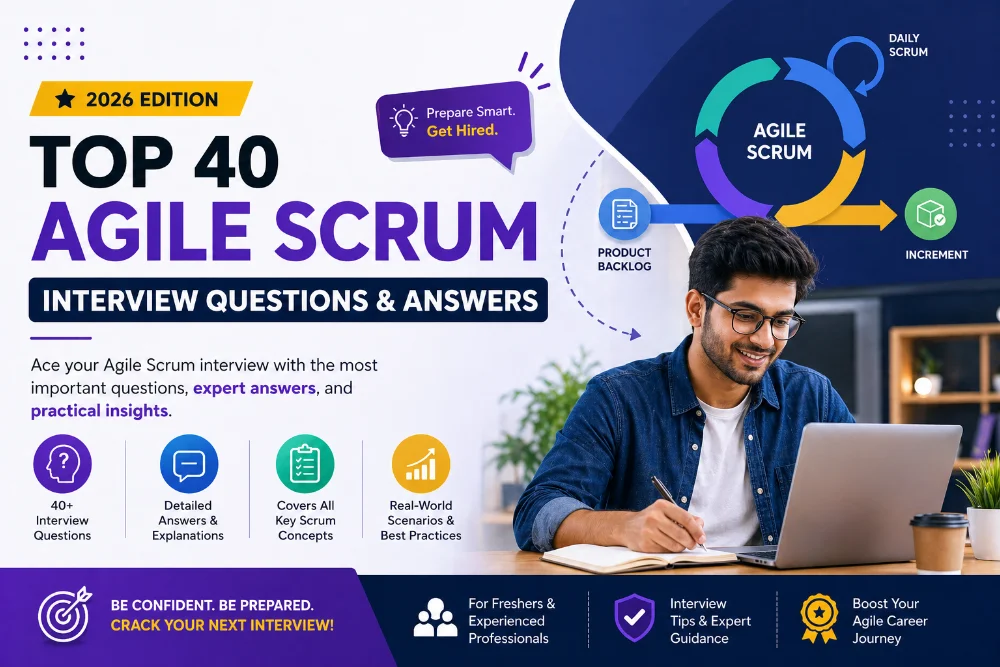
Agile Scrum interview questions are now common in software development, product delivery, testing, DevOps, and project management roles. As more organisations adopt Agile frameworks, interviewers expect candidates to understand both core concepts and practical team execution. Recruiters often ask concept-based and scenario-based questions to assess whether candidates can apply Agile principles beyond theory. This guide covers the top 40 Agile Scrum interview questions and answers for freshers, experienced professionals, and Scrum Master roles.
Agile Scrum Interview Basics 2026
Here are the basic details you should know before attending an Agile Scrum interview, including common interview rounds, preparation areas, and practical expectations.
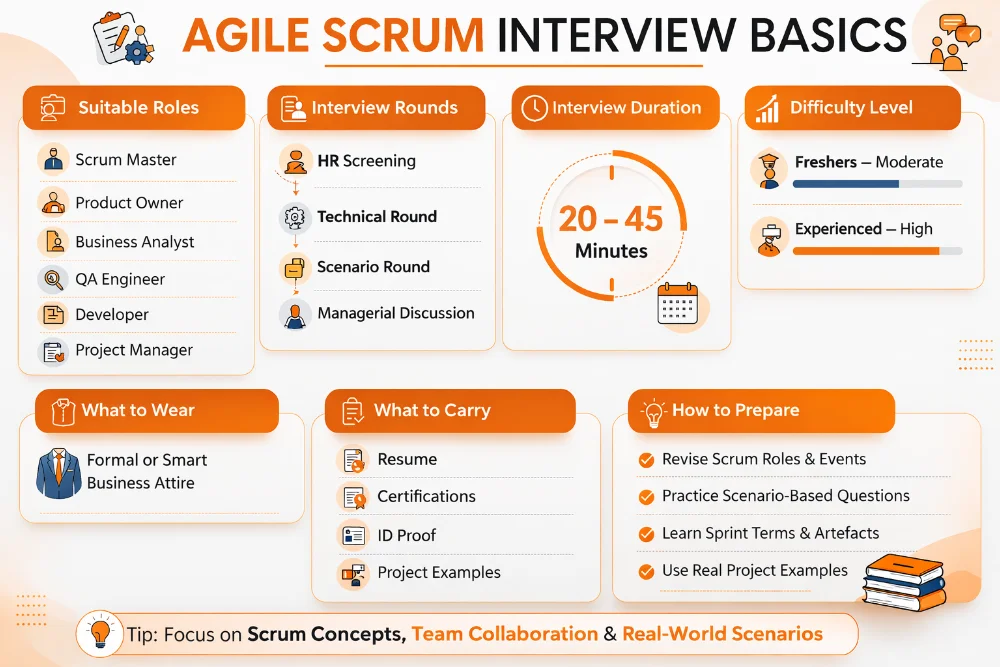
Note: To make interview preparation easier, we have categorised these Agile Scrum interview questions into basic, advanced, and scenario-based sections. This progression helps candidates first review core concepts and then prepare for real-world interview scenarios.
Basic Agile Scrum Interview Questions and Answers
Here are some basic Agile Methodology Scrum interview questions that freshers and experienced candidates are commonly asked during technical and project management interviews. These questions help interviewers assess whether candidates understand Agile fundamentals, Scrum workflow, and core team responsibilities.
1. What is Agile methodology?
Agile methodology is a project management and software development approach that focuses on flexibility, collaboration, and continuous improvement. Instead of completing an entire project in one long cycle, Agile divides work into smaller iterations so teams can deliver usable outputs regularly and respond quickly to changing requirements.
The main goal of Agile is to deliver value faster while allowing teams to adjust priorities based on feedback. It also encourages close communication between developers, testers, product teams, and stakeholders throughout the project lifecycle.
2. What is Scrum in Agile?
Scrum in Agile is a structured framework used to manage complex projects through short development cycles called sprints. It helps teams organise work into manageable tasks and deliver product improvements incrementally rather than waiting until the full project is complete.
Each sprint usually lasts one to four weeks and includes planning, execution, review, and retrospective activities. Scrum is widely used because it improves transparency, team accountability, and adaptability during product development.
3. What is the difference between Agile and Scrum?
Agile is a broader project management philosophy based on iterative development, customer feedback, and adaptability. Scrum is one specific framework under Agile that applies these principles through defined roles, events, and artefacts.
In simple terms, Agile provides the mindset, while Scrum provides a structured way to implement that mindset. Scrum follows sprint cycles, daily standups, sprint reviews, and retrospectives, whereas Agile can also include other frameworks such as Kanban, Lean, and Extreme Programming.
4. What are the key Scrum roles?
Scrum has three key roles that work together to deliver product value effectively:
- Product Owner: Responsible for defining product priorities, managing the product backlog, and ensuring the team works on features that deliver business value.
- Scrum Master: Facilitates Scrum practices, removes impediments, and helps the team follow Agile principles effectively.
- Development Team: A cross-functional group that designs, builds, tests, and delivers the product increment during each sprint.
These roles help maintain clear ownership and improve team collaboration during every sprint.
5. What are Scrum artefacts?
Scrum artefacts are key work items that help teams manage transparency and track progress during a project. There are three main Scrum artefacts:
- Product Backlog: Complete list of all project requirements and features
- Sprint Backlog: Selected backlog items planned for the current sprint
- Increment: The usable product output delivered at the end of a sprint
These artefacts help teams organise work and measure progress clearly.
6. What is a sprint in Scrum?
A sprint is a fixed time period in Scrum during which the team completes selected tasks from the sprint backlog and delivers a usable product increment. Most sprints last between one and four weeks depending on project requirements. Each sprint begins with Sprint Planning and ends with Sprint Review and Sprint Retrospective meetings.
7. What is the difference between product backlog and sprint backlog?
The product backlog is the complete list of all product features, enhancements, bug fixes, and requirements managed by the Product Owner.
The sprint backlog is a smaller set of selected items taken from the product backlog for completion within a specific sprint. It is managed by the development team during sprint execution.
8. What is a user story in Scrum?
A user story is a short description of a feature written from the end user’s perspective. It explains what the user needs and why that feature is valuable. A common user story format is:
As a user, I want to reset my password so that I can regain account access.
9. What is Definition of Done in Scrum?
Definition of Done means a shared agreement within the Scrum team that defines when a task is fully complete. It usually includes coding, testing, review, documentation, and approval requirements before work is considered finished.
10. What is Definition of Ready in Scrum?
Definition of Ready means a backlog item is prepared well enough before entering a sprint. It usually means the requirement is clear, estimated, prioritised, and understood by the team before development starts.
Also Read - Top 25+ Agile Interview Questions and Answers
Scrum Process and Agile Execution Questions
This section covers Scrum events and execution-related interview questions that are commonly asked to test whether candidates understand how Scrum works in real project environments.
11. What happens during Sprint Planning?
Sprint Planning is the meeting held at the beginning of each sprint where the Scrum team decides what work will be completed during that sprint. The Product Owner presents high-priority backlog items, and the team selects tasks based on sprint capacity and business priority.
The team also defines a sprint goal and breaks selected backlog items into actionable tasks. This meeting helps everyone align on what needs to be delivered before the sprint begins.
12. What is a Daily Standup in Scrum?
A Daily Standup, also called a Daily Scrum, is a short 15-minute meeting held every day during the sprint. It helps the team review progress, identify blockers, and plan work for the day.
Team members usually answer three questions:
- What did I complete yesterday?
- What will I work on today?
- Is there any blocker affecting progress?
This meeting improves visibility and keeps sprint execution aligned.
13. What is Sprint Review?
Sprint Review is conducted at the end of the sprint to present completed work to stakeholders and gather feedback. During this meeting, the team demonstrates the product increment and discusses what was completed successfully and what remains pending. Feedback collected here often influences future backlog priorities.
14. What is Sprint Retrospective?
Sprint Retrospective is an internal team meeting held after the Sprint Review. Its purpose is to evaluate how the sprint went and identify areas for improvement.
The team discusses:
- What worked well
- What did not work well
- What should improve in the next sprint
This helps maintain continuous improvement in Scrum.
15. What is velocity in Scrum?
Velocity is a measure of how much work a Scrum team completes during a sprint. It is usually calculated using story points completed across previous sprints. Velocity helps teams estimate how much work they can realistically commit to in future sprints and improves sprint planning accuracy.
16. What is a burndown chart?
A burndown chart is a visual chart that tracks remaining work against sprint time. It helps the team see whether work is progressing as planned. If the remaining work line drops steadily, the sprint is on track. If not, the team may need to address delays or blockers.
17. What is Scrum-ban?
Scrum-ban is a hybrid Agile approach that combines Scrum and Kanban practices. It uses Scrum principles such as backlog planning and team collaboration while adopting Kanban features like visual workflow tracking and work-in-progress limits.
Unlike traditional Scrum, Scrum-ban often allows work to move continuously instead of strictly following fixed sprint cycles. It is useful for teams that need more flexibility in managing changing priorities.
Also Read - Top 15 Agile Methodology Interview Questions and Answers
Advanced Agile Scrum Interview Questions and Answers
These advanced Agile Scrum Master interview questions are often asked to assess whether candidates understand practical challenges, cross-team coordination, and process improvement in real Scrum environments.
18. What are impediments in Scrum? Give examples.
Impediments in Scrum are obstacles that slow down or block the progress of the Scrum team during a sprint. These issues prevent the team from completing planned work efficiently and may affect sprint goals if not addressed quickly.
Common examples of impediments include:
- Technical issues such as system failures or environment problems
- Lack of required resources or tools
- Delays caused by external teams or approvals
- Absence of key team members
- Unclear requirements from stakeholders
- Skill gaps within the team
The Scrum Master usually works to identify and remove these impediments so the team can continue working smoothly.
19. What is Scrum of Scrums?
Scrum of Scrums is a coordination meeting used when multiple Scrum teams are working on the same product or project. It helps teams share progress, discuss dependencies, and resolve issues that affect more than one team.
In this meeting, one representative from each Scrum team joins to discuss major updates, blockers, and coordination needs. It is especially useful in large-scale Agile environments where several teams must stay aligned.
20. What is continuous improvement in Scrum?
Continuous improvement in Scrum means regularly reviewing team processes and making small changes to improve future sprint performance. It is a core Agile principle that encourages learning and adaptation after every sprint.
This usually happens during Sprint Retrospective meetings, where the team discusses what worked well, what created delays, and what should improve in the next sprint.
21. How do you handle scope creep in a Scrum project?
Scope creep happens when additional work is added to a sprint without proper planning or approval. In Scrum, it is managed by keeping sprint goals clear and allowing major changes to enter the product backlog rather than interrupting active sprint work.
The Product Owner reviews new requests and prioritises them for future sprints unless they are urgent enough to justify immediate adjustment. Clear communication with stakeholders helps prevent uncontrolled scope expansion.
22. What is the role of Sashimi in Scrum methodology?
Sashimi in Scrum refers to completing every layer of work needed for a feature within the same sprint so that the output is fully usable.
This means analysis, design, coding, testing, and documentation are completed together rather than in separate phases. The idea is to ensure that each completed item is potentially releasable at the end of the sprint.
Also Read - Top 25 JIRA Interview Questions and Answers
Scenario-Based Scrum Master Interview Questions
Here are some commonly asked scenario-based Agile Scrum Master interview questions that recruiters ask to assess how candidates respond to practical team challenges during sprint execution, communication issues, and delivery risks.
23. How do you handle a team member who is not completing sprint tasks?
If a team member is not completing sprint tasks, the first step is to understand the reason behind the delay. It could be due to unclear requirements, technical blockers, workload imbalance, or personal challenges.
A Scrum Master should discuss the issue privately, identify whether support is needed, and help remove any obstacles affecting progress. If required, tasks can be redistributed within the team to protect the sprint goal while maintaining a supportive team environment.
24. How do you resolve conflicts inside a Scrum team?
Conflicts inside a Scrum team should be addressed early through open communication and objective discussion. The Scrum Master should encourage team members to focus on facts, sprint goals, and shared responsibilities rather than personal opinions.
In many cases, conflicts are resolved by clarifying expectations, encouraging respectful dialogue, and identifying the root cause of disagreement before it affects sprint delivery.
25. What would you do if sprint goals are not achieved?
If sprint goals are not achieved, the team should first review what prevented completion. Common reasons include underestimation, unexpected blockers, changing priorities, or external dependencies.
During the Sprint Retrospective, the team analyses these causes and uses the learning to improve future sprint planning. Incomplete work is usually moved back to the product backlog and reprioritised by the Product Owner.
26. How do you manage delayed dependencies during a sprint?
Delayed dependencies should be identified as early as possible during sprint execution. The Scrum Master works with other teams, stakeholders, or technical owners to reduce the delay and maintain progress.
If the dependency cannot be resolved quickly, the team may adjust sprint work by focusing on other backlog items while keeping stakeholders informed about delivery impact.
Also Read - Top 25+ Project Management Interview Questions and Answers
SAFe Scrum Master Interview Questions
These SAFe Scrum Master interview questions are often asked in enterprise Agile interviews where multiple teams work together under scaled delivery frameworks.
27. What is SAFe?
SAFe stands for Scaled Agile Framework. It is an enterprise-level framework designed to help large organisations apply Agile practices across multiple teams, departments, and projects.
SAFe combines Agile, Lean, and product development principles to improve alignment, coordination, and faster value delivery at scale. It is commonly used when many Scrum teams must work together on large products or programmes.
28. What is the role of a SAFe Scrum Master?
A SAFe Scrum Master supports Agile teams in following Scrum practices while also aligning their work with larger programme goals inside the SAFe framework.
The role includes facilitating team events, removing blockers, supporting continuous improvement, and helping teams coordinate with other Agile teams working within the same release cycle. A SAFe Scrum Master also helps teams understand programme-level planning activities such as PI Planning.
29. How does a SAFe Scrum Master address dependencies and impediments?
A SAFe Scrum Master addresses dependencies and impediments by working closely with other Scrum Masters, Release Train Engineers (RTEs), Product Managers, and stakeholders.
Regular coordination meetings such as Scrum of Scrums help identify shared blockers early. If one team depends on another for delivery, the Scrum Master helps prioritise communication and track resolution so programme timelines remain stable.
Also Read - Top 20+ SDLC Interview Questions and Answers
Agile and Scrum Interview Questions Asked in IT Companies
These Agile Scrum interview questions are commonly asked in IT company interviews, including hiring rounds at companies such as Infosys, TCS, Accenture, and Cognizant. Recruiters often use such questions to evaluate how candidates apply Agile principles in practical project situations.
30. What do you see as the biggest benefit of implementing Agile and Scrum methodologies within a project?
The biggest benefit of Agile and Scrum in real projects is the ability to respond quickly to changing requirements while delivering value in smaller stages. Instead of waiting until the end of the project, teams can release usable outputs regularly and improve them based on feedback. This helps reduce delivery risks, improve collaboration, and keep business priorities aligned throughout the project.
31. Can you share an example of how you have helped a team overcome a significant obstacle or impediment during a sprint?
One common example is when a development team is blocked because of a dependency on another team or delayed approval. In such situations, the Scrum Master works with the Product Owner and other stakeholders to escalate the issue and identify an alternative path.
Clear communication and quick coordination often help remove the blocker and keep sprint progress stable.
32. How do Agile teams handle changing client requirements during development?
Agile teams handle changing client requirements by reviewing new requests regularly and prioritising them in the product backlog. Most changes are assessed by the Product Owner and scheduled for future sprints unless they are urgent enough to affect the current sprint.
This allows teams to remain flexible without disrupting planned sprint goals unnecessarily.
33. Why do IT companies prefer Scrum over traditional project models?
IT companies prefer Scrum because it supports faster delivery, continuous feedback, and easier adaptation when requirements change. Work is divided into short sprints, which makes progress visible and allows teams to detect issues early.
Compared with traditional models, Scrum improves collaboration and helps teams deliver product improvements more frequently.
Also Read - Top 25+ CI/CD Interview Questions and Answers
Agile Scrum MCQs and Practice Questions
This section includes Agile Scrum multiple-choice questions similar to practice exercises often searched for by learners using Agile Scrum in practice answers on Infosys Springboard.
34. Which Scrum role is responsible for managing the product backlog?
A. Scrum Master
B. Product Owner
C. Development Team
D. Stakeholder
Answer: B. Product Owner
35. What is the usual duration of a Scrum sprint?
A. 1 to 2 days
B. 1 to 4 weeks
C. 2 to 3 months
D. 6 months
Answer: B. 1 to 4 weeks
36. Which Scrum event is conducted every day during a sprint?
A. Sprint Review
B. Sprint Planning
C. Daily Standup
D. Retrospective
Answer: C. Daily Standup
37. Which Scrum artefact contains work selected for the current sprint?
A. Product Backlog
B. Sprint Backlog
C. Increment
D. Burndown Chart
Answer: B. Sprint Backlog
38. What does velocity measure in Scrum?
A. Team attendance
B. Work completed in a sprint
C. Number of meetings held
D. Number of bugs found
Answer: B. Work completed in a sprint
39. Which meeting focuses on improving team processes after a sprint?
A. Sprint Review
B. Sprint Planning
C. Sprint Retrospective
D. Daily Standup
Answer: C. Sprint Retrospective
40. What is the main purpose of Agile methodology?
A. Reduce communication
B. Deliver complete product only at the end
C. Improve flexibility and continuous delivery
D. Follow fixed documentation strictly
Answer: C. Improve flexibility and continuous delivery
Also Read - Top 25 Program Manager Interview Questions and Answers
Tips to Answer Scrum and Agile Interview Questions
These practical tips can help you answer Agile interview questions for Scrum Master role more confidently:
- Understand Agile and Scrum principles thoroughly.
- Use real-life examples to illustrate your experience.
- Keep your answers clear and to the point.
- Showcase your ability to identify and address challenges.
- Maintain a positive attitude and show your enthusiasm for Agile methodologies.
- Listen carefully to the interviewer’s questions and respond thoughtfully.
- Stay informed about the latest trends and best practices in Agile and Scrum.
- Show your interest by asking insightful questions about the company’s Agile processes.
Also Read - Top 25+ DevOps Interview Questions and Answers
Conclusion
Agile Scrum interview preparation should focus not only on definitions but also on practical examples, sprint challenges, and team collaboration scenarios. Candidates who explain concepts with real project situations usually perform better in interviews. Review these 40 Agile Scrum interview questions and answers to help you excel in your upcoming interviews. If you are looking for opportunities in Agile Scrum roles and other IT positions, find Agile job listings on Hirist.
Also Read - Top 60+ Business Analyst Interview Questions and Answers
FAQs
Scrum is not difficult to explain if you focus on its basic structure and practical purpose. In most interviews, candidates should briefly explain Scrum as an Agile framework based on short sprints, defined roles, and regular team collaboration.
Freshers are usually asked basic interview questions on Agile and Scrum to check whether they understand core concepts. Common questions include:
What is Agile methodology?
What is Scrum in Agile?
What is the difference between Agile and Scrum?
What is a sprint in Scrum?
What are the key Scrum roles?
Experienced candidates are often asked practical and scenario-based Agile Scrum methodology interview questions. Common questions include:
How do you handle scope creep in an Agile project?
What would you do if sprint goals are not achieved?
How do you prioritise backlog items when requirements keep changing?
How do you manage delayed dependencies during a sprint?
Which Agile metrics do you use to measure team performance?
The five Scrum values are: Commitment, Focus, Openness, Respect, and Courage. These values guide team behaviour and support effective collaboration during sprint execution.
The most frequently asked Agile questions in IT interviews usually focus on Agile principles, Scrum roles, sprint planning, backlog management, and handling changing requirements during development.
Certification is not always mandatory for Scrum-related jobs, but it can improve credibility and help candidates understand Scrum terminology and practices more clearly.
Yes, freshers can enter Scrum-related roles, especially in software development, testing, business analysis, and project support positions where Agile practices are already part of team delivery.